
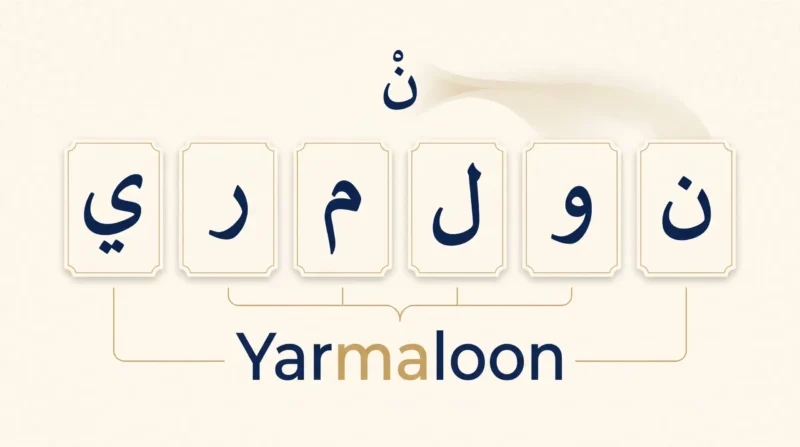

The Idgham letters are six: ي ، ر ، م ، ل ، و ، ن — gathered in the word Yarmaloon (يرملون). When a silent Noon (نْ) or Tanween ends one word and one of these letters opens the next, the Noon merges into that letter. With ن ، م ، ل ، ر the merge is complete and the letter is fully doubled; with ي and و it is incomplete — the Noon itself disappears but its nasal sound (ghunnah) stays. Four of the letters carry a ghunnah; two — ل and ر — do not. Merging is the second of the four rules of Noon Sakinah and Tanween.
Also spelled Idghaam, Iddigham or Idgam in English transliterations.
Scope: this page follows the recitation of Hafs from ‘Asim via Ash-Shatibiyyah, the most widely printed reading today.
⚡ The 30-second version: 6 merging letters (ي ر م ل و ن) · memorised as «يَرْمَلُونَ» · complete merge into ن م ل ر, incomplete merge into ي و (the Noon’s ghunnah stays) · ي ن م و keep a two-count nasal sound, ل and ر keep none · it works across two words, not inside an ordinary word.
What Is Idgham in Tajweed?
Idgham (إدغام) literally means “to insert” or “to merge one thing into another”. In Tajweed it means entering a silent letter into the voiced letter after it, so that the two become a single stressed letter.
This is the point most English pages blur. In Idgham the silent Noon is not read as a faint or quick Noon — the tongue never makes the Noon’s own contact. What happens next depends on the letter. With ن ، م ، ل ، ر the merge is complete: the Noon becomes the next letter, which is read fully doubled, and the mushaf prints a shaddah (ّ) on it. With ي and و the merge is incomplete: the Noon’s body goes but its ghunnah stays, so the doubling is partial — and in the usual Hafs print the و or ي carries no shaddah. Compare مَن يَعْمَلْ with مِن رَّبِّهِمْ.
Read مِنْ رَبِّهِمْ and you will not hear min rabbihim with a small n. You will hear mir-rabbihim. The Noon has been absorbed and only the doubled Raa survives.
Where this rule sits among the four
Clear pronunciation and merging sit at two ends of one spectrum. Izhar keeps the Noon intact before the throat letters, which classical teachers explain by how far those letters are from the Noon. Merging does the opposite before the six Yarmaloon letters, which share a close relationship with the Noon: the same letter (ن), a near articulation point (ل ، ر), or shared qualities such as ghunnah (م) or voicing (و ، ي). Hiding and conversion sit between the two.
These sound relationships help explain the rules, but anatomical distance alone does not explain all of them. و is produced at the lips and ي in the middle of the tongue — neither sits next to the Noon at the tip of the tongue — yet both take Idgham. You can see where each sound is produced in our guide to the Makhraj of Arabic letters.
Phonetics has a name for a related pattern found in many languages — a nasal sound assimilating to the sound that follows it — and the Encyclopedia of Arabic Language and Linguistics is a good starting point for the Arabic side. That explains why Idgham feels natural in the mouth. The Quranic rule itself, though — which letters merge, where the ghunnah stays, and the exceptions — rests on transmission: recitation received from teacher to student through the chain of Hafs, not on phonetic reasoning.
The 6 Idgham Letters (Yarmaloon)
Six letters trigger this rule, and Tajweed teachers rarely ask students to memorise them as a loose list. They are packed into one pronounceable word instead. Tap play on any row to hear the example in the recitation of Sheikh Mahmoud Khalil Al-Husary.
The mnemonic: يَرْمَلُونَ (Yarmaloon)
يَرْمَلُونَ
Every letter in Yarmaloon is one of the six: ي، ر، م، ل، و، ن. Yarmaloon is used here as a mnemonic that gathers the six Idgham letters; its meaning is not needed to learn the rule. Learn the word and the list is yours permanently.
⚠️ The condition everyone forgets: this merging happens across two words — the silent Noon ends one word and a Yarmaloon letter opens the next. If both sit inside the same ordinary word, the Noon is pronounced clearly instead. That exception has a name and only four words in the entire Quran, and it is covered in full further down this page.
One more detail worth noticing on the table above: the six letters do not behave identically. Four of them keep a nasal hum and two erase it completely — and separately from that, two of them let a trace of the Noon survive while four wipe it out entirely. Those are two different splits of the same six letters, and the next three sections take them one at a time.
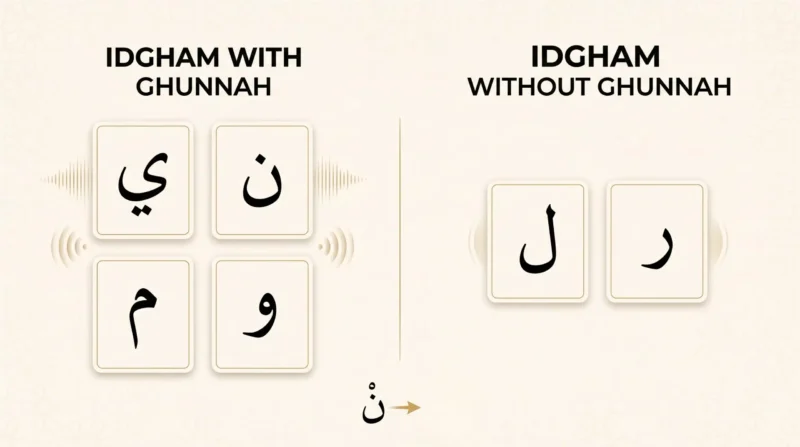
Idgham With Ghunnah (Idgham Maal Ghunnah)
Four of the six letters keep the nasal sound alive after the merge: ي، ن، م، و. They are memorised through a second, smaller mnemonic — يَنْمُو (yanmoo, “it grows”).
The ghunnah here lasts two counts — roughly the time of two short vowels at your own reading pace. Slower recitation stretches each count and faster recitation shortens it; the proportion is what stays fixed. Where the ghunnah comes from depends on the letter: with ي and و it is the ghunnah of the merged Noon or Tanween itself; with ن and م it belongs to the doubled ن or م that receives the merge. The Kamil vs Naqis section explains why.
Ghunnah practice: feel the two counts
Two counts are easy to read and hard to feel. Press Play to hear the ayah recited by Sheikh Al-Husary, then press 2 counts and hold the hum yourself while the bar fills. The first example carries a ghunnah; the second has none at all. Alternate between them until the difference is obvious to your ear without looking at the screen.
مِن نُّطْفَةٍ
‘Abasa 80:19 · with ghunnah · 2 counts at your reading pace
أَن لَّن
Al-Balad 90:5 · without ghunnah · no nasal sound
Play a recitation, then try the 2-count beat.
Idgham Without Ghunnah (Idgham Bila Ghunnah)
Two letters only: ل and ر. Here the merge is total. The Noon is gone, and so is every trace of nasal sound with it — the reader moves straight into a doubled Laam or a doubled Raa as if the Noon had never been written.
The mistake that defines this section
Leaving a light hum on ل and ر is the most common error on this rule. In Hafs via Ash-Shatibiyyah the merge into these two letters is complete and carries no ghunnah, so a hum here is not a matter of polish — it departs from the reading being taught. If you can hear any nasal sound in مِن رَّبِّهِمْ, the merge has not been completed.
The exception: مَنْ رَاقٍ
One phrase in the Quran meets every condition for merging into ر and still is not merged. In Surah Al-Qiyamah 75:27, the recitation of Hafs via Ash-Shatibiyyah places an obligatory brief pause without breath — a saktah — on the Noon. The pause breaks the contact between the two words, so the Noon is pronounced clearly instead.
وَقِيلَ مَنْ ۜ رَاقٍ
Al-Qiyamah 75:27 · saktah blocks the merge · read clearly
Listen for the tiny catch before رَاقٍ. It is not a breath and not a full stop — just a brief held silence, marked in the mushaf with a small س. Once you know it is there, the reason for the clear Noon becomes obvious.
Complete vs Incomplete Idgham (Kamil & Naqis)
Here is the question that almost every English page leaves hanging. If the Noon disappears, where does the nasal sound in مَن يَعْمَلْ come from? Yaa is not a nasal letter. Something has to be producing that hum.
The classical answer is that the six letters split a second time — this time by how much of the Noon is absorbed.
So the hum you hear on ي and و is the last surviving property of a letter that is otherwise gone. The body of the Noon has been absorbed; one of its attributes has not. That is exactly what “incomplete” means here — incomplete absorption and incomplete doubling, not careless pronunciation.
With ن and م the merge is complete and yet a ghunnah is still heard — but that one belongs to the receiving letter itself, since both are nasal by nature. Two different sources, one similar sound. With ل and ر nothing nasal exists on either side, which is why those two are silent in every sense.
Play these two back to back and the distinction stops being theoretical:
مِن نُّطْفَةٍ
‘Abasa 80:19 · Kamil — complete merge; the ghunnah belongs to the doubled ن
فَمَن يَعْمَلْ
Az-Zalzalah 99:7 · Naqis — the Noon is gone, its own ghunnah is not
You do not need these labels to recite well — a teacher’s ear matters more. But they explain two things you can see and hear: why the mushaf prints a shaddah on ن، م، ل، ر and not on و، ي, and why the ghunnah on ي and و is the Noon’s own, while on ن and م it belongs to the doubled letter.
Idgham vs Izhar vs Ikhfaa vs Iqlab
One silent Noon, four possible outcomes, and the only thing that decides between them is which letter comes next. Every letter that can follow a silent Noon belongs to exactly one of these four groups — there is no overlap.
Izhar إظهار
6 throat letters · Noon read clearly
مِنْ عِلْمٍ
Idgham إدغام
6 letters · ي ن م و with ghunnah, ل ر without
مَن يَعْمَلْ · مِن رَّبِّهِمْ
Iqlab إقلاب
1 letter · Noon becomes a hidden Meem
مِنۢ بَعْدِ
Ikhfaa إخفاء
15 letters · Noon hidden with ghunnah
مِن كُلِّ
letter · Idgham letter without ghunnah
The confusions worth settling
Merging vs hiding. These two are mixed up more than any other pair, because both involve a nasal sound and neither gives you a clean Noon. The test is what happens to the Noon. In merging, it gives way to the next letter — fully doubled with ن م ل ر, partially with ي و where only its ghunnah remains. In hiding, the ghunnah comes from the nasal passage while the mouth gets ready for the following letter: the mouth’s position is shaped by that letter, but the tongue does not make the full Noon contact, and nothing is merged or doubled. The mushaf reflects this too — there is never a shaddah after a hidden Noon.
Merging vs clear pronunciation. These are opposite ends of the same line, so confusing them is rarer but more serious. Clear pronunciation keeps the Noon intact before the six throat letters; merging gives it up before the six Yarmaloon letters. Classical teachers explain the throat letters by their distance from the Noon, and the Yarmaloon letters by a close relationship with it — sameness, nearness or shared qualities — rather than by distance alone. Hiding and conversion fall between the two.
Merging vs conversion. Only one letter triggers conversion — ب — and the Noon does not stay and does not vanish. It changes identity and becomes a Meem, held with a two-count hum and the lips only lightly closed. It is the smallest rule of the four and the easiest to spot, since there is exactly one letter to watch for.
Idgham Rules for Noon Sakinah and Tanween
The trigger has two parts, and both must be present. First, a silent Noon or a Tanween. Second, one of the six merging letters opening the next word. Miss the second condition and the rule does not apply, no matter how right the letters look.
1. Silent Noon at the end of a word
The word closes on نْ and the next word opens with a Yarmaloon letter. This is the standard case and the one you will meet most often.
مِن رَّبِّهِمْ · مَن يَعْمَلْ · مِن نُّطْفَةٍ
2. Not inside an ordinary word
A silent Noon followed by و or ي within the same word is read clearly. Only four such words occur in the Quran — all covered below. (The spelled-out opening letters of some surahs follow their own transmitted reading; see the note further down.)
الدُّنْيَا · بُنْيَان · صِنْوَان · قِنْوَان
Rules of Idgham with Tanween
A Tanween is a silent Noon that is pronounced but not written as a letter. That is the whole of it. Every rule that governs نْ governs ـً ـٍ ـٌ in exactly the same way, and all six merging letters apply to it without modification.
هُدًى لِّلْمُتَّقِينَ
Al-Baqarah 2:2 · Tanween fatḥ + ل · No ghunnah
عِيشَةٍ رَّاضِيَةٍ
Al-Qari’ah 101:7 · Tanween kasr + ر · No ghunnah
خَيْرٌ وَأَبْقَىٰ
Al-A’la 87:17 · Tanween ḍamm + و · Ghunnah
يَوْمَئِذٍ نَّاعِمَةٌ
Al-Ghashiyah 88:8 · Tanween kasr + ن · Ghunnah
Notice what the mushaf shows. Where this rule applies, the Noon (or Tanween) is printed without a sukoon. A shaddah then appears on ن، م، ل، ر — the complete merges — but not on و or ي, where the merge is incomplete. The script is telling you how much of the Noon survives.
The exception: when merging does NOT apply
Izhar Mutlaq (إظهار مطلق). When a silent Noon is followed by و or ي inside the same word, the Noon is pronounced clearly. Only four words in the Quran meet this description:
الدُّنْيَا · بُنْيَان · صِنْوَان · قِنْوَان
The reasoning is about preserving meaning, not about sound. If these were merged, they would come out as ad-duyyā, buyyān, ṣiwwān — indistinguishable from words that genuinely contain a doubled letter. The root would be hidden and the word would look like something it is not. So the rule steps aside to keep the structure of the word visible.
📌 Special cases in Hafs via Ash-Shatibiyyah
In يٰس وَالقُرْآن and ن وَالقَلَم, the disconnected letters end on a silent Noon and are followed by و — every condition is met, and yet Hafs reads them clearly. These are transmitted readings, preserved as they were received rather than derived from the rule. Together with مَنْ رَاقٍ, where the saktah blocks the merge, they are the cases on this page where the letters suggest a merge and the recitation keeps the Noon clear.
The reverse also happens in the opening letters: in طسٓمٓ (Ash-Shu’ara 26:1, Al-Qasas 28:1), the Noon at the end of the spelled letter sīn is merged into the mīm in the recitation of Hafs, even though the letters are written as one unit. That is why the “not inside one word” condition above is stated for ordinary words.
Test Yourself: Which Rule Applies?
Four rules, one silent Noon. We’ll show you a verse with the Noon or Tanween highlighted — you pick the rule. And when the answer is merging, there’s a second question waiting: with or without ghunnah? Twelve questions, instant feedback, no sign-up. Each correct answer at each step earns one point — 19 points in total.
Step 1 — which rule applies?
Choose the rule that applies to the highlighted letter.
Idgham Examples from the Quran
Twelve passages: six with a silent Noon, six with Tanween, covering all six letters and both types. The Noon or Tanween is marked in blue, the merging letter in orange. Press play to hear each one recited by Sheikh Al-Husary.
With Noon Sakinah
فَمَن يَعْمَلْ مِثْقَالَ ذَرَّةٍ خَيْرًا يَرَهُۥ
Az-Zalzalah 99:7 · Noon + ي · Ghunnah
كَلَّا إِنَّهُمْ عَن رَّبِّهِمْ يَوْمَئِذٍ لَّمَحْجُوبُونَ
Al-Mutaffifin 83:15 · Noon + ر · No ghunnah
أَلَمْ نَخْلُقكُّم مِّن مَّآءٍ مَّهِينٍ
Al-Mursalat 77:20 · Noon + م · Ghunnah
أَيَحْسَبُ أَن لَّن يَقْدِرَ عَلَيْهِ أَحَدٌ
Al-Balad 90:5 · Noon + ل · No ghunnah
وَمَا لَكُم مِّن دُونِ ٱللَّهِ مِن وَلِىٍّ
Al-Baqarah 2:107 · Noon + و · Ghunnah
مِن نُّطْفَةٍ خَلَقَهُۥ فَقَدَّرَهُۥ
‘Abasa 80:19 · Noon + ن · Ghunnah
With Tanween
يَوْمَئِذٍ يَصْدُرُ ٱلنَّاسُ أَشْتَاتًا
Az-Zalzalah 99:6 · Tanween kasr + ي · Ghunnah
فَهُوَ فِى عِيشَةٍ رَّاضِيَةٍ
Al-Qari’ah 101:7 · Tanween kasr + ر · No ghunnah
فِى جِيدِهَا حَبْلٌ مِّن مَّسَدٍ
Al-Masad 111:5 · Tanween ḍamm + م · Ghunnah
ذَٰلِكَ ٱلْكِتَٰبُ لَا رَيْبَ فِيهِ هُدًى لِّلْمُتَّقِينَ
Al-Baqarah 2:2 · Tanween fatḥ + ل · No ghunnah
وَٱلْـَٔاخِرَةُ خَيْرٌ وَأَبْقَىٰ
Al-A’la 87:17 · Tanween ḍamm + و · Ghunnah
وُجُوهٌ يَوْمَئِذٍ نَّاعِمَةٌ
Al-Ghashiyah 88:8 · Tanween kasr + ن · Ghunnah
Surah Al-Ghashiyah verse 8 is the most efficient drill on this page: one short ayah containing two merges back to back — an incomplete one into ي (وُجُوهٌ يَوْمَئِذٍ) and a complete one into ن. If you can read it without letting the ghunnah slip, the rule is holding.
Common Mistakes to Avoid
1. Leaving a nasal sound on ل and ر
The number one error, and it comes from habit: four of the six letters take a hum, so the hand reaches for it on all six. On these two there is nothing to hold. Say مِن رَّبِّهِمْ and مِن نُّطْفَةٍ back to back — if they feel similar in the nose, the first one is wrong.
2. Keeping a faint Noon instead of completing the merge
Holding on to a weak Noon where Idgham is due is incorrect recitation. It may sound close to Ikhfaa, but that does not turn the rule into Ikhfaa — the rule here is still Idgham, and the fix is simply to complete the merge.
3. Applying the rule inside a single word
Reading الدُّنْيَا as ad-duyyā is a clear error, not a stylistic choice. The four words affected by this are worth memorising precisely because they look like textbook cases and are not.
4. Cutting the ghunnah short
Two counts is longer than most learners think, and fluent readers shorten it without noticing as their pace increases. The counts follow your pace, so keep them in proportion: slow the passage down until the hum is unmistakable, then rebuild the speed around it.
5. Forgetting that Tanween counts
Students watch for a written Noon and read straight past هُدًى لِّلْمُتَّقِينَ. If you can hear an n at the end of the word, the rule applies — whether or not a Noon is printed there.
Play: Idgham Basket (Free Game)
Recognising the rule under time pressure is a different skill from recognising it on a page. Catch the words where the Noon merges, let the rest fall past, and see how long you last. It works on phones and tablets, and no account is needed.
Game not loading? Open it in a new tab · or browse all our free Arabic letter games.
Learn More
Merging is one of four rules that govern the silent Noon. Here’s what to study next:
All of them sit inside the wider set of Tajweed rules, and all of them are covered step by step in our Tajweed courses.
Frequently Asked Questions
May Allah beautify your recitation and accept it from you. 🤲
Hafidha of the Quran · Arabic Language Graduate · Writer on Islamic Sciences
Jehad Mahmoud is a graduate of the Arabic Language department and a Hafidha of the Quran who writes the Islamic educational content at Quran Book Academy.
She writes with a focus on Tajweed, Quranic recitation and the sharia sciences, making technical rules accessible to English-speaking Muslim families.
Her articles are educational, not fatwa. For a ruling on a specific personal situation, readers are advised to consult a qualified scholar or mufti.
References & Sources
1. Al-Marsafi, Hidayat al-Qari — Rules of Noon Sakinah and Tanween (هداية القاري: أحكام النون الساكنة والتنوين) — IslamWeb Library
2. Al-Marsafi, Hidayat al-Qari — Ghunnah and its rules (باب الغنة وأحكامها) — IslamWeb Library
3. Al-Marsafi, Hidayat al-Qari — Complete and incomplete Idgham (أقسام الإدغام من حيث الكمال والنقصان) — IslamWeb Library
4. IslamWeb Fatwa 95597 — The ghunnah in incomplete Idgham (إظهار الغنة في الإدغام الناقص) — IslamWeb
5. IslamWeb Fatwa 196957 — Madd and ghunnah length follow the pace of recitation (مراتب القراءة في المدود والغنة) — IslamWeb
6. Al-Azhar Al-Sharif — azhar.eg
7. Encyclopedia of Arabic Language and Linguistics — Brill Reference Works
8. Surah Al-Ghashiyah 88 — Quran.com
9. Surah Al-Qiyamah 75 — Quran.com
10. Recitation — Sheikh Mahmoud Khalil Al-Husary, via EveryAyah.com
© 2026 Quran Book Academy. All rights reserved.
Book Your Free Trial · Empowering Muslims Worldwide to Connect with the Quran