📖 In This Article
Why Understanding Mashallah Meaning Changes How You Practice Islam
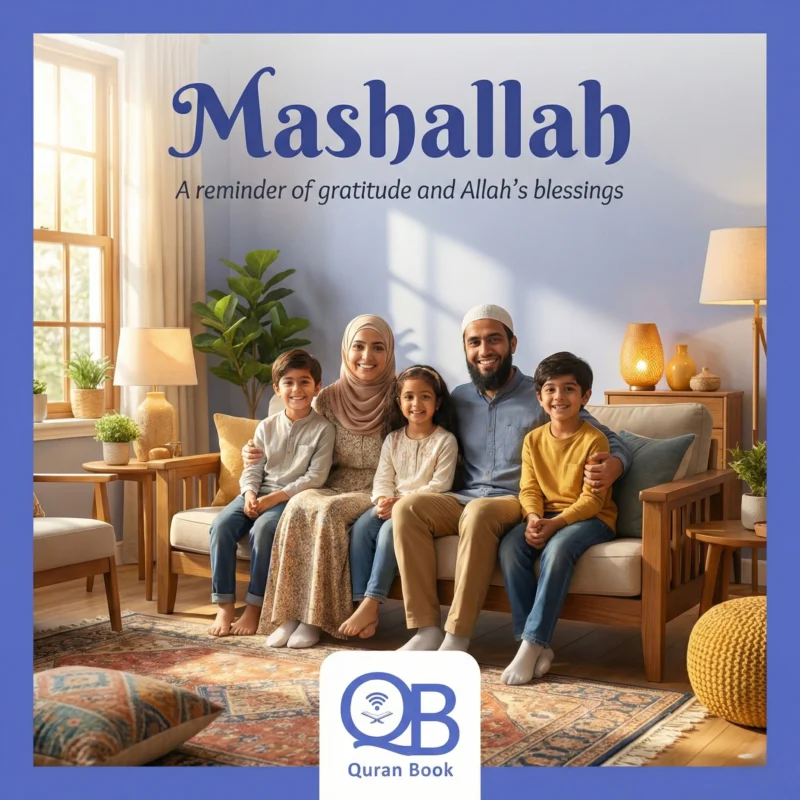
Mashallah meaning in English is “God has willed it” or “What Allah has willed.” Muslims commonly say Mashallah when admiring a blessing, to express admiration and gratitude and to acknowledge that the blessing exists by Allah’s will. Understanding its correct usage strengthens your daily Islamic practice and deepens your connection with Allah’s blessings.
If you have ever felt unsure whether you are saying Mashallah at the right time, or worried about making mistakes with Arabic phrases, you are not alone. Thousands of new Muslims and non-Arabic speakers across the USA, UK, Canada, and Australia share the same concern.
The fear of mispronunciation, cultural intimidation, and simply not knowing when to use certain expressions can feel overwhelming at first. But the good news is that learning the mashallah meaning is simpler than you think — and this guide will walk you through it step by step.
Learning Islamic phrases is a journey, not a test. Every Muslim — whether born into the faith or a new revert — started by learning one word at a time.
The mashallah meaning is deeply rooted in the Quran itself. In Surah Al-Kahf (18:39), Allah recounts the story of two men, where the righteous one advises his companion: “It was better for him to say, when he entered his garden: That which Allah wills (Mashallah)! There is no power but with Allah.”
This verse reminds us that acknowledging Allah’s will is not just a cultural habit — it is a Quranic instruction and a shield of humility. By the end of this article, you will understand the full mashallah meaning, know exactly when and how to say it, and feel confident using it in your everyday conversations.
Explore our full range of Islamic Courses for Kids and Adults at Quran Book Academy to deepen your understanding further.
What Is the Actual Mashallah Meaning in English?
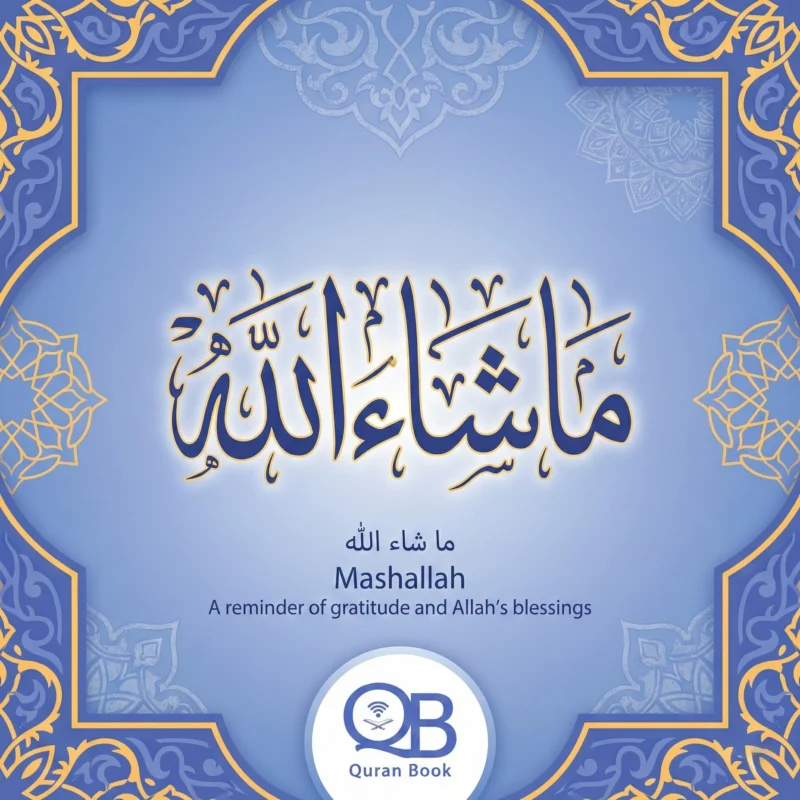
The actual mashallah meaning is “What Allah has willed” or “God has willed it.” It comes from three Arabic words: “Ma” (what), “Sha” (willed), and “Allah” (God). Muslims say it to acknowledge that all good things come from Allah and to express wonder at His creation.
This phrase carries a profound spiritual weight. When a Muslim says Mashallah, they are essentially declaring that whatever beauty, success, or goodness they see before them exists solely because Allah willed it. It removes arrogance from the heart and replaces it with gratitude and humility.
Mashallah in Arabic Script and Transliteration
Here is a quick reference for the correct way to write and spell Mashallah:
Whether you write it as MashAllah, Masha’Allah, or Ma Sha Allah, the mashallah meaning remains the same. It is an expression of awe and recognition of Allah’s divine will.
The Quranic Origin of Mashallah
The mashallah meaning has its strongest roots in Surah Al-Kahf (18:39). The story tells of two men: one who owned a lush, prosperous garden and boasted about his wealth, and another who humbly reminded him that all blessings come from Allah.
The righteous man told his companion that he should have said “Mashallah, La Quwwata Illa Billah” — meaning “What Allah has willed! There is no power except with Allah.”
The lesson is timeless. Mashallah is not just a word of praise — it is an expression of humility and gratitude. It reminds us that no matter how impressive something appears, it exists only because Allah decreed it. This Quranic foundation makes the mashallah meaning much deeper than a simple cultural expression. Strengthen your understanding through our Online Quran Classes.
How to Use Mashallah Correctly — 7 Everyday Situations
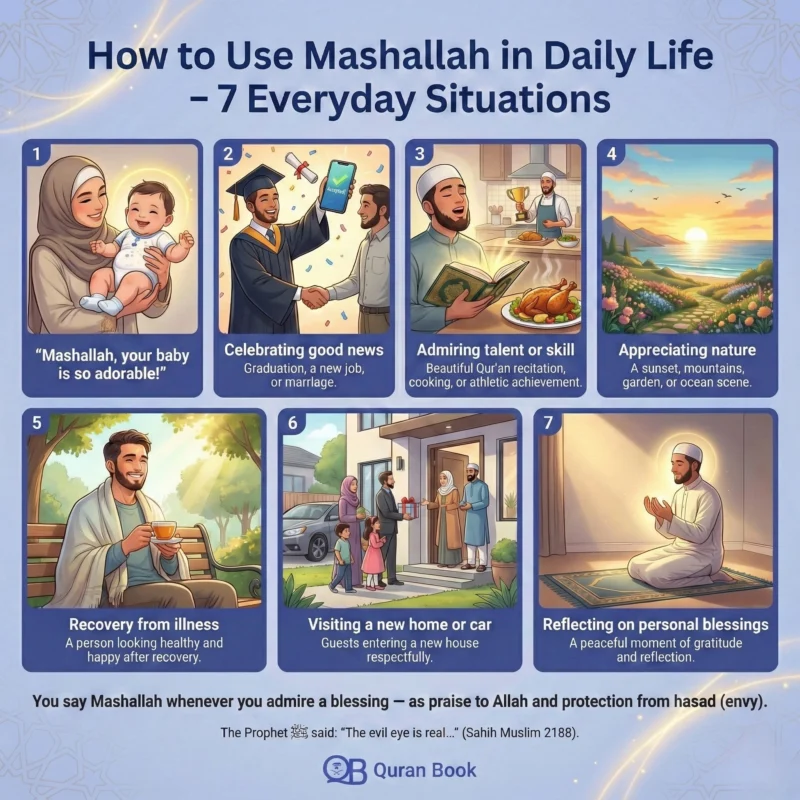
You use Mashallah correctly by saying it whenever you admire something good — a child’s achievement, someone’s health, a new home, or any blessing. It acknowledges that the blessing exists by Allah’s will. When you admire another person’s blessing, it is also good to pray for blessing by saying “Allahumma barik” (O Allah, bless it).
Here are the seven most common everyday situations where saying Mashallah is appropriate:
01
When you see a beautiful child or baby
Saying “Mashallah, your baby is so adorable!” is one of the most common uses. Saying “Mashallah” acknowledges that the child’s beauty is by Allah’s will. You may also say “Allahumma barik” to ask Allah to bless the child.
02
When someone shares good news
Whether it is a new job, a graduation, or a marriage announcement, responding with Mashallah shows you recognize Allah’s hand in their blessing.
03
When admiring someone’s talent or skill
Hearing beautiful Quran recitation, tasting someone’s cooking, or watching an athletic achievement — all are perfect moments to say Mashallah, and to add “Allahumma barik” as a supplication for blessing.
04
When you see something beautiful in nature
Sunsets, mountains, blooming gardens, the ocean — Allah’s creation constantly inspires the mashallah meaning in our hearts.
05
When someone recovers from illness
Expressing “Mashallah, you look so much better!” conveys gratitude for Allah’s mercy in restoring their health.
06
When visiting someone’s new home or car
Saying Mashallah when entering someone’s new space is respectful and acknowledges that their blessing is by Allah’s will. Adding “Allahumma barik” is a direct supplication asking Allah to place blessing in it.
07
When reflecting on your own blessings
The mashallah meaning is not only for others. Looking at your own life and whispering Mashallah is a personal act of gratitude that acknowledges Allah’s will behind every blessing.
The Prophet Muhammad ﷺ confirmed that the evil eye is real: “The evil eye is real…” (Sahih Muslim 2188). However, this hadith does not specifically state that saying “Mashallah” alone prevents it. Muslims commonly use Mashallah to acknowledge Allah’s will, while “Allahumma barik” is a direct supplication asking Allah to bless what is being admired.
Enroll your children in our Islamic Studies for Kids program and join our Quran Book Academy Telegram Channel for daily practice support.
How to Reply to Mashallah — The Complete Response Guide
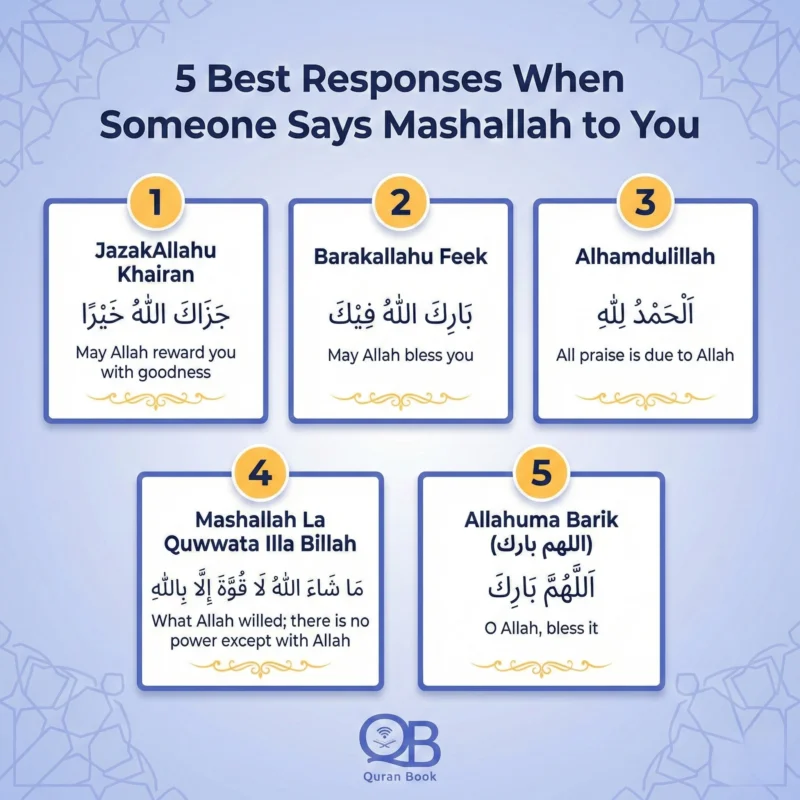
There is no single required Islamic response to “Mashallah.” Depending on the context, you may reply politely with “JazakAllahu Khairan” (May Allah reward you), “Barakallahu Feek” (May Allah bless you), or simply “Alhamdulillah” (All praise is due to Allah). Each response shows gratitude and acknowledges the blessing.
Common and Polite Ways to Respond to Mashallah
There is no single required Islamic response to “Mashallah.” Depending on the context, you may reply politely with “JazakAllahu khayran,” “BarakAllahu feek,” or “Alhamdulillah.” These are courteous responses, not a prescribed formula for replying to Mashallah.
Related Phrases When Admiring a Blessing
The Quran mentions the combined expression “Ma sha Allah, la quwwata illa billah” in Surah Al-Kahf 18:39. In its original context, it acknowledges that a blessing exists by Allah’s will and power; it is not prescribed as a required response to someone saying Mashallah.
“Allahumma barik” (اللهم بارك) means “O Allah, bless it.” It is a direct supplication asking Allah to place blessing in what is being admired, and it is commonly said alongside Mashallah.
Neither phrase should be presented as a mandatory response to someone saying Mashallah. Learn proper Arabic pronunciation through our Arabic Language Course.
Mashallah vs Inshallah vs Subhanallah vs Alhamdulillah — What’s the Difference?
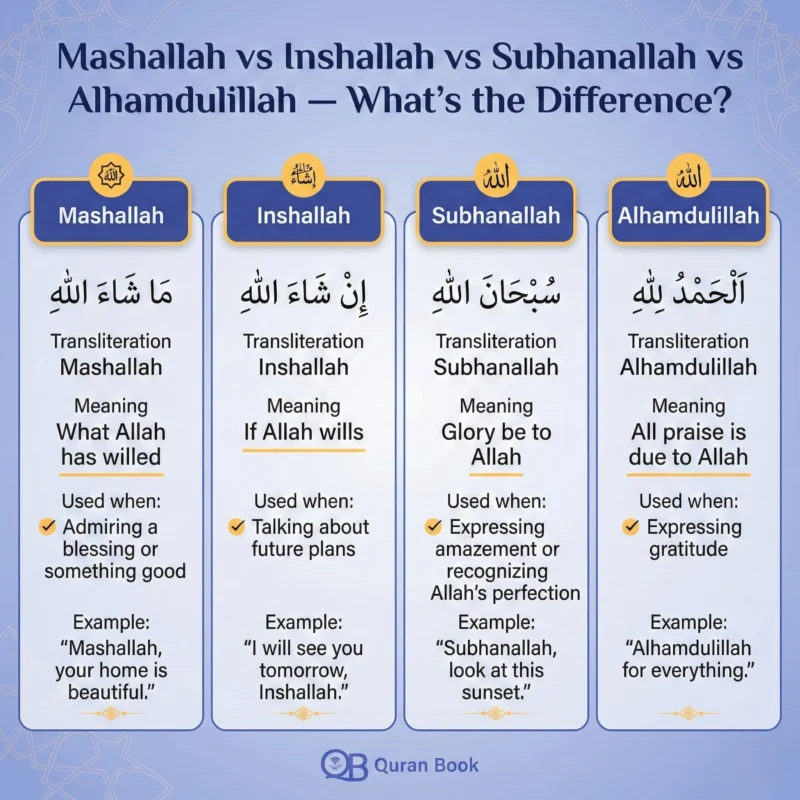
Mashallah means “God has willed it” and is used for admiration. Inshallah means “If God wills” for future events. Subhanallah means “Glory be to God” for amazement. Alhamdulillah means “Praise be to God” for gratitude.
Each phrase has a distinct purpose in a Muslim’s vocabulary. Many people confuse these expressions, so here is a clear comparison:
Understanding the mashallah meaning alongside these related phrases helps you speak with greater clarity and spiritual precision. For a deeper look at each one, see our dedicated guides to the Inshallah meaning and the Subhanallah meaning.
What Is Mashallah TabarakAllah Meaning?
The combined phrase “Mashallah TabarakAllah” translates to “What Allah has willed; Blessed is Allah.” Muslims use this expression when they witness something truly remarkable.
It adds a layer of glorification on top of the admiration that Mashallah alone carries. In Arab culture, saying Mashallah TabarakAllah is common when seeing something exceptionally beautiful — such as a newborn, a stunning Quran recitation, or a life-changing accomplishment.
The mashallah meaning becomes even more powerful when paired with TabarakAllah.
Can I Say Subhanallah and Alhamdulillah Together?
Yes. Both SubhanAllah and Alhamdulillah are established forms of dhikr (remembrance of Allah) and may be said together.
A specific authentic dhikr mentioned in Sahih al-Bukhari is: “Two words which are light on the tongue, heavy on the Scale, and beloved to the Most Merciful: SubhanAllahi wa bihamdihi, SubhanAllahil-Azeem” (Sahih al-Bukhari 6406). The reward mentioned in this hadith relates to that specific wording rather than to pairing the separate words “SubhanAllah” and “Alhamdulillah.”
How Quran Book Academy Teaches Islamic Phrases the Right Way
At Quran Book Academy, learning Islamic phrases like Mashallah, Inshallah, and Alhamdulillah does not feel overwhelming — it feels like a natural part of your spiritual growth. The teaching methodology is built on the principle of manageable psychological “chunks,” a proven educational technique where complex knowledge is broken into small, digestible lessons.
Whether you are an adult learner juggling work and family, or a parent enrolling your child in Islamic Courses for Kids, every lesson is designed to remove the fear of failure and replace it with steady progress.
Live sessions are conducted via Zoom with certified teachers, and every student’s journey is tracked through a custom LMS (Learning Management System) which sends detailed progress reports to parents and adult learners.
Free downloadable resources are also available, including a Reward Chart for Salah, a Salah Lesson Plan for Kids, and a Prayer Chart for Kids in Islam — tools that make daily practice fun and structured. This is not just an online course — it is a complete Islamic learning ecosystem designed around how the brain actually learns.
Explore our Online Quran Classes for Adults and join the Quran Book Academy YouTube Channel and Telegram Channel for ongoing support.
What We Offer — Islamic Courses for Kids and Adults
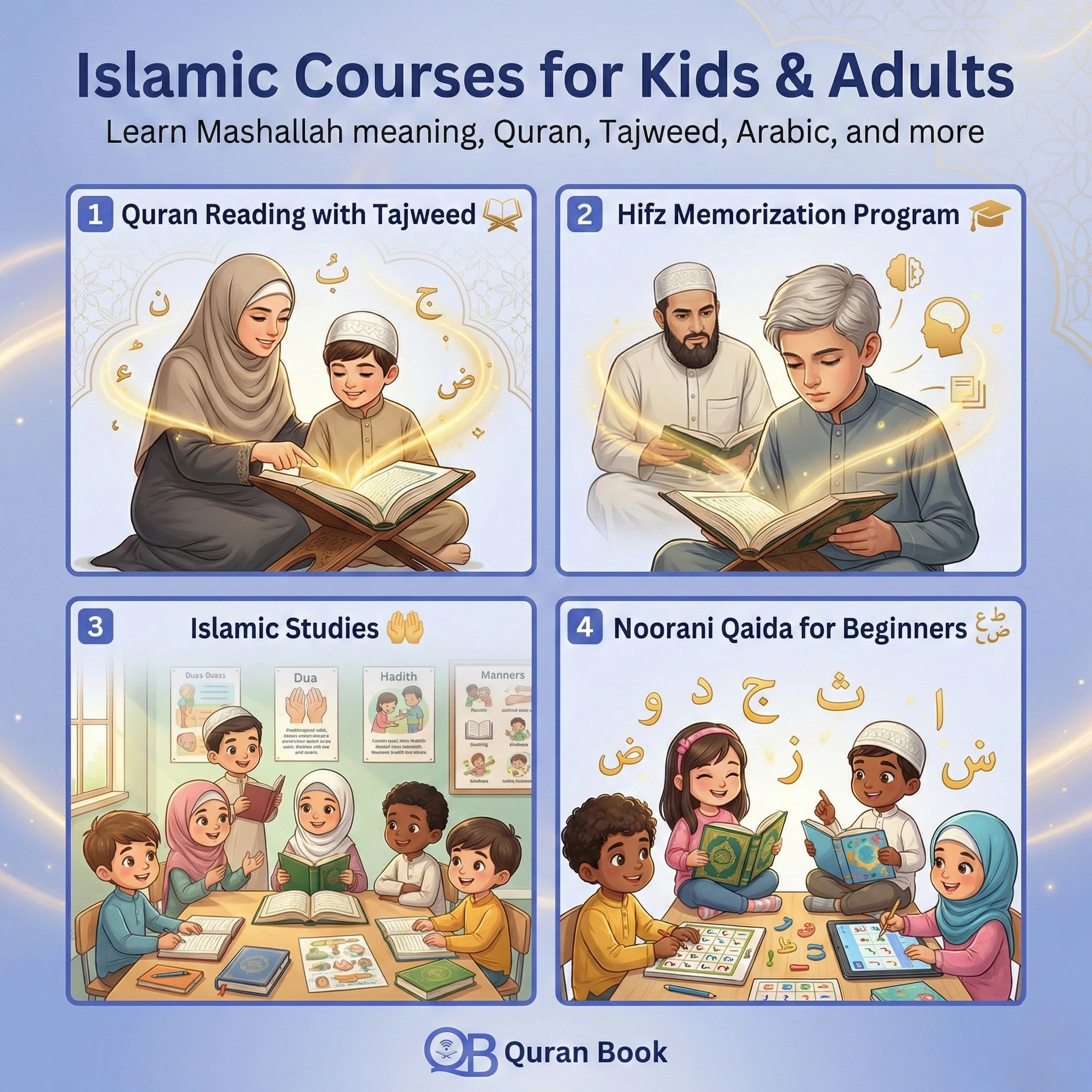
Quran Book Academy offers a comprehensive range of courses designed for every level of learner. Available programs include Quran Reading with Tajweed, Quran Memorization (Hifz), Islamic Studies, Arabic Language, and Noorani Qaida for absolute beginners.
Free resources such as the Reward Chart for Salah, Salah Lesson Plan for Kids, and Prayer Chart for Kids in Islam are included to support students between sessions.
Our Tech Stack — How We Deliver World-Class Learning
The Academy uses Zoom for live one-on-one and group sessions. A custom LMS tracks progress, attendance, and milestones automatically.
Gmail reports are sent to parents weekly, and a dedicated Telegram Channel supports students in practicing Quran reading with Tajweed between sessions. This technology-powered approach ensures that learning the mashallah meaning — and the full Islamic curriculum — happens in a structured and supportive environment.
Frequently Asked Questions About Mashallah Meaning
Q. What is the actual meaning of Mashallah?
Mashallah literally means “What Allah has willed.” It is used by Muslims to express admiration and gratitude while acknowledging that all good things come from Allah alone.
Muslims commonly say it when admiring a blessing, to acknowledge that the blessing exists by Allah’s will. It should not be presented as a guaranteed formula against the evil eye. When admiring another person’s blessing, it is also good to pray for blessing by saying “Allahumma barik.”
Q. How to use Mashallah correctly?
Say Mashallah when you admire something — a person’s beauty, a child’s achievement, someone’s health, or any blessing. It shows you recognize Allah’s will behind all good things.
Always say it sincerely from the heart, and remember that the mashallah meaning is rooted in humility, not flattery.
Q. How to reply to Mashallah?
There is no single required Islamic response to “Mashallah.” Depending on the context, you may reply politely with “JazakAllahu khayran” (May Allah reward you), “BarakAllahu feek” (May Allah bless you), or “Alhamdulillah” (All praise to Allah).
These are courteous responses, not a prescribed formula. The expression “Ma sha Allah, la quwwata illa billah” appears in Surah Al-Kahf 18:39 in the context of acknowledging that a blessing exists by Allah’s will and power — it is not prescribed as a required reply.
Q. What can I say instead of Masha Allah?
You can say “TabarakAllah” (Blessed is Allah), “Allahumma Barik” (O Allah, bless it), or “SubhanAllah” (Glory to Allah). Each carries a similar spirit of acknowledging Allah’s blessings.
However, the mashallah meaning remains the most specific expression for admiration.
Q. What does “اللهم بارك” (Allahumma Barik) mean?
Allahumma Barik means “O Allah, bless it.” It is often said alongside or instead of Mashallah to ask Allah to place blessings upon what is being admired.
It functions as a dua (supplication) — a direct request that Allah place blessing in what is admired — while Mashallah acknowledges Allah’s will.
Q. What is TabarakAllah?
TabarakAllah means “Blessed and Exalted is Allah.” It expresses praise and glorification of Allah, not a supplication meaning “May Allah bless.” To ask Allah to bless someone or something, say “Allahumma barik.”
It is often paired with Mashallah as “Mashallah TabarakAllah,” combining admiration with glorification.
Q. What is Hamdullah?
Hamdullah is a casual shortening of Alhamdulillah, meaning “Praise be to Allah.” Both are used to express gratitude, especially after receiving good news, finishing a meal, or recovering from illness.
Understanding the mashallah meaning alongside Hamdullah completes your essential Islamic vocabulary.
Q. Is it Alhamdulillah or Hamdullah?
Both are correct. “Alhamdulillah” (الحمد لله) is the full, formal Arabic phrase. “Hamdullah” is its shortened, colloquial version.
In formal settings like prayer or Quran recitation, always use the full form Alhamdulillah.
Q. Can I say Subhanallah and Alhamdulillah together?
Yes. Both SubhanAllah and Alhamdulillah are established forms of dhikr (remembrance of Allah) and may be said together.
A specific authentic dhikr mentioned in Sahih al-Bukhari is: “SubhanAllahi wa bihamdihi, SubhanAllahil-Azeem” — words the Prophet Muhammad ﷺ described as light on the tongue, heavy on the Scale, and beloved to the Most Merciful (Sahih al-Bukhari 6406).
Start Your Free Quran Lesson at Quran Book Academy Today

Now that you understand the beautiful mashallah meaning and how to use it in your daily life, imagine what a full Islamic education could do for you or your child.
At Quran Book Academy, a FREE trial lesson is offered with a certified teacher — no commitment, no pressure. Whether you are in the USA, UK, Canada, or Australia, Zoom-based live classes fit your schedule.
Plus, download the free Reward Chart for Salah and Prayer Chart for Kids in Islam when you sign up. Do not let another day pass without growing closer to the Quran. The mashallah meaning is just the beginning of your journey.
Book Your FREE Trial Lesson NowLearn More — Related Islamic Phrases
Now that the mashallah meaning is clear, continue building your Islamic vocabulary with these companion guides:
Hafidha of the Quran · Arabic Language Graduate · Writer on Islamic Sciences
Jehad Mahmoud is a graduate of the Arabic Language department and a Hafidha of the Quran who writes the Islamic educational content at Quran Book Academy.
She specialises in fiqh, the fiqh of women, and the sharia sciences, making complex rulings accessible to English-speaking Muslim families.
Her articles are educational, not fatwa. For a ruling on a specific personal situation, readers are advised to consult a qualified scholar or mufti.
References & Sources
Quranic & Hadith Sources
Academy Resources
© 2026 Quran Book Academy. All rights reserved.
Understanding the mashallah meaning is just the beginning of your Islamic learning journey.
Leave a Reply