
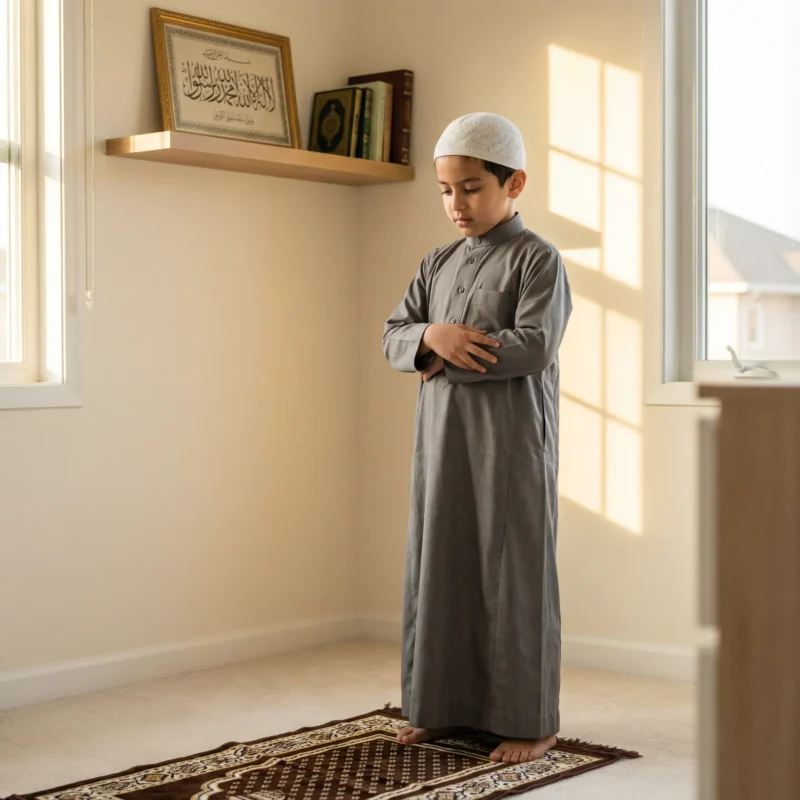
7 Powerful Steps: How to Teach Salah to Kids with Love and Confidence
A comprehensive guide for Muslim parents — by Quran Book Academy

Why Teaching Salah to Kids Feels So Overwhelming (And Why It Doesn’t Have To)

You’ve tried calling your child to prayer, but they run the other way. You feel guilty. You feel lost. You wonder — am I failing as a Muslim parent? If this sounds like your daily experience, take a deep breath because you are not alone. Learning how to teach salah to kids is a journey, not a single event, and thousands of non-Arabic speaking Muslim families across the USA, Canada, UK, and Australia share the exact same struggle.
The truth is, most parents were never given a structured roadmap for teaching salah to kids. Perhaps your own Arabic feels rusty, or you worry that your child will resist or lose interest. These fears are completely normal. The important thing is that you are here, seeking guidance, and that already makes you an exceptional parent.
This article gives you a clear, proven, 7-step framework for how to teach salah to kids with love, patience, and confidence — no guilt, no pressure, and absolutely no overwhelm. By the end, you will have a practical salah lesson plan for kids that you can start using today.
What Is Salah in Simple Words? (Explaining Prayer to Children)
Salah is the Islamic prayer that Muslims perform five times every day. It is a direct conversation between a person and Allah (God). Salah includes specific movements — standing, bowing, and prostrating — along with reciting verses from the Quran. It is the second pillar of Islam and the most important act of worship after the Shahada. Parents who need a complete practical walkthrough can follow our how to pray Salah step by step guide. When explaining muslim prayer for kids, use simple language like: “Salah is our special time to talk to Allah and thank Him for everything He gives us.”
The 5 Daily Prayers (Salah Types) — A Quick Table for Kids
| Prayer | Time of Day | Number of Fard Rak’ahs |
|---|---|---|
| Fajr | Before sunrise | 2 |
| Dhuhr | After midday | 4 |
| Asr | Afternoon | 4 |
| Maghrib | After sunset | 3 |
| Isha | Nighttime | 4 |
Why Is Salah Important for Kids? 5 Key Benefits
Understanding why salah is important for kids helps parents communicate its value in a way children truly grasp:
At What Age Should You Start Teaching Salah to Kids?
The Prophet Muhammad ﷺ instructed parents to teach and command their children to pray from the age of seven, and the same hadith mentions a firmer level of guidance once children reach the age of ten. However, child psychologists and Islamic educators recommend gentle exposure even earlier — ages 3 to 5 — through observation, play, and imitation, which builds familiarity and love long before formal instruction begins.
Age-by-Age Salah Readiness Guide
| Age Range | What to Do |
|---|---|
| 2–4 years | Let them watch you pray; give them a mini prayer mat to stand beside you |
| 5–6 years | Teach names of the 5 prayers; practice movements together through play |
| 7–9 years | Start formal teaching of the complete prayer, gradually: wudu, Al-Fatihah, the movements and the basic adhkar — a 2-rak’ah model makes the teaching easier to follow |
| 10–12 years | Focus on consistency, correcting mistakes, improving pronunciation, understanding the meanings, and developing khushu’ |
For a broader introduction to purification, salah, fasting, and other practical Islamic rulings, see our fiqh for kids guide.
Salah is one part of a balanced Islamic education. Parents can also use our Islamic Studies curriculum for kids to organize Aqeedah, Fiqh, Quran, Seerah, Duas, and Islamic manners by age.
The key principle across all ages is to lead with love, not pressure. When kids associate salah with warmth and family bonding, they naturally want to participate.
How to Teach Salah to Kids — 7 Proven Steps
This is the core section you’ve been waiting for. These seven steps of salah for kids are designed using a psychological “chunking” approach — breaking complex worship into small, manageable pieces that children can master without overwhelm.
1 Start with Wudu (Ablution Made Easy)
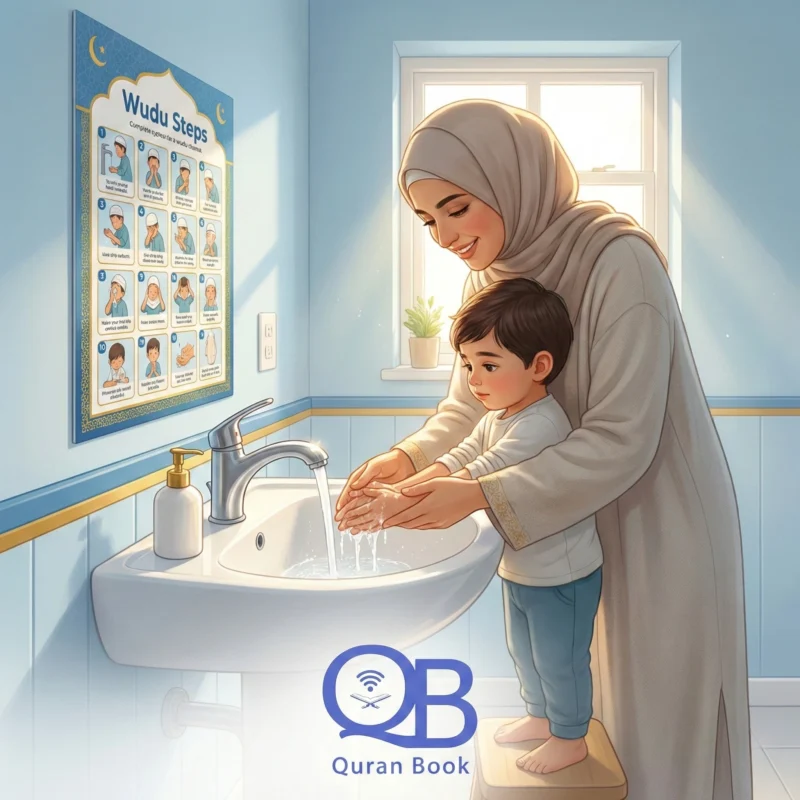
Before salah comes wudu (ablution), and this is a wonderful place to start because it involves water, movement, and a clear sequence — all things children enjoy. Use a colorful printable wudu chart and practice together at the sink. Make it a bonding ritual rather than a chore. Teach the dua before and after wudu so your child understands the spiritual intention behind each wash. Once your child understands the basic steps, it can also help to teach them what breaks wudu in a simple, age-appropriate way.
2 Teach the Salah Movements One at a Time
Do not attempt to teach the entire prayer in a single session. Instead, break salah steps for kids into manageable “chunks”: Takbir → Qiyam (standing) → Ruku (bowing) → Sujood (prostrating) → Tashahhud (sitting). Practice one movement per day. This psychological chunking method is proven to boost retention and reduce frustration. Our Islamic Studies for Kids classes follow this same step-by-step sequence week by week, which takes the guesswork out of your hands.
3 Introduce Key Surahs and Duas with Transliteration
Start with Al-Fatihah, then introduce a few short surahs such as Al-Ikhlas, Al-Falaq, and An-Nas for additional recitation practice. Provide transliteration alongside simple English meanings so your child understands what they are saying, not just repeating sounds. Correct pronunciation becomes increasingly important as children progress, so parents may also find our guide to learning Quran with Tajweed helpful. Allah says in the Quran:
This verse is a beautiful reminder that Allah does not burden us beyond our capacity — start with what is easy and build gradually.
4 Use a Reward Chart for Salah (Free Download)
Children thrive on recognition and positive reinforcement. Introduce a reward chart for salah — a printable tracker where kids place stickers after every prayer. Celebrate milestones together: five prayers in a row earns a family treat, and a full week of consistency means the child gets to choose a weekend activity. Over time, gradually shift from external rewards to internal motivation by helping your child understand that the greatest reward is Allah’s love and pleasure.
5 Pray Together as a Family
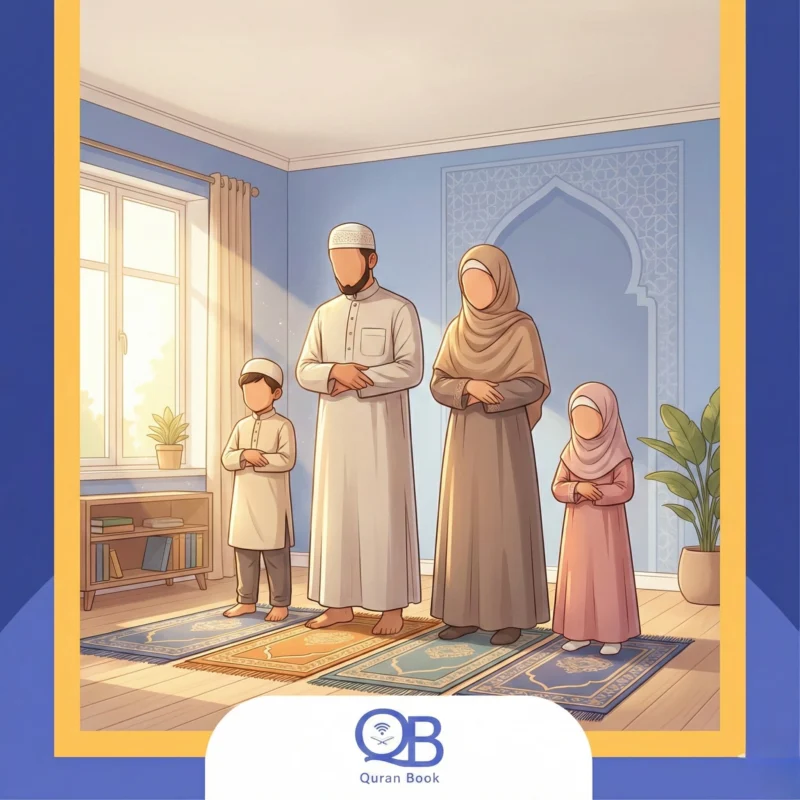
This step is arguably the most powerful. Children model what they see, not what they are told. When you pray consistently in front of your children — and with them — they internalize prayer as a normal, joyful part of daily life. To boost their confidence, let your child act as the “imam” during practice sessions at home.
This hadith reminds us that salah is learned through example and imitation.
6 Make Salah Fun and Meaningful
If you have been wondering how to make salah fun for kids, here are proven ideas that work. Use storytelling: tell the story of Isra and Mi’raj to explain how salah became obligatory — children love narratives, and this one is filled with wonder. Create a dedicated “Salah Corner” at home with a special mat, dua cards, and a small Quran. Use a prayer chart for kids Islam — a visual daily tracker with colorful Islamic art. Play the Adhan on a speaker before each prayer to signal transition and create a sense of sacred time.
7 Track Progress and Stay Consistent
Consistency is the secret ingredient that transforms occasional practice into a lifelong habit. Use our custom LMS to track your child’s salah learning journey and receive weekly progress reports delivered directly to your email. Remember: consistency beats intensity — five minutes of daily practice is far more effective than one hour once a week. The goal is not perfection; it is steady, loving progress.
The Academy Method — How Quran Book Academy Teaches Salah to Kids Online

At Quran Book Academy, we understand that teaching salah to kids, especially for non-Arabic speaking families, requires more than just instruction — it demands a psychologically informed, child-centered approach. That is why we developed “The Academy Method,” a proprietary teaching framework that combines Islamic scholarship with modern educational psychology. Our online Islamic school combines Quran, Arabic, and Islamic Studies with structured learning for children.
Our certified Quran teachers deliver live, one-on-one Zoom sessions tailored to each child’s age, level, and learning pace. Every lesson follows a structured salah lesson plan for kids built on the principle of cognitive “chunking” — breaking complex worship acts into small, manageable parts that children can master without overwhelm. For example, rather than teaching the entire prayer in one session, we dedicate focused lessons to wudu, then standing positions, then ruku, and progressively build until the child can perform a full 2-rak’ah prayer with confidence. You can see how our online classes work before you start.
Between sessions, our custom LMS (Learning Management System) tracks every milestone — from memorizing Al-Fatiha to completing their first full salah independently — and sends detailed progress reports directly to parents so they can celebrate achievements and reinforce learning at home. We also provide downloadable resources including our popular reward chart for salah, a prayer chart for kids (Islam), and age-appropriate activity sheets that keep children engaged between classes.
What to Say During Salah — A Simple Guide for Kids
During salah, kids recite specific phrases at each stage. Here is a simplified breakdown of what to say during salah for kids, complete with transliteration to make learning easy:
| Salah Position | What to Say | Transliteration / Meaning |
|---|---|---|
| Standing (Takbir) | Allahu Akbar | “God is the Greatest” |
| Recitation (Qiyam) | Surah Al-Fatiha + short Surah | Full transliteration provided in lesson materials |
| Bowing (Ruku) | SubhanaRabbiyal Adheem | “Glory to my Lord, the Magnificent” |
| Prostration (Sujood) | SubhanaRabbiyal A’la | “Glory to my Lord, the Most High” |
| Sitting (Tashahhud) | At-Tahiyyatu lillahi… | Full transliteration provided in lesson materials |
Start with transliteration to build your child’s confidence, then gradually introduce the Arabic script as their familiarity and pronunciation improve.
Practice Salah with an Interactive Islamic Studies Game
Children at Quran Book Academy learn through activities and interactive games alongside their lessons. Interactive activities like the one below can help kids review what they are learning in a fun, low-pressure way — try it together after a practice session at home.
Frequently Asked Questions (FAQ)
How do I teach my kid to pray?
Start by letting your child observe you praying daily. Then, introduce salah for kids step by step — begin with wudu, then teach one movement at a time (standing, bowing, prostrating). Use a reward chart for salah to motivate them and keep sessions short (5–10 minutes). For guided support, enroll them in structured online Islamic classes for kids with live, one-on-one Zoom lessons.
How to make salah fun for kids?
Use storytelling (like the story of Isra and Mi’raj), create a special “Salah Corner” at home, use a prayer chart for kids Islam to track daily prayers, let them act as the “imam” during practice, and celebrate milestones with small family rewards.
How to pray salah step by step for kids?
Here is a simple breakdown of how to pray salah step by step for kids: (1) Make wudu, (2) Stand facing Qibla, (3) Say “Allahu Akbar,” (4) Recite Al-Fatiha and a short surah, (5) Bow in Ruku, (6) Stand back up, (7) Prostrate in Sujood twice, (8) Sit for Tashahhud, (9) End with Salam. Repeat for each rak’ah.
What are the 5 types of salah?
The five daily prayers are Fajr (dawn), Dhuhr (midday), Asr (afternoon), Maghrib (sunset), and Isha (night). Each has a specific number of rak’ahs and is performed at set times throughout the day.
How to teach a 7-year-old to pray?
At age 7, the Prophet ﷺ instructed parents to command their children to pray. Begin with proper wudu, then teach a 2-rak’ah prayer (like Fajr). Use transliteration cards for Al-Fatiha, practice together daily, and follow a structured weekly curriculum such as our Islamic Studies for Kids classes.
Why is salah important for kids?
Salah is the second pillar of Islam and the most important act of worship. For kids, it builds discipline, gratitude, spiritual identity, and a direct connection with Allah. The Prophet ﷺ emphasized its significance as the first deed judged on the Day of Judgment.
What to say during salah for kids?
Kids should learn key phrases: “Allahu Akbar” (to start), Surah Al-Fatiha (while standing), “SubhanaRabbiyal Adheem” (during ruku), “SubhanaRabbiyal A’la” (during sujood), and the Tashahhud (while sitting). Start with transliteration and gradually introduce Arabic.

Your Child’s Salah Journey Starts Today — Book a Free Trial Lesson
Every great journey begins with a single step — or in this case, a single rak’ah. You now have a complete roadmap for how to teach salah to kids with love, structure, and confidence. But you do not have to do it alone.
When you book your free trial with Quran Book Academy, here is what you and your child receive:
- A free trial Zoom lesson with a certified teacher
- A free Reward Chart for Salah (downloadable PDF)
- A free Salah Lesson Plan for Kids (structured weekly guide)
- A free Prayer Chart for Kids Islam (daily visual tracker)
- Access to our custom LMS and weekly progress reports
Hafidha of the Quran · Arabic Language Graduate · Writer on Islamic Sciences
Jehad Mahmoud is a graduate of the Arabic Language department and a Hafidha of the Quran who writes Islamic educational content at Quran Book Academy.
She specialises in Quranic Arabic, tajweed and the sharia sciences, making correct pronunciation and complex rulings accessible to English-speaking Muslim families.
Her articles are educational, not fatwa. For a ruling on a specific personal situation, readers are advised to consult a qualified scholar or mufti.