
Laylatul Qadr (the Night of Decree) is the most sacred night in Ramadan, described in the Quran as “better than a thousand months” (Surah Al-Qadr 97:3). Whether you’re a new Muslim, a busy professional struggling to find time for worship, or someone who fears they might “miss” this blessed night—this comprehensive guide will show you how to seek, prepare for, and make the most of your ibadah on Laylatul Qadr. You don’t need to be perfect; you just need to begin.
“Indeed, We sent it [the Quran] down during the Night of Decree. And what can make you know what is the Night of Decree? The Night of Decree is better than a thousand months.” — Surah Al-Qadr (97:1-3)
What is Laylatul Qadr? The Night of Power Explained
Laylatul Qadr, also known as the Night of Decree or Night of Power, is the blessed night when the Quran was first revealed to Prophet Muhammad ﷺ. It occurs during the last ten nights of Ramadan. Worship on Laylatul Qadr is better than worship over a thousand months in which Laylatul Qadr does not occur.
For Muslims around the world, Laylatul Qadr represents the pinnacle of spiritual opportunity. This is not merely another night in the Islamic calendar—it is the night that changed human history forever. On this very night, the first verses of the Quran descended upon the Prophet Muhammad ﷺ in the Cave of Hira, marking the beginning of the final divine revelation to humanity.
The Meaning Behind “Laylatul Qadr”
Understanding the linguistic roots of Laylatul Qadr deepens our appreciation for its significance:
- “Laylah” means Night in Arabic
- “Qadr” carries multiple meanings: Decree, Power, Measure, or Destiny
- Combined meaning: The Night when destinies are decreed and divine power manifests
The word “Qadr” also implies honor and dignity, suggesting that this night elevates the status of those who worship sincerely during it. Some scholars explain that the night is called Laylatul Qadr because it is a night of immense value and magnitude—a night that holds the power to transform your entire spiritual trajectory.
Laylatul Qadr Surah in English (Surah Al-Qadr Complete Translation)
Allah revealed an entire surah dedicated to describing the magnificence of this night. Here is Surah Al-Qadr with Arabic, transliteration, and English translation:
Why is Laylatul Qadr Important? The Spiritual Significance
Laylatul Qadr is important because worship on Laylatul Qadr is better than worship over a thousand months in which Laylatul Qadr does not occur. It is the night in which the angels and the Spirit descend by permission of their Lord, a night of great hope for dua and forgiveness, and—as scholars explain—the night in which the matters of the year are decreed. It comes only once a year, so the believer strives to seek it.
Better Than a Thousand Months: Understanding the Comparison
Let’s pause and reflect on what Allah is offering us. The Quran states that Laylatul Qadr is “better than a thousand months.” Here is what this comparison tells us:
- 1,000 months is about 83 years and 4 months
- Worship on Laylatul Qadr is better than worship over a thousand months in which Laylatul Qadr does not occur
- This is Allah’s gift of “quality over quantity” in worship
Allah describes Laylatul Qadr as better than a thousand months; its precise reward cannot be calculated from this comparison alone. This is why the Prophet ﷺ emphasized seeking this night with such urgency and devotion.
Hadith About Laylatul Qadr
“Whoever stays up (in prayer and remembrance of Allah) on the Night of Qadr, with faith and seeking reward, all his previous sins will be forgiven.” — Prophet Muhammad ﷺ (Sahih Al-Bukhari 1901, Sahih Muslim 760)
“Search for the Night of Qadr in the odd nights of the last ten days of Ramadan.” — Prophet Muhammad ﷺ (Sahih Al-Bukhari 2017)
These authentic narrations highlight two crucial aspects of Laylatul Qadr: The hadith promises forgiveness of previous sins for the person who stands in worship with faith and sincere hope for Allah’s reward. Scholars explain that major sins require sincere repentance, and people’s rights must be restored. The conditions are simple—approach the night with genuine faith (iman) and the intention of seeking Allah’s reward (ihtisab).
When is Laylatul Qadr? Odd Nights & the 27th Night Debate
The Last Ten Nights of Ramadan
- 21Odd night
- 22Night
- 23Odd night
- 24Night
- 25Odd night
- 26Night
- 27Odd night
- 28Night
- 29Odd night
- 30If month completes
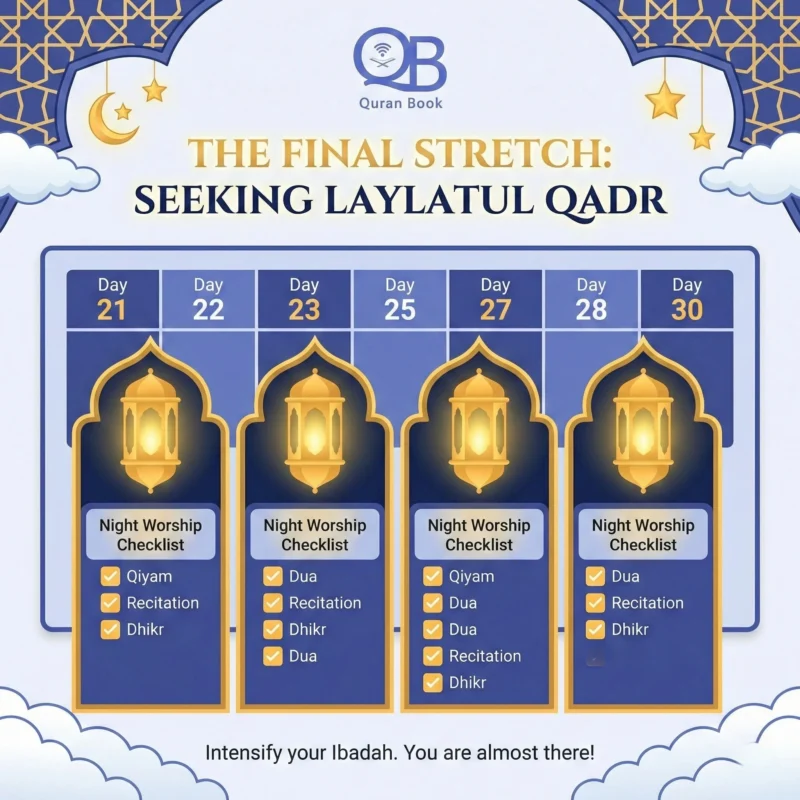
The odd-numbered nights (21, 23, 25, 27, 29) are highlighted because authentic hadith encourage seeking Laylatul Qadr especially on them. The 30th night exists only when Ramadan completes 30 days. Strive in worship on all of the last ten nights. Each Islamic night begins at sunset (Maghrib) on the evening before its day.
Laylatul Qadr occurs during the last ten nights of Ramadan. Authentic hadith encourage seeking Laylatul Qadr especially on the odd-numbered nights, while striving in worship throughout all the last ten nights. The 27th night is widely emphasized, but it is not a confirmed date every year.
One of the most frequently asked questions about Laylatul Qadr is: “Which night exactly is it?” The beautiful wisdom behind Allah concealing the precise date is to encourage consistent devotion throughout Ramadan’s final phase, rather than focusing on just one night.
Is Laylatul Qadr Only on Odd Nights?
Authentic hadith encourage seeking Laylatul Qadr especially on the odd-numbered nights, while striving in worship throughout all the last ten nights. The wisest approach is to increase worship on all ten nights, so you don’t miss this blessed opportunity regardless of which specific night it falls on.
- Authentic hadith: Seek it especially on the odd nights (21, 23, 25, 27, 29)
- Some scholarly opinions do not entirely exclude even nights
- Best practice: Increase worship on ALL last 10 nights of Ramadan
Is Laylatul Qadr on the 27th Night?
The 27th night of Ramadan holds special significance in Islamic tradition. The great companion Ubayy ibn Ka’b (RA) swore that Laylatul Qadr is the 27th night (Sahih Muslim 762), and many Muslims worldwide observe it with particular devotion. Other Companions and scholars held other views, and authentic narrations describe the night falling on different nights in different years—so the 27th is a night to seek, not a confirmed date every year. Here is an overview of the evidence related to each night:
💡 Pro Tip: The wisdom behind concealing the exact night of Laylatul Qadr is to encourage consistent worship throughout Ramadan’s final phase. Don’t put all your effort into just one night!
Signs of Laylatul Qadr: Reported Signs and Important Clarifications
Some signs of Laylatul Qadr are reported in authentic narrations—such as the moon rising like half a large bowl and the sun rising the next morning without rays. These signs are not a guaranteed way to identify the night, and some of them are only noticed after it has passed. A Muslim strives in worship throughout the last ten nights, even without seeing any sign.
The exact date of Laylatul Qadr is hidden. The Sunnah mentions some signs during the night and a sign after it ends: the first encourages us to keep striving, and the second is glad tidings for those who worshipped. Below are the reported signs with their sources, followed by important clarifications about what should not be treated as a reliable sign.
Reported Sign: A Calm Night, Neither Hot nor Cold
A narration recorded by Ibn Khuzaymah, which al-Albani graded acceptable, describes Laylatul Qadr as a calm, gentle night, neither hot nor cold, and mentions that the sun on the following morning rises reddish and weak. This describes the character of the night; it is not a weather forecast that every person in every country can use to pinpoint it.
Reported Sign: The Moon Rises Like Half a Large Bowl
Abu Hurairah (RA) reported that while the Companions were discussing Laylatul Qadr, the Prophet ﷺ asked who remembered the night when the moon rose looking like half a large bowl (shiqq jafnah) (Sahih Muslim 1170). Some scholars noted that this points to the late part of the month, since the moon rises in this shape only in its last nights.
Reported Sign: The Sun Rises Without Rays
Ubayy ibn Ka’b (RA) reported that the Prophet ﷺ informed them that on the morning after Laylatul Qadr the sun rises white, without rays (Sahih Muslim 762). This sign appears after the night has ended, so it is glad tidings for those who worshipped—not a way to know the night in advance.
Clarification: Tranquility and Tears Are Not Proof
Many people feel deep inner peace (sakeenah), closeness to Allah, or tears during worship in the last ten nights. These are blessings to be grateful for, but a personal feeling is not confirmed evidence that a particular night was Laylatul Qadr—and not feeling them does not mean you missed it.
Clarification: The Angels Descend—But This Is Not a Visual Test
The descent of the angels is established by the Quran: the angels and the Spirit (Jibreel, AS) descend therein by permission of their Lord for every matter (Surah Al-Qadr 97:4). We believe in this firmly, but it is not something the reader can see or rely on as a test to identify the night.
Clarification: Reports About Shooting Stars
Some narrations mention that no shooting star is thrown on that night, such as those recorded by Ahmad from Ubadah ibn as-Samit and by at-Tabarani from Wathilah ibn al-Asqa’. Hadith scholars, including al-Bayhaqi and al-Haythami, pointed out weakness in their chains of narration, so this should not be treated as an established sign.
Clarification: Rain Is Not an Annual Sign
In the hadith of Abu Sa’id al-Khudri (Bukhari & Muslim), rain fell in one particular year and the Prophet ﷺ prostrated in water and mud on the morning of the 21st. This describes what happened that year. Rain or a cool breeze is not a sign that recurs every year, nor a method for identifying the night.
🤲 Saw no sign? Keep striving. Seeing a sign is not a condition for seeking Laylatul Qadr, and many sincere worshippers notice no sign at all. Worship throughout the last ten nights with faith and hope for Allah’s reward, and leave the outcome to Him.
Best Duas for Laylatul Qadr (Arabic, Transliteration & English)
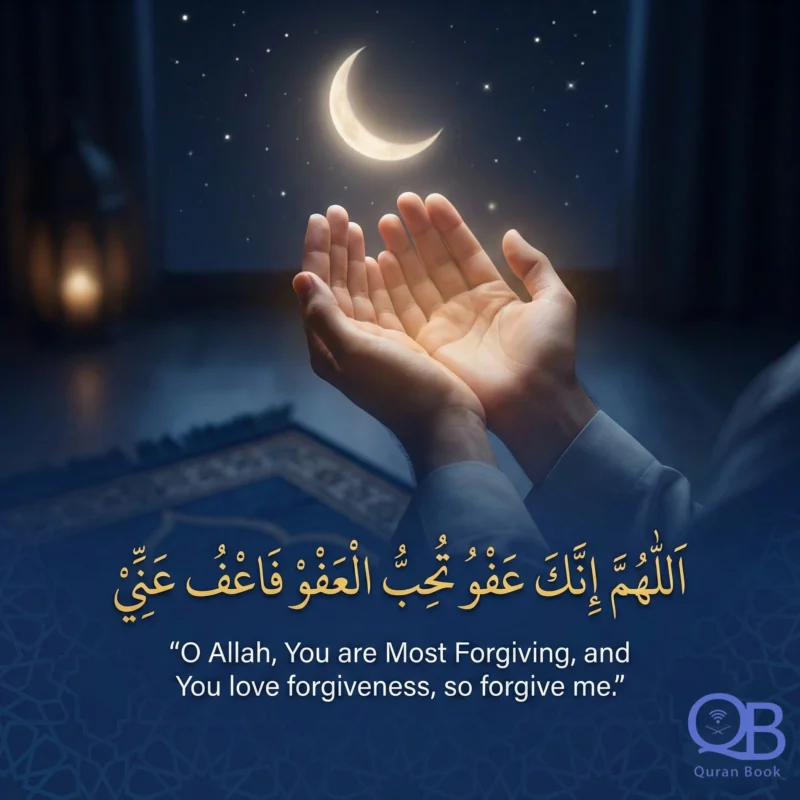
The best dua for Laylatul Qadr, taught by Prophet Muhammad ﷺ to Aisha (RA), is: “Allahumma innaka ‘afuwwun tuhibbul ‘afwa fa’fu ‘anni” (O Allah, You are Forgiving and love forgiveness, so forgive me). This dua should be repeated abundantly throughout the night.
The Primary Dua for Laylatul Qadr
When Aisha (RA) asked the Prophet ﷺ what she should say if she knew which night was Laylatul Qadr, he taught her a dua that has been repeated by millions of Muslims throughout history:
اللَّهُمَّ إِنَّكَ عَفُوٌّ تُحِبُّ الْعَفْوَ فَاعْفُ عَنِّي
Allahumma innaka ‘Afuwwun, tuhibbul-‘afwa, fa’fu ‘anni
O Allah, You are Pardoning and You love to pardon, so pardon me
Source: Sunan Ibn Majah 3850; Jami’ at-Tirmidhi 3513
This dua is profound in its simplicity. The word “‘Afw” (pardon) means complete erasure—as if the sin never existed. This goes beyond mere forgiveness; it is a plea for Allah to wipe away our transgressions entirely.
Additional Recommended Duas for Laylatul Qadr
Beyond the primary dua, here are additional supplications recommended for this blessed night:
Outside salah, you may make dua in English or another language you understand. Within salah, scholars differ regarding non-Arabic supplication, including distinctions based on a person’s ability to use Arabic. Make dua sincerely and with hope in Allah. The answer may come through receiving what you ask for, protection from harm, or reward reserved for the Hereafter. Pour out your hopes, fears, and needs to your Creator on this blessed night.
How to Pray on Laylatul Qadr (Complete Step-by-Step Ibadah Guide)
To pray on Laylatul Qadr, begin after Isha prayer with Tahajjud/Qiyam al-Layl in sets of two rak’ahs, recite Quran with contemplation, make abundant dua, perform dhikr, and end with Witr before Fajr. The night should be spent in a mix of prayer, recitation, and supplication.
What to Do on Laylatul Qadr: A Flexible Night Plan
Night length and prayer times differ by location and season, so build your plan around your own local prayer times. Here is a flexible structure to help you make the most of your ibadah:
Pray Isha and Taraweeh with the congregation or at home. A light meal can help you stay alert for the night ahead.
Recite Quran with contemplation and understanding. If it helps, set a personal reading goal—a few pages or part of a Juz—as an optional target, not a required amount. Pray night prayer in sets of two rak’ahs, and between prayers make personal dua (outside salah) in the language you understand.
The last third of the night is a special time for dua and seeking forgiveness, as described in the authentic hadith of Allah’s descent to the lowest heaven (Sahih Al-Bukhari 1145; Sahih Muslim 758). Increase your dua and istighfar during this time.
If you have not prayed Witr yet, conclude your night prayer with it. Continue dhikr until the Fajr Adhan.
🕰️ How to find the last third of the night: Calculate the time from local Maghrib to true Fajr, divide it into three equal parts, and take the final third.
Example only: if Maghrib is at 6:00 PM and Fajr at 4:30 AM, the night is 10.5 hours; each third is 3.5 hours, so the last third begins at 1:00 AM. Your times will differ by city and season.
Ibadah on Laylatul Qadr: Acts of Worship
The suggested times above are optional planning ideas, not fixed Sunnah amounts specific to Laylatul Qadr. Do what you are able to with sincerity and consistency.
How to Perform Laylatul Qadr Prayer (Tahajjud)
Follow these steps to perform the night prayer on Laylatul Qadr:
- 1 Make wudu (ablution) with the intention of preparing for worship
- 2 Pray 2 rak’ahs with longer Quran recitation.
- 3 Make dua between the two prostrations and after completing the salam
- 4 Repeat in sets of 2 rak’ahs—there is no fixed number, so pray as many as you are able
- 5 End with Witr prayer (1, 3, or 5 rak’ahs)
- 6 Make long, heartfelt dua in prostration (sujood)—this is when you are closest to Allah
💡 Pro Tip: If you don’t know many surahs by heart, this is your sign to enroll in a Quran memorization program. Imagine next Ramadan, reciting from memory with beautiful Tajweed!
The Academy Method: Learning Quran Recitation for Laylatul Qadr

At Quran Book Academy, we understand that many Muslims—especially those in the USA, Canada, UK, and Australia—feel disconnected from the Quran because Arabic isn’t their first language. The fear of mispronunciation, the overwhelm of learning Tajweed rules, and the guilt of not understanding what you recite are psychological barriers we address directly in our teaching methodology. Our “Academy Method” breaks Quran learning into manageable psychological “chunks,” drawing from educational psychology principles that prevent cognitive overload. We use Zoom for live, one-on-one sessions with certified teachers who specialize in teaching non-Arabic speakers, and our custom Learning Management System (LMS) tracks your progress in real-time, sends weekly Gmail reports to keep you accountable, and provides recorded lesson replays so you never fall behind. Whether you’re a complete beginner who struggles with Arabic letters or an intermediate learner wanting to perfect your Tajweed for Laylatul Qadr recitation, our structured approach—rooted in patience, encouragement, and Islamic adab—transforms “I can’t” into “I did.” This Ramadan, imagine standing in Qiyam al-Layl, reciting Surah Al-Qadr from memory, with proper Makharij (pronunciation points), confident that every letter carries the weight of worship. That transformation begins with one free trial lesson.
Our Quran Courses for Laylatul Qadr Preparation
The Tech Stack Behind Your Learning
- Live Sessions: Zoom (interactive, face-to-face with your teacher)
- Progress Tracking: Custom LMS with detailed analytics
- Accountability: Weekly Gmail reports to you (or parents for children)
- Community: Telegram Channel for Practicing Quran with Tajweed
- Support: Dedicated student success coordinators
FAQ: Your Laylatul Qadr Questions Answered

“The best among you are those who learn the Quran and teach it.” — Prophet Muhammad ﷺ (Sahih Al-Bukhari)
May this Laylatul Qadr be accepted from you, and may your journey with the Quran begin tonight. 🤲
Learn More
Continue your Ramadan journey with these helpful guides
References & Sources
1. Surah Al-Qadr (97:1-5) — Quran.com
2. Sahih Al-Bukhari 1901, 2017 — Hadith on Laylatul Qadr virtues and timing
3. Sahih Muslim 760 — Hadith on forgiveness of sins on the Night of Qadr
4. Sahih Muslim 762 — Ubayy ibn Ka’b on the 27th night and the sun rising without rays
5. Sahih Muslim 1170 — The moon rising like half a large bowl
6. Sahih Al-Bukhari & Sahih Muslim — Hadith of Abu Sa’id al-Khudri (the 21st night, water and mud); Sahih Muslim — Hadith of Abdullah ibn Unays (the 23rd night)
7. Sahih Al-Bukhari 1145; Sahih Muslim 758 — Allah’s descent to the lowest heaven in the last third of the night
8. Sunan Ibn Majah 3850; Jami’ at-Tirmidhi 3513 — The primary dua for Laylatul Qadr
9. Ibn Khuzaymah — Description of Laylatul Qadr as a calm night, neither hot nor cold
10. Ibn Majah 4240 — Hadith on consistency in good deeds
11. Sahih Al-Bukhari — “The best among you are those who learn the Quran and teach it”
12. Islamweb Fatwa 6198 — The distinguishing signs of Laylatul Qadr — Islamweb (Arabic)
13. Islamweb Fatwa 11329 — Supplicating in a non-Arabic language within salah — Islamweb (Arabic)
14. Islamweb Fatwa 19243 — Calculating the last third of the night — Islamweb (Arabic)
External Links
© 2026 Quran Book Academy. All rights reserved.
Book Your Free Trial · Empowering Muslims Worldwide to Connect with the Quran