📖

Wait! Before You Go…

Try our 100% free Islamic learning resources — no signup needed!

🏠 Home About
🕌 About Us ⚙️ How It Works 👨‍🏫 Meet Our Teachers
🧒 For Kids
Fiqh for Kids Arabic Online for Kids Islamic School for Kids Tajweed Made Easy Quran Memorization Nour El Bayan Noorani Qaida
👨 For Adults
Tajweed for Adults Islamic School for Adults Quran Memorization Arabic Online Online Quran for Adults
🧕 Ladies Section
Online Quran for Ladies Islamic Studies for Sisters Female Quran Teachers
✨ More Programs
Online Islamic School Quran with Tajweed Quranic Arabic Ijaza in Quran Online Quran Classes Qiraat Course Online Hifz Course Quran Memorization Course New Muslim Programs
🎓 Learn Free
🔤 Arabic Alphabet 🎮 Tajweed Game 🕋 Memorize Quran & Tafseer Free 🕌 Islamic Studies Games 📚 Free Resources
📝 Articles 💰 Price 📱 Follow Us
🎁 Free Trial

Category: Worship

  • The Last 10 Days of Ramadan: 7 Powerful Virtues That Transform Your Faith

    The Last 10 Days of Ramadan: 7 Powerful Virtues That Transform Your Faith

    The Last 10 Days of Ramadan: 7 Powerful Virtues That Transform Your Faith
    🎁 FREE Trial Lesson
    Jehad Mahmoud - writer at Quran Book Academy
    Written by
    Published: PLACEHOLDER_DATE · Updated: PLACEHOLDER_DATE · 12 min read

    The Last 10 Days of Ramadan: 7 Powerful Virtues That Transform Your Faith

    Last 10 days of Ramadan - Muslims praying in a beautifully lit mosque during Ramadan nights
    Muslims praying in a beautifully lit mosque during the blessed Ramadan nights

    The last 10 days of Ramadan are the most sacred and spiritually rewarding period in the Islamic calendar. These blessed nights contain Laylatul Qadr (the Night of Decree), a night the Quran describes as better than a thousand months. For Muslims worldwide, this is the ultimate opportunity to seek forgiveness, renew faith, and draw closer to Allah.

    If you feel overwhelmed by the thought of maximizing these final days, or if you worry that your Arabic is not strong enough to connect deeply with the Quran during this time, you are not alone. Thousands of non-Arabic-speaking Muslims across the USA, Canada, UK, and Australia share this exact struggle. The pressure of balancing work, family, and worship—especially across challenging time zones—can feel like an impossible task.

    But here is the beautiful truth: understanding the virtues of the last 10 days of Ramadan and having the right support system can remove these barriers entirely. Whether you are a complete beginner or someone looking to deepen your connection with the Quran, this guide will walk you through the seven most powerful virtues of these blessed nights and show you exactly how to make the most of them.

    Allah says in the Quran: “Indeed, We sent it [the Quran] down during the Night of Decree. And what can make you know what the Night of Decree is? The Night of Decree is better than a thousand months.”Surah Al-Qadr, 97:1-3

    What Are the Last 10 Days of Ramadan Called?

    What are the last 10 days of Ramadan called - infographic comparing regular Ramadan nights with the last ten nights
    Infographic comparing regular Ramadan nights with the transformative last 10 nights

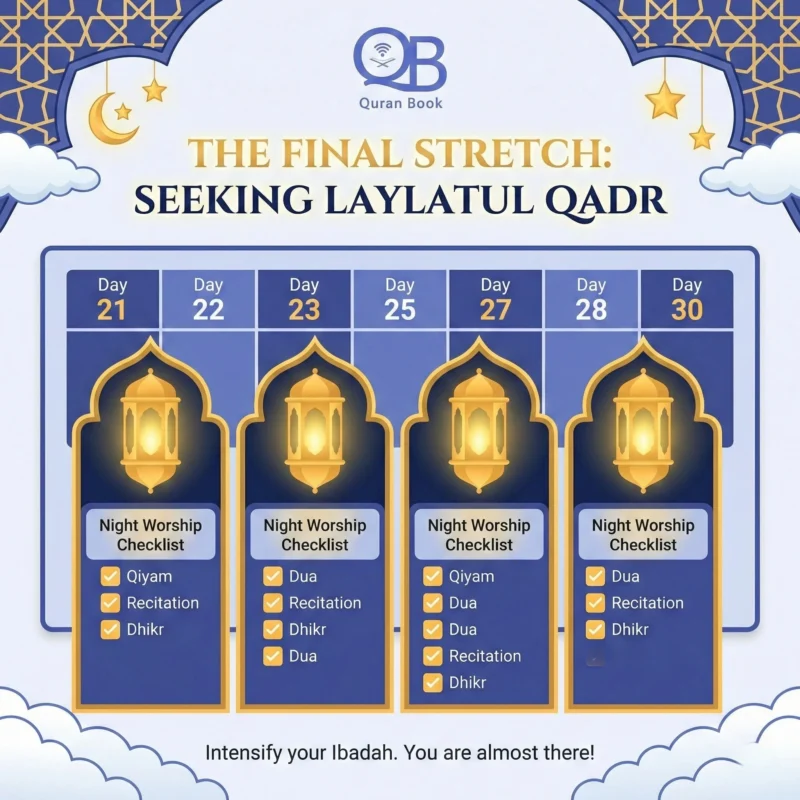
    The last 10 days of Ramadan are known in Arabic as Al-Ashr Al-Awakhir (the final ten). This sacred period begins on the 21st night of Ramadan and includes the odd nights—the 21st, 23rd, 25th, 27th, and 29th—where Laylatul Qadr is most likely to occur. Understanding when the last 10 days of Ramadan start is essential for every Muslim who wants to prepare spiritually and practically.

    The Prophet Muhammad (PBUH) treated these nights with extraordinary devotion. Aisha (RA) reported: “When the last ten days of Ramadan began, the Prophet (PBUH) would tighten his waist belt, stay up at night, and wake his family.”Sahih al-Bukhari 2024. This hadith reveals just how seriously the Messenger of Allah approached these blessed nights, and it serves as a model for every believer.

    Regular Ramadan Nights vs. Last 10 Nights:

    Aspect Regular Ramadan Nights Last 10 Nights
    Spiritual Weight High reward Multiplied reward (1,000+ months)
    Key Practice Fasting, Taraweeh Itikaf, extra Qiyam, intensive dua
    Laylatul Qadr Not present Hidden among odd nights
    Prophet’s Practice Regular worship Intensified worship (stayed up all night)

    7 Virtues of the Last 10 Days of Ramadan Every Muslim Should Know

    Virtues of the last ten days of Ramadan - infographic showing 7 powerful virtues including Laylatul Qadr and dua
    The 7 powerful virtues that make the last 10 days of Ramadan transformative

    Virtue 1: Contains Laylatul Qadr—The Night Better Than 1,000 Months

    The single greatest virtue of the last 10 days of Ramadan is the presence of Laylatul Qadr, the Night of Decree. Allah revealed this blessed night in Surah Al-Qadr, stating: “The Night of Decree is better than a thousand months”Surah Al-Qadr 97:3. This means worshiping on Laylatul Qadr equals more than 83 years of continuous worship.

    The Prophet Muhammad (PBUH) instructed Muslims to seek it on the odd nights of the last 10 days, particularly the 27th night, though scholars emphasize that it can fall on any odd night. Imagine the spiritual weight: one night of sincere worship, heartfelt dua, and Quran recitation can erase decades of sins and rewrite your destiny.

    Virtue 2: Angels Descend and Bring Divine Peace

    On Laylatul Qadr, countless angels descend to Earth, led by the angel Jibreel (Gabriel), filling the world with tranquility and blessings. Allah says: “The angels and the Spirit descend therein by permission of their Lord for every matter. Peace it is until the emergence of dawn”Surah Al-Qadr 97:4-5.

    This divine presence creates an atmosphere unlike any other night of the year. The very air becomes saturated with mercy and forgiveness. For believers seeking to connect with Allah, this angelic presence amplifies every prayer, every tear shed, and every Quranic verse recited.

    Virtue 3: The Prophet Intensified His Worship (Itikaf and Qiyam)

    The Prophet Muhammad (PBUH) not only fasted during Ramadan but also performed Itikaf (spiritual seclusion) during the last 10 days of Ramadan. Aisha (RA) reported: “The Prophet used to practice Itikaf in the last ten days of Ramadan till he died, and then his wives continued to practice Itikaf after him”Sahih al-Bukhari 1901.

    Itikaf involves staying in the mosque (or a designated prayer space at home if mosque access is limited) and dedicating all time to worship—Quran recitation, prayer, dua, and reflection. This act of spiritual seclusion removes worldly distractions and creates an uninterrupted connection with Allah.

    Virtue 4: The Best Dua for Forgiveness Is Accepted

    The last 10 days of Ramadan offer the perfect opportunity to seek Allah’s forgiveness through a specific dua taught by the Prophet (PBUH). When Aisha (RA) asked what supplication to make if she encountered Laylatul Qadr, he replied:

    “Allahumma innaka ‘Afuwwun tuhibbul-‘afwa fa’fu ‘anni”
    (O Allah, You are the Pardoner, You love to pardon, so pardon me) — Sunan al-Tirmidhi 3513

    This simple yet profound dua carries immense power. Repeating it sincerely during the odd nights can open doors to divine mercy and wipe away years of sins.

    Virtue 5: The Quran Was First Revealed During These Nights

    The Quran—the ultimate guidance for humanity—was first revealed to Prophet Muhammad (PBUH) during the last 10 days of Ramadan on Laylatul Qadr. Allah says: “The month of Ramadan [is that] in which was revealed the Quran, a guidance for the people and clear proofs of guidance and criterion”Surah Al-Baqarah 2:185.

    This historical and spiritual connection makes these nights ideal for Quran recitation. For those who struggle with Arabic pronunciation or understanding Tajweed rules, this is the perfect time to invest in learning how to read Quran with Tajweed for beginners. Even reciting a few verses correctly during Laylatul Qadr carries exponential reward.

    Virtue 6: A Time to Wake Your Family and Seek Collective Blessings

    The Prophet Muhammad (PBUH) not only worshiped more during the last 10 days of Ramadan, but he also woke his family to join him. Aisha (RA) narrated: “When the last ten nights began, the Prophet would keep awake at night (for prayer and devotion), wake his family, and prepare himself to observe prayer (with more vigour)”Sahih al-Bukhari 2025.

    This teaches us that the blessings of these nights are meant to be shared. Praying together as a family, reciting Quran, and making dua collectively creates a powerful spiritual environment that benefits everyone—especially children, who learn the value of devotion from a young age.

    Virtue 7: Your Entire Year’s Decree Is Written

    One of the most profound aspects of Laylatul Qadr is that Allah decrees the affairs of the coming year on this night. This includes matters of life, death, sustenance, health, and success. The Prophet (PBUH) said that the angels take down what Allah has decreed for the year ahead.

    This makes these nights critical for sincere dua. Whatever you ask for—whether it is guidance, provision, health, protection, or success in this life and the next—can be written into your destiny on this blessed night. Approach these nights with hope, humility, and complete reliance on Allah.

    How Quran Book Academy’s Proven Method Helps You Master Quran Reading Before Ramadan

    The Academy Method: Structured, Simple, and Proven

    At Quran Book Academy, we understand the unique challenges faced by non-Arabic speakers. That’s why we developed the Academy Method—a step-by-step learning framework designed to eliminate confusion, build confidence, and help you read the Quran correctly before the next Ramadan arrives.

    Our approach breaks Tajweed rules into manageable psychological chunks, so you are never overwhelmed. Each lesson builds on the previous one, ensuring steady progress. Whether you are a complete beginner or someone who learned basic Arabic letters years ago but never continued, our certified teachers will meet you exactly where you are.

    What Makes Our Method Different?

    • Live Zoom Sessions Tailored to Your Schedule: No more struggling alone with YouTube videos or apps that do not correct your mistakes. Our one-on-one and small group classes give you direct access to certified Quran teachers who listen to your recitation, correct your pronunciation, and guide you step by step.
    • Custom Learning Management System (LMS): Track your progress in real time, review past lessons, and access supplementary resources anytime. Our LMS ensures you stay on track and never feel lost.
    • Focus on Practical Application: We do not just teach theory. From day one, you will practice reciting actual Quranic verses with proper Tajweed. By the time Ramadan arrives, you will confidently recite during Taraweeh and Qiyam.
    • Flexible Plans for Busy Professionals and Families: We know life is hectic. That is why we offer flexible scheduling, weekend classes, and family packages so everyone can learn together.

    Thousands of students across the USA, Canada, UK, and Australia have already transformed their Quran reading through our Quran Reading and Tajweed courses. Join them today and experience the joy of reciting the Quran beautifully during the last 10 days of Ramadan.

    📖 Book Your FREE Trial Lesson Today

    Join students who transformed their Quran reading. Start now.

    Frequently Asked Questions About the Last 10 Days of Ramadan

    Q1: Why Are the Last 10 Days of Ramadan So Important?

    The last 10 days of Ramadan are the most spiritually significant because they contain Laylatul Qadr, the Night of Decree, which is better than 1,000 months of worship. The Prophet Muhammad (PBUH) intensified his worship during this period, performed Itikaf, and encouraged his followers to seek Allah’s forgiveness and mercy during these nights.

    Q2: When Do the Last 10 Days of Ramadan Start?

    The last 10 days of Ramadan begin on the 21st night of Ramadan and continue until the end of the month. The exact calendar dates vary each year depending on the lunar calendar and moon sighting in your region. Check your local Islamic center or moon-sighting authority for precise dates.

    Q3: What Is the Best Dua for Laylatul Qadr?

    The best dua for Laylatul Qadr is: “Allahumma innaka ‘Afuwwun tuhibbul-‘afwa fa’fu ‘anni” (O Allah, You are the Pardoner, You love to pardon, so pardon me), as taught by Prophet Muhammad (PBUH) to Aisha (RA) in Sunan al-Tirmidhi 3513. Repeat this dua frequently on all odd nights.

    Q4: What Are the Signs of Laylatul Qadr?

    According to authentic hadiths, signs of Laylatul Qadr include a calm, peaceful night that is neither too hot nor too cold, and the sun rises the next morning without strong rays. However, scholars advise seeking it on all odd nights of the last 10 days of Ramadan rather than waiting for signs, as the wisdom behind concealing it is to encourage worship on every night.

    Q5: Can I Learn to Read Quran with Tajweed Before Ramadan?

    Yes! Quran Book Academy offers structured Tajweed courses for beginners via live Zoom sessions. Our Academy Method breaks Tajweed rules into manageable psychological chunks so you can start reading correctly within weeks. Start with a free trial lesson and build your confidence before the last 10 days of Ramadan arrive.

    Q6: What Should I Read During the Last 10 Days of Ramadan?

    Focus on completing or progressing through the Quran, reciting Surah Al-Mulk nightly, making abundant Dhikr and Istighfar, and repeating the Laylatul Qadr dua on every odd night. If time is limited, even reciting a few verses with proper Tajweed is immensely rewarding during the last 10 days of Ramadan.

    Q7: How Do I Observe Itikaf During the Last 10 Days?

    Itikaf involves secluding yourself in a mosque (or a designated prayer area at home if mosque access is limited) for the last 10 days of Ramadan, focusing entirely on worship, Quran recitation, dua, and reflection. If full Itikaf is not possible, scholars recommend observing partial Itikaf by spending extended time in the mosque during the odd nights.

    Start Your Quran Journey Before the Last 10 Days of Ramadan

    Do not let another Ramadan pass without connecting deeply with the Quran. Whether you are a complete beginner or looking to perfect your Tajweed, Quran Book Academy’s certified teachers are ready to guide you step by step. Our live Zoom sessions fit around your schedule, our custom LMS tracks your progress, and our method is designed to eliminate the fear and frustration that holds so many learners back.

    📖 Book Your FREE Trial Lesson Today

    Join students who transformed their Quran reading. Start now.

    Learn More About Ramadan

    How to Prepare for Ramadan

    Discover essential tips and spiritual practices to prepare your heart and mind for the blessed month of Ramadan.

    Read Full Guide →

    How to Complete Quran in Ramadan

    Learn proven strategies and schedules to complete your Quran recitation during the holy month of Ramadan.

    Read Full Guide →

    Laylatul Qadr: The Night of Power

    Everything you need to know about Laylatul Qadr, including its signs, virtues, and the best acts of worship to perform.

    Read Full Guide →
    Jehad Mahmoud - Hafidha and Arabic Language graduate, writer at Quran Book Academy

    Hafidha of the Quran · Arabic Language Graduate · Writer on Islamic Sciences

    Jehad Mahmoud is a graduate of the Arabic Language department and a Hafidha of the Quran who writes the Islamic educational content at Quran Book Academy.

    She writes with a focus specialising in fiqh, the fiqh of women and the sharia sciences, making complex rulings accessible to English-speaking Muslim families.

    Her articles are educational, not fatwa. For a ruling on a specific personal situation, readers are advised to consult a qualified scholar or mufti.

    Fiqh Purification (Tahara) Wudu Fiqh of Women

    References & Internal Links

    © 2026 Quran Book Academy. All rights reserved.

    Empowering Muslims worldwide to connect with the Quran | Visit Our Website

  • How to Prepare for Ramadan: Your Complete Guide to a Blessed Month

    How to Prepare for Ramadan: Your Complete Guide to a Blessed Month

    How to Prepare for Ramadan: Your Complete Guide to a Blessed Month
    QB

    Quran Book Academy

    Your Journey to Quran Mastery

    Free Trial

    How to Prepare for Ramadan: Your Complete Guide to a Blessed Month

    Written by Quran Book Academy | Updated for Ramadan 2026

    📿 Spiritual Guide ⏱️ 15 min read

    1. Introduction: Embracing the Sacred Journey

    Learning how to prepare for Ramadan can feel overwhelming, especially if you’re new to fasting or worried about balancing worship with daily responsibilities. You might be asking yourself: “Will I be able to read Quran properly? Can I manage fasting while working? Am I spiritually ready?” These feelings are completely normal—and you’re not alone in experiencing them.

    The beautiful truth is that preparing for Ramadan is itself an act of worship. When you take the time to plan and ready yourself for this blessed month, you’re already walking the path of spiritual growth. Whether you’re a complete beginner or someone looking to deepen their connection with Allah, this comprehensive guide will show you exactly how to prepare for Ramadan in a way that transforms your entire experience.

    “O you who believe, fasting is prescribed for you as it was prescribed for those before you, that you may become righteous.”

    Surah Al-Baqarah 2:183
    Muslim family preparing for Ramadan together - how to prepare for Ramadan guide
    A warm image showing a Muslim family gathered together, organizing their home and discussing Ramadan goals.

    2. What is Ramadan Preparation? Understanding the Basics

    Featured Snippet: Ramadan preparation involves spiritual, physical, and practical steps taken before the holy month begins. This includes setting worship goals, adjusting sleep schedules, preparing for fasting, improving Quran recitation skills, and creating a supportive environment. Proper preparation helps Muslims maximize the spiritual benefits of this blessed month.

    Why Preparing for Ramadan Matters

    The Prophet Muhammad (PBUH) used to increase his worship during the month of Sha’ban, the month preceding Ramadan, demonstrating the importance of gradual preparation. According to a hadith narrated by Bukhari and Muslim: “Whoever fasts Ramadan out of faith and seeking reward, his previous sins will be forgiven.” This powerful promise reminds us why knowing how to prepare for Ramadan is so essential—it’s not just about the physical act of fasting, but about entering the month with the right spiritual mindset.

    The 3 Pillars of Ramadan Readiness

    🕌 Spiritual

    💪 Physical

    • • Sleep schedule adjustment
    • • Practice fasting
    • • Hydration habits

    📋 Practical

    • • Work/school planning
    • • Meal prep strategies
    • • Family coordination

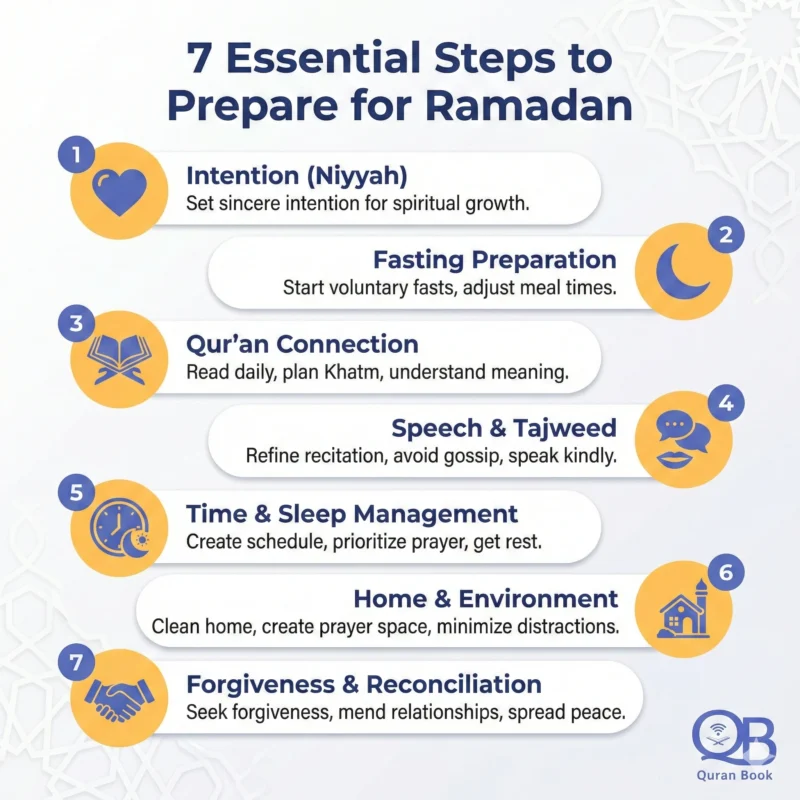
    3. 7 Essential Steps to Prepare for Ramadan

    7 essential steps to prepare for Ramadan - Ramadan preparation tips
    A numbered visual guide showing all 7 steps with simple icons for Ramadan preparation.

    When planning Ramadan preparation, following a structured approach ensures you cover all bases. Here are the seven essential steps that will help you get ready for Ramadan effectively:

    1 Set Clear Spiritual Intentions (Niyyah)

    Begin your journey of preparing for Ramadan by setting sincere intentions. Write down 3-5 specific goals: completing Quran recitation, improving prayer consistency, memorizing new surahs, or increasing your charitable giving. The Prophet (PBUH) said, “Actions are judged by intentions” (Bukhari). Your niyyah sets the foundation for everything that follows.

    2 Start Practicing Your Fasting

    One of the most practical ways to learn how to prepare for Ramadan fasting is to begin voluntary fasts in Sha’ban. Consider fasting the “white days” (13th, 14th, and 15th of each Islamic month) and Mondays and Thursdays. Allah’s Messenger (ﷺ) used to fast till one would say that he would never stop fasting. He never fasted for a whole month except the month of Ramadan and did not see him fasting in any month more than in the month of Sha’ban. (Sahih al-Bukhari 1969)

    3 Establish Your Quran Reading Routine

    This is where many Muslims struggle when figuring out how to get ready for Ramadan. Start with just 15-20 minutes of daily Quran reading. Consistency matters more than quantity at this stage. Even beginners can build confidence with proper guidance through our Quran Reading Course. Choose a specific time each day—perhaps after Fajr prayer—and protect this time.

    4 Learn or Refresh Your Tajweed Basics

    Quran recitation with proper Tajweed multiplies your rewards. Even learning basic pronunciation rules transforms your reading experience. The Prophet (PBUH) said: “The one who recites the Quran beautifully, smoothly, and precisely will be in the company of noble angels” (Bukhari). Invest in Tajweed learning as one of the best ways to prepare spiritually.

    5 Adjust Your Sleep Schedule

    Start waking up 15 minutes earlier each week leading up to Ramadan. This gradual adjustment prepares your body for Taraweeh prayers, Suhoor timing, and potentially Tahajjud in the last ten nights. Managing your sleep effectively is crucial for maintaining energy throughout the fasting day.

    6 Prepare Your Environment

    Create a dedicated prayer and reading corner in your home. Organize your Ramadan supplies, meal prep containers, and Quran materials. Communicate schedule changes with your family and employer in advance. Reduce social media distractions by adjusting notification settings or using app timers.

    7 Seek Forgiveness and Mend Relationships

    Enter Ramadan with a clean heart. Reach out to anyone you may have wronged or have unresolved issues with. Make amends, ask for forgiveness, and let go of grudges. This spiritual cleansing is perhaps the most important step in preparing for Ramadan, as it opens your heart to receive the full blessings of the month.

    4. How to Prepare Your Quran Reading for Ramadan

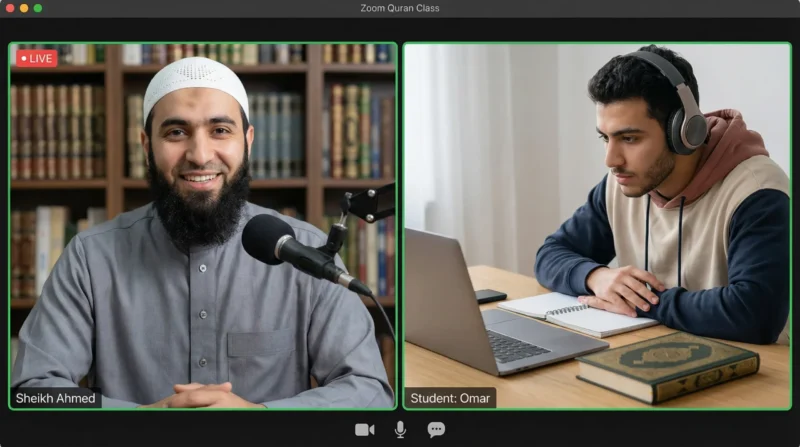
    Student learning Quran reading online via Zoom - how to prepare for Ramadan Quran goals
    An image showing a student engaged in an online Quran learning session, demonstrating modern Quran education.

    Featured Snippet: To prepare your Quran reading for Ramadan, start by assessing your current level, set achievable daily goals (1-2 pages for beginners), practice Tajweed rules, and establish a consistent reading time. Many Muslims aim to complete the entire Quran (Khatmah) during the month, making pre-Ramadan preparation essential.

    Assessing Your Current Quran Level

    Understanding where you are is the first step in planning Ramadan Quran goals. Beginners are those still learning Arabic letters and basic reading skills. Intermediate readers can read but need Tajweed improvement for proper pronunciation. Advanced readers focus on fluency, speed, and memorization. Be honest with yourself about your level—this ensures you set realistic, achievable goals.

    Setting Realistic Reading Goals

    Level Daily Goal Ramadan Target
    Beginner 1-2 pages 5-10 Juz
    Intermediate 4-5 pages Half Quran (15 Juz)
    Advanced 1 Juz (20 pages) Complete Khatmah

    Remember, the goal is progress, not perfection. Whether you complete one Juz or the entire Quran, every verse you read is a step closer to Allah. Focus on quality and understanding alongside quantity. Consider enrolling in our Khatmah Course for guided completion.

    5. The Academy Method: Building Quran Fluency Before Ramadan

    Featured Snippet: The Academy Method at Quran Book Academy uses proven psychological techniques—breaking complex Tajweed rules into manageable ‘chunks’—combined with live Zoom sessions, personalized feedback through our custom LMS, and progress tracking via Gmail reports to help students achieve Quran fluency before Ramadan arrives.

    Our Teaching Philosophy

    At Quran Book Academy, we understand that learning to read Quran—especially for non-Arabic speakers—requires more than just repetition. Our methodology is built on educational psychology principles that recognize how adults learn best. We break down complex Tajweed rules into manageable psychological ‘chunks,’ each building upon the previous lesson.

    Our Tech-Stack That Supports Your Learning

    📹

    Live Zoom Sessions

    One-on-one interactive classes with native Arabic-speaking teachers

    📊

    Custom LMS

    Track progress, access recorded lessons, and complete practice exercises

    📧

    Gmail Progress Reports

    Weekly updates on your advancement and detailed teacher feedback

    Courses to Prepare for Ramadan

    6. Creating Your Daily Ramadan Routine

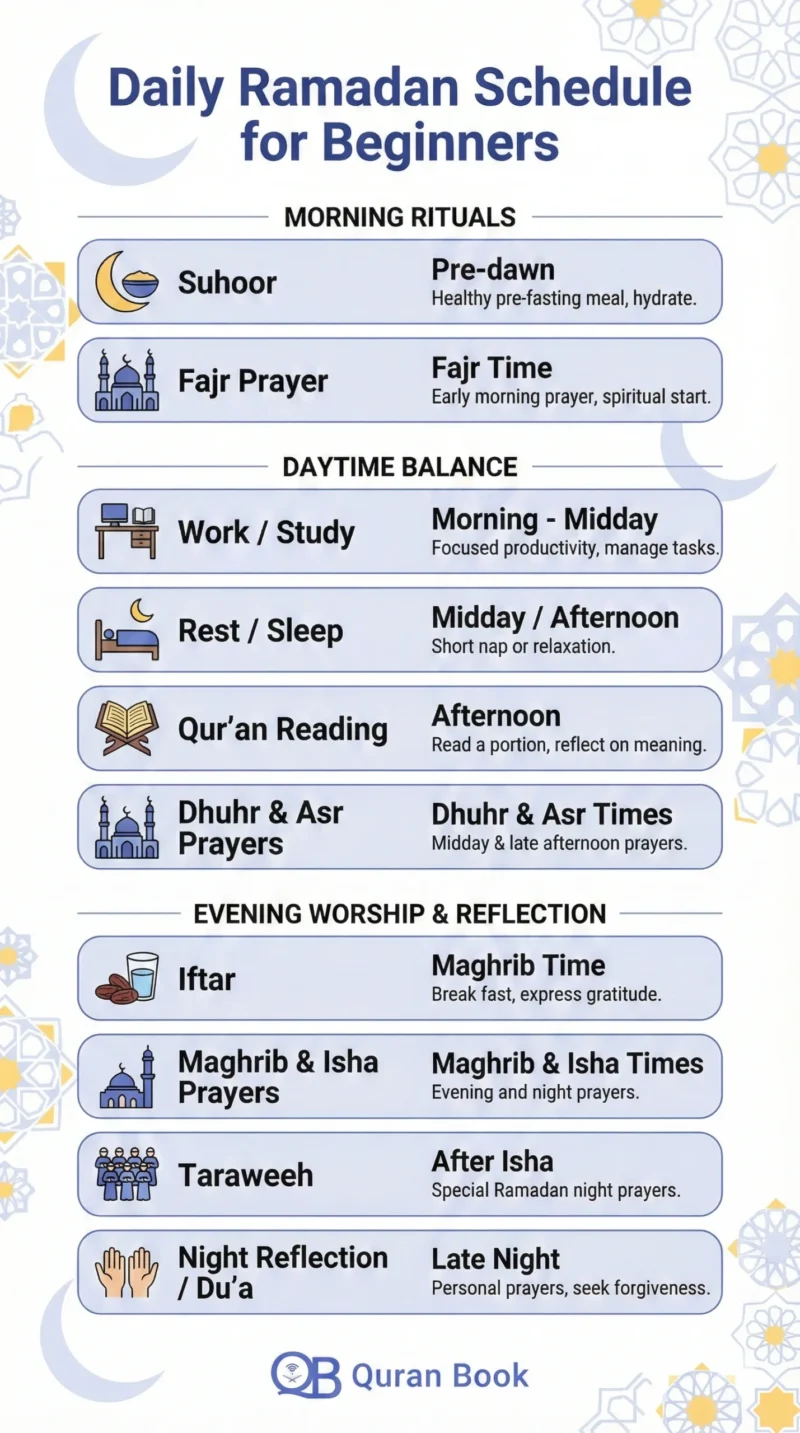
    Daily Ramadan schedule template for beginners - daily routine in Ramadan
    A clean, printable schedule template showing time blocks for Suhoor, work, Iftar, and prayers with Islamic design elements.

    Featured Snippet: A productive daily routine in Ramadan includes waking for Suhoor 30 minutes before Fajr, morning Quran reading after Fajr, maintaining work/school commitments, afternoon rest, breaking fast with dates and water at Maghrib, performing Taraweeh prayers, and ending with reflection and early sleep.

    Sample Ramadan Daily Schedule

    Time Activity Spiritual Focus
    4:00-5:00 AM Suhoor & Fajr Prayer Tahajjud, dua time
    5:00-7:00 AM Quran Reading Morning adhkar, reflection
    9:00 AM-5:00 PM Work/School Dhikr during breaks
    5:00-7:00 PM Rest & Iftar Prep Dua before Iftar
    7:30-10:00 PM Maghrib, Isha, Taraweeh Community worship
    10:00 PM Sleep Gratitude reflection

    This schedule is flexible and should be adapted to your specific circumstances, work schedule, and family needs. The key is consistency—having a routine helps you maximize every precious day of Ramadan.

    7. Ramadan Rules for Beginners: What You Need to Know

    Featured Snippet: Basic Ramadan rules for beginners include fasting from dawn (Fajr) to sunset (Maghrib), abstaining from food, drink, and marital relations during fasting hours, making intention (niyyah) before dawn, breaking fast immediately at Maghrib, and increasing prayers, Quran reading, and charitable acts throughout the month.

    What Breaks and Doesn’t Break Your Fast

    ❌ Breaks Fast

    • • Intentionally eating or drinking
    • • Intentional vomiting
    • • Smoking
    • • IV nutrition

    ✓ Does NOT Break Fast

    • • Accidentally eating (forgetfulness)
    • • Unintentional vomiting
    • • Using miswak/toothbrush (without swallowing)
    • • Injections (non-nutritive)

    Who is Exempt from Fasting?

    Islam is a religion of mercy, and certain individuals are exempt from fasting: travelers on long journeys, those who are sick, pregnant or nursing mothers who fear harm to themselves or their child, elderly individuals who cannot fast, and children who haven’t reached puberty. Those who are temporarily exempt should make up missed fasts later, while those permanently unable to fast may pay Fidya (feeding one poor person for each missed day). Consult with knowledgeable scholars at IslamQA for specific situations.

    8. FAQs About How to Prepare for Ramadan

    Q1: How do Muslims prepare for Ramadan?

    Muslims prepare for Ramadan by increasing voluntary fasting in Sha’ban, setting spiritual goals, improving Quran reading skills, organizing daily schedules, preparing meal plans, and seeking forgiveness from others. This holistic approach to Ramadan preparation ensures maximum spiritual benefit during the holy month.

    Q2: What are the fasting rules for Ramadan?

    The main fasting rules include abstaining from food, drink, smoking, and marital relations from dawn (Fajr) to sunset (Maghrib). Fasting also involves avoiding lies, gossip, and anger. Make your intention (niyyah) before Fajr and break fast immediately when the Adhan of Maghrib is called.

    Q3: Can you drink water during Ramadan?

    During fasting hours (dawn to sunset), you cannot drink water. However, you can drink freely during non-fasting hours—between Iftar (sunset) and Suhoor (pre-dawn meal). It’s recommended to hydrate well during these times to stay healthy throughout the fast.

    Q4: How to break fast during Ramadan?

    Following the Sunnah, break your fast with dates and water. The Messenger of Allah (ﷺ) used to break his Saum (fasting) before performing Maghrib prayer with three fresh date-fruits; if there were no fresh date-fruits, he would eat three dry dates; and if there were no dry date-fruits, he would take three draughts of water. (Tirmidhi)

    Q5: What can I do during Ramadan to maximize rewards?

    Maximize Ramadan rewards by reading Quran daily (even one page counts), performing all five prayers on time, praying Taraweeh at night, giving charity regularly, making abundant dua especially before Iftar, seeking Laylatul Qadr in the last ten nights, and practicing patience and kindness in all interactions.

    Q6: How long before Ramadan should I start preparing?

    Ideally, begin preparing 4-6 weeks before Ramadan (during Sha’ban). This gives you time to build Quran reading habits, practice voluntary fasting, adjust sleep schedules, and enroll in courses like Quran Reading or Tajweed to strengthen your recitation skills before the holy month begins.

    9. Start Your Ramadan Journey with Quran Book Academy

    “The month of Ramadan in which the Quran was revealed, a guidance for mankind and clear proofs of guidance and criterion.”

    Surah Al-Baqarah 2:185

    Your Transformation Starts Now

    Don’t let this Ramadan pass without meaningful connection to the Quran. Whether you’re a complete beginner learning Arabic letters or seeking to perfect your Tajweed, Quran Book Academy is here to guide you on your journey. Our experienced teachers, flexible Zoom scheduling, and progress-tracking technology make learning accessible no matter where you are in the USA, Canada, UK, or Australia.

    Quran Book Academy free trial lesson - learn how to prepare for Ramadan with expert teachers
    A professional banner showing the Quran Book Academy branding with online learning imagery and Islamic elements.

    Experience our teaching methodology firsthand. No obligation, no pressure—just the first step toward a more meaningful Ramadan.

    One-on-one Zoom session with a qualified teacher

    Personalized assessment of your current level

    Custom learning plan for Ramadan readiness

    No credit card required

    Join our community: Telegram Channel

    📚 Learn More

    Continue your Ramadan journey with these related articles:

  • Laylatul Qadr: Powerful Signs, Duas & How to Pray This Blessed Night

    Laylatul Qadr: Powerful Signs, Duas & How to Pray This Blessed Night

    Laylatul Qadr 2026: 7 Powerful Signs, Duas & How to Pray This Blessed Night
    Jehad Mahmoud - writer at Quran Book Academy
    Written by
    Published: PLACEHOLDER_DATE · Updated: PLACEHOLDER_DATE · 12 min read
    Ramadan Special Guide

    Laylatul Qadr 2026: 7 Powerful Signs, Duas & How to Pray This Blessed Night

    By Quran Book Academy · Ramadan 2026

    Last Updated: February 2026 · 18 min read

    Laylatul Qadr night sky with mosque silhouette and peaceful atmosphere
    A serene night sky with stars, crescent moon, and a mosque silhouette representing the spiritual significance of Laylatul Qadr (Night of Decree).

    Laylatul Qadr (the Night of Decree) is the most sacred night in Ramadan, described in the Quran as “better than a thousand months” (Surah Al-Qadr 97:3). Whether you’re a new Muslim, a busy professional struggling to find time for worship, or someone who fears they might “miss” this blessed night—this comprehensive guide will show you exactly how to recognize, prepare for, and maximize your ibadah on Laylatul Qadr. You don’t need to be perfect; you just need to begin.

    “Indeed, We sent it [the Quran] down during the Night of Decree. And what can make you know what is the Night of Decree? The Night of Decree is better than a thousand months.” — Surah Al-Qadr (97:1-3)

    What is Laylatul Qadr? The Night of Power Explained

    Laylatul Qadr, also known as the Night of Decree or Night of Power, is the blessed night when the Quran was first revealed to Prophet Muhammad ﷺ. It occurs during the last ten nights of Ramadan and carries the reward of worship equivalent to over 83 years of devotion.

    For Muslims around the world, Laylatul Qadr represents the pinnacle of spiritual opportunity. This is not merely another night in the Islamic calendar—it is the night that changed human history forever. On this very night, the first verses of the Quran descended upon the Prophet Muhammad ﷺ in the Cave of Hira, marking the beginning of the final divine revelation to humanity.

    The Meaning Behind “Laylatul Qadr”

    Understanding the linguistic roots of Laylatul Qadr deepens our appreciation for its significance:

    • “Laylah” means Night in Arabic
    • “Qadr” carries multiple meanings: Decree, Power, Measure, or Destiny
    • Combined meaning: The Night when destinies are decreed and divine power manifests

    The word “Qadr” also implies honor and dignity, suggesting that this night elevates the status of those who worship sincerely during it. Some scholars explain that the night is called Laylatul Qadr because it is a night of immense value and magnitude—a night that holds the power to transform your entire spiritual trajectory.

    Laylatul Qadr Surah in English (Surah Al-Qadr Complete Translation)

    Allah revealed an entire surah dedicated to describing the magnificence of this night. Here is Surah Al-Qadr with Arabic, transliteration, and English translation:

    Verse Arabic Transliteration English Translation
    97:1 إِنَّا أَنزَلْنَاهُ فِي لَيْلَةِ الْقَدْرِ Innā anzalnāhu fī laylat-il-qadr Indeed, We sent it down during the Night of Decree
    97:2 وَمَا أَدْرَاكَ مَا لَيْلَةُ الْقَدْرِ Wa mā adrāka mā laylat-ul-qadr And what can make you know what the Night of Decree is?
    97:3 لَيْلَةُ الْقَدْرِ خَيْرٌ مِّنْ أَلْفِ شَهْرٍ Laylat-ul-qadri khairun min alfi shahr The Night of Decree is better than a thousand months
    97:4 تَنَزَّلُ الْمَلَائِكَةُ وَالرُّوحُ فِيهَا Tanazzal-ul-malā’ikatu war-rūḥu fīhā The angels and the Spirit descend therein
    97:5 سَلَامٌ هِيَ حَتَّىٰ مَطْلَعِ الْفَجْرِ Salāmun hiya ḥattā maṭla’-il-fajr Peace it is until the emergence of dawn

    Why is Laylatul Qadr Important? The Spiritual Significance

    How to pray on Laylatul Qadr - Muslim in prostration during night prayer
    A Muslim in humble prostration during Tahajjud prayer, representing the sincere worship encouraged on Laylatul Qadr.

    Laylatul Qadr is important because worship on this single night equals over 83 years of devotion. It’s the night when angels descend in abundance, duas are accepted, and the yearly decree for each person is written. Missing this night means missing an opportunity granted only once a year.

    The Mathematical Miracle: Better Than 1,000 Months

    Let’s pause and truly comprehend what Allah is offering us. When the Quran states that Laylatul Qadr is “better than a thousand months,” this isn’t poetic exaggeration—it’s divine mathematics:

    • 1,000 months equals approximately 83.3 years
    • One single night of sincere worship grants rewards equivalent to a lifetime of devotion
    • This is Allah’s gift of “quality over quantity” in worship

    Consider this: even if you lived to be 100 years old and worshipped every single day, the rewards of Laylatul Qadr would still exceed that lifetime of effort. This is why the Prophet ﷺ emphasized seeking this night with such urgency and devotion.

    Hadith About Laylatul Qadr

    “Whoever stays up (in prayer and remembrance of Allah) on the Night of Qadr, with faith and seeking reward, all his previous sins will be forgiven.” — Prophet Muhammad ﷺ (Sahih Al-Bukhari 1901, Sahih Muslim 760)
    “Search for the Night of Qadr in the odd nights of the last ten days of Ramadan.” — Prophet Muhammad ﷺ (Sahih Al-Bukhari 2017)

    These authentic narrations highlight two crucial aspects of Laylatul Qadr: the promise of complete forgiveness for those who sincerely seek it, and the practical guidance on when to look for this blessed night. The conditions are simple—approach the night with genuine faith (iman) and the intention of seeking Allah’s reward (ihtisab).

    When is Laylatul Qadr? Odd Nights & the 27th Night Debate

    When is Laylatul Qadr - Ramadan calendar showing odd nights of last ten days
    A Ramadan calendar highlighting the last ten nights with emphasis on odd nights (21, 23, 25, 27, 29) when Laylatul Qadr is most likely to occur.

    Laylatul Qadr occurs during the last ten nights of Ramadan, most likely on the odd nights (21st, 23rd, 25th, 27th, or 29th). While many scholars emphasize the 27th night, Prophet Muhammad ﷺ encouraged searching all odd nights to maximize the chance of catching this blessed night.

    One of the most frequently asked questions about Laylatul Qadr is: “Which night exactly is it?” The beautiful wisdom behind Allah concealing the precise date is to encourage consistent devotion throughout Ramadan’s final phase, rather than focusing on just one night.

    Is Laylatul Qadr Only on Odd Nights?

    Based on authentic hadith, the scholarly consensus strongly emphasizes the odd nights of the last ten days of Ramadan. However, the wisest approach is to increase worship on all ten nights, ensuring you don’t miss this blessed opportunity regardless of which specific night it falls on.

    • Scholarly consensus: Focus primarily on odd nights (21, 23, 25, 27, 29)
    • Some scholarly opinions do not entirely exclude even nights
    • Best practice: Increase worship on ALL last 10 nights of Ramadan

    Is Laylatul Qadr on the 27th Night?

    The 27th night of Ramadan holds special significance in Islamic tradition. The great companion Ubayy ibn Ka’b (RA) expressed certainty that Laylatul Qadr falls on this night, and many Muslims worldwide observe it with particular devotion. Here’s a comparison of evidence for different nights:

    Night Evidence Scholarly Opinion
    21stHadith about early part of last 10 nightsPossible
    23rdSome companion reports and narrationsPossible
    25thMultiple hadith references and indicatorsHighly Possible
    27thStrongest scholarly tradition; Ubayy ibn Ka’b’s certaintyMost Emphasized ⭐
    29thLast odd night; mentioned in hadith narrationsPossible

    💡 Pro Tip: The wisdom behind concealing the exact night of Laylatul Qadr is to encourage consistent worship throughout Ramadan’s final phase. Don’t put all your effort into just one night!

    7 Authentic Signs of Laylatul Qadr (How to Recognize the Night)

    7 authentic signs of Laylatul Qadr including peaceful night and sun without rays
    An infographic displaying the seven authentic signs of Laylatul Qadr: peaceful calm night, moon like half a plate, sun rising without strong rays, sense of tranquility, angels descending, serene skies, and light rain.

    The signs of Laylatul Qadr include a peaceful, calm night that is neither too hot nor too cold, a moon that appears like half a plate, a sun rising the next morning without strong rays, and an overwhelming sense of tranquility and spiritual connection during worship.

    While the exact date of Laylatul Qadr is hidden, Allah in His mercy has provided us with signs to recognize this blessed night. These signs come from authentic hadith and the experiences of the righteous predecessors.

    Sign #1: A Peaceful, Calm Night

    The first sign of Laylatul Qadr is an atmosphere of exceptional tranquility. The night is neither excessively hot nor uncomfortably cold—it feels moderate and pleasant, as if the very air itself has been blessed. According to a narration in Ibn Khuzaymah, the Prophet ﷺ described it as “a calm night, neither hot nor cold.” This physical serenity mirrors the spiritual peace that descends upon the earth.

    Sign #2: The Moon Appears Like Half a Plate

    Companion Abu Hurairah (RA) reported that the moon on Laylatul Qadr appears in a specific way, resembling half of a plate. This unique lunar appearance has been noted by scholars as one of the observable signs of this blessed night.

    Sign #3: The Sun Rises Without Strong Rays

    Perhaps the most well-documented sign is observable the morning after Laylatul Qadr. The sun rises appearing weak, reddish, and without its usual harsh rays. In Sahih Muslim, the Prophet ﷺ said: “The sun rises on that morning with no rays.” This sign serves as confirmation for those who worshipped the previous night.

    Sign #4: Increased Sense of Tranquility (Sakeenah)

    Beyond physical signs, many who experience Laylatul Qadr report an internal transformation. There is a deep inner peace during worship, hearts feel unusually connected to Allah, and tears flow easily during dua. This spiritual tranquility (sakeenah) is a gift from Allah to those sincere in their devotion.

    Sign #5: Angels Descend in Abundance

    Surah Al-Qadr explicitly states that angels descend on this night. Scholars explain that more angels descend on Laylatul Qadr than there are pebbles on earth. The angel Jibreel (AS) himself descends with them, bringing peace, mercy, and blessings from Allah. While we cannot see the angels, their presence contributes to the night’s unique atmosphere.

    Sign #6: No Shooting Stars That Night

    Some scholars mention that on Laylatul Qadr, the skies are particularly serene with no shooting stars observed. The heavens appear calm and undisturbed, reflecting the peace that blankets the earth.

    Sign #7: Rain May Fall

    Some reports mention that light rain may fall on Laylatul Qadr, symbolizing the descent of mercy and blessings. While not a definitive sign, it has been noted in connection with this blessed night.

    Best Duas for Laylatul Qadr (Arabic, Transliteration & English)

    Best dua for Laylatul Qadr - Muslim with hands raised in supplication
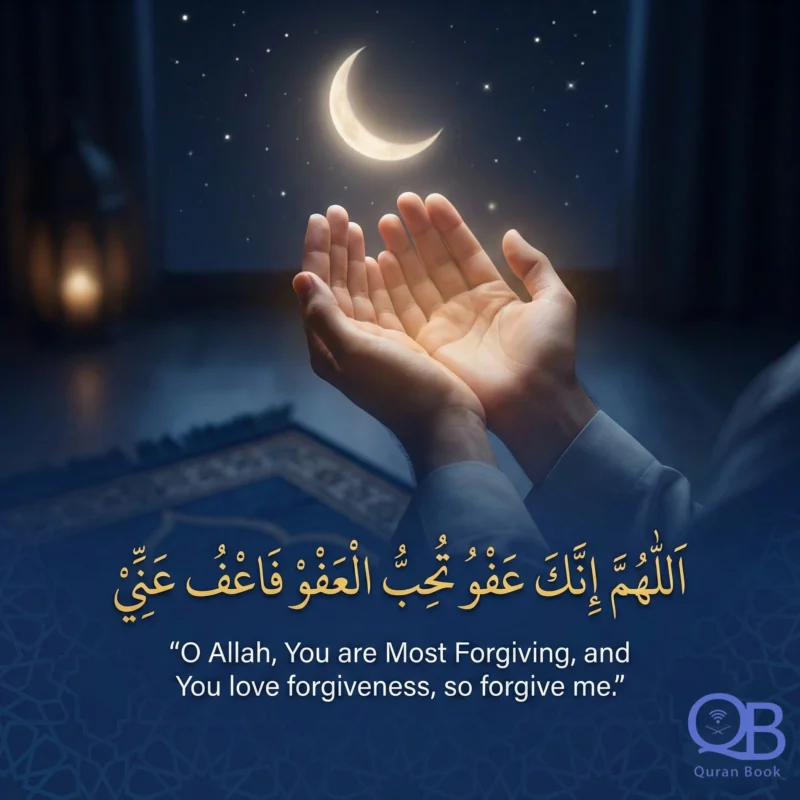
    Hands raised in sincere dua (supplication) during Laylatul Qadr, representing the recommended practice of making abundant duas on the Night of Decree.

    The best dua for Laylatul Qadr, taught by Prophet Muhammad ﷺ to Aisha (RA), is: “Allahumma innaka ‘afuwwun tuhibbul ‘afwa fa’fu ‘anni” (O Allah, You are Forgiving and love forgiveness, so forgive me). This dua should be repeated abundantly throughout the night.

    The Primary Dua for Laylatul Qadr

    When Aisha (RA) asked the Prophet ﷺ what she should say if she knew which night was Laylatul Qadr, he taught her a dua that has been repeated by millions of Muslims throughout history:

    اللَّهُمَّ إِنَّكَ عَفُوٌّ تُحِبُّ الْعَفْوَ فَاعْفُ عَنِّي

    Allahumma innaka ‘Afuwwun, tuhibbul-‘afwa, fa’fu ‘anni

    O Allah, You are Pardoning and You love to pardon, so pardon me

    Source: Sunan Ibn Majah 3850; Jami’ at-Tirmidhi 3513

    This dua is profound in its simplicity. The word “‘Afw” (pardon) means complete erasure—as if the sin never existed. This goes beyond mere forgiveness; it is a plea for Allah to wipe away our transgressions entirely.

    Additional Recommended Duas for Laylatul Qadr

    Beyond the primary dua, here are additional supplications recommended for this blessed night:

    1
    Dua for Forgiveness: Astaghfirullah wa atubu ilayh (I seek Allah’s forgiveness and repent to Him)
    2
    Dua for Parents: Rabbi-rhamhuma kama rabbayani sagheera (My Lord, have mercy on them as they raised me when I was small)
    3
    Dua for Guidance: Allahumma-hdini wa saddidni (O Allah, guide me and make me steadfast)
    4
    Dua for Ease: Allahumma la sahla illa ma ja’altahu sahla (O Allah, nothing is easy except what You make easy)
    5
    Dua for Protection: Allahumma inni a’udhu bika min ‘adhabil-qabr (O Allah, I seek refuge in You from the punishment of the grave)

    Remember, you can also make dua in your own language. Allah understands all languages, and sincere supplication from the heart is always accepted. Pour out your hopes, fears, and needs to your Creator on this blessed night.

    How to Pray on Laylatul Qadr (Complete Step-by-Step Ibadah Guide)

    To pray on Laylatul Qadr, begin after Isha prayer with Tahajjud/Qiyam al-Layl in sets of two rak’ahs, recite Quran with contemplation, make abundant dua, perform dhikr, and end with Witr before Fajr. The night should be spent in a mix of prayer, recitation, and supplication.

    What to Do on Laylatul Qadr: Hour-by-Hour Guide

    Here is a practical schedule to help you maximize your ibadah on Laylatul Qadr:

    8:00–9:30 PM After Isha

    Pray Taraweeh with the congregation or at home. Eat a light meal in preparation for the night ahead.

    9:30–11:00 PM First Third

    Focus on Quran recitation. Aim for at least 2-3 Juz, reading with contemplation and understanding.

    11:00 PM–1:00 AM Middle Third

    Pray Tahajjud (4-8 rak’ahs). Take breaks for personal duas in your own language.

    1:00–4:00 AM Last Third ⭐

    This is when Allah descends to the lowest heaven. Intensify your dua and istighfar during these blessed hours.

    4:00–5:00 AM Pre-Fajr

    Pray Witr to conclude your night prayer. Continue dhikr until the Fajr Adhan.

    Ibadah on Laylatul Qadr: Acts of Worship

    Act of Worship Duration Priority Level
    Qiyam al-Layl (Night Prayer)1-2 hours⭐⭐⭐ Essential
    Quran Recitation1-2 hours⭐⭐⭐ Essential
    Dua (Personal Supplication)30-60 mins⭐⭐⭐ Essential
    Dhikr (Remembrance of Allah)Continuous⭐⭐ Important
    Istighfar (Seeking Forgiveness)Continuous⭐⭐ Important
    Sadaqah (Charity)One-time⭐ Recommended
    I’tikaf (Seclusion in Masjid)Full night⭐ If possible

    How to Perform Laylatul Qadr Prayer (Tahajjud)

    Follow these steps to perform the night prayer on Laylatul Qadr:

    1. 1 Make wudu (ablution) with the intention of preparing for worship
    2. 2 Pray 2 rak’ahs with longer Quran recitation (Surah Al-Mulk, Surah Yasin, or other surahs you know)
    3. 3 Make dua between the two prostrations and after completing the salam
    4. 4 Repeat in sets of 2 rak’ahs (aim for 4, 8, or 12 total rak’ahs)
    5. 5 End with Witr prayer (1, 3, or 5 rak’ahs)
    6. 6 Make long, heartfelt dua in prostration (sujood)—this is when you are closest to Allah

    💡 Pro Tip: If you don’t know many surahs by heart, this is your sign to enroll in a Quran memorization program. Imagine next Ramadan, reciting from memory with beautiful Tajweed!

    The Academy Method: Learning Quran Recitation for Laylatul Qadr

    Quran Book Academy online Quran learning for Laylatul Qadr preparation
    A student learning Quran online via Zoom with a qualified teacher, representing the Academy Method for preparing to recite beautifully on Laylatul Qadr.

    At Quran Book Academy, we understand that many Muslims—especially those in the USA, Canada, UK, and Australia—feel disconnected from the Quran because Arabic isn’t their first language. The fear of mispronunciation, the overwhelm of learning Tajweed rules, and the guilt of not understanding what you recite are psychological barriers we address directly in our teaching methodology. Our “Academy Method” breaks Quran learning into manageable psychological “chunks,” drawing from educational psychology principles that prevent cognitive overload. We use Zoom for live, one-on-one sessions with certified teachers who specialize in teaching non-Arabic speakers, and our custom Learning Management System (LMS) tracks your progress in real-time, sends weekly Gmail reports to keep you accountable, and provides recorded lesson replays so you never fall behind. Whether you’re a complete beginner who struggles with Arabic letters or an intermediate learner wanting to perfect your Tajweed for Laylatul Qadr recitation, our structured approach—rooted in patience, encouragement, and Islamic adab—transforms “I can’t” into “I did.” This Ramadan, imagine standing in Qiyam al-Layl, reciting Surah Al-Qadr from memory, with proper Makharij (pronunciation points), confident that every letter carries the weight of worship. That transformation begins with one free trial lesson.

    Our Quran Courses for Laylatul Qadr Preparation

    Course Duration Best For
    Quran Reading Basics (Noorani Qaida)3-6 monthsComplete beginners learning Arabic letters
    Tajweed Mastery6-12 monthsIntermediate learners perfecting recitation
    Quran Memorization (Hifz)2-4 yearsDedicated memorizers seeking to memorize the entire Quran
    Arabic Language6-12 monthsUnderstanding the meaning of what you recite

    The Tech Stack Behind Your Learning

    • Live Sessions: Zoom (interactive, face-to-face with your teacher)
    • Progress Tracking: Custom LMS with detailed analytics
    • Accountability: Weekly Gmail reports to you (or parents for children)
    • Community: Telegram Channel for Practicing Quran with Tajweed
    • Support: Dedicated student success coordinators

    FAQ: Your Laylatul Qadr Questions Answered

    Q1. What is the exact date of Laylatul Qadr 2026?
    Laylatul Qadr 2026 will fall during the last ten nights of Ramadan, which begins approximately in late February/early March 2026. The exact date is hidden by divine wisdom, but most scholars emphasize searching on odd nights (21st, 23rd, 25th, 27th, 29th of Ramadan). The 27th night (approximately March 22-23, 2026) is most commonly observed.
    Q2. Can Laylatul Qadr be on even nights?
    While the majority of scholars and hadith emphasize odd nights, some scholarly opinions do not entirely exclude even nights. The safest approach is to increase worship throughout all ten nights, ensuring you don’t miss the blessed night regardless of which specific night it falls on.
    Q3. What is the best dua to recite on Laylatul Qadr?
    The best dua, taught by Prophet Muhammad ﷺ to Aisha (RA), is: “Allahumma innaka ‘Afuwwun tuhibbul-‘afwa fa’fu ‘anni” (O Allah, You are Pardoning and love to pardon, so pardon me). Repeat this abundantly alongside personal duas in your own language.
    Q4. How many rak’ahs should I pray on Laylatul Qadr?
    There is no fixed number. The Prophet ﷺ prayed in sets of two rak’ahs. You can pray as many as you’re able—4, 8, 12, or more—focusing on quality and khushoo (humility) over quantity. End with Witr (odd number: 1, 3, or 5 rak’ahs).
    Q5. Can I make dua in English on Laylatul Qadr?
    Yes! Allah understands all languages. While learning Arabic duas is rewarding, sincere supplication in English (or any language) is completely valid and accepted. Pour your heart out to Allah in the language most natural to you.
    Q6. What if I can’t stay up all night?
    Focus on quality, not duration. Even praying the last third of the night (1-2 hours before Fajr) is highly rewarding, as this is when Allah’s mercy descends closest. The Prophet ﷺ said: “Take on only as much as you can do of good deeds, for the best of deeds is that which is done consistently” (Ibn Majah 4240).
    Q7. Is it necessary to go to the masjid for Laylatul Qadr?
    While praying in the masjid has additional rewards and is encouraged for men, women and those unable to attend can worship at home. The sincerity of your worship matters more than the location.
    Q8. Can I recite Quran from my phone on Laylatul Qadr?
    Yes, reciting from a Quran app or digital Quran is permissible. Focus on proper recitation with Tajweed, whether from a physical Mushaf or digital device.

    Take Action: Start Your Quran Journey Today 🌙

    This Laylatul Qadr, don’t just observe—TRANSFORM.

    Imagine next Ramadan: Reciting Quran with confidence and proper Tajweed. Understanding the meaning of what you recite. Leading your family in Taraweeh. Memorizing surahs that bring you peace in Qiyam al-Layl.

    🎁 CLAIM YOUR FREE TRIAL LESSON

    30-minute live session with a certified Quran teacher · Personalized assessment · Custom learning roadmap · No commitment

    👉 BOOK YOUR FREE TRIAL NOW

    QuranbookOnline.com

    Start your Quran journey today - free trial lesson for Laylatul Qadr preparation
    A welcoming image encouraging viewers to begin their Quran learning journey with a free trial lesson at Quran Book Academy.
    “The best among you are those who learn the Quran and teach it.” — Prophet Muhammad ﷺ (Sahih Al-Bukhari)

    May this Laylatul Qadr be accepted from you, and may your journey with the Quran begin tonight. 🤲

    Jehad Mahmoud - Hafidha and Arabic Language graduate, writer at Quran Book Academy

    Hafidha of the Quran · Arabic Language Graduate · Writer on Islamic Sciences

    Jehad Mahmoud is a graduate of the Arabic Language department and a Hafidha of the Quran who writes the Islamic educational content at Quran Book Academy.

    She writes with a focus specialising in fiqh, the fiqh of women and the sharia sciences, making complex rulings accessible to English-speaking Muslim families.

    Her articles are educational, not fatwa. For a ruling on a specific personal situation, readers are advised to consult a qualified scholar or mufti.

    Fiqh Purification (Tahara) Wudu Fiqh of Women

    References & Sources

    1. Surah Al-Qadr (97:1-5) — Quran.com

    2. Sahih Al-Bukhari 1901, 2017 — Hadith on Laylatul Qadr virtues and timing

    3. Sahih Muslim 760 — Hadith on forgiveness of sins on the Night of Qadr

    4. Sunan Ibn Majah 3850; Jami’ at-Tirmidhi 3513 — The primary dua for Laylatul Qadr

    5. Ibn Khuzaymah — Description of the signs of Laylatul Qadr

    6. Ibn Majah 4240 — Hadith on consistency in good deeds

    7. Sahih Al-Bukhari — “The best among you are those who learn the Quran and teach it”

    External Links

    © 2026 Quran Book Academy. All rights reserved.

    Book Your Free Trial · Empowering Muslims Worldwide to Connect with the Quran

  • How to Complete Quran in Ramadan (khatam)

    How to Complete Quran in Ramadan (khatam)

    How to Complete Quran in Ramadan 2026 (Even with a Busy Schedule)

    📖 Ramadan 2026 Guide

    How to Complete Quran in Ramadan 2026

    (Even with a Busy Schedule)

    By Quran Book Academy | Reading Time: 15 min | Updated for Ramadan 2026

    How to complete Quran in Ramadan 2026 - Muslim reading Quran during blessed month
    A serene image of a Muslim reading the Quran during Ramadan, with soft lighting suggesting dawn or evening time, creating an atmosphere of peace and devotion.

    Every Ramadan, millions of Muslims set out to complete the Quran—and many fall short, not due to lack of faith, but because life gets overwhelming. If you’ve ever felt the guilt of an unfinished Quran or wondered how to complete Quran in Ramadan while juggling work, family, and daily prayers, you’re not alone.

    The beautiful truth? Khatam Quran isn’t reserved for scholars or the retired—it’s achievable for anyone with the right system. Whether you’re a busy professional in New York, a parent managing a household in London, or a student balancing studies in Sydney, this guide will show you exactly how to finish your Ramadan Quran reading with confidence and barakah.

    This comprehensive guide breaks down the exact steps, realistic timelines, and psychological strategies that have helped thousands of students at Quran Book Academy complete their Ramadan recitation successfully. By the end, you’ll have a clear Ramadan Quran reading schedule tailored to your lifestyle.

    Why Completing the Quran in Ramadan Holds Special Significance

    Completing the Quran during Ramadan carries immense spiritual reward because this blessed month is when the Quran was first revealed. The Prophet Muhammad ﷺ reviewed the entire Quran with Jibreel every Ramadan, and twice in his final year. This practice, known as Khatam Quran, multiplies blessings during the month when good deeds are magnified.

    “The month of Ramadan [is that] in which the Quran was revealed, a guidance for the people and clear proofs of guidance and criterion.”

    — Surah Al-Baqarah 2:185

    The connection between Ramadan and Quran runs deep in Islamic tradition. This is the month when the heavens opened, and divine guidance descended to humanity. Reading Quran during Ramadan isn’t just a tradition—it’s a way of connecting with the very essence of what makes this month sacred.

    “Jibreel used to meet the Prophet ﷺ every night during Ramadan and review the Quran with him.”

    — Sahih Al-Bukhari, 6

    During Laylatul Qadr (the Night of Power), the rewards multiply exponentially—worship on this single night is better than a thousand months. Many Muslims increase their Quran recitation significantly during the last ten nights of Ramadan, seeking the blessings of this magnificent night while striving to complete their Khatam Quran.

    How Long Does It Take to Complete the Quran?

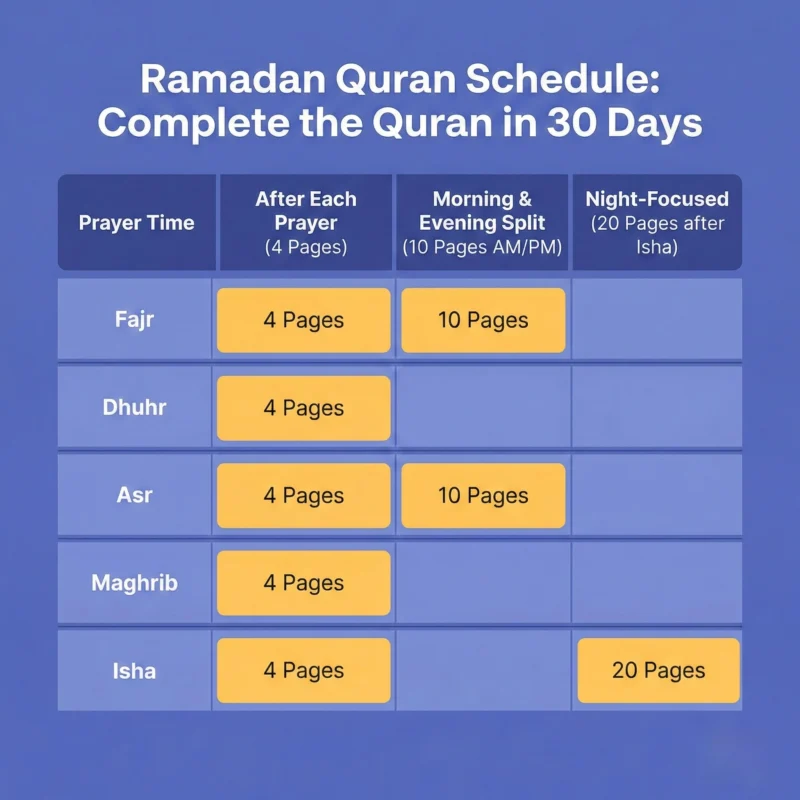
    Ramadan Quran reading schedule - 30-day plan to complete Quran in Ramadan
    An infographic showing a visual 30-day Ramadan Quran reading schedule with daily Juz breakdown, perfect for visual learners planning their Quran reading plan.

    Understanding the time commitment is crucial for creating a realistic Quran reading plan. The Quran contains 30 Juz (parts), approximately 604 pages, and around 77,000 words. Here’s what this means in practical terms:

    • 1 Reading 1 Juz takes 30–45 minutes for most readers
    • 2 Completing the full Quran takes 15–23 hours total
    • 3 In Ramadan (30 days), that’s just 30–45 minutes daily
    • 4 Beginners may need 60–90 minutes per Juz initially

    Understanding How Long One Juz Takes

    How long is one Juz? Each Juz contains approximately 20 pages of the Quran. Your reading time depends on your fluency level and whether you’re focusing on Tajweed (proper pronunciation rules):

    • Fluent Arabic readers: 20–30 minutes per Juz
    • Non-Arabic speakers reading transliteration: 45–60 minutes
    • New learners with Tajweed focus: 60–90 minutes

    The Math Behind Your Ramadan Quran Reading Schedule

    Let’s break down exactly what you need based on your reading speed. This table helps you understand how long it takes to complete the Quran and plan accordingly:

    Reading Speed Time per Juz Daily Commitment 30-Day Feasibility
    Fast (fluent) 25 min 25 min/day ✅ Very achievable
    Moderate 40 min 40 min/day ✅ Achievable
    Beginner 60 min 60 min/day ✅ Achievable with planning
    New learner 90 min 90 min/day ⚠️ Consider half-Quran goal

    New to Quran reading? Our Online Quran Reading Course can help you build the foundation you need.

    “Whoever reads a letter from the Book of Allah will receive a hasanah (good deed) from it, and the hasanah is multiplied by ten.”

    — Jami’ at-Tirmidhi, 2910

    7 Proven Steps to Complete Quran in Ramadan 2026

    Now let’s dive into the practical methodology. These seven steps have been refined through years of teaching experience and have helped thousands of students successfully finish their Ramadan Quran reading:

    1. 1 Set your intention (Niyyah) before Ramadan begins
    2. 2 Create a personalized Ramadan Quran reading schedule
    3. 3 Anchor reading to your 5 daily prayers
    4. 4 Use the “chunking” method for psychological ease
    5. 5 Leverage technology and accountability tools
    6. 6 Join a community or study circle
    7. 7 Build flexibility for difficult days

    1 Set Your Intention (Niyyah) Before Ramadan Begins

    Before Ramadan arrives, take time to set a sincere intention for completing your Quran reading. The power of Niyyah in Islam cannot be overstated—it transforms routine actions into acts of worship. Write down your goal, make dua (supplication) for success, and mentally commit to this blessed journey.

    Research in behavioral psychology confirms what our faith teaches: pre-commitment dramatically increases follow-through. When you declare your intention before Ramadan begins, you’re not just hoping to finish the Quran—you’re making a promise to yourself and to Allah.

    “Actions are judged by intentions, and every person will be rewarded according to their intention.”

    — Sahih Al-Bukhari, 1

    2 Create Your Personalized Ramadan Quran Reading Schedule

    Quran reading plan - daily schedule to finish Quran in Ramadan
    A clean, easy-to-follow chart showing different Ramadan Quran reading schedule options with time blocks for each prayer, helping readers visualize how to finish Quran in Ramadan.

    A Ramadan Quran reading schedule isn’t one-size-fits-all. Your optimal plan depends on your daily routine, energy levels, and personal preferences. The key formula is simple: 1 Juz per day for 30 days equals Khatam Quran. Here are four proven schedule types:

    Schedule Type When to Read Juz Coverage
    After Fajr Plan Post-Fajr until sunrise 1 Juz (best focus)
    Prayer-Linked Plan After each of 5 prayers 6 pages = 1 Juz total
    Night Owl Plan After Taraweeh 1 Juz (quiet environment)
    Split Session Plan Half Juz morning + half evening 1 Juz (for busy schedules)

    The After Fajr Plan works exceptionally well because your mind is fresh, the house is quiet, and you start your day with barakah. However, if you’re not a morning person, don’t force it—the best Quran reading plan is the one you’ll actually follow consistently.

    📥 Download your free schedule: Get our Free Ramadan Quran Schedule PDF to track your daily progress!

    3 Anchor Your Reading to the 5 Daily Prayers

    One of the most effective strategies for reading Quran during Ramadan is anchoring your recitation to your five daily prayers. This approach leverages a powerful psychological principle called habit stacking—attaching a new behavior to an existing routine increases your success rate by up to 70%.

    Here’s how it works: read 4–6 pages after each Salah. Since you’re already in a state of wudu and spiritual focus, transitioning to Quran recitation feels natural. The Adhan serves as a built-in reminder five times daily, and since prayers are non-negotiable for practicing Muslims, you’ll never completely miss a reading session.

    This method distributes your reading throughout the day, preventing fatigue and making the goal of one Juz feel effortless. Many of our students report that this approach transformed their entire relationship with Quran—it stopped being a task to complete and became a natural part of their daily rhythm.

    4 Use the “Chunking” Method for Psychological Ease

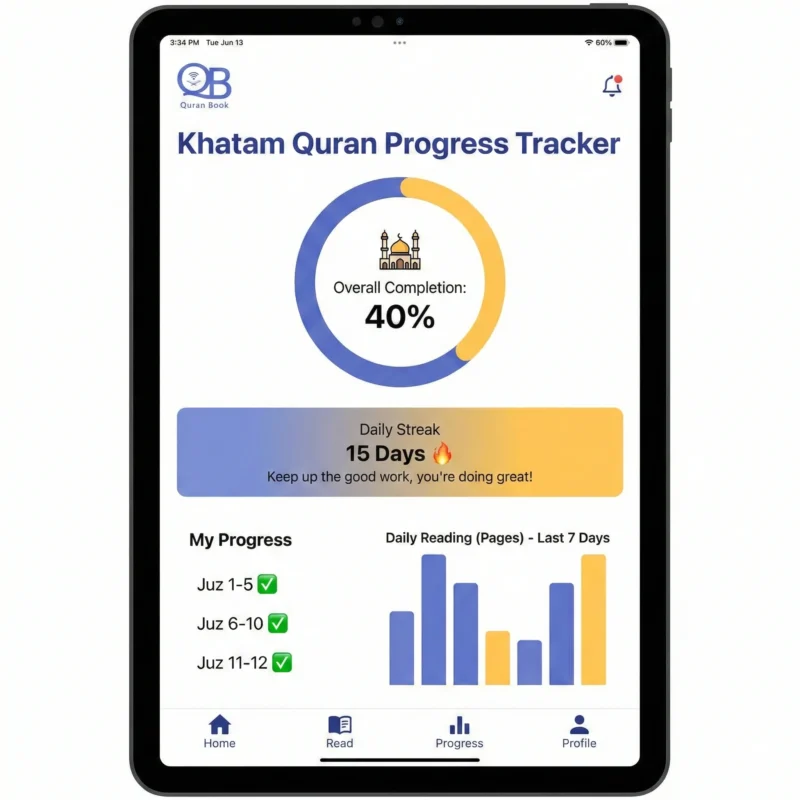
    Khatam Quran progress tracker - chunking method for completing Quran in Ramadan
    A screenshot or mockup of a Quran reading progress dashboard showing completed Juz, daily streaks, and motivational elements that help students achieve Quran Khatam.

    At Quran Book Academy, we’ve discovered that the biggest barrier to completing Quran isn’t time—it’s psychological overwhelm. Looking at 604 pages feels insurmountable, but our “Chunking Method” transforms this mountain into manageable hills. Here’s how it works:

    Instead of thinking “I need to read the entire Quran,” we train students to focus only on the current page—then the next. This technique, rooted in cognitive load theory, reduces mental fatigue and increases retention. During our live Zoom sessions, our certified teachers guide students through Tajweed-focused reading in digestible 25-minute blocks, followed by 5-minute breaks.

    Our custom Learning Management System (LMS) tracks your daily progress, automatically generating Gmail reports that show exactly how many pages you’ve completed, your consistency streak, and personalized recommendations for catching up if you fall behind.

    The psychology is simple: small wins create momentum. When you complete one Juz and see the progress bar move on your student dashboard, your brain releases dopamine—the same reward chemical that makes social media addictive, but channeled toward Quran completion. Our students report that after the first week of following this system, reading Quran stops feeling like a chore and becomes something they look forward to.

    5 Leverage Technology and Accountability Tools

    Modern technology offers incredible resources to support your Quran for Ramadan journey. Here are the most effective tools our students use:

    • 📱 Quran apps with bookmarking (Quran.com, Tarteel AI) – Track your position and resume instantly
    • Daily reminder alarms – Set for your chosen reading times
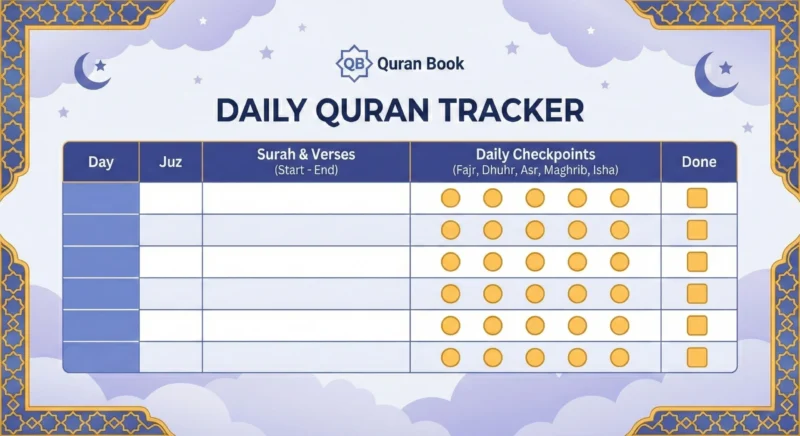
    • 📊 Progress tracking spreadsheets – Visual representation of your journey
    • 👥 Accountability partner check-ins – Share daily progress with a friend or family member

    6 Join a Community or Study Circle

    Quran Khatam community - virtual study circle for Ramadan Quran completion
    An image showing diverse Muslims engaged in online Quran learning, representing the community aspect of achieving Khatam Quran during Ramadan through group study.

    There’s profound wisdom in learning together. Group accountability significantly increases completion rates, and virtual halaqas (study circles) make this accessible regardless of your location. At Quran Book Academy, our live classes create a supportive community where students encourage each other through the Ramadan journey.

    “No people gather in a house of Allah, reciting the Book of Allah and studying it together, except that tranquility descends upon them, mercy covers them, angels surround them, and Allah mentions them to those near Him.”

    — Sahih Muslim, 2699

    The Prophetic tradition emphasizes learning together, and modern research confirms that social support is one of the strongest predictors of goal achievement. Whether you join an online community, a local mosque program, or simply partner with a friend, don’t underestimate the power of collective motivation.

    Connect with our community: YouTube Channel | Telegram Channel

    7 Build Flexibility for Difficult Days

    Life happens. Work emergencies, family obligations, health issues, or simple exhaustion may disrupt even the best-laid plans. Instead of letting one missed day derail your entire Quran Khatam goal, build flexibility into your system from the start.

    • Plan for catch-up days: Designate Fridays or weekends as buffer days
    • Permission to adjust: Reading half a Juz on hard days is better than nothing
    • “2 Juz days” strategy: Make up missed readings on days with more energy
    • Grace over perfection: Progress matters more than perfect adherence

    💡 Remember: Even if you don’t complete the full Quran, every single ayah you read is rewarded. Allah sees your effort, not just your finish line.

    Common Mistakes That Derail Your Ramadan Quran Goals

    Awareness of common pitfalls helps you avoid them. Here are the five most frequent mistakes we see students make when trying to complete their Quran reading during Ramadan:

    1. 1
      Starting too fast, burning out by week 2 — Enthusiasm in the first days leads to unsustainable pace
    2. 2
      No fixed reading time — Relying on “whenever I have time” rarely works
    3. 3
      Perfectionism paralysis — Stopping completely because of mispronunciation fears
    4. 4
      Isolation — Trying to do it completely alone without support
    5. 5
      Neglecting Tajweed — Prioritizing speed over quality of recitation

    This is exactly why structured learning with qualified teachers makes the difference. Our Tajweed-focused approach ensures you’re reading correctly while maintaining pace. You don’t have to choose between speed and accuracy—proper technique actually makes reading faster over time.

    What If You Can’t Complete the Entire Quran?

    Let’s address this important question with honesty and compassion. Not everyone can realistically finish the entire Quran in 30 days, and that’s perfectly okay. What matters is sincere effort and consistent worship.

    “The most beloved deeds to Allah are those done consistently, even if they are small.”

    — Sahih Al-Bukhari, 6464

    Consider these alternative goals based on your circumstances:

    Goal Daily Commitment Total Pages
    Full Quran 20 pages/day 604 pages
    Half Quran 10 pages/day 302 pages
    Quarter Quran 5 pages/day 151 pages
    Juz Amma Focus 2-3 pages/day 37 pages (with deep understanding)

    A half-Quran goal (15 Juz) is still immensely blessed. Some students choose to read fewer pages but with deeper reflection and understanding. Others focus on memorizing Juz Amma with proper Tajweed. Quality and consistency often matter more than quantity.

    Frequently Asked Questions

    How many pages of Quran should I read daily in Ramadan?

    To complete the Quran in Ramadan, read approximately 20 pages (1 Juz) per day. This equals about 4 pages after each of the 5 daily prayers, taking 30–45 minutes total depending on your reading speed. Beginners should allow more time and may consider starting with 10 pages daily.

    Can beginners complete Quran in Ramadan?

    Yes, beginners can complete the Quran in Ramadan with proper planning. Beginners should allow 60–90 minutes daily and may benefit from following along with audio recitation. Starting with a qualified teacher before Ramadan helps build confidence and proper pronunciation. Our Academy offers pre-Ramadan preparation courses specifically designed for this purpose.

    What is the best time to read Quran during Ramadan?

    The best time to read Quran during Ramadan is after Fajr prayer, when the mind is fresh and distractions are minimal. Other effective times include after each of the five daily prayers, during the last third of the night, and after Taraweeh prayers. Choose the time that aligns best with your natural energy patterns.

    How can I read Quran faster without losing quality?

    To read Quran faster while maintaining quality, practice consistent daily reading to build fluency, use your finger to track lines, minimize subvocalization for familiar passages, and learn proper Tajweed rules to avoid hesitation. Audio recitation can also help establish natural reading rhythm. Speed comes naturally with practice—don’t sacrifice accuracy for pace.

    Is it okay to read Quran in English during Ramadan?

    While reading the Arabic Quran holds the primary reward for recitation, reading the Quran in English is beneficial for understanding. Many scholars recommend reading Arabic text alongside the translation to gain both the reward of recitation and the benefit of comprehension. The goal is connection with Allah’s words in whatever form is most meaningful to you.

    What is Khatam Quran and why is it important?

    Quran Khatam completion - how to finish Quran in Ramadan successfully
    A celebratory, peaceful image representing the achievement of completing Quran Khatam, inspiring readers to begin their journey of reading Quran during Ramadan.

    Khatam Quran means completing a full reading of the entire Quran from Al-Fatiha to An-Nas. It’s particularly significant during Ramadan because the Prophet ﷺ completed the Quran with Jibreel every Ramadan, and twice in his final year. This practice connects Muslims worldwide in a blessed tradition that has continued for over 1,400 years.

    Start Your Ramadan Quran Journey with Expert Guidance

    Completing the Quran in Ramadan doesn’t have to be a solo struggle. At Quran Book Academy, we’ve helped thousands of students—from complete beginners to intermediate readers—achieve their Ramadan Quran goals through our structured, supportive approach.

    What You Get with Our Free Trial:

    • One-on-one live session with a certified Quran teacher via Zoom
    • Personalized assessment of your current reading level
    • Custom Ramadan reading plan tailored to your schedule
    • Introduction to our LMS tracking system
    • No commitment, no pressure—just pure learning

    🎯 This Ramadan, don’t just hope to complete the Quran—prepare to succeed.

    Book Your Free Trial Lesson Now

    Also explore: Tajweed Course for Beginners

    Learn More

    Continue your Quran learning journey with these helpful resources:

    References

    Hadith Collections

    • Sunnah.com — Authentic Hadith collections including Sahih Al-Bukhari, Sahih Muslim, and Jami’ at-Tirmidhi

    Quran Resources

    • Quran.com — Digital Quran with translations and audio recitations
    • Tarteel AI — AI-powered Quran recitation assistant

    Community Resources

    📖 Quran Book Academy

    Helping Muslims worldwide connect with the Quran through quality online education.

    © 2026 Quran Book Academy. All rights reserved.