The Beauty of Islamic Greeting
The Islamic greeting “Assalamu Alaikum” (السلام عليكم) means “Peace be upon you” and represents one of the most beautiful expressions of goodwill in any language. This traditional Muslim greeting creates an instant bond of peace, respect, and brotherhood between people, regardless of their background. When you learn how to greet in Islam, you are not merely learning words—you are embracing a spiritual practice that has connected hearts for over 1,400 years.
If you have ever felt hesitant to say Assalamu Alaikum because you worried about mispronouncing it or responding incorrectly, you are not alone. Many people, both Muslims and non-Muslims alike, share this concern. Understanding how to say hello in Arabic properly can feel daunting at first, but this guide will break down every aspect of the Islamic greeting into simple, manageable steps—so you can greet with confidence and spiritual intention.
The Quran itself emphasizes the importance of greeting others with peace:
“When you are greeted with a greeting, greet in return with what is better than it, or at least return it equally.
— Quran 4:86
What Does “Assalamu Alaikum” Mean?
Assalamu Alaikum (السلام عليكم) is the standard Islamic greeting meaning “Peace be upon you.” The phrase comes from the Arabic root “S-L-M” (س ل م). “Salam” relates to peace, safety, and wellbeing; “Islam” means submission and surrender to Allah; and a “Muslim” is one who submits to Allah. These words share the same Arabic root, but they do not have the same definition. When you understand what does Assalamu Alaikum mean, you realize it is not just a greeting—it is a prayer, a supplication (dua) that you offer to the person you are addressing.
The word “Salam” (سلام) means peace, while “Alaikum” (عليكم) means “upon you.” Together, they form a powerful wish for the other person’s wellbeing, safety, and spiritual peace. This is why the Islamic greeting holds such deep significance in Muslim communities worldwide.
✦ Three Common Forms of the Islamic Greeting
Jamiʿ at-Tirmidhi 2689 reports three forms of the greeting and mentions ten, twenty, and thirty rewards respectively. See the narration at Jamiʿ at-Tirmidhi 2689.
What Are the 3 Ways to Greet in Islam?
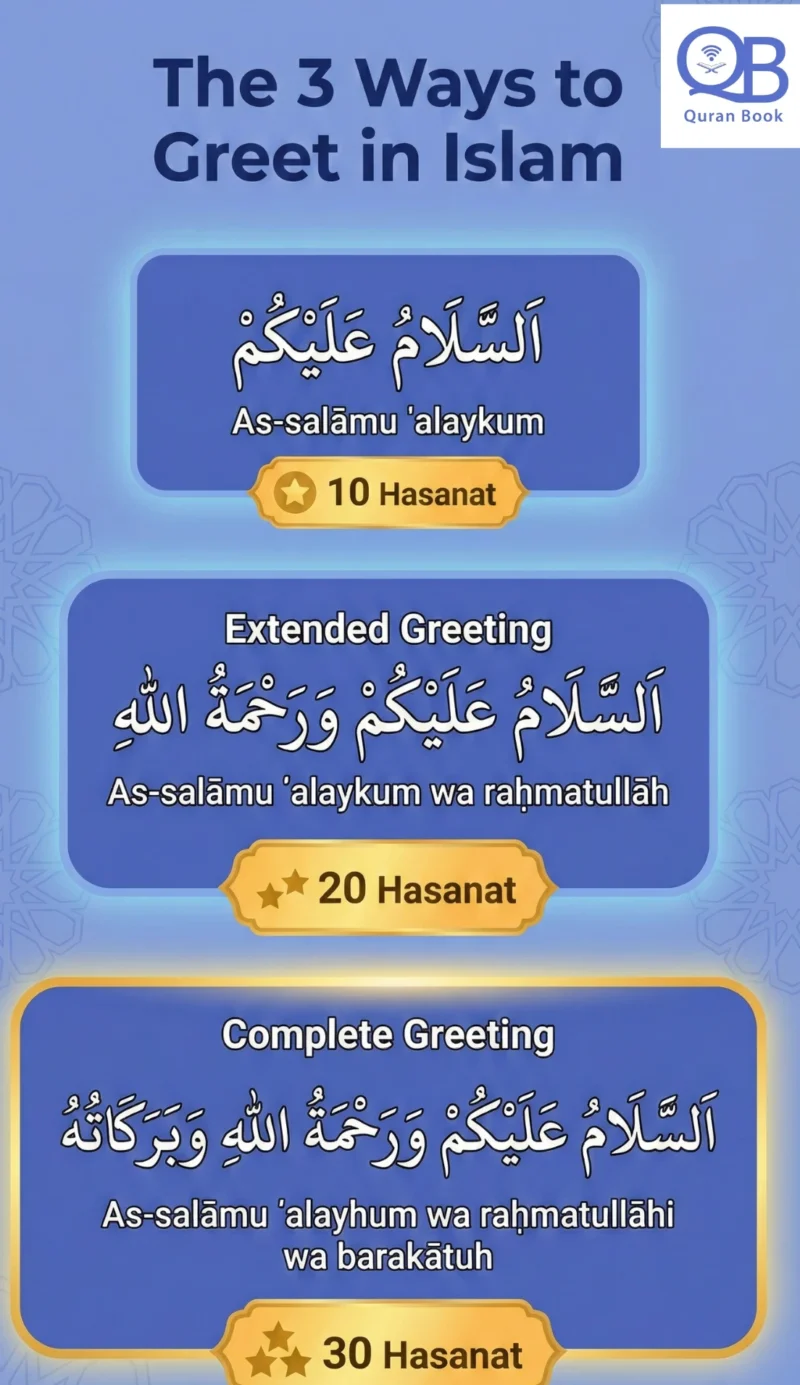
The three ways to greet in Islam are: (1) The short greeting: “Assalamu Alaikum” (Peace be upon you), (2) The medium greeting: “Assalamu Alaikum wa Rahmatullah” (Peace and mercy of Allah be upon you), and (3) The complete greeting: “Assalamu Alaikum wa Rahmatullahi wa Barakatuh” (Peace, mercy, and blessings of Allah be upon you). Each form of the Islamic greeting carries spiritual rewards. Learn more about Understanding Hasanat and Good Deeds.
The meaning of the narration, in paraphrase:
A man came to the Prophet (ﷺ) and said: ‘Assalamu Alaikum.’ The Prophet (ﷺ) responded and said: ‘Ten.’ Then another man came and said: ‘Assalamu Alaikum wa Rahmatullah.’ The Prophet (ﷺ) responded and said: ‘Twenty.’ Then another man came and said: ‘Assalamu Alaikum wa Rahmatullahi wa Barakatuh.’ The Prophet (ﷺ) responded and said: ‘Thirty.’
— Paraphrased meaning of Jamiʿ at-Tirmidhi 2689
How to Pronounce Assalamu Alaikum
To pronounce “Assalamu Alaikum” correctly, break it into syllables: “As-sa-LA-mu A-LAY-kum.” Emphasize the “LA” in both words. The ending should sound like a soft “kum,” not a harsh sound. Learning how to say hello in Arabic becomes much easier when you master each syllable separately.
✦ Syllable Breakdown
⚠ Common Mistakes to Avoid
- Do not rush the greeting—take your time with each syllable
- Do not skip the “wa” in extended versions
- Pronounce each Arabic letter distinctly for clarity
How to Respond to Assalamu Alaikum
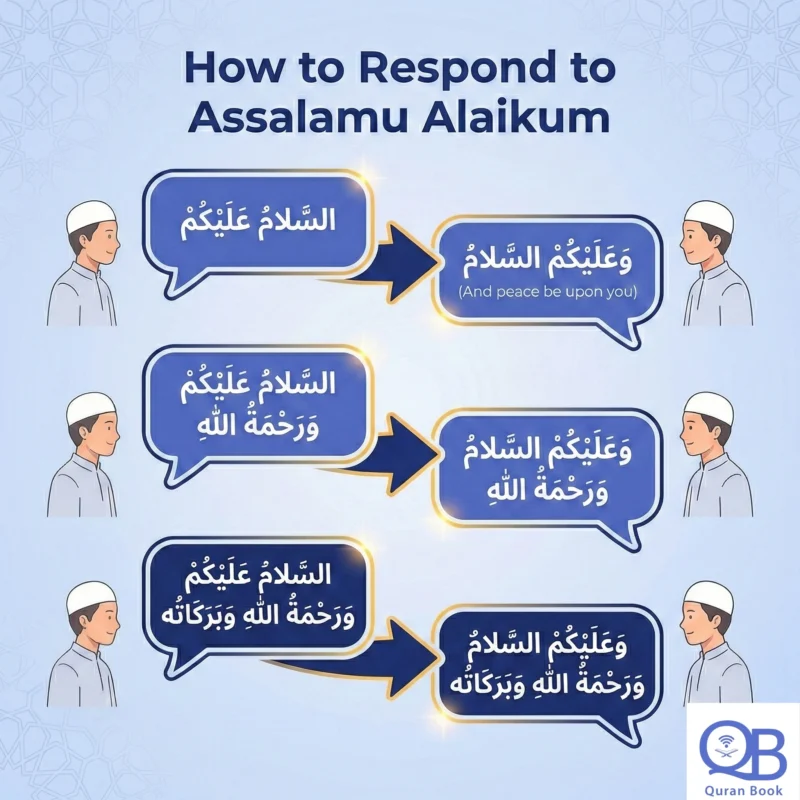
The proper response to “Assalamu Alaikum” is “Wa Alaikum Assalam” (وعليكم السلام), meaning “And upon you be peace.” For a more complete response, say “Wa Alaikum Assalam wa Rahmatullahi wa Barakatuh” to return the Islamic greeting with equal or greater blessings. Knowing how to respond to Assalamu Alaikum is essential for proper Islamic etiquette.
✦ Response Table
Returning the Islamic greeting is obligatory, and the response should be clear and audible. When the Salam is directed to one Muslim, responding is that person’s individual obligation. When it is directed to a group, a response from one member of the group may fulfil the obligation on behalf of the others. Quran 4:86 instructs Muslims to return a greeting with one that is equal or better, so responding to a short Salam with a longer form follows that instruction.
✦ How to Respond in Text Messages
- Full form: Wa Alaikum Assalam wa Rahmatullahi wa Barakatuh
- Common abbreviations: W.S., WSWR, or simply “Wa Alaikum Assalam”
- Emojis: 🤲 can accompany digital greetings
Islamic Phrases and Duas for Different Occasions
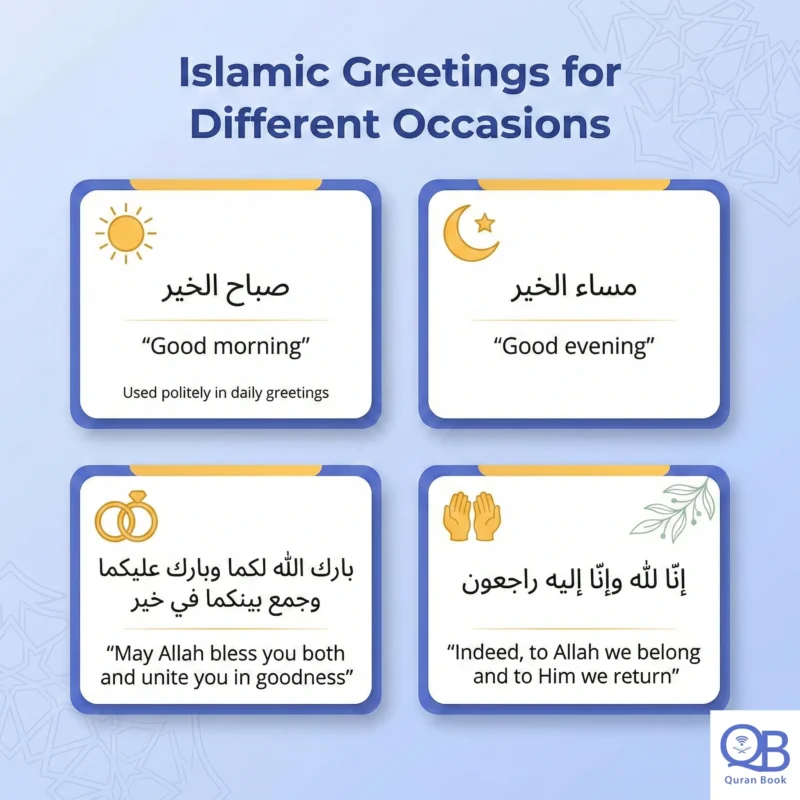
Different occasions have their own Islamic phrases and duas. Salam remains the Islamic greeting; alongside it, Muslims say “Sabah al-Khair” (صباح الخير) for good morning, recite the Quranic Istirjaʿ “Inna lillahi wa inna ilayhi rajiʿun” (إنا لله وإنا إليه راجعون) when a calamity occurs, and offer a dua such as “Barakallahu laka, wa baraka ʿalayka, wa jamaʿa baynakuma fi khayr” for newlyweds. Each phrase carries a specific meaning and shows how to respect Muslim culture and beliefs appropriately. Explore more Essential Arabic Phrases.
✦ Common Islamic Phrases and Duas for Different Occasions
✦ Notes on These Phrases
Visiting the sick: “La ba’sa, tahurun in sha Allah” (No harm, may it be a purification, if Allah wills) is a Prophetic supplication said when visiting a sick person, not a form of Islamic greeting. It is authentically reported in Sahih al-Bukhari; see Riyad as-Salihin 907. It is a supplication and a hope, not a guarantee about the outcome of any particular illness.
Sneezing: a Muslim says “Yarhamuk Allah” to the sneezer when the sneezer says “Alhamdulillah.” Tashmit is not an unconditional response to every sneeze.
Istirjaʿ: “Inna lillahi wa inna ilayhi rajiʿun” is the Quranic phrase recited when a calamity occurs. It is not, by itself, the complete way of consoling a grieving family. Offering condolences also includes kind words, practical support, encouragement to be patient, and an appropriate dua — for example, asking Allah to forgive and have mercy on a deceased Muslim, and to grant the family patience. No one can state with certainty the final destination of a particular person.
Newborn congratulation: no single fixed wording for congratulating parents on a newborn is established in an authentic Prophetic hadith, although scholars have mentioned suitable supplications, including the well-known wording above. It is a permissible congratulation and dua, and is not attributed here to the Prophet (ﷺ) as a fixed Sunnah formula.
Can Non-Muslims Say Assalamu Alaikum?
Yes, a non-Muslim may say “Assalamu Alaikum” as a respectful greeting, and Muslims generally appreciate the respectful intention behind it. This question about how to greet a Muslim as a non-Muslim is one of the most common inquiries we receive. Three related matters are often mixed together, so it helps to separate them: a non-Muslim using the words respectfully, a Muslim initiating the specific Islamic Salam to a non-Muslim, and how a Muslim responds when a non-Muslim offers Salam.
The rulings on a Muslim initiating the formal Salam to a non-Muslim, and on the precise wording of the response, contain jurisprudential detail and are discussed by scholars rather than settled by a single universal rule. Authentic narrations instruct Muslims to say “Wa Alaikum” (“and upon you”) when the People of the Book offer the greeting — see Sahih Muslim 2167a — while scholars discuss further details when the greeting is clearly and peacefully pronounced. For everyday courteous interaction, neutral greetings such as “Hello” or “Good morning” may also be used; these are ordinary courteous words and are not the Islamic Salam.
The greeting itself is a prayer for peace. When non-Muslim friends, colleagues, or neighbours use the Islamic greeting, most Muslims appreciate the effort and respect shown. Islam encourages kindness, justice, and good relations with people who are peaceful towards Muslims.
“Allah does not forbid you from those who do not fight you because of religion… from being kind to them and acting justly toward them.”
— Quran 60:8
This verse establishes the general principle of kindness and justice towards non-hostile non-Muslims. It does not, by itself, settle the specific jurisprudential rulings concerning initiating the formal Islamic Salam or the exact wording used when returning it.
Master Islamic Greetings with The Academy Method
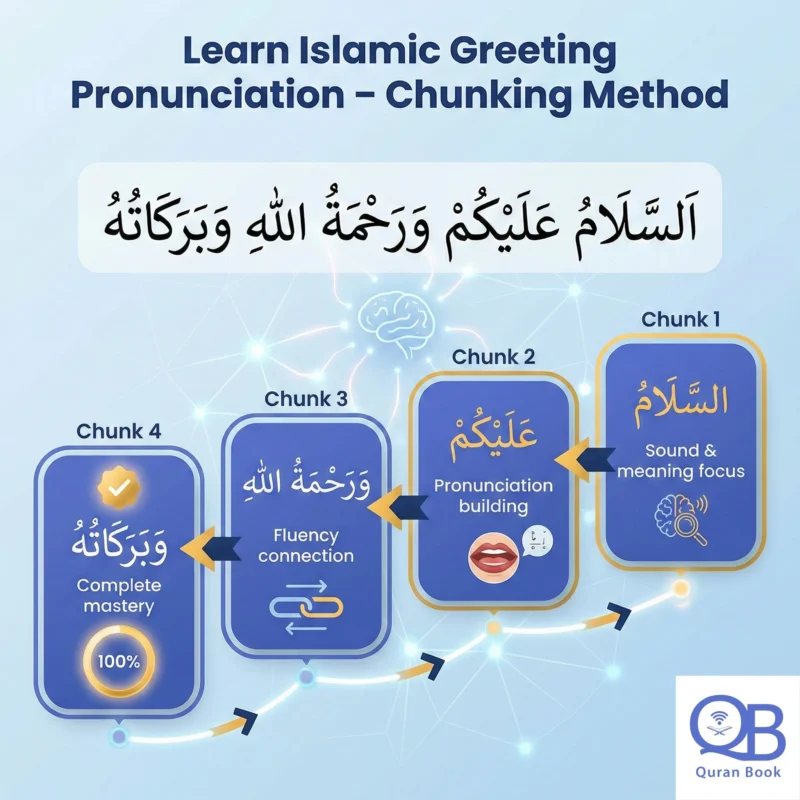
The Academy Method at Quran Book Academy uses cognitive “chunking”—a proven psychological technique that breaks complex Arabic phrases into small, memorable units. Breaking a long Arabic phrase into smaller chunks can make it easier to practise and remember, especially when combined with listening, repetition, teacher feedback, and consistent practice. Progress depends on the effort and regularity each learner brings.
At Quran Book Academy, we understand that learning Arabic greetings and Quranic Arabic can feel overwhelming—especially if you have never studied the language before. That is why we developed The Academy Method, a teaching approach rooted in educational psychology and designed specifically for non-Arabic speaking Muslims in the USA, Canada, UK, and Australia. Learn more about Our Teaching Methodology.
✦ How The Academy Method Works
The human brain can only process 4-7 pieces of new information at a time. When you try to learn “Assalamu Alaikum wa Rahmatullahi wa Barakatuh” all at once, your working memory becomes overloaded. Our method breaks this phrase into psychological “chunks” that are easier to remember and perfect:
✦ Our Tech-Stack for Success
💡 Addressing Your Fears
We know what holds you back. Fear of mispronunciation. Worry about looking foolish. Concern about finding time in your busy schedule. Our teachers help students overcome these common barriers. Every journey begins with a single step—and that first step is easier than you think.
Frequently Asked Questions
Start Your Arabic Learning Journey Today
You have just learned the beauty, meaning, and proper pronunciation of the Islamic greeting. But this is only the beginning of your journey into the rich world of Arabic and Quranic learning.
At Quran Book Academy, we specialize in helping non-Arabic speakers like you master Quranic recitation, Arabic pronunciation, and Islamic knowledge—all from the comfort of your home. Whether you want to perfect your Islamic greeting or memorize the entire Quran, we have a program designed for you.

📚 Learn More
Expand your knowledge with these valuable resources from Quran Book Academy:
📑 References & External Links
Sources for the Narrations and Rulings Cited
- Jamiʿ at-Tirmidhi 2689 – The three forms of the greeting and the ten, twenty, and thirty rewards
- Sahih Muslim 2167a – Saying “Wa Alaikum” when the People of the Book offer the greeting
- Sunan Abi Dawud 2130 – The Prophetic dua for congratulating a newly married person
- Riyad as-Salihin 907 – The supplication said when visiting a sick person
- IslamWeb Fatwa 170629 (Arabic) – The ruling discussed concerning shaking hands with a non-mahram woman
Community
- Quran Book Academy Telegram – Join our community for daily Tajweed practice
السلام عليكم ورحمة الله وبركاته
Start Your Free Trial Today
Leave a Reply