

How to Make Wudu: 8 Easy Steps of Ablution for Beginners (2026 Guide)
Watch: How to Make Wudu Step by Step
Watch this practical demonstration, then use the written steps below as a reference while practising.
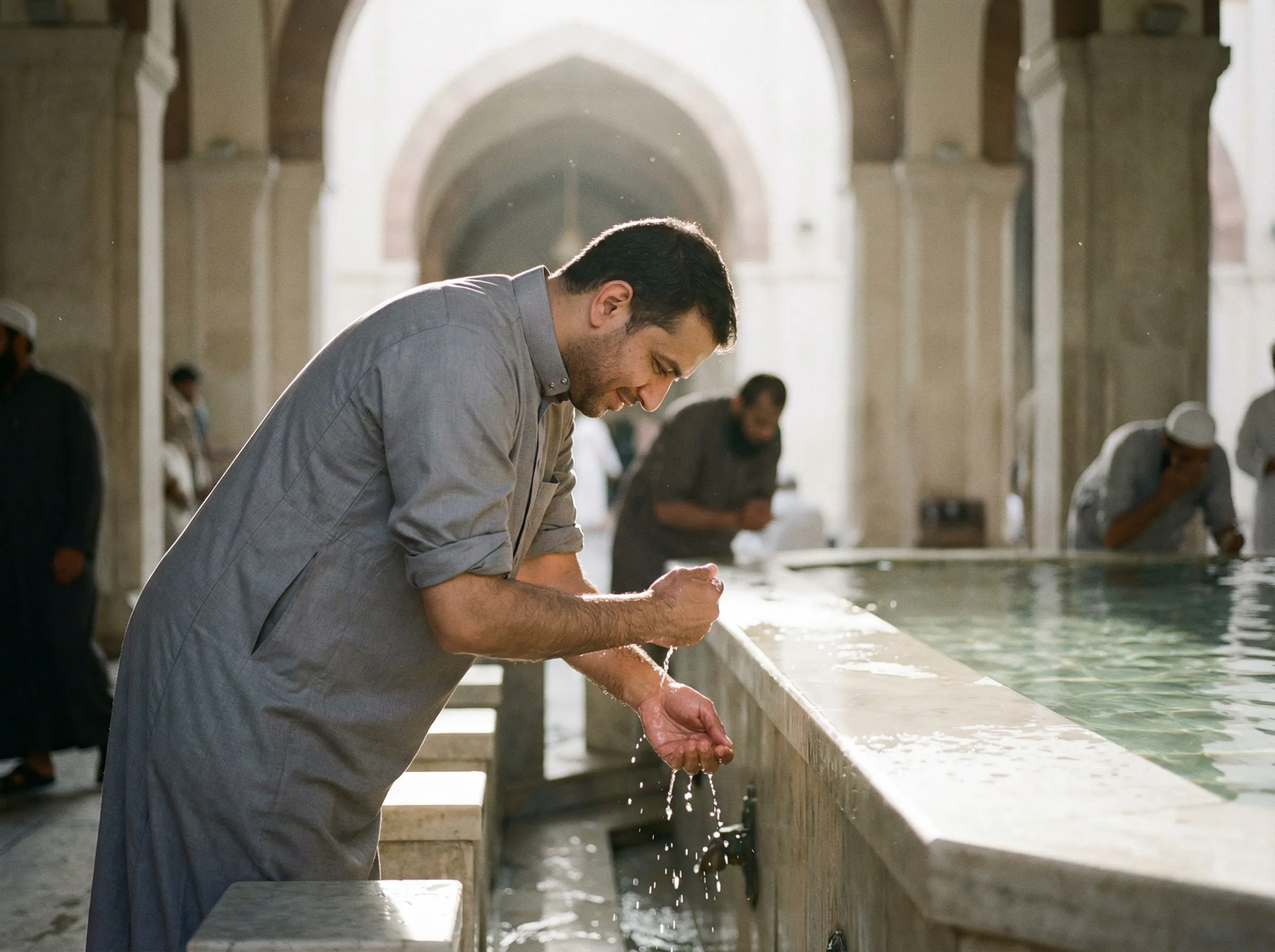
Learning how to make wudu can feel overwhelming when you’re a new Muslim or someone returning to practice — especially if you didn’t grow up learning it as a child. You might worry about doing it wrong, forgetting a step, or feeling embarrassed to ask. You’re not alone; adult converts and born Muslims across the USA, Canada, UK, and Australia look for this exact guide every day.
Here’s the truth: wudu is not complicated. It is a simple, beautiful act of purification that Allah made accessible to everyone, regardless of age, background, or experience. The fact that you’re here looking for answers shows sincerity — and that’s what matters most. This guide will walk you through all 8 steps of ablution with complete clarity, including the commonly forgotten step of wiping the ears. Whether you’re a complete beginner or brushing up on your knowledge, Quran Book Academy supports learners from different ages and backgrounds as they build confidence in their worship.
“O you who believe! When you rise for prayer, wash your faces and your hands up to the elbows…”
— Quran 5:6 · Quran.com
This verse from Surah Al-Ma’idah is the foundation of the steps of ablution we’ll explore below. Let’s begin.
Online Quran Classes for BeginnersWhat Is Wudu and Why Does It Matter?
Wudu (also spelled wudhu or wuḍūʾ) is the Islamic ritual of ablution — a specific washing of the body parts before prayer (salah). The wudu meaning comes from the Arabic root word for cleanliness and radiance. In Islam, wudu is a prerequisite for the five daily prayers and for touching the Quran. It consists of 8 specific washing and wiping steps performed in a set order.
But understanding what is wudu goes beyond just physical washing. Ablution in Islam is a holistic act — it purifies the body and the soul simultaneously. Every time a wudu Muslim washes their hands, face, and feet, they are symbolically shedding minor sins and preparing to stand before their Creator in a state of cleanliness and humility.
It’s important to note that wudu in Islam is classified as the “minor ablution” (al-wudu al-asghar). It is different from ghusl (the major ablution), which involves washing the entire body and is required after specific states such as sexual intercourse or menstruation. For daily prayers, wudu is sufficient when only minor ritual purification is required. Ghusl is required after major ritual impurity, such as janabah or after menstruation has ended. In circumstances where Islamic conditions for tayammum are met, dry purification may be used instead.
“Cleanliness is half of faith.”
— Sahih Muslim 223 · Sunnah.com
The Spiritual Importance of Wudu in Islam
Wudu is far more than hygiene. It is a spiritual reset — a moment of mindfulness before you stand in conversation with Allah. Each time you perform wudu, you are transitioning from the noise of daily life into a sacred state of worship. This is why learning how to make wudu properly matters so deeply.
“My ummah will be called on the Day of Resurrection with bright faces and bright hands and feet from the traces of wudu.”
— Sahih al-Bukhari 136 · Sunnah.com
Imagine that — the water you use today for ablution becomes light on your face, hands, and feet on the Day of Judgment. This is the reward Allah has prepared for those who take wudu seriously and perform it with sincerity.
“Indeed, Allah loves those who are constantly repentant and loves those who purify themselves.”
— Quran 2:222 · Quran.com
Wudu is your gateway to being among those beloved to Allah. Every drop of water that falls from your limbs during ablution washes away minor sins, as authentic hadith narrations confirm.
Importance of Prayer in IslamWhat You Need Before Making Wudu (Prerequisites)
Before you begin learning how to perform wudu, make sure you have the following in place:
“Actions are judged by intentions…”
— Sahih al-Bukhari 1 · Sunnah.com
Without a sincere intention, the physical steps of wudu alone are not sufficient for valid worship. Niyyah is what transforms a routine act of washing into a powerful spiritual practice.
How to Make Wudu Step by Step — The 8 Steps of Ablution ⭐
To make wudu step by step, follow these 8 steps of ablution in order: wash your hands, rinse your mouth, clean your nose, wash your face, wash your arms, wipe your head, wipe your ears, and wash your feet. Each step is performed with the intention of purifying yourself before prayer.
Here is the complete wudu step by step process:
Start with the right hand, then the left. Make sure water reaches between the fingers and covers the entire hand up to and including the wrist. This step removes physical impurities and prepares you for the remaining steps of wudu.
Take water into your mouth with the right hand, swirl it around thoroughly, and spit it out. This is called “madmadah.” Ensure the water reaches all areas inside the mouth, including the gums and between the teeth. Using a miswak (tooth stick) or toothbrush before this step is a recommended Sunnah.
Sniff water gently into the nostrils with the right hand and blow it out with the left hand. This is called “istinshaq” (inhaling) and “istinthar” (expelling). Be gentle — there’s no need to inhale water deeply. Just enough to cleanse the inner part of the nostrils.
Wash from the hairline to the chin, and from ear to ear. Ensure water covers every part of the face, including the eyebrows and the area around the nose. If you have a beard, run wet fingers through it so water reaches the skin beneath. This is one of the most important steps of ablution.
Wash your right hand and arm from the fingertips all the way up to and including the elbow, then repeat with the left. Make sure water reaches your fingers, palms, wrists, forearms, and elbows. Even though you washed your hands at the beginning, wash them again as part of this obligatory step. This is one of the most common mistakes beginners make when learning how to make wudu. Make sure no dry patches remain on the forearms or around the elbow joints. IslamWeb: washing the hands with the arms.
Wet your hands and wipe them from the front of the head (hairline) to the back of the head (nape of the neck), then return them to the front. This step is done only once, not three times. You do not need to drench your hair — a light wipe with wet hands is sufficient.
Immediately after wiping the head, wipe the ears. Insert the tips of your index fingers into the ear openings and use your thumbs to wipe the back of the ears simultaneously. The ears are considered part of the head in Islamic jurisprudence, but they are a distinct step that many beginners forget.
The Prophet’s manner of wudu includes wiping the inner ears with the index fingers and the outer ears with the thumbs. (Paraphrase)
— Sunan Abu Dawud 135 · Sunnah.com
Start with the right foot, then the left. Use your little finger to wash between the toes thoroughly. Make sure water reaches the ankles, the soles of the feet, and the heels.
“Woe to the heels from the Hellfire!”
— Sahih al-Bukhari 165 · Sunnah.com
Understanding the Details: The order of these steps (known as “tartib”) is essential for a valid wudu according to the Shafi’i and Hanbali schools, while the Hanafi school is more lenient on exact ordering. Washing the washed limbs up to three times is Sunnah. Washing once is sufficient when all obligatory acts are fulfilled. The head and ears are wiped rather than washed.
The four major schools of Islamic jurisprudence — Hanafi, Shafi’i, Maliki, and Hanbali — agree on the core obligations of wudu, while they differ in the details and in how some acts are classified as obligatory (fard) or recommended (sunnah). Some scholars count the ears as part of the head-wiping step, while others list them separately. We’ve listed them as a separate step here because beginners frequently forget them, and giving the ears their own step ensures nothing is missed.
As a beginner, do not stress about perfection. Allah values your sincerity and consistency far more than flawless technique. Learn the 8 steps of wudu, practice them regularly, and trust that your effort is accepted.
In Sahih al-Bukhari 159, Uthman ibn Affan demonstrated wudu by washing the prescribed limbs three times and wiping his head. He then related a statement of the Prophet ﷺ about this manner of wudu. [Paraphrase of Sahih al-Bukhari 159]
— Sahih al-Bukhari 159 · Sunnah.com
Quick Wudu Check: Test What You Learned
Answer these five questions to check your understanding of the basic wudu steps.
Show answer
Show answer
Show answer
Show answer
Show answer
Dua After Wudu — What to Say When You Finish
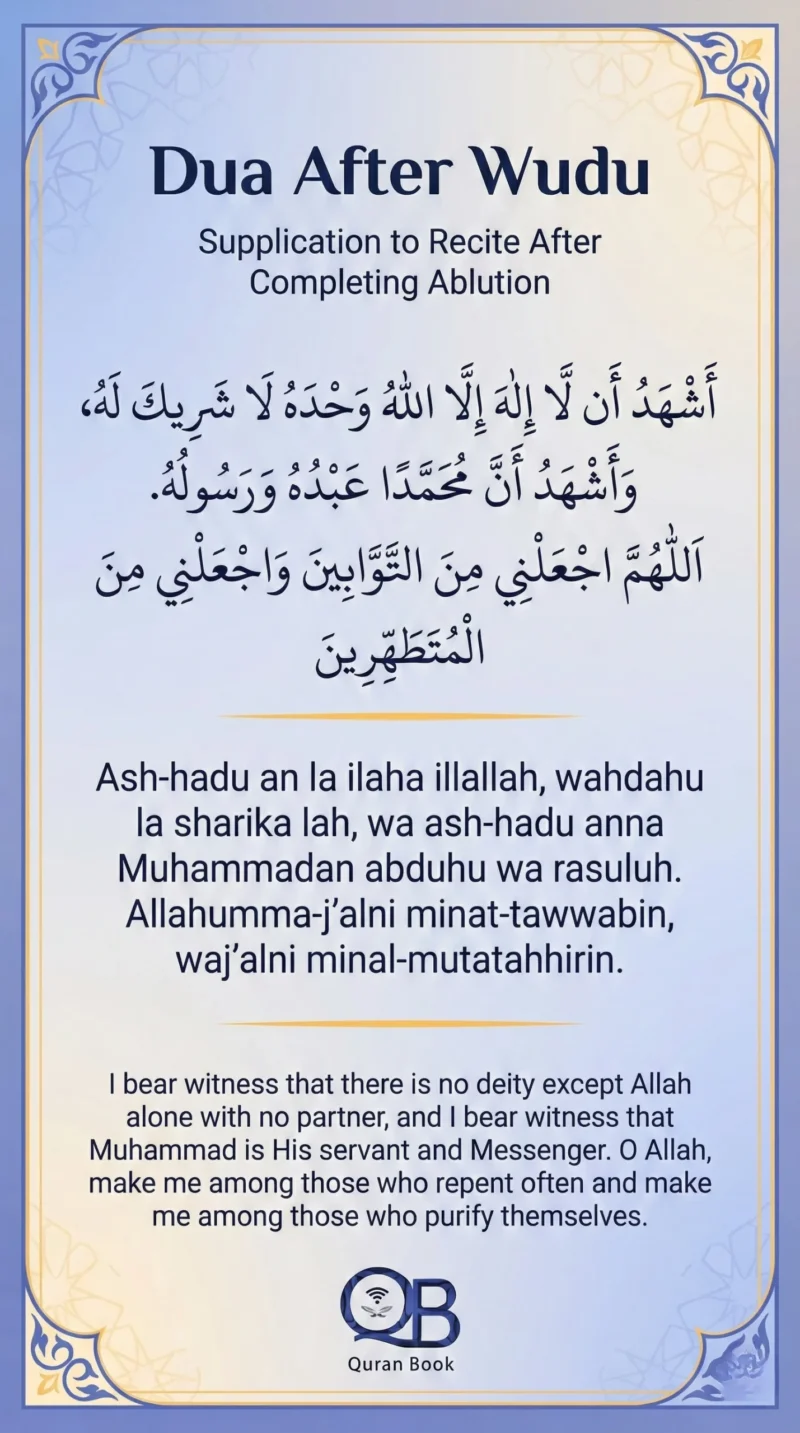
After completing wudu, the recommended dua is:
The testimony of faith after wudu is authentically reported in Sahih Muslim 234a. The additional supplication, “Allahumma-j’alni minat-tawwabin, waj’alni minal-mutatahhirin,” appears together with the testimony in Jami’ at-Tirmidhi 55. Scholars differed over the authenticity of this additional wording; the published grading of the Tirmidhi report on Sunnah.com is Da’if.
“None of you performs wudu and does it perfectly, then says: ‘I bear witness that there is no god but Allah alone, with no partner, and I bear witness that Muhammad is His servant and messenger,’ except that the eight gates of Paradise are opened for him.”
— Sahih Muslim 234a · Sunnah.com
“Allahumma-j’alni minat-tawwabin, waj’alni minal-mutatahhirin” — “O Allah, make me among those who repent and make me among those who purify themselves.”
— Jami’ at-Tirmidhi 55 · Sunnah.com
Try to make this recommended dua a regular habit after wudu, while remembering that it is not a condition for the validity of your ablution.
What Breaks Wudu? Common Nullifiers and Scholarly Differences
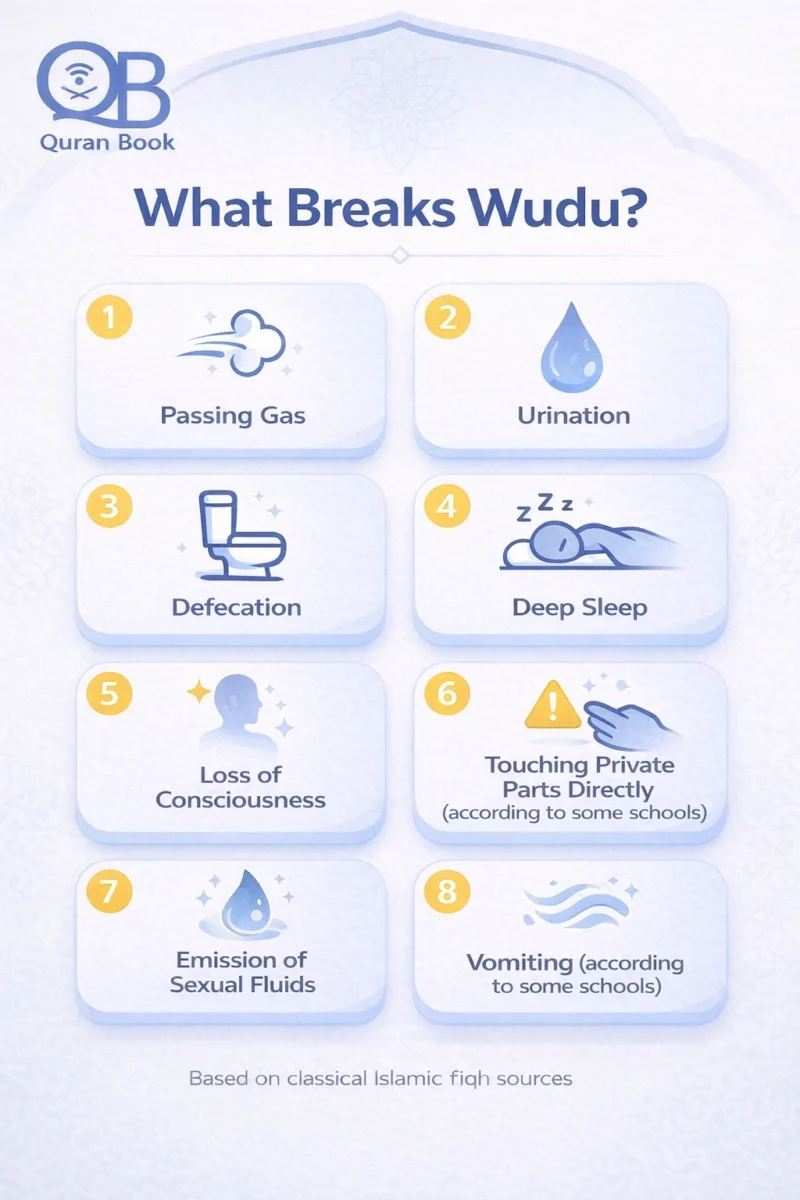
Some matters are treated as nullifiers of wudu by scholars across the schools, while others are the subject of recognised scholarly difference. The list below separates the two so that beginners do not assume every item carries the same ruling. Where scholars differ, follow the school of Islamic law you adhere to, or ask a qualified scholar about your own situation.
A. Nullifiers broadly agreed upon
B. Matters in which scholars differ
These differences are recognised positions held by qualified scholars, and a beginner is not expected to weigh the evidence alone. Practise according to the school you follow, and ask a qualified scholar when your own case is unclear or unusual.
Frequently Asked Inline Questions
“Allah does not accept the prayer of anyone who has broken their wudu until they perform wudu again.”
— Sahih al-Bukhari 6954 · Sunnah.com
Wudu for Women — Is There a Difference?
The basic manner of wudu is the same for women and men; there is no separate method of ablution for women. When it comes to the head-wiping step (Step 6), the starting point is that a woman wipes her head directly, according to the amount considered sufficient in the school of Islamic law she follows.
The majority of jurists do not allow wiping over a headscarf instead of the head in the ordinary situation. Some scholars have permitted wiping over the khimar under certain conditions or in cases of hardship, such as difficulty in removing and replacing it. This is a concession discussed with conditions, not a general ruling for every situation, so a woman whose circumstances are unusual should ask a qualified scholar about her own case.
Here are a few additional notes specifically for women learning how to make wudu:
The Academy Method — How Quran Book Academy Teaches Wudu & Islamic Foundations

At Quran Book Academy, we don’t just hand you a textbook — we walk beside you. Learning how to make wudu is often the first step in a much larger journey of Islamic education, and our Academy Method is designed to make every step feel manageable, supportive, and rewarding.
As part of this article, we’ve also prepared a free “How to Make Wudu PDF” — a beautifully designed, printable reference card that you can keep in a clean, respectful place away from the toilet for daily use.
Ready to learn with a live teacher? Book your Free Trial Lesson today →
Download Your Free How to Make Wudu PDF
📥 Free Wudu Step-by-Step PDF
We’ve created a beautifully designed, printable How to Make Wudu PDF that you can download completely free. It includes all 8 steps of ablution with clear illustrations, the dua after wudu in Arabic and transliteration, and a quick-reference checklist of what breaks wudu.
Keep the guide in a clean, respectful place near the washing area, away from the toilet, especially because it includes a supplication mentioning Allah’s name.
Download Your Free Wudu PDFFAQ — People Also Ask About Wudu
How to take wudu step by step?
Can I pray without wudu if I showered?
What common wudu mistake did the Prophet ﷺ strongly warn against?
Can I kiss my wife if I have wudu?
Is touching the Quran without wudu a sin?
Does crying invalidate wudu?
What is the difference between the obligatory and recommended acts of wudu?
Does using lotion break wudu?
Start Your Quran Journey Today — Free Trial Lesson at Quran Book Academy

You’ve just learned how to make wudu — the first step toward a deeper connection with Allah. But why stop here? At Quran Book Academy, our teachers will guide you through wudu, prayer, Quran recitation with Tajweed, and full Islamic studies — all from the comfort of your home.
🎓 Book Your FREE Trial Lesson
Join students across the USA, Canada, UK, and Australia who started exactly where you are today.
Your journey toward confident worship begins with a single step — and you’ve already taken it by reading this guide.
Hafidha of the Quran · Arabic Language Graduate · Writer on Islamic Sciences
Jehad Mahmoud is a graduate of the Arabic Language department and a Hafidha of the Quran who writes Islamic educational content at Quran Book Academy.
She specialises in Quranic Arabic, Tajweed and the Sharia sciences, making complex topics accessible to English-speaking Muslim families.
She also holds credentials in Tajweed and Quranic sciences, supporting her educational work on worship, purification and Quran learning.
Her articles are educational, not fatwa. For a ruling on a specific personal situation, readers are advised to consult a qualified scholar or mufti.
Leave a Reply