Waqf and Ibtida: 7 Essential Rules for Flawless Quran Recitation
Master the art of stopping and starting in Quranic recitation — transform anxiety into spiritual flow with our comprehensive guide.
Start Your Free TrialIntroduction: Overcoming the Fear of Stopping

Does my breath run out too fast? Did I just negate a blessing?
If you have ever felt your heart race while reciting a long verse, worrying that stopping to breathe might accidentally distort the meaning of Allah’s words, you are not alone. For many non-Arabic speakers, the rules of Waqf and Ibtida (stopping and starting) can feel like a minefield. The anxiety of turning a compliment into an insult or negating a divine truth simply because you ran out of air is a very real struggle.
But here is the truth: Waqf and Ibtida are not designed to be a burden. They are the “breathing room” for your soul during recitation. They provide the roadmap that allows you to navigate the Quran’s vast meanings with grace and precision.
By the end of this guide, you will understand the roadmap of the Quran, allowing you to recite smoothly without anxiety. We will move past the fear and into a space of connection, ensuring that every pause you take honors the Divine message. Explore our psychology-based methodology that makes learning Tajweed intuitive and stress-free.
What is Waqf and Ibtida in Tajweed?
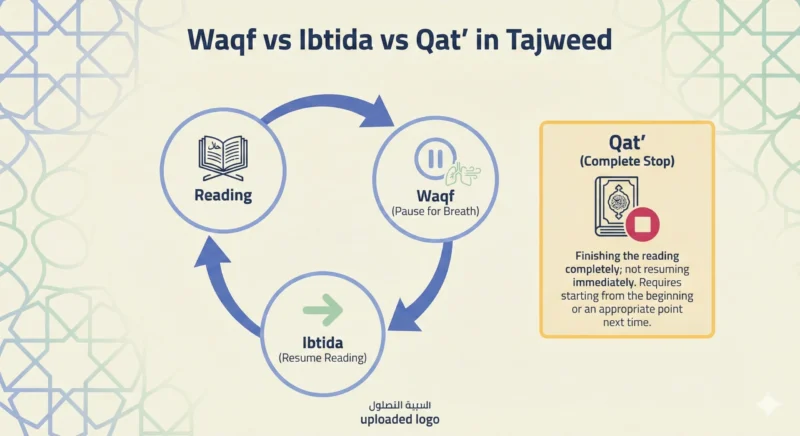
Waqf and Ibtida refer to the precise rules of stopping and starting in Quranic recitation.
This is the act of pausing the voice at the end of a word to take a breath, with the specific intention of continuing the recitation. It is not abandoning the reading; it is a strategic pause to refuel.
This is resuming the recitation from a correct starting point that preserves the linguistic and theological meaning of the verse.
Unlike Waqf, this is stopping the recitation completely to move on to another activity, usually done at the end of a passage or surah.
Understanding the distinction between a temporary breath (Waqf) and a final stop (Qat’) is the first step in mastering the flow of the Quran. If you are new to recitation, our Learn to Read Quran for Beginners course is the perfect starting point.
Why Meaning Matters: The Psychology of Recitation
Reciting the Quran is not merely a mechanical exercise of pronouncing letters; it is an act of intellectual and spiritual engagement. The connection between breath and meaning is profound. The Quran was revealed orally, and the Prophet Muhammad (PBUH) utilized pauses to group ideas together, making the message digestible for the listeners.
⚠ Critical Example: When we neglect the rules of Waqf and Ibtida, we risk fracturing the divine narrative. A classic example often cited by scholars involves the declaration of faith. If a reciter stops at “There is no god” (La ilaha) and does not continue to “…except Allah” (illa Allah), they have linguistically stated an atheistic concept. While the intention is rarely malicious, the impact on the listener and the integrity of the text is significant.
Learning these stopping rules is an act of Adab (respect) towards the Divine message. It builds cognitive fluency, allowing you to process the text in meaningful chunks rather than a breathless stream of sound. This is why our methodology focuses on the psychology of the learner—removing the panic of “running out of air” and replacing it with the confidence of knowing exactly where to rest.
The 3 Main Types of Waqf (Stopping)
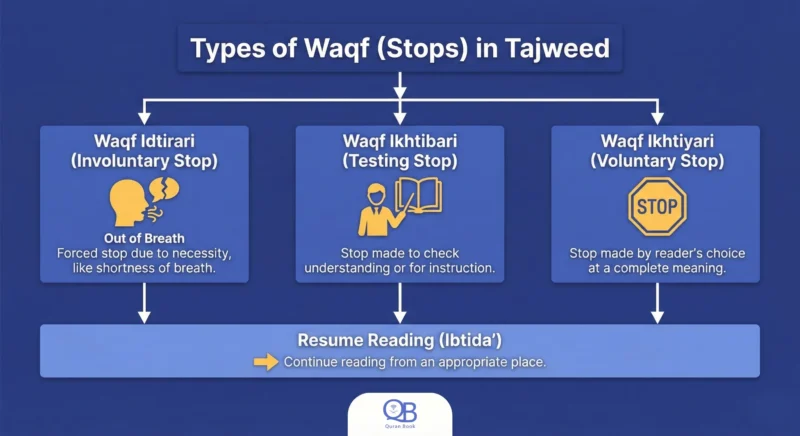
In the journey of Tajweed, not all stops are planned. Scholars generally categorize Waqf into three main types to help students handle different scenarios.
This occurs when you are forced to stop due to necessity. Perhaps you ran out of breath, sneezed, coughed, or simply forgot the next word.
This is a testing stop. It happens when a teacher (like Teacher Abdelrahman at our Academy) asks you to stop at a specific word to test your knowledge of how to end that word (e.g., how to handle the vowel signs when stopping).
This is the ideal stop. It is stopping by choice at a designated sign or the end of a verse because the meaning is complete. This is the goal of learning Waqf and Ibtida—to move from compelled stops to voluntary, meaningful pauses.
Decoding the Stop Signs in the Quran (The “How-To” Guide)
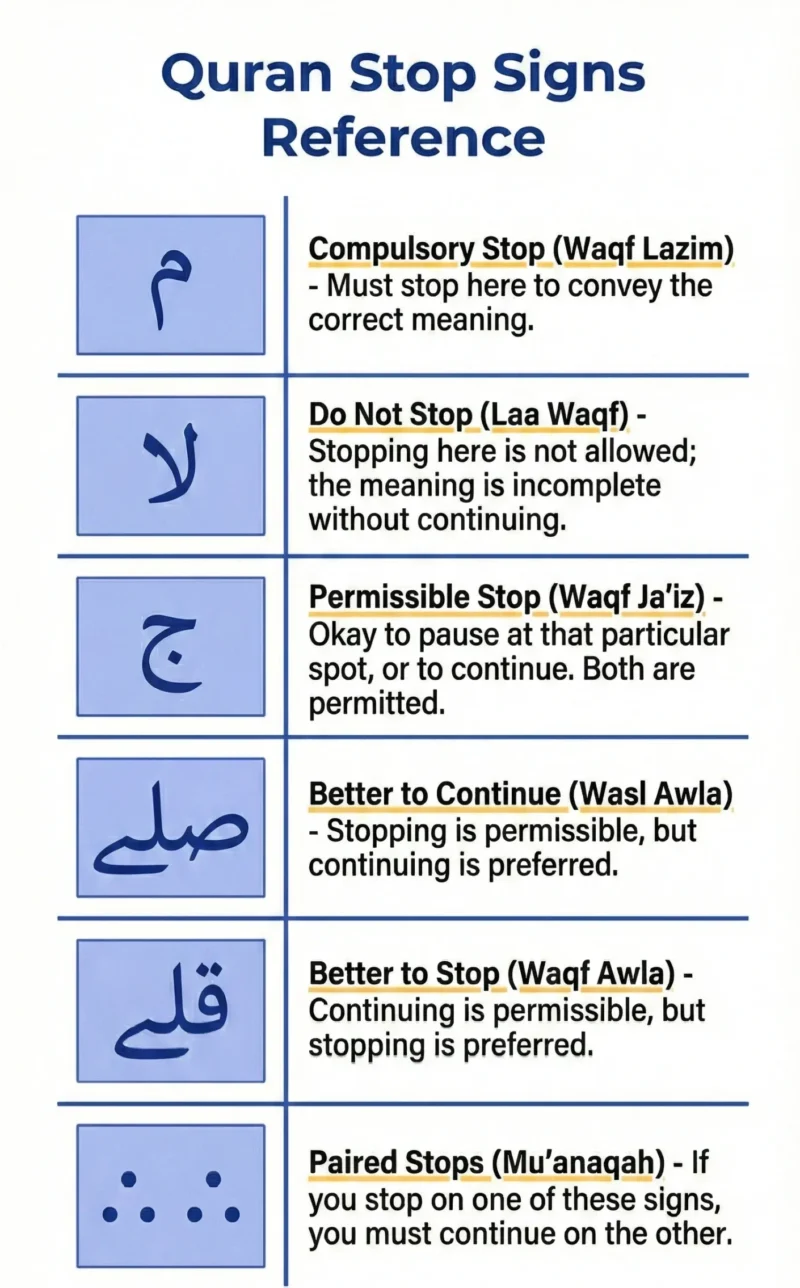
The Mushaf is filled with small symbols above the text. These are the traffic lights of your recitation. Mastering these stop signs in the Quran is essential for reciting with confidence.
Here is your essential guide to the Waqf signs meaning:
| Sign | Name | Meaning | Action |
|---|---|---|---|
| م | Waqf Lazim | Mandatory Stop | Must Stop. Continuing here changes the meaning significantly. |
| لا | La Waqf | No Stop | Do Not Stop. Keep reading; if you are forced to stop, you must backtrack. |
| ج | Waqf Ja’iz | Permissible Stop | You can stop or continue. It is a 50/50 choice, both are equally valid. |
| صلے | Al-Wasil Awla | Better to Continue | You are allowed to stop, but continuing is preferred for the flow of meaning. |
| قلے | Al-Waqf Awla | Better to Stop | You are allowed to continue, but stopping is preferred to highlight the meaning. |
| ∴ ∴ | Mu’anaqah | Paired Stop | Stop at ONE of the two signs, not both. If you stop at the first, do not stop at the second. |
The Academy Method: How We Teach Waqf and Ibtida
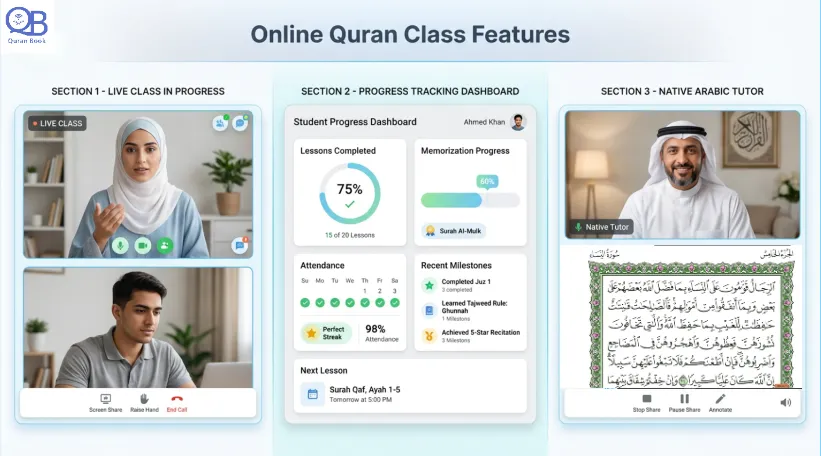
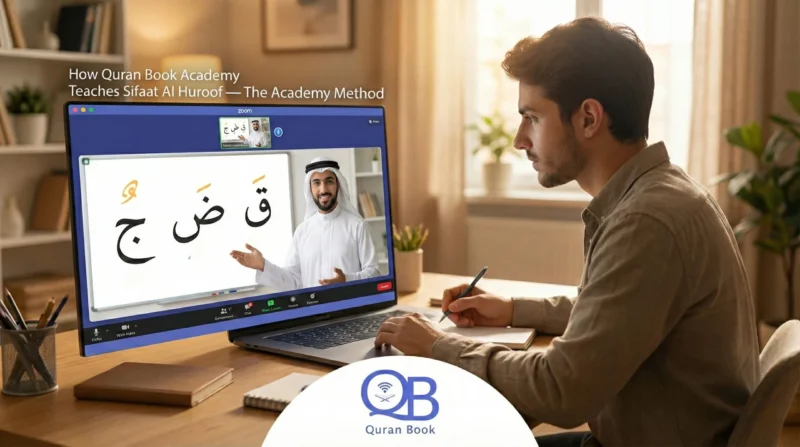
At Quran Book Academy, we understand that memorizing rules is different from applying them under pressure. That is why we use a psychology-based approach to teaching.
Cognitive overload is the enemy of learning. We break long, complex verses into manageable “chunks” for beginners. Instead of fearing the entire page, you focus on navigating from one stop sign to the next. This builds confidence and rhythm.
We leverage modern technology to ensure you aren’t just guessing:
Zoom: Our live sessions allow teachers to demonstrate breath control in real-time, showing you exactly where to inhale and exhale.
LMS & Gmail: We track your specific progress on stopping rules using our custom Learning Management System (LMS). After lessons, we send personalized feedback reports directly to your Gmail, helping you visualize your improvement week by week. You will see notes like, “Improved on Waqf Lazim, needs focus on Al-Wasil Awla.”
Quranic Evidence & Hadith

Our dedication to Waqf and Ibtida is rooted in the tradition of the Prophet (PBUH) and the commands of Allah.
The Quranic Command:
Allah (SWT) says in Surah Al-Muzzammil:
“And recite the Qur’an with measured recitation.”
— Surah Al-Muzzammil (73:4)
The term Tartil (measured recitation) encompasses the proper articulation of letters and the knowledge of stopping points.
The Prophetic Method:
Narrated by Umm Salamah (May Allah be pleased with her):
“The Prophet (ﷺ) used to pause his recitation verse by verse.”
— Hadith Reference (Sunnah.com)
This Hadith confirms that pausing is not a sign of weakness, but a Sunnah that clarifies the meaning and adds beauty to the recitation.
Common Learner Mistakes to Avoid
Even advanced students can fall into these traps. Being aware of them is half the battle.
Starting with “And” or “But”
A common mistake in Ibtida (starting) is beginning a sentence with a conjunction like “And” (Wa) without the preceding context. If you stop on a word, ensure your restart includes enough context to make sense.
The “Breathless” Rush
This is the most common anxiety-driven error. Students try to finish a long verse in a single breath, which leads to mumbling, loss of Tajweed, and eventual gasping. Remember, the stop signs are there to help you!
Ignoring the “Meem” (م)
Treating the Mandatory Stop (Waqf Lazim) as if it were optional is a critical error. This sign is a “Red Light”—you must stop to protect the creed and meaning of the verse.
FAQ: Frequently Asked Questions about Tajweed Stops
Conclusion & Call to Action

Mastering Waqf and Ibtida transforms your recitation from a struggle for air into a spiritual flow. It allows you to connect with the Quran as it was revealed—breath by breath, meaning by meaning.
You are capable of reciting flawlessly. Do not let the fear of making mistakes hold you back from the beauty of Allah’s words.
Ready to master your breath and recite with confidence?
Join Quran Book Academy today and let our expert teachers guide you through every pause and start.
Join the Academy NowJoin our Telegram Community for daily Tajweed tips and support.