7 Common Mistakes in Quran Reading Beginners Must Avoid in 2026
By Quran Book Academy | February 2026

Common mistakes in Quran reading include mispronouncing Arabic letters, ignoring Tajweed rules, rushing through verses, and incorrect elongation (Madd). These errors are especially prevalent among non-Arabic speaking beginners and can alter the meaning of sacred verses. Learning proper Tajweed with qualified teachers prevents these mistakes.
If you’ve ever felt nervous about reciting Quran aloud, worried that you might be making mistakes without knowing it, you’re not alone. Many new Muslims and non-Arabic speakers share this fear—the worry that their pronunciation isn’t quite right, or that they might be changing the meaning of Allah’s words unintentionally.
The good news? Even the Prophet Muhammad (peace be upon him) encouraged those who struggle, promising them double the reward. Your effort matters, and with the right guidance, perfecting your recitation is absolutely achievable. Understanding the common mistakes in Quran reading is the first step toward beautiful, accurate recitation that honors the sacred text. Consider enrolling in our Quran Reading Course or Tajweed Course for Beginners.
“…and recite the Quran with measured recitation (Tarteel).” — Surah Al-Muzzammil (73:4)
Table of Contents
Understanding Lahn Jali and Lahn Khafi: The Two Types of Quran Reading Mistakes
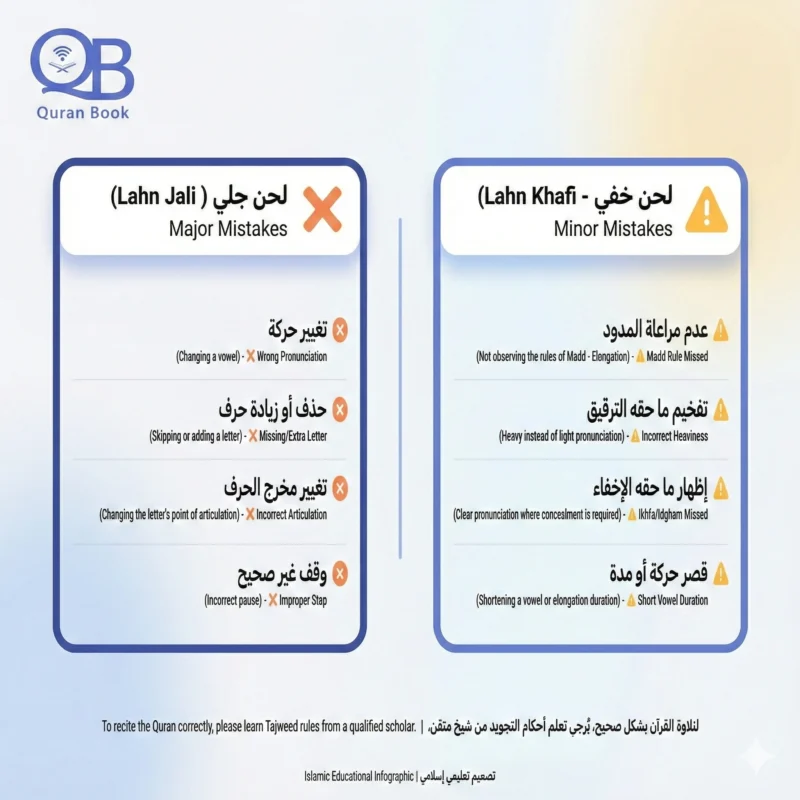
Quran reading mistakes are categorized into two types: Lahn Jali (major mistakes) that change the meaning of words or add/remove letters, and Lahn Khafi (minor mistakes) that affect the quality of recitation without changing meaning, such as improper elongation or missing ghunnah. Learn more about What is Tajweed?
Before diving into specific common mistakes in Quran reading, it’s essential to understand how Islamic scholars categorize recitation errors. This classification helps you prioritize which mistakes to address first and understand their significance in preserving the integrity of the Quran.
What is Lahn Jali (Major Mistakes)?
Lahn Jali refers to obvious, clear errors that violate fundamental Arabic language rules. These mistakes are considered serious because they can potentially change the meaning of Quranic verses. Even listeners with basic Arabic knowledge can detect these errors.
Common examples of Lahn Jali include:
- Pronouncing ط (Ṭa) as ت (Ta) — changing emphatic letters to non-emphatic
- Saying “الحَمْدَ” instead of “الحَمْدُ” — incorrect vowel marks (harakat)
- Adding or removing letters from words
- Confusing similar-looking letters with different sounds
Ruling: Lahn Jali must be avoided. If committed intentionally, it is considered sinful. For beginners learning Quran with Tajweed online, addressing these major mistakes should be the first priority.
What is Lahn Khafi (Minor Mistakes)?
Lahn Khafi refers to subtle errors that only Tajweed specialists can typically detect. These mistakes affect the beauty and quality of recitation but don’t change the fundamental meaning of verses.
Common examples of Lahn Khafi include:
- Shortening the types of Madd in Tajweed (elongation rules)
- Missing Ghunnah Tajweed (nasal sounds)
- Improper application of Qalqalah letters
- Not observing proper pauses between verses
Ruling: Lahn Khafi is considered Makruh (disliked) but not sinful. However, serious students of Quran recitation should strive to correct these errors to achieve beautiful, proper Tajweed.
7 Common Mistakes in Quran Reading Every Beginner Should Know
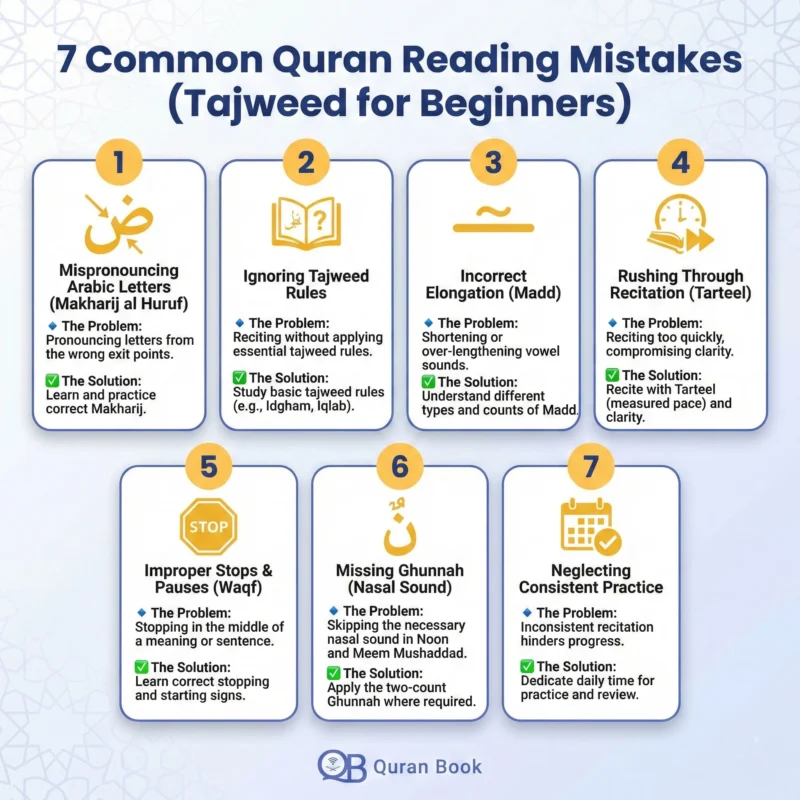
Whether you’re learning Quran reading with Tajweed for beginners or you’ve been reciting for years, these seven common mistakes are the ones our certified teachers encounter most frequently. Recognizing them is the first step toward the correct way of reading Quran.
Mispronouncing Arabic Letters (Makharij al Huruf)
The Problem: Arabic contains unique sounds that don’t exist in English or many other languages. Non-Arabic speakers often confuse similar-sounding letters, leading to incorrect pronunciation that can change word meanings entirely.
Commonly confused letter pairs include:
- ط (Ṭa) vs ت (Ta) — emphatic vs non-emphatic
- ظ (Ẓa) vs ز (Za) — similar sound, different articulation points
- ق (Qaf) vs ك (Kaf) — deep throat vs back of tongue
- ض (Ḍad) vs د (Dal) — the unique Arabic letter
- ح (Ḥa) vs ه (Ha) — throat vs chest
Why It Happens: Non-Arabic speakers lack natural exposure to these distinct sounds during childhood language acquisition. The Makharij al huruf (17 articulation points) require deliberate practice to master.
✅ The Solution: Learn the 17 articulation points systematically with a qualified teacher who can provide real-time feedback. Watch our Makharij al Huruf Playlist on YouTube.
Ignoring Tajweed Rules
The Problem: Many beginners read the Quran like regular Arabic text, ignoring the specific rules that govern Quranic recitation. This results in flat, incorrect pronunciation that lacks the beauty and precision Allah commanded.
Essential Tajweed rules often overlooked:
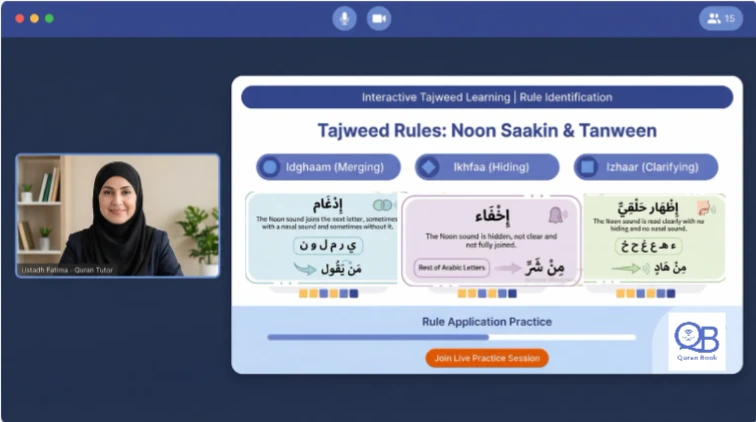
- Noon Sakinah and Tanween rules (Idgham, Ikhfa, Iqlab, Izhar)
- Meem Sakinah rules
- Qalqalah letters (ق ط ب ج د) — the bouncing sound
- Ghunnah Tajweed — the nasal sound lasting two counts
✅ The Solution: Enroll in a structured Tajweed for beginners online course with live correction from certified instructors. Learning each rule systematically with immediate feedback prevents bad habits from forming.
Incorrect Elongation (Types of Madd in Tajweed)
The Problem: Madd (elongation) rules specify exactly how long certain vowel sounds should be held. Getting this wrong—either too short or too long—is one of the most common mistakes in Quran reading.
Key types of Madd to master:
- Natural Madd (Madd Tabee’i) — 2 counts, the foundation
- Connected Madd (Madd Muttasil) — 4-5 counts when followed by hamza
- Obligatory Madd (Madd Lazim) — 6 counts, the longest
✅ The Solution: Practice with a teacher who can count and correct in real-time. Recording your sessions and comparing to expert reciters like Sheikh Husary also helps develop accurate timing.
Rushing Through Recitation
The Problem: In an effort to complete more verses or due to nervousness, many reciters read too fast. This leads to skipping sounds, merging words incorrectly, and missing important rules.
Ibn Masoud (may God be pleased with him) said to a man who was quick and confused: “Do you recite it as quickly as poetry? If it enters the heart and becomes firmly established there, it will be beneficial.”
✅ The Solution: Practice Tarteel (measured recitation) as commanded in Surah Al-Muzzammil. Record yourself and identify rushed sections. Remember: quality of recitation matters more than quantity.
Improper Stops and Pauses (Waqf)
The Problem: Stopping in the wrong place or starting from inappropriate points can completely change the meaning of Quranic verses. This is particularly dangerous when the incorrect stop creates a meaning contrary to Islamic belief.
Common Waqf mistakes:
- Stopping mid-word when running out of breath
- Ignoring Waqf symbols in the Mushaf
- Starting from the middle of a sentence after a pause
- Not understanding obligatory vs. forbidden stops
✅ The Solution: Learn the Waqf symbols used in the Quran and their meanings. Practice with guidance to understand which stops preserve meaning and which ones must be avoided.
Missing Ghunnah (Nasal Sound)
The Problem: Ghunnah Tajweed is the nasal sound that should last approximately two counts. Many reciters either skip it entirely or don’t hold it long enough, affecting the beauty and accuracy of recitation.
When Ghunnah is required:
- Noon with Shaddah (نّ)
- Meem with Shaddah (مّ)
- During Idgham with Ghunnah
- When applying Ikhfa rules
✅ The Solution: Practice humming exercises to develop the nasal resonance. Listen carefully to expert reciters like Sheikh Husary, known for his clear, slow recitation perfect for beginners learning Tajweed.
Neglecting Consistent Practice
The Problem: Perhaps the most damaging mistake isn’t about pronunciation at all—it’s inconsistent practice. Sporadic learning leads to forgotten rules, developing bad habits, and ultimately, loss of motivation.
Consequences of irregular practice:
- Rules learned are quickly forgotten
- Bad pronunciation habits become ingrained
- Progress plateaus, causing frustration
- The joy of recitation diminishes
✅ The Solution: Establish daily 15–20-minute practice sessions with accountability. Consider our Quran Memorization Course for structured, consistent learning.
The Quran Book Academy Method: How We Help You Avoid These Mistakes
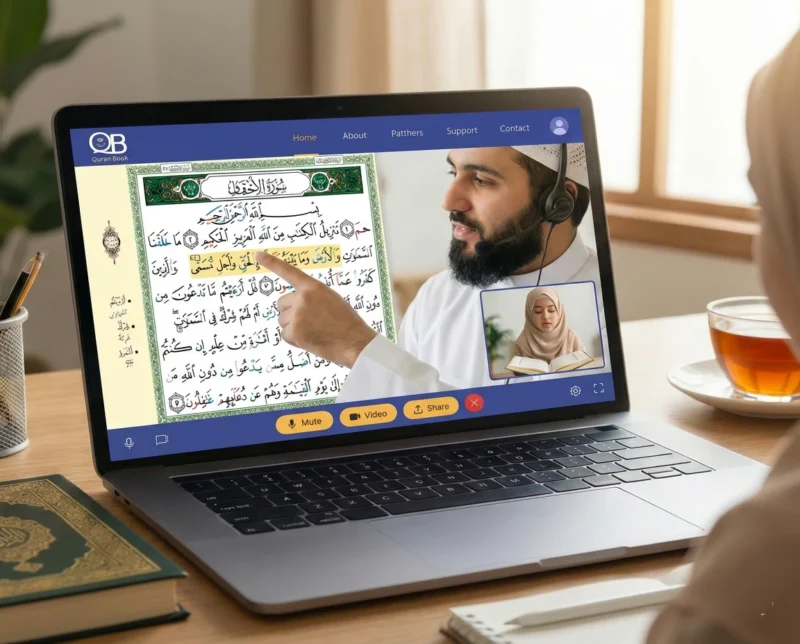
At Quran Book Academy, we’ve developed a comprehensive methodology specifically designed for non-Arabic speaking beginners in the USA, Canada, UK, and Australia who want to learn Quran reading with Tajweed. Our approach combines traditional Islamic scholarship with modern educational psychology, breaking down complex Tajweed rules into manageable psychological “chunks” that students can master without feeling overwhelmed.
Each lesson builds upon the previous one, creating neural pathways that make correct pronunciation automatic over time. We understand that adult learners face unique challenges—busy schedules, fear of making mistakes publicly, and previous unsuccessful attempts at self-study. That’s why our certified teachers, trained in both Tajweed and student psychology, create a supportive environment where mistakes become learning opportunities rather than sources of embarrassment. Learn more about Our Teaching Method.
💻 Our Technology Stack
- Live Sessions via Zoom: One-on-one interaction with instant pronunciation feedback
- Custom LMS Platform: Track your progress through each Tajweed rule
- Email Progress Reports: Regular updates sent to parents and students
- Recording Feature: Review your sessions to identify improvement areas
- Mobile-Friendly Access: Learn from anywhere, anytime on any device
📚 Our Teaching Methodology
- Assessment Phase: Identify current skill level and specific mistakes
- Foundation Building: Master Arabic letters and Makharij al huruf first
- Rule-by-Rule Progress: One Tajweed rule at a time until complete mastery
- Live Practice: Apply rules with teacher supervision
- Independent Reading: Build confidence with new passages
- Ijazah Preparation: For advanced students seeking certification
How to Correct Common Quran Reading Mistakes: A Step-by-Step Guide
Now that you understand the common mistakes in Quran reading, here’s a practical roadmap for how to avoid mistakes when reading Quran and achieve beautiful, accurate recitation:
-
Get a Qualified Teacher
Self-study without feedback reinforces errors. A certified teacher catches mistakes you can’t hear yourself making. -
Start with Noorani Qaida
Build strong foundational pronunciation before tackling full verses. This classic method has helped millions learn correctly. -
Learn One Rule at a Time
Don’t overwhelm yourself trying to master everything at once. Master Madd before moving to Ghunnah, for example. -
Listen to Expert Reciters
Sheikh Husary’s slow, clear style is perfect for beginners. His recitations are ideal for learning proper Tajweed. -
Record and Review
Compare your recitation to your teacher’s feedback. Hearing your own mistakes is a powerful learning tool. -
Practice Daily
15-20 minutes consistently beats occasional long sessions. Set a specific time each day for Quran practice. -
Join a Supportive Community
Motivation through accountability helps you stay consistent. Our Telegram community provides daily encouragement.
5 Life-Changing Benefits of Learning Correct Quran Reading

Investing time in mastering Tajweed and avoiding common Tajweed mistakes beginners make brings rewards far beyond improved pronunciation. Explore the full Benefits of Tajweed. Here are five transformative benefits:
1. Deeper Spiritual Connection
When you recite correctly, you experience deeper khushu (concentration) in Salah. Understanding that you’re pronouncing Allah’s words as they were revealed creates a profound spiritual connection that rushed, incorrect recitation cannot provide.
2. Double Reward for Effort
Remember the hadith mentioned earlier—those who struggle with recitation receive double the reward. Your effort, even when difficult, is immensely valuable in Allah’s sight. Learning the correct way of reading Quran honors both the struggle and the achievement.
3. Preserved Meaning
Proper Tajweed protects the integrity of Allah’s words. By avoiding mistakes in Quran reading that change meaning, you become a guardian of the Quran’s original message, exactly as it was revealed to Prophet Muhammad (peace be upon him).
4. Confidence in Worship
Imagine leading prayers or reciting publicly without anxiety. When you’ve mastered correct pronunciation, you can focus on the meaning and spirituality rather than worrying about making embarrassing mistakes.
5. Ability to Teach Others
Once you’ve learned correctly, you can pass this knowledge to your children and community. This fulfills one of the greatest Islamic acts: “The best among you are those who learn the Quran and teach it.” — Sahih al-Bukhari 5027
Frequently Asked Questions About Common Mistakes in Quran Reading
Here are answers to the most common questions we receive from students learning how to improve Quran recitation:
Start Your Journey to Flawless Quran Reading Today

Every Muslim deserves to experience the beauty of reciting Allah’s words correctly. The common mistakes in Quran reading we’ve discussed—from mispronunciation to rushing through verses—are all fixable with the right guidance and consistent practice. At Quran Book Academy, our certified teachers have helped thousands of non-Arabic speaking students in the USA, Canada, UK, and Australia transform their recitation from hesitant and error-prone to confident and beautiful.
Remember, the journey of a thousand miles begins with a single step. Whether you’re a complete beginner worried about Quran pronunciation mistakes for non-Arabs, or an experienced reciter looking to polish your Tajweed, we’re here to guide you every step of the way.
Learn More
Expand your knowledge of Tajweed and Quran reading with these helpful resources: