
🎓 100% Free — No Credit Card Needed
📖

Wait! Before You Go...
Try Our Free Learning!

Explore our free resources — no subscription required.

🎮 Start Learning for Free Now
🏠 Home About
🕌 About Us ⚙️ How It Works 👨‍🏫 Meet Our Teachers
🧒 For Kids
Fiqh for Kids Arabic Online for Kids Islamic School for Kids Tajweed Made Easy Quran Memorization Nour El Bayan Noorani Qaida
👨 For Adults
Tajweed for Adults Islamic School for Adults Quran Memorization Arabic Online Online Quran for Adults
🧕 Ladies Section
Online Quran for Ladies Islamic Studies for Sisters Female Quran Teachers
✨ More Programs
Online Islamic School Quran with Tajweed Quranic Arabic Ijaza in Quran Online Quran Classes Qiraat Course Online Hifz Course Quran Memorization Course New Muslim Programs
🎓 Learn Free
🔤 Arabic Alphabet 📖 Free Quran Lessons 📚 Free Resources
📝 Articles 💰 Price 📱 Follow Us
🎁 Free Trial

Author: rabieabdo06841@gmail.com

  • Laylatul Qadr

    Laylatul Qadr 2026: 7 Powerful Signs, Duas & How to Pray This Blessed Night
    Ramadan Special Guide

    Laylatul Qadr 2026: 7 Powerful Signs, Duas & How to Pray This Blessed Night

    By Quran Book Academy · Ramadan 2026

    Last Updated: February 2026 · 18 min read

    Laylatul Qadr night sky with mosque silhouette and peaceful atmosphere
    A serene night sky with stars, crescent moon, and a mosque silhouette representing the spiritual significance of Laylatul Qadr (Night of Decree).

    Laylatul Qadr (the Night of Decree) is the most sacred night in Ramadan, described in the Quran as “better than a thousand months” (Surah Al-Qadr 97:3). Whether you’re a new Muslim, a busy professional struggling to find time for worship, or someone who fears they might “miss” this blessed night—this comprehensive guide will show you exactly how to recognize, prepare for, and maximize your ibadah on Laylatul Qadr. You don’t need to be perfect; you just need to begin.

    “Indeed, We sent it [the Quran] down during the Night of Decree. And what can make you know what is the Night of Decree? The Night of Decree is better than a thousand months.” — Surah Al-Qadr (97:1-3)

    What is Laylatul Qadr? The Night of Power Explained

    Laylatul Qadr, also known as the Night of Decree or Night of Power, is the blessed night when the Quran was first revealed to Prophet Muhammad ﷺ. It occurs during the last ten nights of Ramadan and carries the reward of worship equivalent to over 83 years of devotion.

    For Muslims around the world, Laylatul Qadr represents the pinnacle of spiritual opportunity. This is not merely another night in the Islamic calendar—it is the night that changed human history forever. On this very night, the first verses of the Quran descended upon the Prophet Muhammad ﷺ in the Cave of Hira, marking the beginning of the final divine revelation to humanity.

    The Meaning Behind “Laylatul Qadr”

    Understanding the linguistic roots of Laylatul Qadr deepens our appreciation for its significance:

    • “Laylah” means Night in Arabic
    • “Qadr” carries multiple meanings: Decree, Power, Measure, or Destiny
    • Combined meaning: The Night when destinies are decreed and divine power manifests

    The word “Qadr” also implies honor and dignity, suggesting that this night elevates the status of those who worship sincerely during it. Some scholars explain that the night is called Laylatul Qadr because it is a night of immense value and magnitude—a night that holds the power to transform your entire spiritual trajectory.

    Laylatul Qadr Surah in English (Surah Al-Qadr Complete Translation)

    Allah revealed an entire surah dedicated to describing the magnificence of this night. Here is Surah Al-Qadr with Arabic, transliteration, and English translation:

    Verse Arabic Transliteration English Translation
    97:1 إِنَّا أَنزَلْنَاهُ فِي لَيْلَةِ الْقَدْرِ Innā anzalnāhu fī laylat-il-qadr Indeed, We sent it down during the Night of Decree
    97:2 وَمَا أَدْرَاكَ مَا لَيْلَةُ الْقَدْرِ Wa mā adrāka mā laylat-ul-qadr And what can make you know what the Night of Decree is?
    97:3 لَيْلَةُ الْقَدْرِ خَيْرٌ مِّنْ أَلْفِ شَهْرٍ Laylat-ul-qadri khairun min alfi shahr The Night of Decree is better than a thousand months
    97:4 تَنَزَّلُ الْمَلَائِكَةُ وَالرُّوحُ فِيهَا Tanazzal-ul-malā’ikatu war-rūḥu fīhā The angels and the Spirit descend therein
    97:5 سَلَامٌ هِيَ حَتَّىٰ مَطْلَعِ الْفَجْرِ Salāmun hiya ḥattā maṭla’-il-fajr Peace it is until the emergence of dawn

    Why is Laylatul Qadr Important? The Spiritual Significance
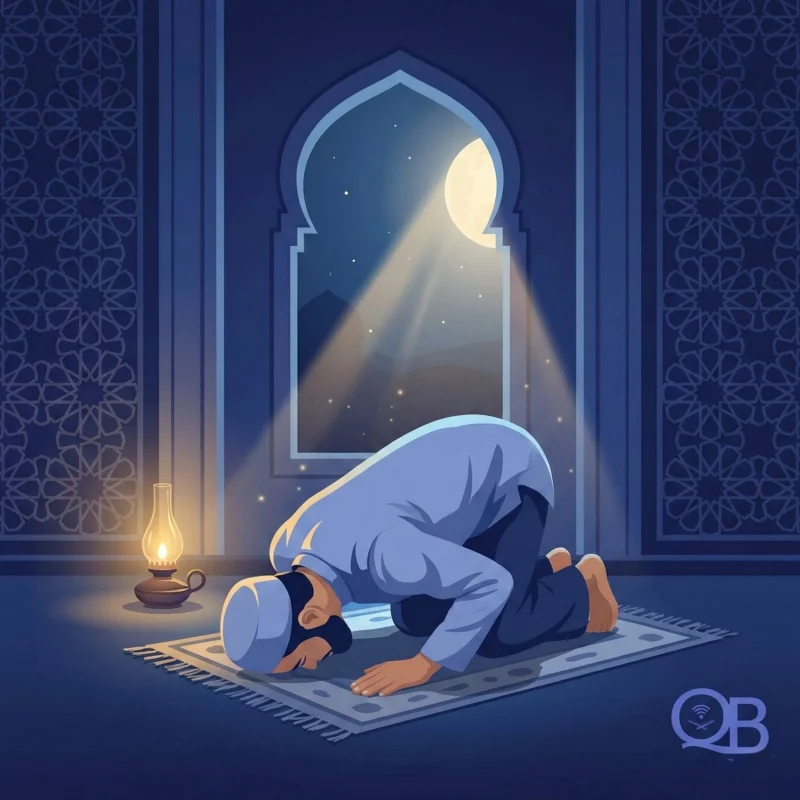
    How to pray on Laylatul Qadr - Muslim in prostration during night prayer
    A Muslim in humble prostration during Tahajjud prayer, representing the sincere worship encouraged on Laylatul Qadr.

    Laylatul Qadr is important because worship on this single night equals over 83 years of devotion. It’s the night when angels descend in abundance, duas are accepted, and the yearly decree for each person is written. Missing this night means missing an opportunity granted only once a year.

    The Mathematical Miracle: Better Than 1,000 Months

    Let’s pause and truly comprehend what Allah is offering us. When the Quran states that Laylatul Qadr is “better than a thousand months,” this isn’t poetic exaggeration—it’s divine mathematics:

    • 1,000 months equals approximately 83.3 years
    • One single night of sincere worship grants rewards equivalent to a lifetime of devotion
    • This is Allah’s gift of “quality over quantity” in worship

    Consider this: even if you lived to be 100 years old and worshipped every single day, the rewards of Laylatul Qadr would still exceed that lifetime of effort. This is why the Prophet ﷺ emphasized seeking this night with such urgency and devotion.

    Hadith About Laylatul Qadr

    “Whoever stays up (in prayer and remembrance of Allah) on the Night of Qadr, with faith and seeking reward, all his previous sins will be forgiven.” — Prophet Muhammad ﷺ (Sahih Al-Bukhari 1901, Sahih Muslim 760)
    “Search for the Night of Qadr in the odd nights of the last ten days of Ramadan.” — Prophet Muhammad ﷺ (Sahih Al-Bukhari 2017)

    These authentic narrations highlight two crucial aspects of Laylatul Qadr: the promise of complete forgiveness for those who sincerely seek it, and the practical guidance on when to look for this blessed night. The conditions are simple—approach the night with genuine faith (iman) and the intention of seeking Allah’s reward (ihtisab).

    When is Laylatul Qadr? Odd Nights & the 27th Night Debate
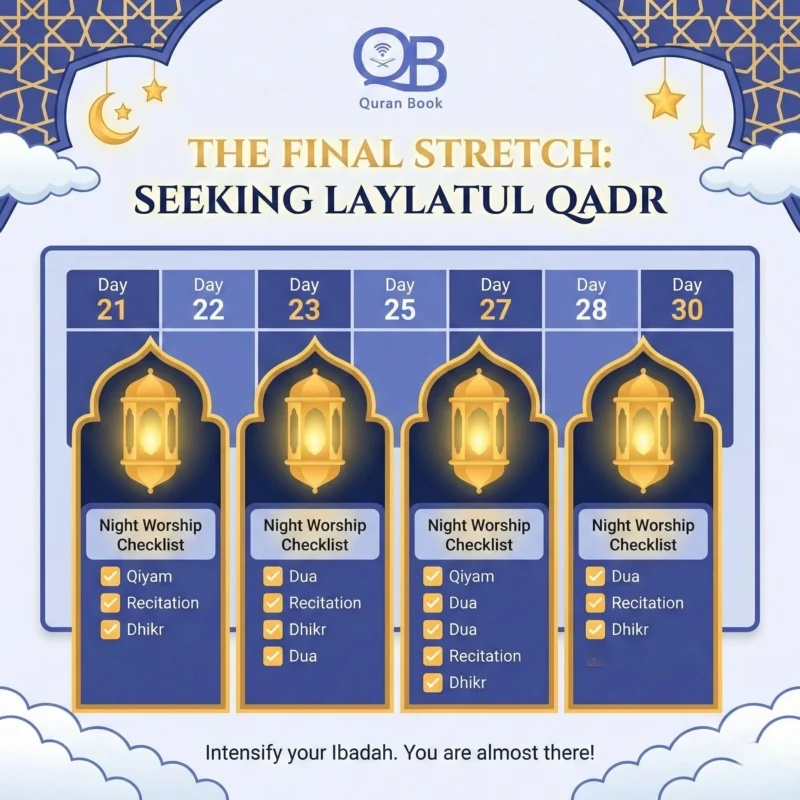
    When is Laylatul Qadr - Ramadan calendar showing odd nights of last ten days
    A Ramadan calendar highlighting the last ten nights with emphasis on odd nights (21, 23, 25, 27, 29) when Laylatul Qadr is most likely to occur.

    Laylatul Qadr occurs during the last ten nights of Ramadan, most likely on the odd nights (21st, 23rd, 25th, 27th, or 29th). While many scholars emphasize the 27th night, Prophet Muhammad ﷺ encouraged searching all odd nights to maximize the chance of catching this blessed night.

    One of the most frequently asked questions about Laylatul Qadr is: “Which night exactly is it?” The beautiful wisdom behind Allah concealing the precise date is to encourage consistent devotion throughout Ramadan’s final phase, rather than focusing on just one night.

    Is Laylatul Qadr Only on Odd Nights?

    Based on authentic hadith, the scholarly consensus strongly emphasizes the odd nights of the last ten days of Ramadan. However, the wisest approach is to increase worship on all ten nights, ensuring you don’t miss this blessed opportunity regardless of which specific night it falls on.

    • Scholarly consensus: Focus primarily on odd nights (21, 23, 25, 27, 29)
    • Some scholarly opinions do not entirely exclude even nights
    • Best practice: Increase worship on ALL last 10 nights of Ramadan

    Is Laylatul Qadr on the 27th Night?

    The 27th night of Ramadan holds special significance in Islamic tradition. The great companion Ubayy ibn Ka’b (RA) expressed certainty that Laylatul Qadr falls on this night, and many Muslims worldwide observe it with particular devotion. Here’s a comparison of evidence for different nights:

    Night Evidence Scholarly Opinion
    21stHadith about early part of last 10 nightsPossible
    23rdSome companion reports and narrationsPossible
    25thMultiple hadith references and indicatorsHighly Possible
    27thStrongest scholarly tradition; Ubayy ibn Ka’b’s certaintyMost Emphasized ⭐
    29thLast odd night; mentioned in hadith narrationsPossible

    💡 Pro Tip: The wisdom behind concealing the exact night of Laylatul Qadr is to encourage consistent worship throughout Ramadan’s final phase. Don’t put all your effort into just one night!

    7 Authentic Signs of Laylatul Qadr (How to Recognize the Night)
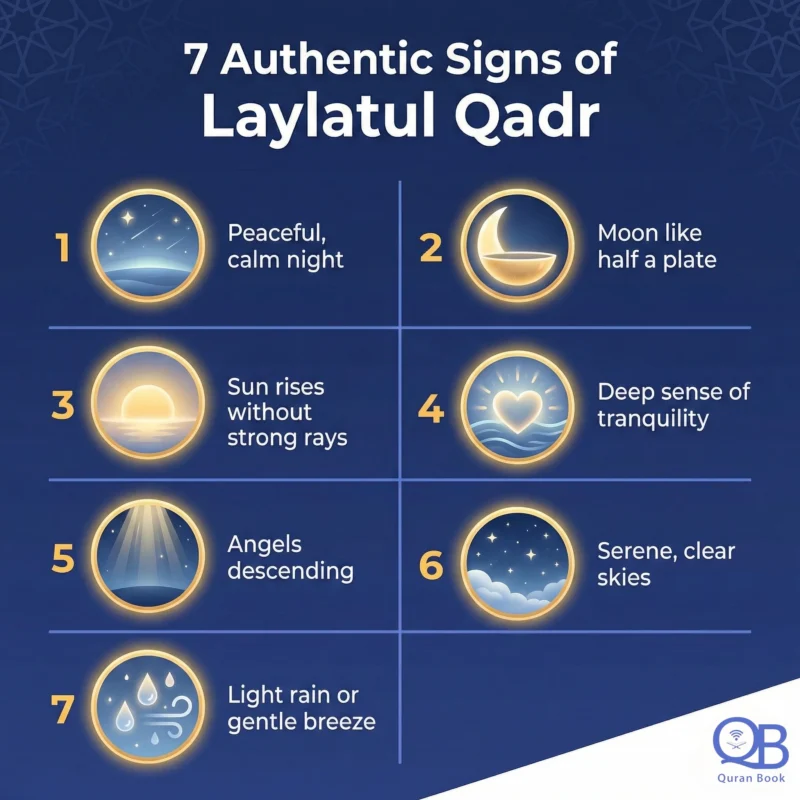
    7 authentic signs of Laylatul Qadr including peaceful night and sun without rays
    An infographic displaying the seven authentic signs of Laylatul Qadr: peaceful calm night, moon like half a plate, sun rising without strong rays, sense of tranquility, angels descending, serene skies, and light rain.

    The signs of Laylatul Qadr include a peaceful, calm night that is neither too hot nor too cold, a moon that appears like half a plate, a sun rising the next morning without strong rays, and an overwhelming sense of tranquility and spiritual connection during worship.

    While the exact date of Laylatul Qadr is hidden, Allah in His mercy has provided us with signs to recognize this blessed night. These signs come from authentic hadith and the experiences of the righteous predecessors.

    Sign #1: A Peaceful, Calm Night

    The first sign of Laylatul Qadr is an atmosphere of exceptional tranquility. The night is neither excessively hot nor uncomfortably cold—it feels moderate and pleasant, as if the very air itself has been blessed. According to a narration in Ibn Khuzaymah, the Prophet ﷺ described it as “a calm night, neither hot nor cold.” This physical serenity mirrors the spiritual peace that descends upon the earth.

    Sign #2: The Moon Appears Like Half a Plate

    Companion Abu Hurairah (RA) reported that the moon on Laylatul Qadr appears in a specific way, resembling half of a plate. This unique lunar appearance has been noted by scholars as one of the observable signs of this blessed night.

    Sign #3: The Sun Rises Without Strong Rays

    Perhaps the most well-documented sign is observable the morning after Laylatul Qadr. The sun rises appearing weak, reddish, and without its usual harsh rays. In Sahih Muslim, the Prophet ﷺ said: “The sun rises on that morning with no rays.” This sign serves as confirmation for those who worshipped the previous night.

    Sign #4: Increased Sense of Tranquility (Sakeenah)

    Beyond physical signs, many who experience Laylatul Qadr report an internal transformation. There is a deep inner peace during worship, hearts feel unusually connected to Allah, and tears flow easily during dua. This spiritual tranquility (sakeenah) is a gift from Allah to those sincere in their devotion.

    Sign #5: Angels Descend in Abundance

    Surah Al-Qadr explicitly states that angels descend on this night. Scholars explain that more angels descend on Laylatul Qadr than there are pebbles on earth. The angel Jibreel (AS) himself descends with them, bringing peace, mercy, and blessings from Allah. While we cannot see the angels, their presence contributes to the night’s unique atmosphere.

    Sign #6: No Shooting Stars That Night

    Some scholars mention that on Laylatul Qadr, the skies are particularly serene with no shooting stars observed. The heavens appear calm and undisturbed, reflecting the peace that blankets the earth.

    Sign #7: Rain May Fall

    Some reports mention that light rain may fall on Laylatul Qadr, symbolizing the descent of mercy and blessings. While not a definitive sign, it has been noted in connection with this blessed night.

    Best Duas for Laylatul Qadr (Arabic, Transliteration & English)
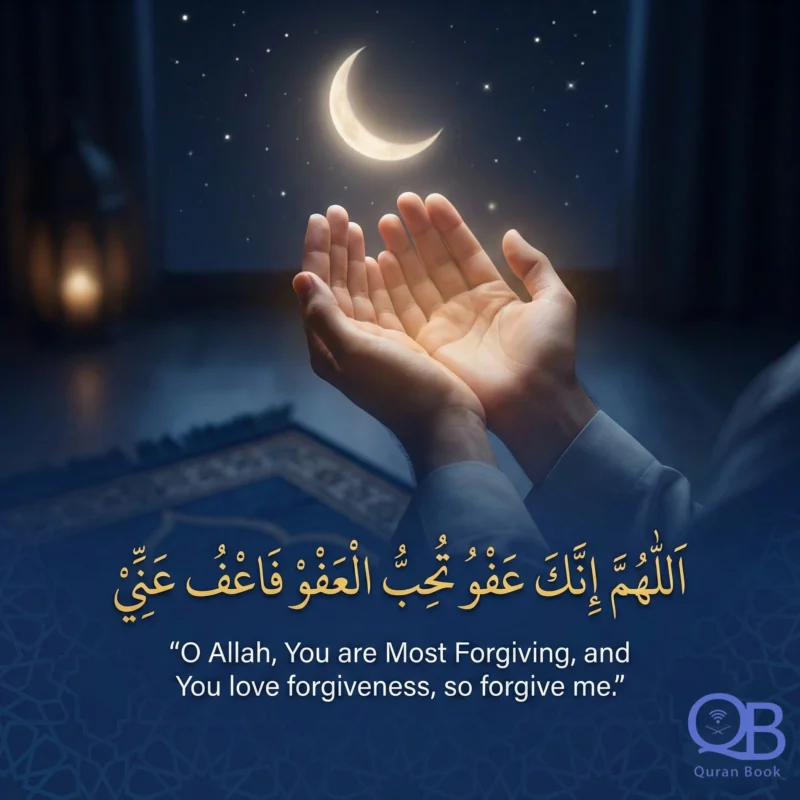
    Best dua for Laylatul Qadr - Muslim with hands raised in supplication
    Hands raised in sincere dua (supplication) during Laylatul Qadr, representing the recommended practice of making abundant duas on the Night of Decree.

    The best dua for Laylatul Qadr, taught by Prophet Muhammad ﷺ to Aisha (RA), is: “Allahumma innaka ‘afuwwun tuhibbul ‘afwa fa’fu ‘anni” (O Allah, You are Forgiving and love forgiveness, so forgive me). This dua should be repeated abundantly throughout the night.

    The Primary Dua for Laylatul Qadr

    When Aisha (RA) asked the Prophet ﷺ what she should say if she knew which night was Laylatul Qadr, he taught her a dua that has been repeated by millions of Muslims throughout history:

    اللَّهُمَّ إِنَّكَ عَفُوٌّ تُحِبُّ الْعَفْوَ فَاعْفُ عَنِّي

    Allahumma innaka ‘Afuwwun, tuhibbul-‘afwa, fa’fu ‘anni

    O Allah, You are Pardoning and You love to pardon, so pardon me

    Source: Sunan Ibn Majah 3850; Jami’ at-Tirmidhi 3513

    This dua is profound in its simplicity. The word “‘Afw” (pardon) means complete erasure—as if the sin never existed. This goes beyond mere forgiveness; it is a plea for Allah to wipe away our transgressions entirely.

    Additional Recommended Duas for Laylatul Qadr

    Beyond the primary dua, here are additional supplications recommended for this blessed night:

    1
    Dua for Forgiveness: Astaghfirullah wa atubu ilayh (I seek Allah’s forgiveness and repent to Him)
    2
    Dua for Parents: Rabbi-rhamhuma kama rabbayani sagheera (My Lord, have mercy on them as they raised me when I was small)
    3
    Dua for Guidance: Allahumma-hdini wa saddidni (O Allah, guide me and make me steadfast)
    4
    Dua for Ease: Allahumma la sahla illa ma ja’altahu sahla (O Allah, nothing is easy except what You make easy)
    5
    Dua for Protection: Allahumma inni a’udhu bika min ‘adhabil-qabr (O Allah, I seek refuge in You from the punishment of the grave)

    Remember, you can also make dua in your own language. Allah understands all languages, and sincere supplication from the heart is always accepted. Pour out your hopes, fears, and needs to your Creator on this blessed night.

    How to Pray on Laylatul Qadr (Complete Step-by-Step Ibadah Guide)

    To pray on Laylatul Qadr, begin after Isha prayer with Tahajjud/Qiyam al-Layl in sets of two rak’ahs, recite Quran with contemplation, make abundant dua, perform dhikr, and end with Witr before Fajr. The night should be spent in a mix of prayer, recitation, and supplication.

    What to Do on Laylatul Qadr: Hour-by-Hour Guide

    Here is a practical schedule to help you maximize your ibadah on Laylatul Qadr:

    8:00–9:30 PM After Isha

    Pray Taraweeh with the congregation or at home. Eat a light meal in preparation for the night ahead.

    9:30–11:00 PM First Third

    Focus on Quran recitation. Aim for at least 2-3 Juz, reading with contemplation and understanding.

    11:00 PM–1:00 AM Middle Third

    Pray Tahajjud (4-8 rak’ahs). Take breaks for personal duas in your own language.

    1:00–4:00 AM Last Third ⭐

    This is when Allah descends to the lowest heaven. Intensify your dua and istighfar during these blessed hours.

    4:00–5:00 AM Pre-Fajr

    Pray Witr to conclude your night prayer. Continue dhikr until the Fajr Adhan.

    Ibadah on Laylatul Qadr: Acts of Worship

    Act of Worship Duration Priority Level
    Qiyam al-Layl (Night Prayer)1-2 hours⭐⭐⭐ Essential
    Quran Recitation1-2 hours⭐⭐⭐ Essential
    Dua (Personal Supplication)30-60 mins⭐⭐⭐ Essential
    Dhikr (Remembrance of Allah)Continuous⭐⭐ Important
    Istighfar (Seeking Forgiveness)Continuous⭐⭐ Important
    Sadaqah (Charity)One-time⭐ Recommended
    I’tikaf (Seclusion in Masjid)Full night⭐ If possible

    How to Perform Laylatul Qadr Prayer (Tahajjud)

    Follow these steps to perform the night prayer on Laylatul Qadr:

    1. 1 Make wudu (ablution) with the intention of preparing for worship
    2. 2 Pray 2 rak’ahs with longer Quran recitation (Surah Al-Mulk, Surah Yasin, or other surahs you know)
    3. 3 Make dua between the two prostrations and after completing the salam
    4. 4 Repeat in sets of 2 rak’ahs (aim for 4, 8, or 12 total rak’ahs)
    5. 5 End with Witr prayer (1, 3, or 5 rak’ahs)
    6. 6 Make long, heartfelt dua in prostration (sujood)—this is when you are closest to Allah

    💡 Pro Tip: If you don’t know many surahs by heart, this is your sign to enroll in a Quran memorization program. Imagine next Ramadan, reciting from memory with beautiful Tajweed!

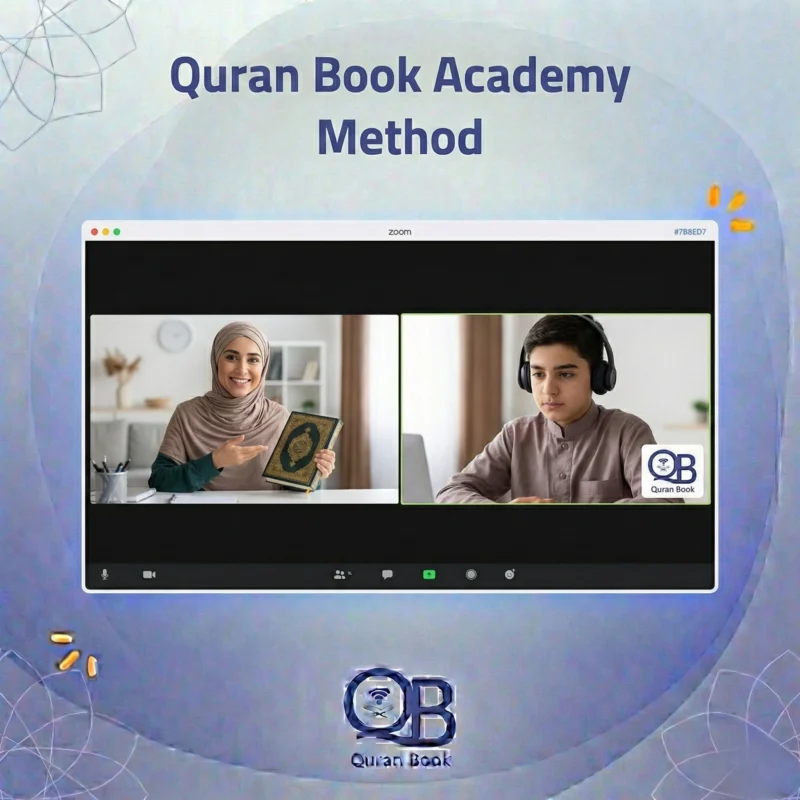
    The Academy Method: Learning Quran Recitation for Laylatul Qadr
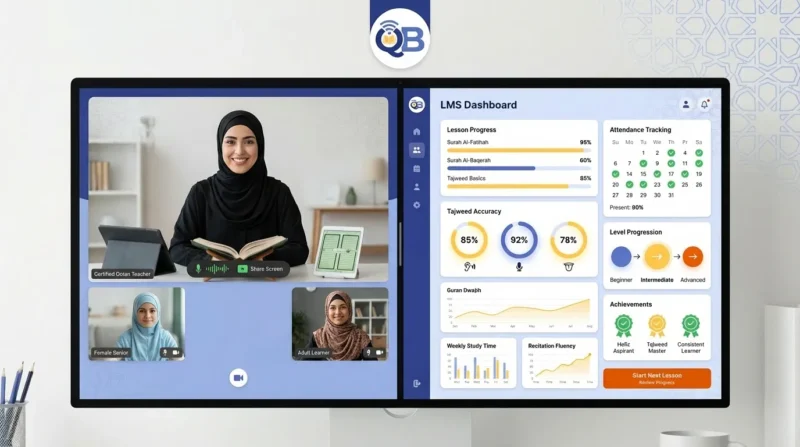
    Quran Book Academy online Quran learning for Laylatul Qadr preparation
    A student learning Quran online via Zoom with a qualified teacher, representing the Academy Method for preparing to recite beautifully on Laylatul Qadr.

    At Quran Book Academy, we understand that many Muslims—especially those in the USA, Canada, UK, and Australia—feel disconnected from the Quran because Arabic isn’t their first language. The fear of mispronunciation, the overwhelm of learning Tajweed rules, and the guilt of not understanding what you recite are psychological barriers we address directly in our teaching methodology. Our “Academy Method” breaks Quran learning into manageable psychological “chunks,” drawing from educational psychology principles that prevent cognitive overload. We use Zoom for live, one-on-one sessions with certified teachers who specialize in teaching non-Arabic speakers, and our custom Learning Management System (LMS) tracks your progress in real-time, sends weekly Gmail reports to keep you accountable, and provides recorded lesson replays so you never fall behind. Whether you’re a complete beginner who struggles with Arabic letters or an intermediate learner wanting to perfect your Tajweed for Laylatul Qadr recitation, our structured approach—rooted in patience, encouragement, and Islamic adab—transforms “I can’t” into “I did.” This Ramadan, imagine standing in Qiyam al-Layl, reciting Surah Al-Qadr from memory, with proper Makharij (pronunciation points), confident that every letter carries the weight of worship. That transformation begins with one free trial lesson.

    Our Quran Courses for Laylatul Qadr Preparation

    Course Duration Best For
    Quran Reading Basics (Noorani Qaida)3-6 monthsComplete beginners learning Arabic letters
    Tajweed Mastery6-12 monthsIntermediate learners perfecting recitation
    Quran Memorization (Hifz)2-4 yearsDedicated memorizers seeking to memorize the entire Quran
    Arabic Language6-12 monthsUnderstanding the meaning of what you recite

    The Tech Stack Behind Your Learning

    • Live Sessions: Zoom (interactive, face-to-face with your teacher)
    • Progress Tracking: Custom LMS with detailed analytics
    • Accountability: Weekly Gmail reports to you (or parents for children)
    • Community: Telegram Channel for Practicing Quran with Tajweed
    • Support: Dedicated student success coordinators

    FAQ: Your Laylatul Qadr Questions Answered

    Q1. What is the exact date of Laylatul Qadr 2026?
    Laylatul Qadr 2026 will fall during the last ten nights of Ramadan, which begins approximately in late February/early March 2026. The exact date is hidden by divine wisdom, but most scholars emphasize searching on odd nights (21st, 23rd, 25th, 27th, 29th of Ramadan). The 27th night (approximately March 22-23, 2026) is most commonly observed.
    Q2. Can Laylatul Qadr be on even nights?
    While the majority of scholars and hadith emphasize odd nights, some scholarly opinions do not entirely exclude even nights. The safest approach is to increase worship throughout all ten nights, ensuring you don’t miss the blessed night regardless of which specific night it falls on.
    Q3. What is the best dua to recite on Laylatul Qadr?
    The best dua, taught by Prophet Muhammad ﷺ to Aisha (RA), is: “Allahumma innaka ‘Afuwwun tuhibbul-‘afwa fa’fu ‘anni” (O Allah, You are Pardoning and love to pardon, so pardon me). Repeat this abundantly alongside personal duas in your own language.
    Q4. How many rak’ahs should I pray on Laylatul Qadr?
    There is no fixed number. The Prophet ﷺ prayed in sets of two rak’ahs. You can pray as many as you’re able—4, 8, 12, or more—focusing on quality and khushoo (humility) over quantity. End with Witr (odd number: 1, 3, or 5 rak’ahs).
    Q5. Can I make dua in English on Laylatul Qadr?
    Yes! Allah understands all languages. While learning Arabic duas is rewarding, sincere supplication in English (or any language) is completely valid and accepted. Pour your heart out to Allah in the language most natural to you.
    Q6. What if I can’t stay up all night?
    Focus on quality, not duration. Even praying the last third of the night (1-2 hours before Fajr) is highly rewarding, as this is when Allah’s mercy descends closest. The Prophet ﷺ said: “Take on only as much as you can do of good deeds, for the best of deeds is that which is done consistently” (Ibn Majah 4240).
    Q7. Is it necessary to go to the masjid for Laylatul Qadr?
    While praying in the masjid has additional rewards and is encouraged for men, women and those unable to attend can worship at home. The sincerity of your worship matters more than the location.
    Q8. Can I recite Quran from my phone on Laylatul Qadr?
    Yes, reciting from a Quran app or digital Quran is permissible. Focus on proper recitation with Tajweed, whether from a physical Mushaf or digital device.

    Take Action: Start Your Quran Journey Today 🌙

    This Laylatul Qadr, don’t just observe—TRANSFORM.

    Imagine next Ramadan: Reciting Quran with confidence and proper Tajweed. Understanding the meaning of what you recite. Leading your family in Taraweeh. Memorizing surahs that bring you peace in Qiyam al-Layl.

    🎁 CLAIM YOUR FREE TRIAL LESSON

    30-minute live session with a certified Quran teacher · Personalized assessment · Custom learning roadmap · No commitment

    👉 BOOK YOUR FREE TRIAL NOW

    QuranbookOnline.com

    Start your Quran journey today - free trial lesson for Laylatul Qadr preparation
    A welcoming image encouraging viewers to begin their Quran learning journey with a free trial lesson at Quran Book Academy.
    “The best among you are those who learn the Quran and teach it.” — Prophet Muhammad ﷺ (Sahih Al-Bukhari)

    May this Laylatul Qadr be accepted from you, and may your journey with the Quran begin tonight. 🤲

    References & Sources

    1. Surah Al-Qadr (97:1-5) — Quran.com

    2. Sahih Al-Bukhari 1901, 2017 — Hadith on Laylatul Qadr virtues and timing

    3. Sahih Muslim 760 — Hadith on forgiveness of sins on the Night of Qadr

    4. Sunan Ibn Majah 3850; Jami’ at-Tirmidhi 3513 — The primary dua for Laylatul Qadr

    5. Ibn Khuzaymah — Description of the signs of Laylatul Qadr

    6. Ibn Majah 4240 — Hadith on consistency in good deeds

    7. Sahih Al-Bukhari — “The best among you are those who learn the Quran and teach it”

    External Links

    © 2026 Quran Book Academy. All rights reserved.

    Book Your Free Trial · Empowering Muslims Worldwide to Connect with the Quran

  • benefits Learning quran online

    7 Powerful Benefits of Learning Quran Online in 2026 | Quran Book Academy
    Benefits of learning Quran online – Muslim family studying Quran together on laptop at home
    Benefits of learning Quran online – Muslim family studying Quran together on laptop at home

    7 Powerful Benefits of Learning Quran Online in 2026

    By Quran Book Academy  ·  2026  ·  15 min read

    Introduction

    The benefits of learning Quran online go far beyond convenience. For busy Muslim families across the USA, UK, Canada, and Australia, online Quran classes eliminate the two biggest barriers to consistent Quran study: time and access to qualified teachers. Whether you are an adult beginner or a parent seeking Tajweed instruction for your child, digital learning makes the Quran accessible from the comfort of your home.

    You may worry that you are too old to start, that your pronunciation will never be correct, or that you simply cannot fit classes into your packed schedule. These are the exact challenges our students at Quran Book Academy overcame – and this article will show you how online Quran learning makes it possible, one manageable step at a time. By the end, you will understand why thousands of Muslims worldwide are choosing to learn Quran with Tajweed online and how you can begin your own journey today.

    1. Learn From Certified Tajweed Teachers Anywhere in the World

    Learn Quran with Tajweed online – certified Egyptian teacher conducting a live Tajweed lesson via Zoom
    Learn Quran with Tajweed online – certified Egyptian teacher conducting a live Tajweed lesson via Zoom

    One of the most important benefits of learning Quran online is direct access to certified, Arabic-speaking Tajweed teachers. Students no longer need to rely solely on local options that may be limited in quality or availability. Online Tajweed classes connect learners with qualified Egyptian and Arab instructors who specialize in Quranic phonetics (Makharij al-Huruf) and the precise rules of recitation. This means that whether you live in a small town in the USA or a suburb in Australia, you receive the same world-class instruction as someone studying in Cairo.

    Why a Native Arabic Teacher Matters for Tajweed

    Tajweed is the science of reciting the Quran with correct pronunciation, and mastering it requires learning the exact articulation points (Makhraj al-Huruf) for each Arabic letter. A native Arabic speaker naturally produces these sounds and can detect even subtle errors in a student’s recitation. Incorrect pronunciation can change the meaning of Quranic words entirely, which is why learning from a certified teacher is essential for anyone who wants to learn Quran with Tajweed properly.

    At Quran Book Academy, every instructor undergoes rigorous qualification screening. Our teachers hold recognized Ijazah certifications in Quran recitation and have years of experience teaching non-Arabic speaking students. This combination of academic credentials and practical teaching experience is what sets Quran Tajweed online classes apart from informal learning methods.

    The best among you are those who learn the Quran and teach it.

    Sahih al-Bukhari, Hadith 5027
    Practice your Tajweed with our community on Telegram

    2. Flexible Scheduling That Fits Your Real Life

    Online Quran classes for adults offer the flexibility that traditional madrasas simply cannot match. Students in the USA, Canada, UK, and Australia can schedule live, one-on-one sessions at times that work around their jobs, school, and family obligations. This is one of the most practical benefits of learning Quran online – removing the rigid time constraints that prevent many Muslims from beginning or continuing their Quran education.

    Best Online Quran Classes for Adults & Working Professionals

    Quran Book Academy provides 24/7 scheduling availability across multiple time zones, ensuring that every student finds a slot that genuinely fits their life. All sessions are live, one-on-one interactions via Zoom – not pre-recorded videos – so students receive personalized attention and real-time feedback. For busy parents and professionals, the academy also offers generous rescheduling flexibility, because life is unpredictable.

    You do not need hours every day. Even 30 minutes, three times a week, can lead to remarkable progress when guided by an expert teacher. The key is consistency, and the flexibility of adult Quran classes online makes that consistency achievable for the first time for many learners.

    3. A Safe, Comfortable Learning Environment (Especially for Women & Children)

    Online Quran classes for ladies – Muslim woman learning Quran online with a female teacher from home
    Online Quran classes for ladies – Muslim woman learning Quran online with a female teacher from home

    For Muslim women and children, learning Quran online provides a secure, private environment that traditional settings may not always guarantee. Female students can learn from dedicated online female Quran teachers without leaving the comfort and safety of their homes. Parents can monitor their children’s progress in real-time. This safety and privacy dimension is one of the most valued benefits of online Quran learning for families.

    Online Quran Classes for Ladies with Female Teachers

    Quran Book Academy understands the importance of providing online Quran classes for ladies with the option of female instructors. Sisters who prefer learning from a woman can choose from our roster of certified female Tajweed teachers. Camera-optional settings ensure maximum comfort and modesty, and the privacy of home-based learning means students can study in an environment where they feel completely at ease.

    Benefits of Online Quran Learning for Kids

    Children thrive when learning is interactive, engaging, and safe. The best online Quran classes for kids use age-appropriate lesson structures that keep young learners excited about their Quran journey. Parents can sit in on Zoom sessions to observe their child’s progress, and gamified progress tracking through the custom LMS gives kids a sense of accomplishment after every lesson.

    “And We have certainly made the Quran easy for remembrance, so is there any who will remember?”

    Quran 54:17

    4. The Academy Method: How We Teach Quran Reading with Tajweed

    Best online Quran classes for kids – child engaged in an interactive online Quran lesson
    Best online Quran classes for kids – child engaged in an interactive online Quran lesson

    Quran Book Academy uses a structured, psychologically-informed teaching methodology called “The Academy Method,” designed specifically for non-Arabic speaking beginners who want to learn Quran reading with Tajweed for beginners. This method is the cornerstone of everything we do, and it is one of the reasons our students consistently achieve their goals.

    The Academy Method Explained

    The Academy Method is built on the Nour El Bayan foundation – a proven pedagogical framework that breaks Arabic letters and sounds into manageable psychological “chunks,” so students never feel overwhelmed. The learning journey follows a progressive Tajweed integration path: students first master basic letter recognition and pronunciation (Makhraj al-Huruf), then advance to connecting letters into words, and finally progress to applying Tajweed rules in actual Quran recitation. Every lesson is designed around the psychological principle of “small wins” – each session ends with a measurable achievement that builds confidence and momentum. This approach directly addresses the fear of failure that prevents many adults from starting their Quran education. Unlike pre-recorded videos that offer no interaction, our live one-on-one Zoom sessions allow instant correction and personalized pacing. When a teacher hears a mispronunciation, they correct it immediately, creating a feedback loop that accelerates learning. This is what makes online Quran learning with Tajweed at Quran Book Academy fundamentally different from self-study or group classes. The method transforms apprehension into enthusiasm, and hesitation into consistent progress.

    Nour El Bayan: The Foundation Course

    Nour El Bayan is the ideal starting point for absolute beginners – those with zero Arabic knowledge who dream of reading the Quran. This foundation course bridges the gap between not knowing a single Arabic letter and being able to read the Quran fluently. The program is available as a structured course through Quran Book Academy’s Nour El Bayan Course and is also supported by introductory content on the academy’s YouTube channel, giving prospective students a taste of the methodology before they enroll.

    For anyone searching for Tajweed for beginners online, the Nour El Bayan pathway combined with The Academy Method provides the most comprehensive and supportive learning experience available.

    “Verily the one who recites the Quran beautifully, smoothly, and precisely, will be in the company of the noble and obedient angels.”

    Sahih al-Bukhari, Hadith 4937

    5. Spiritual Rewards and Islamic Motivation for Learning Quran

    Reward for learning Quran – open Quran with prayer beads and soft light representing spiritual rewards
    Reward for learning Quran – open Quran with prayer beads and soft light representing spiritual rewards

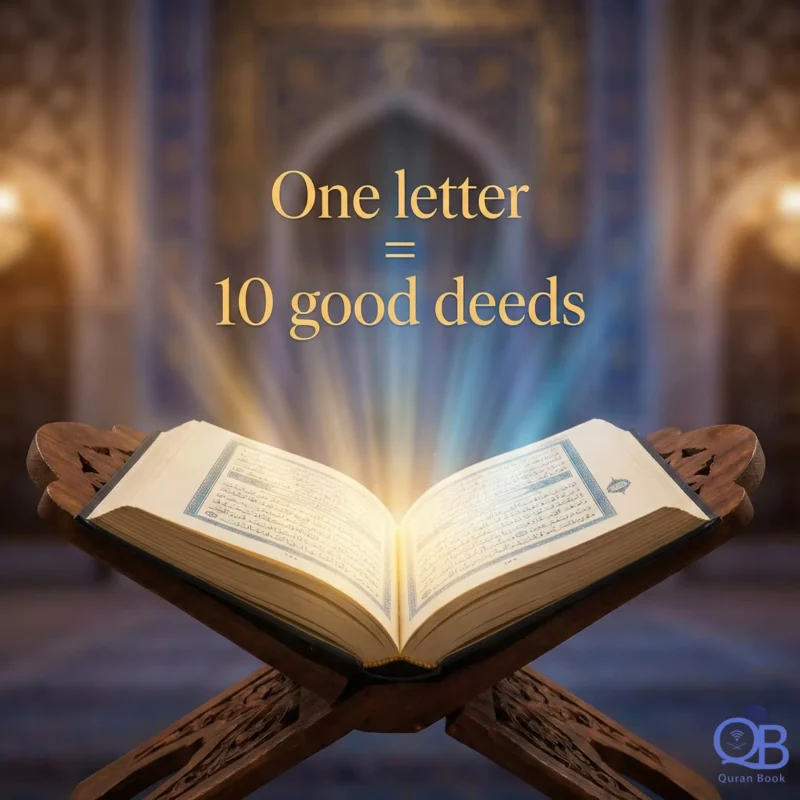
    The spiritual reward for learning the Quran is immense. Every letter recited carries a reward (hasanah) multiplied tenfold, and both the learner and the teacher earn ongoing blessings. This is one of the most profound benefits of learning Quran online – the ability to pursue these divine rewards consistently, from anywhere in the world, without barriers.

    What Is the Reward of Learning and Teaching the Quran?

    The Prophet Muhammad (PBUH) taught us that whoever recites a single letter from the Book of Allah receives a good deed, and that good deed is multiplied ten times. Imagine the rewards accumulated from an entire Surah, an entire Juz, or a complete recitation of the Quran. The reward for teaching the Quran is equally magnificent – it is considered Sadaqah Jariyah, a continuous charity whose reward persists even after death.

    The status of the Hafiz (one who memorizes the entire Quran) and their family on the Day of Judgment is described in numerous ahadith as one of great honor. This spiritual motivation serves as one of the strongest intrinsic drivers of student persistence. When the journey feels challenging, remembering the eternal rewards of Quran education provides the motivation to continue. Explore our Hifz program to start your memorization journey.

    “Whoever recites a letter from the Book of Allah, he will be credited with a good deed, and a good deed gets a ten-fold reward.”

    Jami at-Tirmidhi, Hadith 2910

    “Read! And your Lord is the Most Generous.”

    Quran 96:3

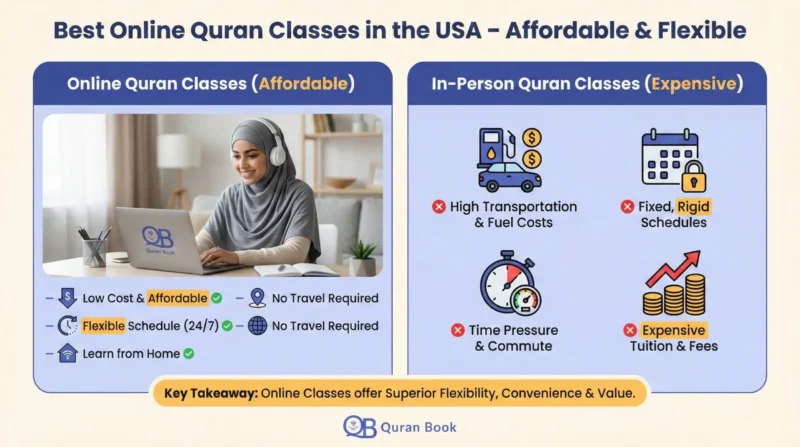
    6. Affordable & Accessible: Best Online Quran Classes in the USA, UK & Beyond

    Best online Quran classes USA – affordable online Quran learning comparison with pricing icons
    Best online Quran classes USA – affordable online Quran learning comparison with pricing icons

    Learning Quran online is significantly more affordable than traditional in-person tutoring. The best online Quran classes in the USA, UK, Canada, and Australia eliminate commuting costs, save valuable time, and offer flexible pricing plans that fit different budgets. Many platforms, including Quran Book Academy, offer free trial lessons so students can experience the quality before committing – making Quran online classes free of risk to begin.

    Cost Comparison: Online vs. In-Person Quran Classes

    Feature Online Classes (Quran Book Academy) In-Person / Masjid Classes
    Teacher Qualification Certified Egyptian Tajweed Teachers Varies by location
    Schedule Flexibility 24/7, any time zone Fixed times only
    Average Cost Affordable monthly plans Higher per-session rates
    Commute None – learn from home Required (time + cost)
    Free Trial Yes (Quran Book Academy) Rarely offered
    Progress Tracking LMS + Automated Gmail Reports Usually none

    Start with a free trial lesson to experience the difference yourself. There is absolutely zero risk – and the potential reward is a lifelong connection with the Quran.

    7. Technology-Powered Progress: Zoom, LMS & Gmail Reports

    Online Quran classes – technology-powered learning with Zoom, LMS dashboard, and progress reports
    Online Quran classes – technology-powered learning with Zoom, LMS dashboard, and progress reports

    Quran Book Academy uses a modern technology stack to ensure every student makes measurable, trackable progress. Our platform combines Zoom for live interactive sessions, a custom Learning Management System (LMS) for tracking milestones, and automated Gmail reports to keep students and parents informed. This technology-driven approach is a key part of what makes online Quran learning so effective in 2026.

    Our Tech Stack

    Zoom

    HD video and crystal-clear audio for live one-on-one and group sessions, with screen sharing for Mushaf display. Students interact face-to-face with their teacher, creating the same personal connection as in-person learning.

    Custom LMS

    Tracks lesson completion, Tajweed milestones, Hifz progress, and attendance in real-time. Students and parents can view their learning journey at a glance and celebrate progress.

    Gmail Reports

    Automated weekly and monthly progress reports are sent directly to students and parents, ensuring transparency and accountability. You always know exactly where you stand in your Quran learning journey.

    Visible progress tracking is not just a convenience – psychological research shows it significantly increases student motivation and reduces dropout rates. When you can see how far you have come, the next step feels achievable. Learn more about how it works at Quran Book Academy.

    FAQ – Your Questions About Learning Quran Online Answered

    What are the benefits of learning the Quran online? +

    The benefits of learning Quran online include access to certified Tajweed teachers worldwide, flexible scheduling for all time zones, affordable pricing with free trial lessons, a safe and private learning environment for women and children, technology-powered progress tracking through LMS and reports, and the immense spiritual rewards of consistent Quran study. Quran Book Academy offers all these benefits with a free trial lesson to get started.

    Is it possible to learn the Quran online? +

    Yes, it is absolutely possible to learn the Quran online. With platforms like Quran Book Academy, students learn through live Zoom sessions with certified Tajweed teachers, using structured curricula like Nour El Bayan and progressive Tajweed courses designed specifically for non-Arabic speakers. Thousands of students across the USA, UK, Canada, and Australia are successfully learning Quran online every day.

    What is the reward for teaching the Quran? +

    The Prophet Muhammad (PBUH) said: “The best among you are those who learn the Quran and teach it” (Sahih al-Bukhari 5027). Teaching the Quran is considered Sadaqah Jariyah – a continuous charity whose reward persists even after death. Both the teacher and the student are blessed in this noble pursuit.

    Can I complete Hifz in 6 months? +

    Completing Hifz (full Quran memorization) in 6 months is possible but extremely intensive, requiring approximately 1.5 pages of memorization daily with consistent revision. Most students benefit from a longer, more sustainable timeline of 1–3 years with regular review cycles. Quran Book Academy’s Hifz program provides personalized pacing to match each student’s capacity and schedule.

    What do you call a person who memorized the Quran? +

    A male who has memorized the entire Quran is called a “Hafiz” (plural: Huffaz). A female who has memorized the Quran is called a “Hafiza.” This title carries great honor and respect in Islam, and the Hafiz holds a special status on the Day of Judgment.

    What are common mistakes in Quran recitation? +

    Common recitation mistakes include incorrect Makhraj (articulation points), ignoring essential Tajweed rules like Ghunnah and Idgham, rushing through verses without proper pauses, and confusing similar-sounding Arabic letters. A qualified Tajweed teacher can identify and correct these errors in real-time during live online sessions.

    Can listening to Quran help with sleep? +

    Many Muslims report that listening to Quran recitation promotes tranquility and better sleep. The Quran itself states: “Verily, in the remembrance of Allah do hearts find rest” (Quran 13:28). While Quran recitation is not a substitute for medical advice, it can be a beneficial and soothing part of a calming bedtime routine.
    Why is Quran education important? +

    Quran education is the foundation of Islamic knowledge. It develops a deep spiritual connection with Allah, teaches timeless moral principles, improves Arabic literacy, and fulfills a fundamental religious duty. Online Quran education makes these benefits accessible to Muslims everywhere, regardless of geographic location or schedule constraints.

    Online Quran learning free trial – start your Quran journey today with Quran Book Academy
    Start your Quran journey today with Quran Book Academy

    Start Your Quran Journey Today with a Free Trial Lesson

    You have read about the benefits of learning Quran online. Now it is time to experience them firsthand. Whether you are an adult taking your first step toward reading the Quran, a parent enrolling your child in a safe and engaging program, or a sister looking for a certified female teacher – Quran Book Academy is ready to guide you.

    Our certified teachers, proven Academy Method, and flexible scheduling make it easy to start. And our free trial lesson means there is absolutely zero risk. Join thousands of students across the USA, Canada, UK, and Australia who have transformed their Quran journey with us.

    References

    Internal Links

    1. About Quran Book Academy
    2. Quran Reading and Tajweed Course
    3. Schedule / Booking Page
    4. Quran for Kids Course / Nour El Bayan Course
    5. Female Teachers Page
    6. Hifz Course / Blog
    7. Pricing Page
    8. How It Works Page
    9. All Courses Page

    External Links & Hadith/Quran Sources

    1. Sahih al-Bukhari, Hadith 5027 – sunnah.com
    2. Sahih al-Bukhari, Hadith 4937 – sunnah.com
    3. Jami at-Tirmidhi, Hadith 2910 – sunnah.com
    4. Quran 54:17 – quran.com
    5. Quran 96:3 – quran.com
    6. Quran 13:28 – quran.com
    7. Telegram Channel – Tajweed Practice
    8. YouTube: Makhraj al-Huruf Video
    9. YouTube: Nour El Bayan Intro

  • Islamic Etiquette Guide

    Islamic Etiquette: 10 Essential Manners Every Muslim Must Know
    QB
    Quran Book Academy
    Free Trial Lesson
    Comprehensive Guide

    Islamic Etiquette: 10 Essential Manners Every Muslim Must Know

    By Quran Book Academy · Updated February 2026

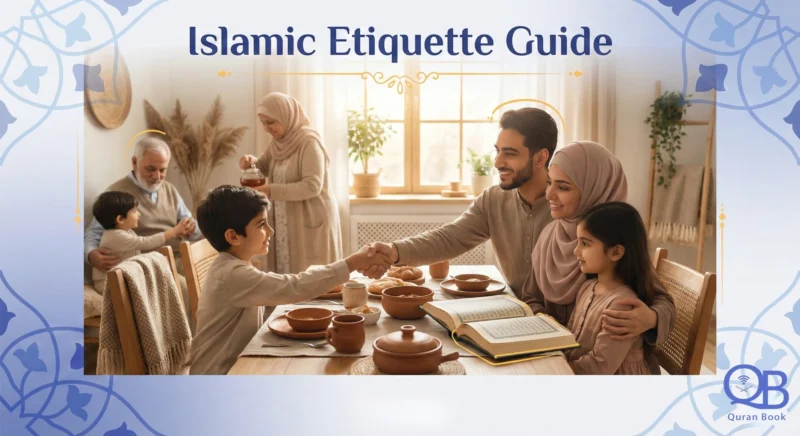
    Islamic etiquette guide showing essential Muslim manners from Quran and Sunnah
    Featured: A Muslim family practicing daily Islamic manners — the spirit of Islamic etiquette in everyday life

    Opening Section — Introduction

    Islamic etiquette (Adab) is the comprehensive code of conduct in Islam that governs how Muslims should behave in every aspect of life — from greeting others with “As-Salamu Alaykum” to eating with the right hand, respecting parents, and speaking with kindness. Rooted in the Quran and the Sunnah of Prophet Muhammad (peace be upon him), Islamic etiquette transforms everyday actions into acts of worship. These Islamic manners are not just social customs; they are a reflection of inner faith and devotion to Allah.

    If you have ever felt unsure about the “right” way to greet someone, eat a meal, or enter a mosque as a Muslim, you are not alone — and this guide was created for you. Many non-Arabic-speaking Muslims feel overwhelmed by Arabic terminology, fear doing things incorrectly, or carry guilt about not knowing basic Islamic manners. These feelings are completely natural. The truth is, learning Islamic etiquette happens in manageable steps, and building confidence comes through consistent, gentle practice.

    “And you are truly a man of outstanding character.” — Quran 68:4

    This verse was revealed about Prophet Muhammad ﷺ, whose entire life was a living example of Islamic etiquette. In this guide, you will discover ten essential rules of Islamic etiquette drawn directly from the Quran and Sunnah — practical, easy-to-follow manners that will elevate your daily life and strengthen your connection with Allah.

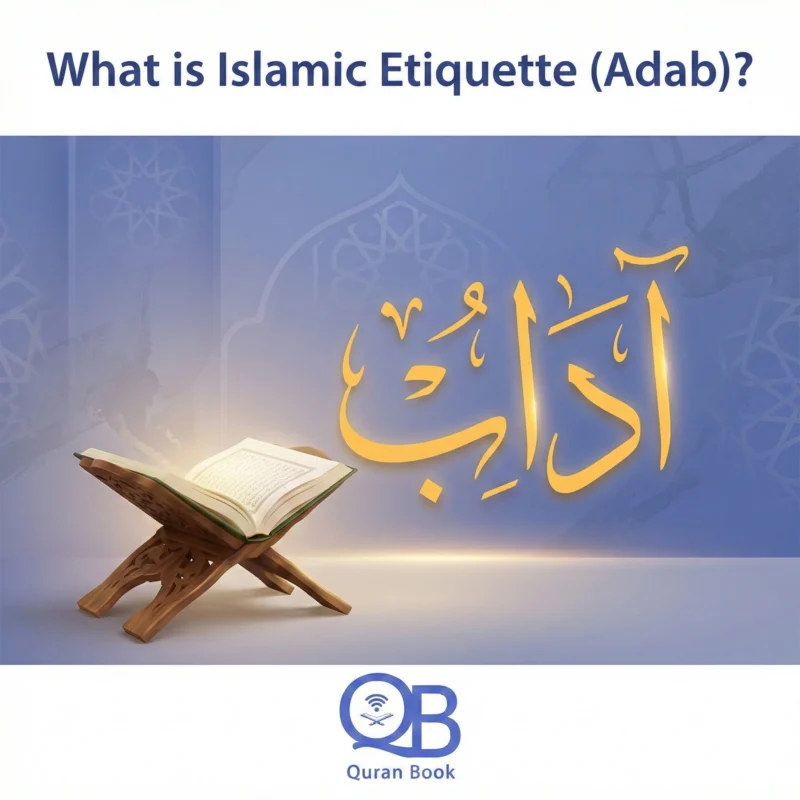
    What Is Islamic Etiquette (Adab)? — The Foundation of Good Character

    What is Islamic etiquette Adab — foundation of good character in Islam
    The Arabic word “Adab” (آداب) alongside the Quran — the spiritual and moral roots of Islamic etiquette

    Islamic etiquette, known in Arabic as “Adab” (آداب), refers to the system of proper manners, moral conduct, and spiritual refinement that Islam teaches. The word Adab linguistically carries the meaning of discipline, courtesy, and culture — but in the Islamic context, it goes far beyond simple politeness.

    While Western etiquette typically focuses on social rules and outward behavior, Islamic etiquette (Adab) combines social refinement with spiritual depth. Every act of courtesy in Islam is performed with the intention of pleasing Allah, making it both an outward practice and an inward act of worship.

    Prophet Muhammad ﷺ embodied Islamic etiquette so perfectly that Aisha (may Allah be pleased with her) described him as “the walking Quran.” His character was not separate from the revelation — it was the revelation in practice. He himself said: “I was sent to perfect noble character.” — Sahih al-Bukhari, Al-Adab Al-Mufrad, Hadith 273

    “Indeed, in the Messenger of Allah you have an excellent example for anyone who hopes in Allah and the Last Day and remembers Allah often.” — Quran 33:21

    Understanding Islamic etiquette begins with understanding that the Prophet ﷺ is the standard. Every manner discussed in this guide traces back to his blessed example.

    ➡️ Learn more about the Prophet’s teachings in our Islamic Studies Course →

    10 Key Rules of Islamic Etiquette from the Quran and Sunnah

    The 10 key rules of Islamic etiquette include greeting with Salam, eating with the right hand, honoring parents, speaking truthfully, being kind to neighbors, controlling anger, practicing modesty, maintaining cleanliness, seeking knowledge with humility, and showing mercy to all creation. These rules are derived directly from the Quran and the Prophetic Sunnah, and they form the backbone of Islamic values that every Muslim should strive to live by.

    1

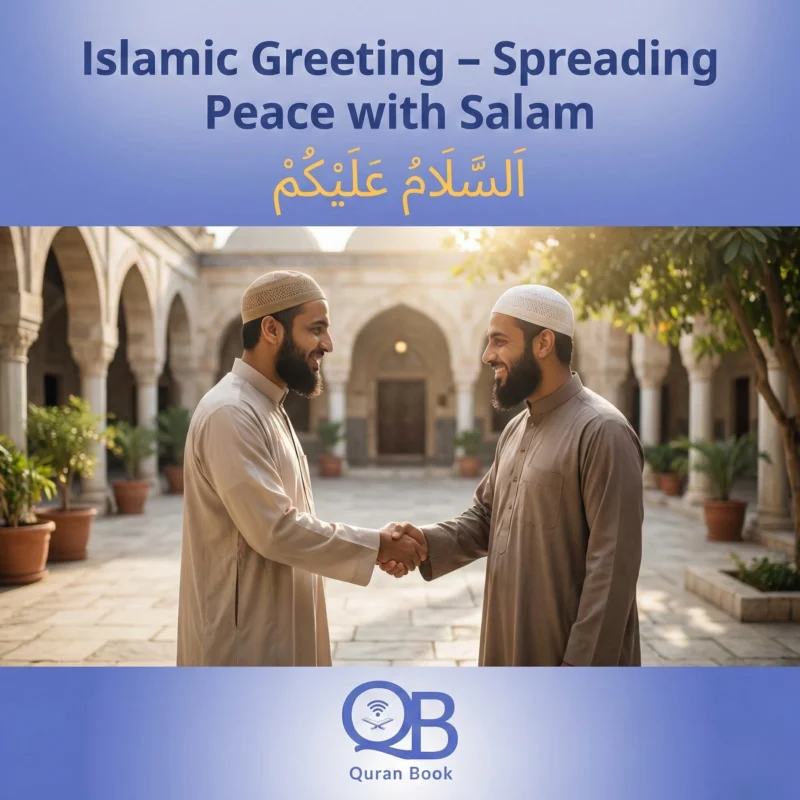
    The Islamic Greeting — Spreading Peace with Salam

    Islamic greeting — spreading peace with Salam as part of Islamic etiquette
    Two Muslims warmly greeting each other — the Sunnah of “As-Salamu Alaykum”

    The Islamic greeting “As-Salamu Alaykum” (peace be upon you) is one of the most recognizable aspects of Islamic etiquette. It is not merely a hello — it is a prayer of peace that you offer to every person you meet. The Muslim greeting carries spiritual weight and strengthens the bonds between believers.

    “You will not enter Paradise until you believe, and you will not believe until you love one another. Shall I tell you of something that will make you love one another? Spread Salam amongst yourselves.” — Sahih Muslim 54

    Allah also commands in the Quran: “When you are greeted with a greeting, greet with one better than it or return it.” — Quran 4:86

    This means if someone says “As-Salamu Alaykum,” you should respond with “Wa Alaykum As-Salam Wa Rahmatullahi Wa Barakatuh” — adding blessings to your reply. This simple exchange is one of the most powerful daily expressions of Islamic etiquette. Similarly, saying “Alhamdulillah” after sneezing and receiving the response “Yarhamuk Allah” is another beautiful part of everyday Islamic manners.

    2

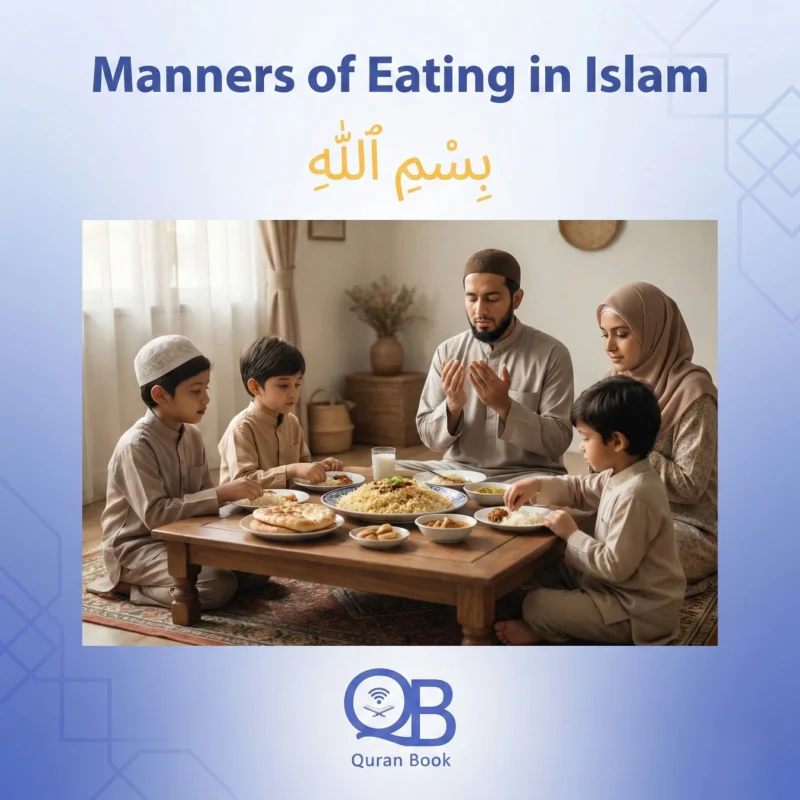
    Eating Manners in Islam — The Sunnah of Every Meal

    Manners of eating in Islam — Sunnah eating etiquette with right hand
    A Muslim family eating with their right hands — proper Islamic eating etiquette

    The manners of eating in Islam transform every meal into an act of worship. Islamic etiquette teaches that you should begin eating by saying “Bismillah” (In the name of Allah), eat with your right hand, and eat from what is nearest to you on the plate.

    “Mention the name of Allah and eat with your right hand, and eat from what is nearest to you.” — Sahih al-Bukhari 5376

    Islam also prohibits wastefulness in food and drink. Allah says in the Quran: “…and eat and drink, but be not excessive. Indeed, He does not like those who commit excess.” — Quran 7:31

    These eating manners in Islam are easy to follow and serve as a constant reminder of gratitude to Allah for every provision. Teaching children these habits early is one of the simplest ways to introduce Islamic etiquette into family life.

    3

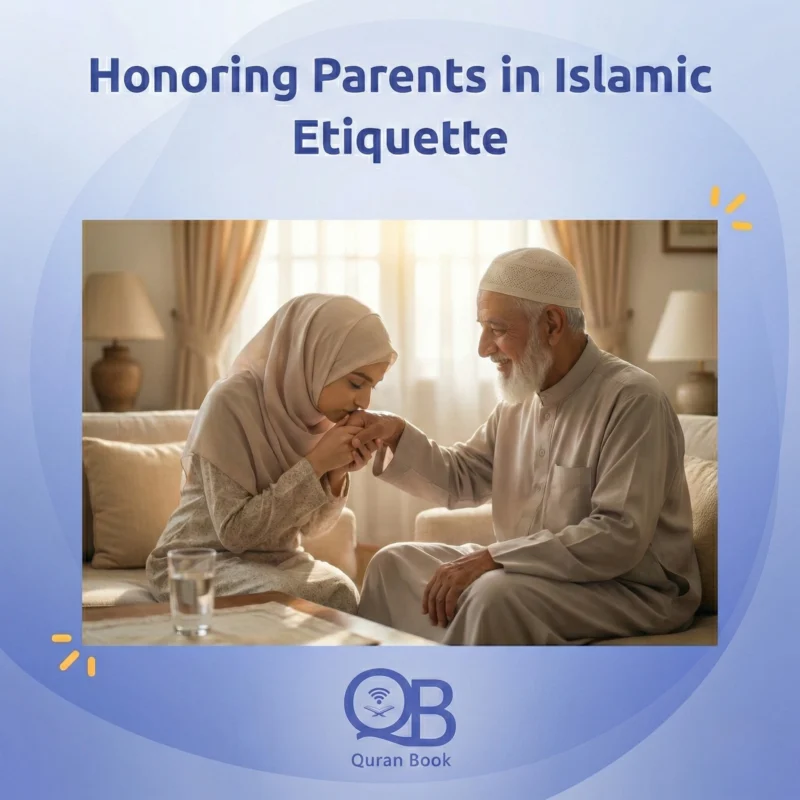
    Honoring and Respecting Parents

    Honoring and respecting parents in Islamic etiquette
    A young Muslim gently holding an elderly parent’s hand — the deep respect Islam places on honoring parents

    Respecting parents holds an extraordinarily high place in Islamic etiquette. Allah pairs obedience to parents directly with worship of Him alone, underscoring how seriously Islam treats this relationship.

    “And your Lord has decreed that you worship none but Him, and that you be kind to parents. Whether one or both of them reach old age in your care, never say to them ‘uff’ and do not repel them, but speak to them a noble word.” — Quran 17:23

    In daily practice, this means speaking to your parents gently, serving their needs willingly, making dua for them, and never raising your voice in frustration. Islamic manners demand that even if you disagree with your parents, you do so with patience and respect. This is one of the most emphasized aspects of Islamic morality.

    4

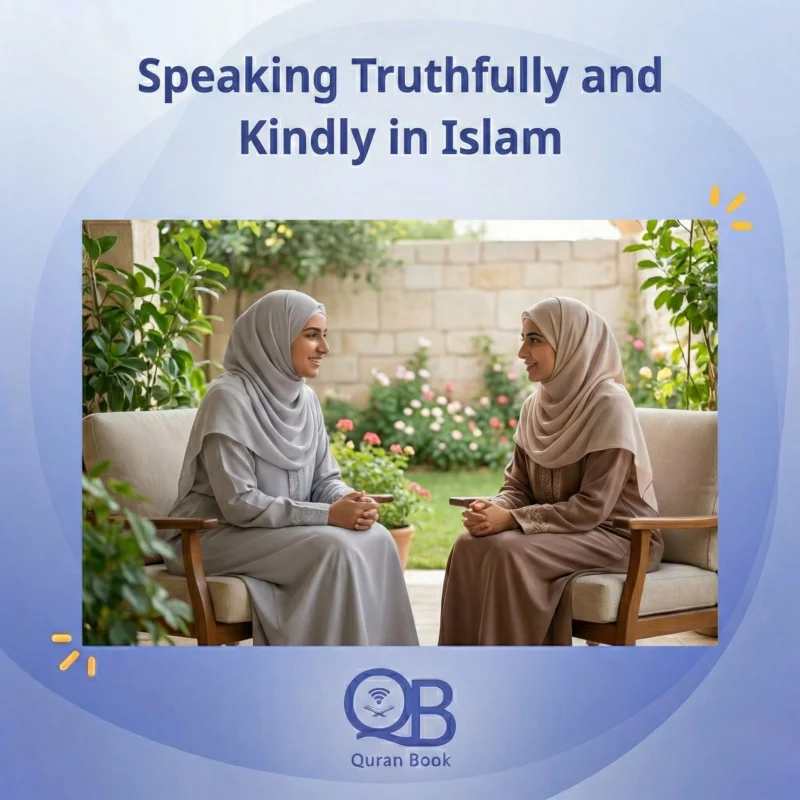
    Speaking Truthfully and Kindly

    Speaking truthfully and kindly as Islamic etiquette in daily life
    A calm conversation symbolizing kind and honest speech — a core principle of Islamic manners

    Islamic etiquette places enormous emphasis on the tongue. What you say — and how you say it — is a direct reflection of your faith. Allah commands in the Quran: “And speak to people good words.” — Quran 2:83

    “Whoever believes in Allah and the Last Day, let him speak good or remain silent.” — Sahih al-Bukhari 6018

    This means that Islamic manners require Muslims to be truthful, to choose words that build rather than destroy, and to prefer silence over harmful speech. Gossip, backbiting, and lying are among the greatest violations of Islamic ethics — not just social mistakes, but sins that carry spiritual consequences.

    5

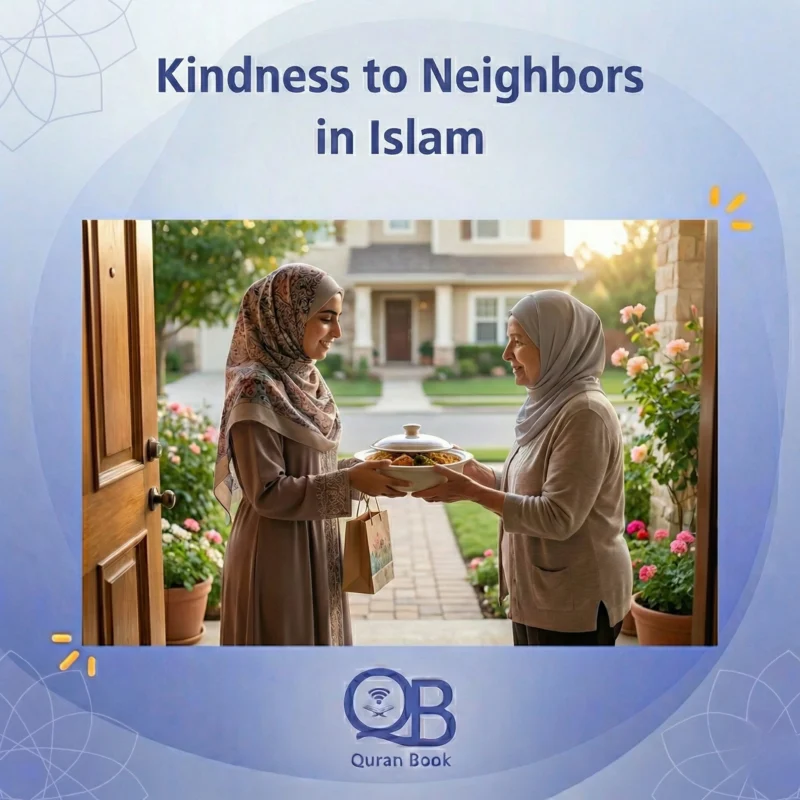
    Being Kind to Neighbors

    Being kind to neighbors — Islamic etiquette and Islamic values
    A Muslim sharing food with a neighbor — the Prophet’s emphasis on neighborly kindness

    Kindness to neighbors is a fundamental aspect of Islamic etiquette that many people overlook. The Prophet ﷺ elevated the right of the neighbor so highly that his companions were astonished.

    “Jibril kept advising me to be kind to my neighbor until I thought he would inherit from me.” — Sahih al-Bukhari 6014

    This means that in Islam, your neighbor has such a strong right over you that it almost resembles family rights. Islamic values teach Muslims to check on their neighbors, share meals with them, avoid causing them any harm, and treat them with generosity regardless of their religion or background. This aspect of Islamic etiquette builds strong, compassionate communities.

    6

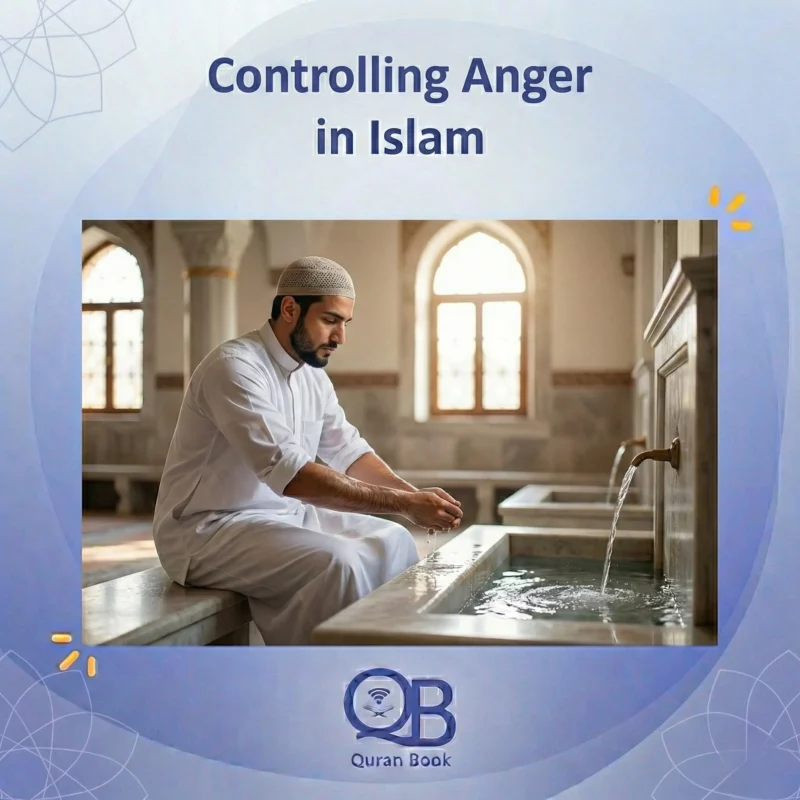
    Controlling Anger — A Sign of True Strength

    Controlling anger in Islam — a sign of true strength in Islamic etiquette
    A Muslim in calm reflection — controlling anger through patience and remembrance of Allah

    Learning to control anger in Islam is considered one of the highest achievements of Islamic etiquette. Society often equates strength with aggression, but the Prophet ﷺ redefined true power.

    “The strong man is not the one who can overpower others. Rather, the strong man is the one who controls himself when he is angry.” — Sahih al-Bukhari 6114

    Allah praises those who practice this restraint: “Those who restrain their anger and pardon people — and Allah loves the doers of good.” — Quran 3:134

    The Sunnah teaches practical steps: when anger strikes, seek refuge in Allah from Shaytan, change your position (if standing, sit; if sitting, lie down), and perform wudu. These are not just spiritual recommendations — they are proven techniques for emotional regulation, fully aligned with Islamic manners.

    7

    Practicing Modesty in Dress and Behavior

    Modesty (Haya’) in Islamic etiquette is not limited to clothing — it encompasses behavior, speech, gaze, and inner attitude. However, modest dress in Islam is one of its most visible expressions.

    “Haya’ (modesty) is a branch of faith.” — Sahih Muslim 35

    Islamic etiquette teaches that modesty protects the individual and the community. It cultivates dignity, self-respect, and focus on character over appearance. For both men and women, practicing modesty is an act of obedience to Allah and a reflection of strong Islamic values. It is not about restriction — it is about liberation from a culture that often reduces human worth to outward appearance.

    8

    Cleanliness — Half of Faith

    Cleanliness holds a unique status in Islamic etiquette — it is not just recommended, it is described as half of the faith itself.

    “Purification is half of faith.” — Sahih Muslim 223

    This covers personal hygiene, cleanliness of clothing, tidiness of living spaces, and most importantly, the spiritual purification of wudu (ablution) before prayer. Islam was teaching the importance of hand-washing, oral hygiene (using the miswak), and bathing centuries before modern hygiene standards were established. Maintaining cleanliness is one of the most practical and daily expressions of Islamic etiquette that every Muslim — adult or child — can implement immediately.

    9

    Seeking Knowledge with Humility

    The etiquette of learning in Islam is a subject that deserves special attention. Seeking knowledge is not just encouraged — it is obligatory.

    “Seeking knowledge is an obligation upon every Muslim.” — Sunan Ibn Majah 224

    But Islamic etiquette does not stop at the act of learning itself. It extends to how you learn: with humility before your teacher, patience with the process, consistency in practice, and sincerity in intention. The best students in Islam are not those who memorize the most, but those who apply what they learn with the best character. This is the essence of Islamic ethics applied to education.

    ➡️ Explore our structured Online Quran Courses for beginners →

    10

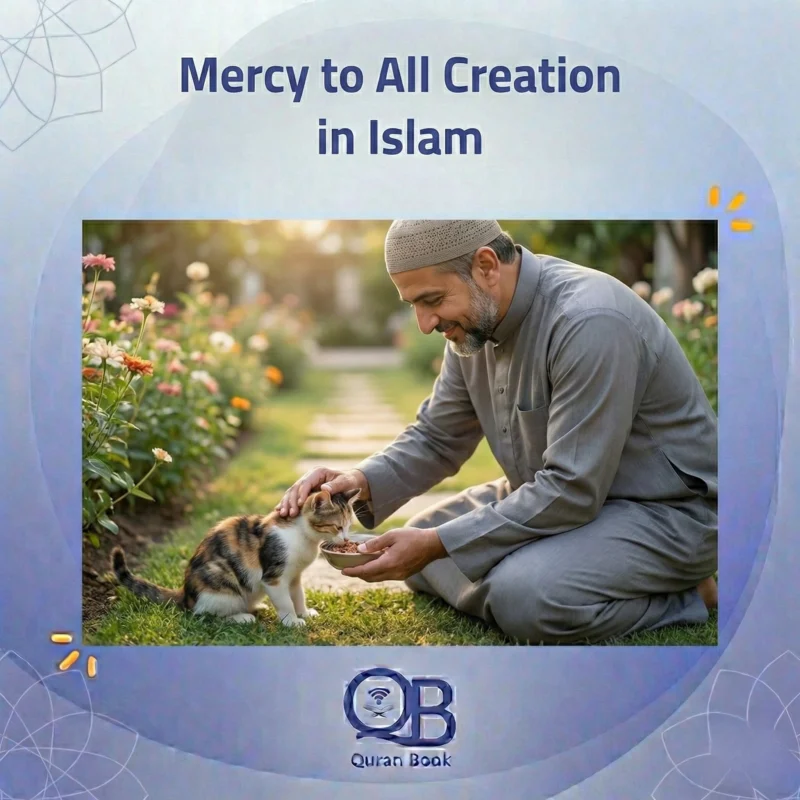
    Showing Mercy and Compassion to All Creation

    Showing mercy and compassion to all creation — Islamic etiquette
    A Muslim showing kindness to all creation — the all-encompassing mercy of Islamic etiquette

    The crown of Islamic etiquette is mercy. It is the quality that defines the entire message of Islam and the mission of Prophet Muhammad ﷺ.

    “Show mercy to those on earth, and the One above the heavens will show mercy to you.” — Sunan Abu Dawud 4941

    And Allah declares: “And We have not sent you, [O Muhammad], except as a mercy to the worlds.” — Quran 21:107

    Islamic manners require Muslims to show compassion to all of creation — humans, animals, and even the environment. This is not optional kindness; it is a fundamental principle of Islamic morality. When you practice mercy in your daily interactions, you are embodying the highest form of Islamic etiquette and walking in the footsteps of the Prophet ﷺ.

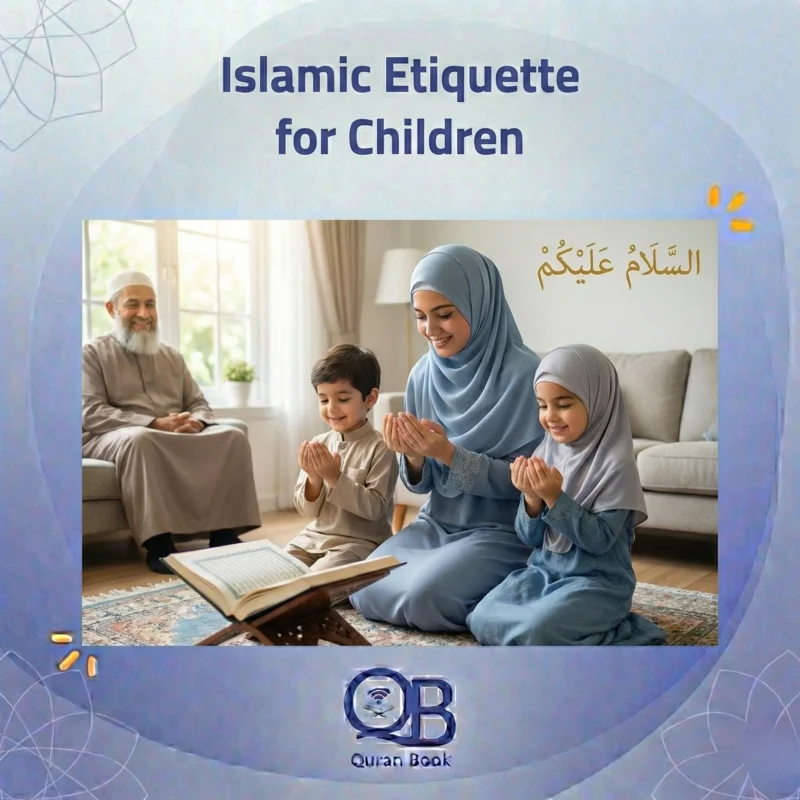
    Islamic Etiquette for Children — Building Character from a Young Age

    Islamic etiquette for children — teaching Islamic manners for kids
    Young Muslim children learning to pray and greet elders — Islamic manners begin with gentle guidance

    Islamic etiquette for children starts with teaching them the basics: saying “Bismillah” before eating, greeting others with Salam, respecting elders, sharing with friends and siblings, and speaking kindly. The Prophet Muhammad ﷺ was remarkably gentle with children, and Islam encourages parents to teach Islamic manners for kids through love, patience, and consistent modeling — never through harshness or fear.

    Age-appropriate Islamic manners can be introduced naturally. Toddlers can learn to say “Bismillah” before meals. School-aged children can practice the Islamic greeting with family members every morning. Older children can be taught mosque etiquette, the importance of honesty, and the value of helping others. The key principle from educational psychology is that children learn best through storytelling, positive reinforcement, and watching their parents practice what they teach.

    The Prophet ﷺ used to allow children to climb on his back during prayer, and he would lengthen his prostration so as not to disturb them. He kissed his grandchildren and expressed love openly. When a companion said he had ten children and had never kissed any of them, the Prophet ﷺ responded by saying that one who does not show mercy will not be shown mercy.

    As parents, you are your child’s first and most important teacher of Islamic etiquette. The habits you build in them today become the character they carry for life.

    How to Practice Islamic Etiquette in a Mosque

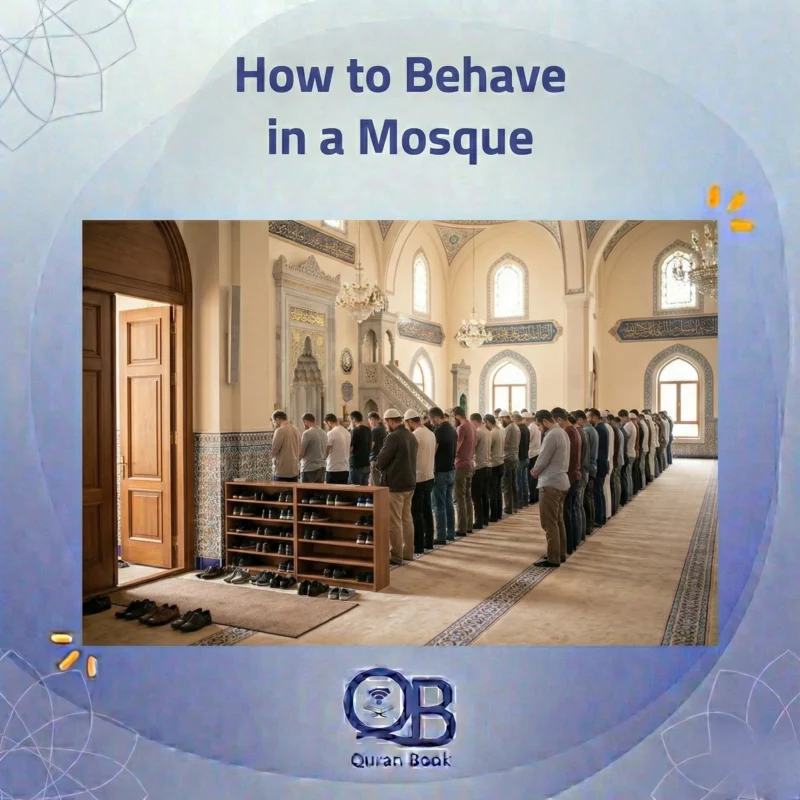
    How to behave in a mosque — Islamic etiquette for mosque visits
    A beautiful mosque interior with Muslims praying in orderly rows — proper Islamic etiquette in sacred spaces

    Islamic etiquette in a mosque includes entering with the right foot while saying a dua, praying two rak’ahs of Tahiyyat al-Masjid (greeting the mosque), keeping your voice low, maintaining cleanliness, and avoiding walking in front of someone praying. The mosque is a sacred space, and observing proper manners reflects your reverence for Allah. Here is how to behave in a mosque according to the Sunnah:

    1

    Enter with your right foot and say: “Allahumma iftah li abwaba rahmatik” (O Allah, open for me the doors of Your mercy).

    2

    Pray two rak’ahs of Tahiyyat al-Masjid before sitting down, as the Prophet ﷺ instructed.

    3

    Keep your voice low — the mosque is a place of worship and reflection, not casual conversation.

    4

    Maintain cleanliness — ensure your body, clothes, and breath are clean before entering.

    5

    Do not walk in front of someone praying — this is a specific prohibition in Islamic etiquette.

    6

    Leave with your left foot and say: “Allahumma inni as’aluka min fadlik” (O Allah, I ask You of Your bounty).

    These mosque manners are simple to learn and deeply rewarding to practice. They reflect the depth of Islamic etiquette in sacred spaces.

    The Academy Method — How Quran Book Academy Teaches Islamic Etiquette and Quran with Confidence

    Quran Book Academy teaching Islamic etiquette and Quran online
    An online Quran lesson at Quran Book Academy — personalized, confidence-building Islamic education

    At Quran Book Academy, we believe that learning Islamic etiquette is not separate from learning the Quran — they are deeply intertwined, and mastering one enriches the other. Our unique methodology is built on educational psychology principles that break the learning journey into manageable psychological “chunks,” ensuring that every student progresses at a pace that builds genuine confidence rather than overwhelming pressure. Through live Zoom sessions with certified teachers who specialize in Quran reading with Tajweed, Islamic studies, and Islamic etiquette, each student receives personalized attention tailored to their current level — whether they are a complete beginner with no Arabic background or an intermediate learner seeking to refine their recitation and deepen their understanding of Islamic manners. Our custom-built Learning Management System (LMS) tracks each student’s progress in real time, and Gmail-based progress reports are sent regularly to parents and adult learners so they always know exactly where they stand — eliminating the fear of falling behind and removing all guesswork from the learning process. Our courses are specifically designed for non-Arabic speakers, so no prior knowledge is needed to begin. The method is rooted in one core principle: consistency in small, well-structured steps leads to mastery — in Quran reading, Tajweed rules, and Islamic character development alike. When you learn with Quran Book Academy, you are not just studying a subject — you are transforming your daily life through the beauty of Islamic etiquette and the guidance of the Quran.

    Comparison Table — Islamic Etiquette in Daily Life Situations

    Situation Islamic Etiquette (Sunnah Way) Common Mistake
    Before eating Say “Bismillah,” eat with right hand Forgetting to mention Allah’s name
    Meeting someone Greet with “As-Salamu Alaykum” Skipping the greeting or mumbling
    Entering a mosque Enter with right foot, pray Tahiyyat al-Masjid Walking in without greeting the mosque
    Speaking to parents Use gentle, respectful tone Raising your voice or being dismissive
    When angry Stay silent, seek refuge in Allah, sit or lie down Reacting impulsively or shouting
    Getting dressed Practice modesty, begin with the right side Ignoring the Sunnah of dressing
    Before sleeping Recite Ayat al-Kursi, sleep on right side Sleeping without remembrance of Allah

    Frequently Asked Questions About Islamic Etiquette

    Q1: What is Islamic etiquette?

    Islamic etiquette, known as Adab in Arabic, is the complete code of manners and moral conduct taught by the Quran and the Prophet Muhammad ﷺ. It covers how Muslims should eat, greet, speak, dress, interact with family and strangers, and worship — transforming everyday actions into acts of worship.

    Q2: What are the 10 rules in Islam?

    The 10 foundational rules of Islamic etiquette include spreading Salam, eating with the right hand, honoring parents, speaking truthfully, being kind to neighbors, controlling anger, practicing modesty, maintaining cleanliness, seeking knowledge humbly, and showing mercy to all creation.

    Q3: What are Islamic manners?

    Islamic manners (Akhlaq) refer to the moral character traits that Islam encourages, such as honesty, patience, generosity, humility, and kindness. The Prophet ﷺ taught that the heaviest thing on the Scale of Deeds on the Day of Judgment will be good character. — Sunan Abu Dawud 4799

    Q4: What is Islamic etiquette for children?

    Islamic etiquette for children includes teaching them to say Bismillah before eating, greeting elders with Salam, being kind to siblings and friends, telling the truth, and learning to share. The Prophet ﷺ taught children gently and with love, making him the ultimate example of nurturing Islamic manners in young hearts.

    Q5: What is the etiquette of learning in Islam?

    The etiquette of learning in Islam includes approaching knowledge with sincerity, respecting the teacher, being patient and consistent, asking questions politely, and applying what you learn. The Prophet ﷺ said that seeking knowledge is obligatory for every Muslim.

    Q6: What is the proper response to “Alhamdulillah”?

    When someone says “Alhamdulillah” after sneezing, the correct Alhamdulillah response is “Yarhamuk Allah” (May Allah have mercy on you). The one who sneezed should then reply, “Yahdikum Allah wa yuslihu balakum” (May Allah guide you and set your affairs right). — Sahih al-Bukhari 6224

    Free trial lesson at Quran Book Academy — learn Islamic etiquette online
    Book your FREE Trial Lesson at Quran Book Academy and start your learning journey

    Start Your Journey — Free Trial Lesson at Quran Book Academy

    Learning Islamic etiquette and Quran is a journey, not a destination — and every journey begins with a single step. You do not need to be perfect. You just need to begin.

    Ready to learn Islamic etiquette, Quran reading, and Tajweed with expert teachers who understand your pace? At Quran Book Academy, we offer live Zoom lessons, a personal LMS dashboard to track your progress, and certified teachers for kids and adults — all from the comfort of your home.

    References

    All Quranic verses and Hadith references cited in this article are sourced from authentic Islamic texts. Click any reference to view the original source.

    Quran 68:4 — Outstanding Character · quran.com/68/4

    Quran 33:21 — Excellent Example · quran.com/33/21

    Sahih Muslim 54 — Salam Hadith · sunnah.com

    Quran 4:86 — Greeting Verse · quran.com/4/86

    Sahih al-Bukhari 5376 — Eating Hadith · sunnah.com

    Quran 7:31 — Excess Verse · quran.com/7/31

    Quran 17:23 — Parents Verse · quran.com/17/23

    Quran 2:83 — Good Words Verse · quran.com/2/83

    Sahih al-Bukhari 6018 — Speech Hadith · sunnah.com

    Sahih al-Bukhari 6014 — Neighbor Hadith · sunnah.com

    Sahih al-Bukhari 6114 — Anger Hadith · sunnah.com

    Quran 3:134 — Restraining Anger · quran.com/3/134

    Sahih Muslim 35 — Modesty Hadith · sunnah.com

    Sahih Muslim 223 — Purification Hadith · sunnah.com

    Sunan Ibn Majah 224 — Knowledge Hadith · sunnah.com

    Sunan Abu Dawud 4941 — Mercy Hadith · sunnah.com

    Quran 21:107 — Mercy to the Worlds · quran.com/21/107

    Sunan Abu Dawud 4799 — Good Character Hadith · sunnah.com

    Sahih al-Bukhari 6224 — Sneezing Etiquette · sunnah.com

    📖

    Quran Book Academy

    Transforming lives through the beauty of Islamic etiquette and the guidance of the Quran.

    © 2026 Quran Book Academy. All rights reserved.

  • essential arabic phrase

    7 Powerful Basic Arabic Phrases of Virtue Every Muslim Should Learn | Quran Book Academy
    Islamic Learning Guide

    7 Powerful Basic Arabic Phrases of Virtue Every Muslim Should Learn

    Master Bismillah, Alhamdulillah, SubhanAllah and more — with correct Tajweed pronunciation and deep spiritual context.

    By Quran Book Academy | © 2026 quranbookonline.com

    Introduction: Why Learning Basic Arabic Phrases Changes Your Spiritual Life

    Muslim woman learning basic Arabic phrases from the Quran during morning study
    A warm, natural-light photo of a Muslim woman reading the Quran at a wooden desk, symbolizing the beginning of learning basic Arabic phrases.

    Basic Arabic phrases rooted in Islamic virtues—like Alhamdulillah, SubhanAllah, and JazakAllahu Khairan—are more than simple words. They are daily acts of worship that connect every Muslim to the Quran and Sunnah, regardless of their native language. Whether you are a new revert or a lifelong believer seeking deeper understanding, mastering these basic Arabic phrases can genuinely transform the way you pray, give thanks, and navigate everyday life.

    If you have ever felt overwhelmed trying to learn Arabic, or worried you would never pronounce it correctly—you are not alone. Millions of Muslims around the world share that same concern. The encouraging truth is that you only need a handful of powerful, virtue-based phrases to elevate your daily worship and strengthen your connection with Allah.

    Allah says in the Quran: “Indeed, We have sent it down as an Arabic Quran so that you might understand.”Quran 12:2

    This verse reminds us that Arabic is the chosen language of divine guidance. Learning even a few common Arabic words opens a window into the meaning behind your prayers and dhikr.

    In this comprehensive guide, we will walk you through the 7 most essential Arabic phrases about virtues, explain their deep spiritual significance, and show you exactly how to pronounce and use them. You will also discover a practical step-by-step method to master these easy Arabic words with correct Tajweed. Let’s begin.

    ➤ Start your Arabic journey → Quran Reading Course

    What Are Virtues-Based Arabic Phrases? (And Why They Matter for Muslims)

    Arabic calligraphy showing common Arabic words and virtue phrases from the Quran
    Elegant Islamic calligraphy artwork displaying key Arabic virtue phrases like Alhamdulillah and SubhanAllah on a cream background.

    Virtues-based Arabic phrases for beginners are expressions deeply rooted in Islamic moral teachings—gratitude, patience, praise, and mercy. Unlike casual greetings such as “Marhaba” (Hello) or “Shukran” (Thanks), these virtue phrases carry spiritual reward (ajr) and are used in daily prayers, Quran recitation, and interactions between Muslims worldwide. When you say “Alhamdulillah,” you are not simply expressing thanks; you are performing an act of worship that the Prophet Muhammad (PBUH) practiced and encouraged.

    Understanding the difference between common Arabic phrases and virtue-based ones is essential. Common phrases serve social purposes, while virtue phrases serve both social and spiritual purposes simultaneously. This distinction is what makes learning basic Arabic words and phrases of virtue so uniquely rewarding for every Muslim.

    Comparison Table: Common vs. Virtue-Based Phrases

    Type Example Meaning Spiritual Context
    Common Greeting Marhaba Hello Social only
    Virtue As-salamu Alaykum Peace be upon you Sunnah greeting with reward
    Common Thanks Shukran Thanks Social only
    Virtue JazakAllahu Khairan May Allah reward you Hadith-based supplication
    The Prophet Muhammad (PBUH) said: “The best of you are those who learn the Quran and teach it.”Sahih al-Bukhari 5027

    The Quranic foundation of these phrases is unmistakable. These learn Arabic words and phrases appear throughout the Quran and Hadith, forming the spiritual vocabulary every Muslim should know.

    ➤ Learn proper Quran pronunciation → Tajweed Course

    7 Essential Basic Arabic Phrases of Virtue (with Meaning & Pronunciation)

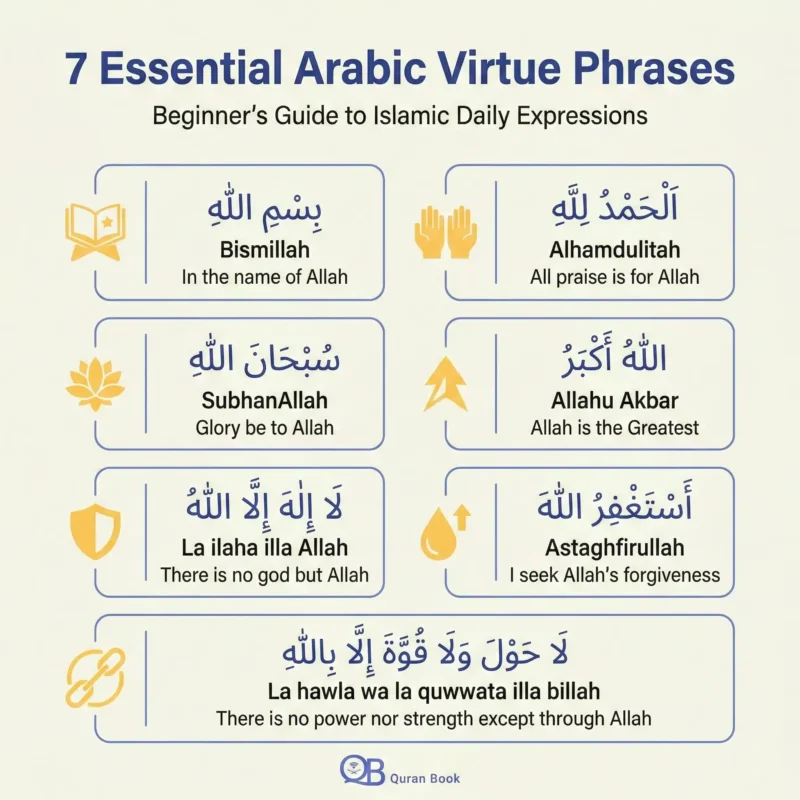
    Infographic showing 7 basic Arabic phrases of virtue with meanings for beginners
    A clean, modern infographic listing all 7 virtue phrases with Arabic script, transliteration, and English meaning.

    The 7 most essential basic Arabic phrases of virtue are: Bismillah, Alhamdulillah, SubhanAllah, Allahu Akbar, Astaghfirullah, JazakAllahu Khairan, and La hawla wa la quwwata illa billah. Each carries deep spiritual significance rooted in the Quran and authenticated Hadith. Below, we explore every phrase in detail so you can learn Arabic words and phrases with full confidence.

    ١

    1. Bismillah (بِسْمِ اللّهِ)

    — In the Name of Allah

    Bismillah is the phrase every Muslim utters before eating, drinking, entering the home, starting a new task, or beginning any significant action. It is the declaration of intention that invites Allah’s blessing into everything you do.

    Remarkably, every surah in the Quran (except Surah At-Tawbah) begins with Bismillah. This makes it one of the most frequently recited basic Arabic phrases in the entire Islamic tradition. Quran 1:1

    🎙 Pronunciation Tip: Focus on the soft “s” sound in “Bis” and the elongated “Lah” at the end. Learning proper Tajweed ensures you honor every letter of this sacred phrase.

    ٢

    2. Alhamdulillah (الحَمْدُ لِلّهِ)

    — All Praise is for Allah

    This is the Islamic way to express gratitude—and it directly answers the popular question: how to say thank you in Arabic the Islamic way. When you say Alhamdulillah, you acknowledge that every blessing comes from Allah alone.

    The Quran opens with this very phrase: “Alhamdulillahi Rabbil Aalameen” (All praise is for Allah, Lord of all worlds — Quran 1:2). Muslims say Alhamdulillah after sneezing, after meals, upon waking, and in moments of both joy and hardship.

    ٣

    3. SubhanAllah (سُبْحَانَ اللّهِ)

    — Glory Be to Allah

    SubhanAllah is an expression of awe and wonder at Allah’s creation and perfection. The Prophet Muhammad (PBUH) said: “SubhanAllah fills half the scale” (Sahih Muslim 223). Muslims recite SubhanAllah 33 times after every prayer as part of the Tasbih, making it one of the most powerful easy Arabic words you can add to your daily worship routine.

    ٤

    4. Allahu Akbar (اللّهُ أكْبَرُ)

    — Allah is the Greatest

    Allahu Akbar is perhaps the most recognized Arabic phrase worldwide. It is spoken in every unit of Salah (prayer), during the Adhan (call to prayer), and in moments of profound reverence.

    Saying Allahu Akbar reminds the believer that no matter how great worldly challenges may seem, Allah is always greater. Correct pronunciation through Tajweed training is especially important for this phrase since it forms the structural backbone of Muslim prayer.

    ٥

    5. Astaghfirullah (أسْتَغْفِرُ اللّهَ)

    — I Seek Allah’s Forgiveness

    The Prophet Muhammad (PBUH) used to seek Allah’s forgiveness more than 70 times every single day (Sahih al-Bukhari 6307). Astaghfirullah is the phrase of repentance, humility, and spiritual renewal. It addresses one of the deepest human needs—the need for self-forgiveness and a fresh start. For Muslims experiencing spiritual anxiety or guilt, regularly saying Astaghfirullah brings peace of heart and closeness to Allah.

    ٦

    6. JazakAllahu Khairan (جَزَاكَ اللّهُ خَيْرًا)

    — May Allah Reward You with Good

    JazakAllahu Khairan is the Islamic alternative to simply saying “thank you.” The Prophet (PBUH) taught: “Whoever has a favour done for him and says JazakAllahu Khairan has done enough in thanking.” (Tirmidhi 2035). This beautiful phrase addresses the keyword how to say thank you in Arabic in the most spiritually complete way.

    A common related response is “Allah Yisalmak” (الله يسلمك), meaning “May Allah keep you safe.” It is used when someone does you a kindness or favour.

    ٧

    7. La Hawla Wa La Quwwata Illa Billah (لا حَوْلَ وَلا قُوَّةَ إِلّا بِاللّهِ)

    — There is No Power Except with Allah

    Known as the “treasure of Paradise” (Sahih al-Bukhari 4205), this profound phrase is the ultimate declaration of tawakkul (reliance on Allah). Muslims recite it during times of hardship, before important decisions, and whenever they feel overwhelmed by life’s challenges. It is the longest of our seven basic Arabic phrases, but its spiritual weight makes every syllable worth memorizing.

    How These 7 Phrases Map to the Core Islamic Virtues

    When you look at these seven basic Arabic words and phrases together, a beautiful pattern emerges. Each phrase maps directly to a foundational Islamic virtue that shapes the believer’s daily life.

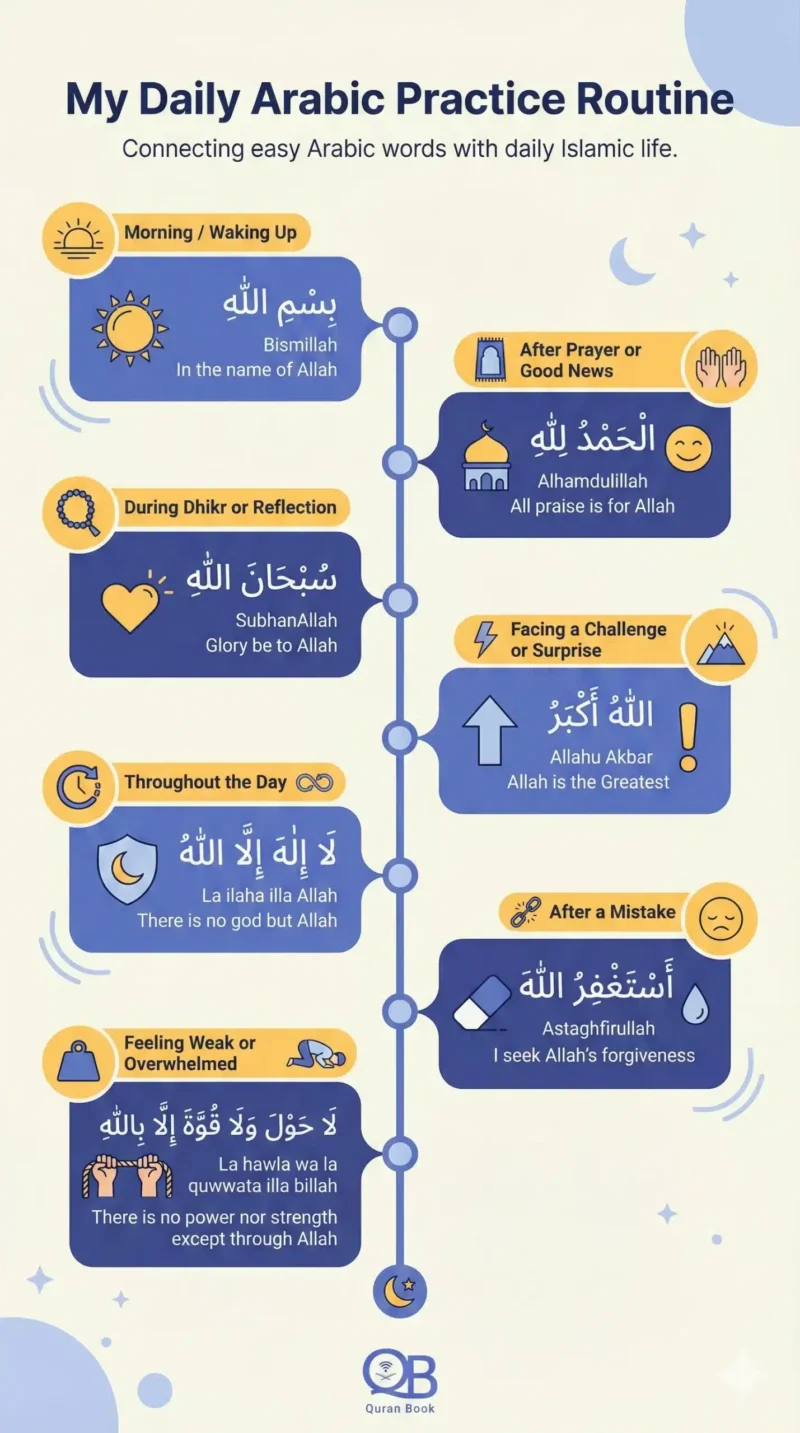
    Bismillah represents intention (niyyah). Alhamdulillah embodies gratitude (shukr). SubhanAllah captures wonder and awe (ta’ajjub). Allahu Akbar instills humility (khushu’). Astaghfirullah cultivates repentance (tawbah). JazakAllahu Khairan fosters generosity of spirit (karam). La Hawla Wa La Quwwata Illa Billah anchors the believer in complete reliance on Allah (tawakkul).

    Educational psychologists call this approach “chunking”—learning manageable, meaningful pieces rather than trying to absorb an entire language at once. By mastering just these seven basic Arabic phrases, you build a spiritual vocabulary that strengthens your salah, your dhikr, and your daily interactions as a Muslim.

    How to Learn Basic Arabic Phrases with Correct Tajweed (Step-by-Step)

    To learn Arabic words and phrases with correct Tajweed, follow this proven five-step method: listen to native recitation, break each phrase into syllables, practice with a qualified teacher, use spaced repetition daily, and record yourself for self-assessment. Here is how each step works in detail.

    5 Steps to Master Arabic Virtue Phrases

    1

    Listen to Native Pronunciation

    Before attempting to speak, listen to a native Arabic speaker or qualified Quran teacher recite each phrase multiple times. Pay attention to the rhythm, the emphasis, and the unique Arabic sounds that do not exist in English. Audio and video resources from trusted teachers are invaluable at this stage.

    2

    Break Each Phrase into Syllables

    Use the “chunking” method: break long phrases like “La Hawla Wa La Quwwata Illa Billah” into small, manageable syllable groups. Practice each chunk separately before combining them into the full phrase.

    3

    Practice with a Live Quran Teacher via Zoom

    Nothing replaces real-time feedback from a certified teacher. A qualified instructor can hear subtle pronunciation errors and correct them immediately, preventing bad habits from forming.

    4

    Use Spaced Repetition

    Review phrases at increasing intervals—daily at first, then every few days, then weekly. This scientifically proven technique transfers knowledge from short-term to long-term memory.

    5

    Record Yourself and Compare

    Use your phone to record your recitation, then compare it with your teacher’s model. This self-assessment accelerates improvement and builds confidence.

    🎥 YouTube Video Resources

    We highly recommend visiting the Quran Book Academy YouTube Channel where our certified teachers demonstrate correct pronunciation of each virtue phrase. Our channel also features a fun and engaging series that teaches Arabic letters in a playful, kid-friendly way—perfect for children and absolute beginners who want to build a strong foundation before tackling phrases.

    Additionally, we recommend the Nour El Bayan course on YouTube—a widely respected Arabic reading methodology that takes learners from recognizing individual letters all the way to fluent Quran reading. Combining Nour El Bayan with our live Tajweed sessions creates a comprehensive learning path for mastering basic Arabic phrases and beyond.

    ➤ Book a free Tajweed lesson → Tajweed Course

    The Academy Method: How Quran Book Academy Teaches Arabic Phrases

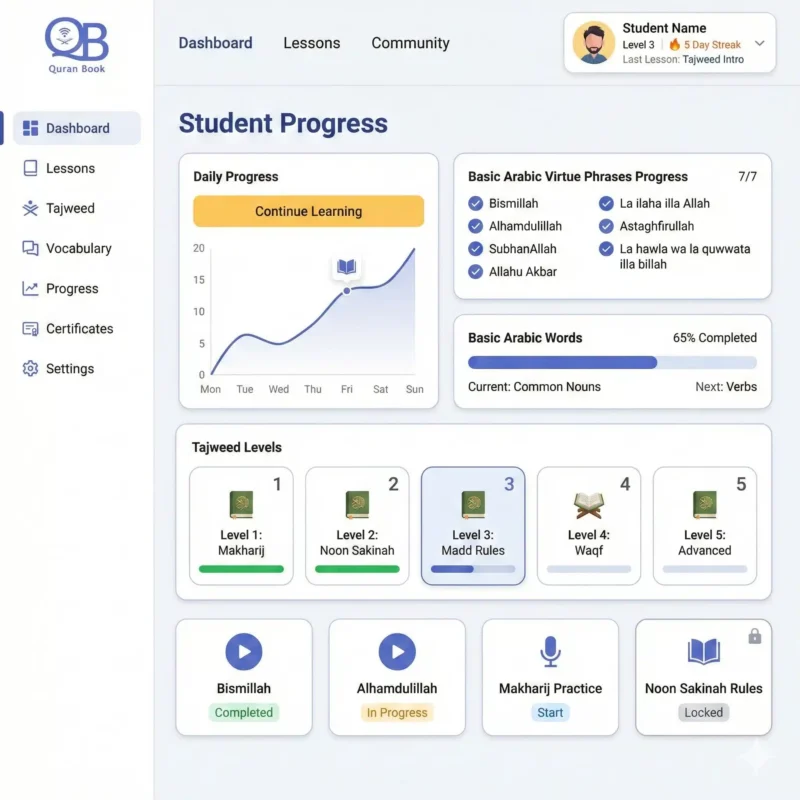
    Quran Book Academy LMS dashboard for tracking basic Arabic words and phrases progress
    A clean mockup of the Quran Book Academy Learning Management System showing a student’s progress through Arabic phrases and Tajweed levels.

    Quran Book Academy uses a proven 3-step methodology to help students master basic Arabic phrases and develop full Quran reading fluency: live one-on-one Zoom sessions with certified teachers, a custom Learning Management System (LMS) to track progress and send email reports, and a psychological “chunking” approach that builds confidence through manageable daily practice.

    🎓

    Live Zoom Sessions with Certified Teachers

    Every student receives personalized, one-on-one instruction via Zoom. Our certified teachers use screen sharing for real-time correction of Arabic pronunciation. Unlike group classes where individual errors go unnoticed, our approach ensures every mispronunciation is caught and corrected immediately.

    📊

    Custom LMS + Email Progress Reports

    Our custom-built Learning Management System tracks each student’s journey through Arabic letters, words, phrases, Tajweed rules, and Quran surahs. Parents of young learners receive regular email progress reports, creating transparency and accountability.

    🧠

    Psychological Chunking for Quran Reading Fluency

    Our curriculum follows the educational psychology principle of “chunking”: breaking complex Arabic into small, repeatable pieces. The learning path moves from Arabic letters → common Arabic words → basic Arabic phrases → Quran verses → full surahs.

    Practice Arabic Phrases Daily: Free Resources & Community

    Daily practice routine for learning easy Arabic words and basic Arabic phrases
    A visually appealing schedule graphic showing when to use each Arabic virtue phrase throughout a typical Muslim’s day.

    Practice basic Arabic phrases daily by incorporating them into your natural routine: say Bismillah before meals, recite Tasbih after every Salah, express Alhamdulillah throughout the day, and close your evening with Astaghfirullah. Consistency—not perfection—is the key to fluency. Here is a simple daily practice routine you can start today.

    Daily Practice Routine

    Time of Day Phrase Context
    ☀️ Morning Bismillah Before breakfast
    🌅 After Fajr SubhanAllah x33 Tasbih after Salah
    🕐 Anytime Alhamdulillah Express gratitude
    🤝 After any favour JazakAllahu Khairan Thank someone the Islamic way
    🌙 Evening Astaghfirullah Before sleep — seek forgiveness

    Join Our Community for Daily Practice

    Join the Quran Book Academy Telegram Community for daily Arabic phrase challenges, teacher Q&A sessions, and live recitation circles. Practicing with a supportive community keeps you motivated and accountable on your journey to mastering basic Arabic words and phrases.

    FAQ: Common Questions About Basic Arabic Phrases

    Q What are the most useful Arabic phrases?

    The most useful basic Arabic phrases for Muslims are Bismillah (In the name of Allah), Alhamdulillah (All praise is for Allah), SubhanAllah (Glory to Allah), and Allahu Akbar (Allah is Greatest).

    Other essential phrases include Astaghfirullah (I seek forgiveness), JazakAllahu Khairan (May Allah reward you), and La hawla wa la quwwata illa billah (There is no power except with Allah). These 7 virtue phrases are used in daily worship and carry spiritual reward.

    Q What are some famous Arabic sayings?

    Famous Arabic sayings rooted in Islamic virtue include “In sha Allah” (If Allah wills), “Ma sha Allah” (What Allah has willed), and “Tawakkul ala Allah” (Reliance on Allah). These phrases reflect core Islamic values of trust, gratitude, and submission to Allah’s divine will.

    Q What are common Arabic phrases with English meaning?

    Common Arabic phrases with English meanings include: As-salamu Alaykum (Peace be upon you), Alhamdulillah (Praise be to God), SubhanAllah (Glory to God), Bismillah (In the name of God), and Astaghfirullah (I seek God’s forgiveness). Each of these is both a greeting or expression and an act of worship in Islam.

    Q When to say الله يسلمك (Allah Yisalmak)?

    You say “Allah Yisalmak” as a response when someone does you a favour or when someone greets you with “As-salamu Alaykum” in certain dialects. It means “May Allah keep you safe and well.” It is a virtuous expression of care and supplication for another person’s wellbeing.

    Q What does “Yalla Wallah” mean?

    “Yalla” means “let’s go” or “hurry up,” while “Wallah” means “I swear by Allah.” Together, “Yalla Wallah” is a casual Arabic expression meaning “Let’s go, I swear!” While common in spoken Arabic, it is important to note that swearing by Allah is a serious matter in Islam and should not be used lightly.

    Q How can a non-Arabic speaker learn basic Arabic phrases quickly?

    The fastest way for non-Arabic speakers to learn Arabic words and phrases is through: repetition during daily prayers, working with a native-speaking teacher who can correct pronunciation in real time, and learning Tajweed rules that govern Arabic sounds. Quran Book Academy offers free trial lessons with certified teachers via Zoom, plus you can start building your foundation with our YouTube channel that teaches Arabic letters in a fun, engaging way.

    Start learning basic Arabic phrases with a free Quran Book Academy trial lesson
    A warm, inviting banner featuring a smiling Quran teacher on Zoom — Book Your Free Trial today.

    Start Your Arabic Journey Today — Free Trial Lesson

    You have now discovered the 7 most powerful basic Arabic phrases that every Muslim should know. The next step is yours. Whether you want to perfect your pronunciation, deepen your understanding of the Quran, or help your children build a strong Arabic foundation, Quran Book Academy is here to guide you every step of the way.

    Book your FREE trial lesson today and experience our live one-on-one Zoom classes with certified Quran teachers. Your spiritual growth starts with a single phrase—Bismillah.

    Book Your FREE Trial Lesson

    Don’t forget to subscribe to our YouTube channel for fun Arabic letter lessons, pronunciation guides, and the Nour El Bayan course to accelerate your Quran reading journey.

    References

    Quranic Sources:

    Quran 12:2 — “Indeed, We have sent it down as an Arabic Quran so that you might understand.”

    Quran 1:1 — Bismillahir Rahmanir Raheem — quran.com/1/1

    Quran 1:2 — Alhamdulillahi Rabbil Aalameen — quran.com/1/2

    Hadith Sources:

    Sahih al-Bukhari 5027 — “The best of you are those who learn the Quran and teach it.” — sunnah.com

    Sahih Muslim 223 — “SubhanAllah fills half the scale.” — sunnah.com

    Sahih al-Bukhari 6307 — The Prophet (PBUH) sought forgiveness 70+ times daily. — sunnah.com

    Tirmidhi 2035 — JazakAllahu Khairan as sufficient thanks. — sunnah.com

    Sahih al-Bukhari 4205 — La Hawla as “treasure of Paradise.” — sunnah.com

    Learning Resources:

    Quran Book Academy YouTube Channel — youtube.com

    Nour El Bayan Course (YouTube) — youtube.com

    Quran Book Academy Telegram Community — t.me/maqraquranbookonline

  • understanding hasanat good deeds

    7 Powerful Hasanat in Islam | Complete Guide to Good Deeds That Multiply Rewards

    7 Powerful Hasanat in Islam: Your Complete Guide to Good Deeds That Multiply Rewards

    Published by Quran Book Academy · February 2026 · 12 min read

    Hasanat in Islam – A visual guide to good deeds and spiritual rewards in Islam
    Hasanat in Islam — Earning spiritual rewards through sincerity and righteous deeds

    Have you ever felt like your daily life is so busy that you’re not doing enough good deeds? You’re not alone. Many Muslims in the West — balancing work, school, and family — worry that they’re falling behind spiritually. The beautiful truth about hasanat in Islam is that Allah’s mercy system is designed to be accessible, not overwhelming. Even a smile is a form of sadaqah. Even removing a stone from a path fills your scale with reward.

    This guide will walk you through the hasanat meaning, the best good deeds in Islam backed by the Quran and Sunnah, and a simple method to build a consistent hasanat habit — even if you only have 10 minutes a day. Whether you are a new Muslim, a busy parent, or someone reconnecting with their faith, this article is for you.

    Learn how Quran recitation multiplies hasanat → Online Quran Reading Course

    What Does Hasanat Mean? The True Hasanat Meaning in Islam

    Hasanat meaning in Islam – Arabic calligraphy of the word hasanah showing its root in beauty and goodness
    Arabic calligraphy of “حسنات” — the linguistic root of hasanat carries meanings of beauty and goodness

    Hasanat (حسنات) is the Arabic plural of hasanah, meaning “good deed” or “reward.” In Islam, hasanat refers to the spiritual rewards recorded by Allah for every righteous act a Muslim performs — from prayer and charity to something as simple as removing harm from a path. Hasanat are the building blocks of a believer’s scale on the Day of Judgment.

    Linguistically, the word comes from the Arabic root ح-س-ن, which carries meanings of beauty, goodness, and excellence. A single good deed is a hasanah; multiple good deeds are hasanat. Theologically, hasanat function as units of divine reward, often referred to alongside the terms thawab (reward) and ajr (divine compensation).

    For non-Arabic speakers, it is helpful to know that in daily Muslim life, the words “hasanat,” “good deeds,” and “rewards” are often used interchangeably. They all point to the same concept: every action done sincerely for Allah’s sake earns spiritual credit that is weighed on the Day of Judgment.

    “Whoever recites a letter from the Book of Allah will have one hasanah for it, and each hasanah brings a tenfold reward.” Sunan al-Tirmidhi 2910

    This single hadith reveals just how generous Allah’s reward system truly is.

    New to Arabic? Start with our Noorani Qaida Course →

    Hasanat vs. Sayyi’at: Understanding the Islamic Scale of Deeds

    Hasanat vs Sayyi'at – Islamic scale of good deeds and bad deeds in Islam
    The divine scale (Mizan) — good deeds are multiplied while bad deeds are recorded only once

    In Islam, every action is weighed on a divine scale. Hasanat (good deeds) are placed on one side, and sayyi’at (bad deeds) on the other. The mercy of Allah ensures that good deeds are multiplied from 10 to 700 times or more, while bad deeds are recorded as only one. This asymmetry is one of the clearest signs of Allah’s boundless compassion.

    Feature Hasanat (Good Deeds) Sayyi’at (Bad Deeds)
    Minimum Multiplier 10× reward 1× only
    Maximum Multiplier 700× or unlimited 1× only
    Intention Only (not acted upon) 1 hasanah recorded Nothing recorded
    Bad intention (not acted upon) Not recorded (or 1 hasanah for resisting)
    Erasing power Good deeds erase bad deeds Cannot erase good deeds
    “Whoever comes with a good deed will have ten times the like thereof.” Quran 6:160

    The Prophet ﷺ also said: “Allah has written down the good deeds and the bad deeds…” — Sahih al-Bukhari 6491. This hadith details that even intending a good deed without performing it earns reward, while intending a bad deed and refraining from it is itself recorded as a hasanah. The entire system is tilted in the believer’s favor.

    7 Best Good Deeds in Islam That Multiply Your Hasanat

    Best good deeds in Islam – 7 powerful ways to earn hasanat including charity, dhikr, and Quran recitation
    7 powerful ways to earn hasanat — from daily dhikr to acts of charity and kindness

    The best good deeds in Islam are those that are consistent, sincere, and aligned with the Quran and Sunnah. From daily dhikr that takes 30 seconds to acts of charity and kindness, here are 7 powerful hasanat-earning deeds backed by authentic sources. Building these into your routine is one of the smartest spiritual investments you can make.

    Daily Dhikr and Tasbeeh

    Dhikr is one of the easiest and most rewarding deeds. The Prophet ﷺ said that saying “SubhanAllah wa bihamdihi” 100 times causes sins to be forgiven even if they are like the foam of the sea (Sahih al-Bukhari 6405). He also taught that saying “La ilaha ill-Allah wahdahu la sharika lah…” 100 times earns 100 hasanat and erases 100 sayyi’at (Sahih al-Bukhari 3293). These phrases take mere minutes but carry immense weight on the scale.

    Reciting the Quran Daily

    Every single letter of the Quran earns a minimum of 10 hasanat (Tirmidhi 2910). Even those who struggle with recitation receive double the reward — one for the effort and one for the recitation itself (Sahih al-Bukhari 4937). This means beginners are not at a disadvantage; they are actually earning more per verse than fluent readers.

    Improve your recitation with our Tajweed Course →

    Charity (Sadaqah) — Even a Smile

    The reward for charity in Islam is extraordinary. The Prophet ﷺ said: “Every act of kindness is sadaqah.” — Sahih al-Bukhari 6021. This includes financial charity, but also a warm smile, a helpful word, and guiding someone who is lost. In Ramadan, the reward for charity is multiplied even further. No amount is too small in the eyes of Allah.

    Helping Orphans and Feeding the Poor

    The reward for helping orphans in Islam is Paradise itself. The Prophet ﷺ said: “I and the one who sponsors an orphan will be like this in Paradise” — and he held his index and middle fingers together (Sahih al-Bukhari 5304). Similarly, the reward for feeding the poor in Islam is mentioned repeatedly in the Quran as a defining trait of the righteous.

    Patience During Hardship

    The reward for patience in Islam is unlimited. Allah says: “Indeed, the patient will be given their reward without account.” — Quran 39:10. Unlike other deeds that are multiplied up to 700 times, patience has no cap on its reward. Every difficulty endured with faith and steadfastness fills the believer’s record with uncounted hasanat.

    Honoring and Caring for Parents

    Allah directly links the worship of Him to the treatment of parents: “And your Lord has decreed that you not worship except Him, and to parents, good treatment.” — Quran 17:23. Caring for aging parents, speaking kindly to them, and serving them are among the most beloved deeds to Allah and among the highest rewards in Islam.

    Giving Water and Removing Harm

    The Prophet ﷺ told the story of a man who was forgiven all his sins because he gave water to a thirsty dog (Sahih al-Bukhari 2363). The reward for giving water in Islam is immense. Similarly, removing an obstacle from a road is recorded as a hasanah. These small, everyday acts show that hasanat in Islam are woven into the fabric of daily life.

    Teach your children these deeds → Islamic Courses for Kids

    Quran Verses About Good Deeds Every Muslim Should Know

    The Quran repeatedly emphasizes that good deeds in Islam, paired with sincere faith, are the path to Allah’s pleasure and Paradise. Here are key Quran verses about good deeds that serve as daily reminders for every Muslim striving to increase their hasanat.

    Surah Al-Baqarah 2:261

    This verse presents the parable of charity: the likeness of those who spend in Allah’s way is like a grain that grows into seven ears, each bearing one hundred grains. Allah multiplies reward for whomever He wills. This is the foundation of the concept that hasanat can be multiplied up to 700 times or more.

    Surah An-Nahl 16:97

    Allah promises that whoever does righteousness, whether male or female, while being a believer, will be granted a good and fulfilling life. This verse connects good deeds not only to the Hereafter but also to well-being in this world.

    Surah Al-Kahf 18:30

    Allah assures believers that He will never allow the reward of anyone who does good to be lost. This is a powerful motivator: no hasanah, no matter how small, is ever wasted.

    Surah Hud 11:114

    This verse teaches that good deeds erase bad deeds. It is a direct reminder that consistent hasanat have a cleansing effect on one’s record.

    Surah Al-Mulk 67:2

    Allah created life and death to test which of us is best in deed. This verse frames our entire existence as a test of the quality and sincerity of our actions, not merely the quantity.

    Understand these verses deeply → Online Quran Tafseer Course

    How Quran Recitation Earns You Unlimited Hasanat

    How Quran recitation earns hasanat in Islam – a Muslim reading Quran with reward multiplier concept
    Every letter of the Quran earns a minimum of 10 hasanat — beginners earn double

    Reading the Quran is one of the highest-reward hasanat in Islam. The Prophet ﷺ told us that each letter earns a minimum of 10 hasanat — and for those who struggle with recitation, the reward is doubled. This is why learning to read the Quran correctly is one of the greatest investments a Muslim can make in this life and the next.

    The reward system of Quran recitation is breathtakingly generous. According to the hadith in Sunan al-Tirmidhi 2910, every single letter — not word, but letter — of the Quran earns at least 10 hasanat. The Prophet ﷺ clarified this by saying that “Alif-Lam-Meem” is not one letter but three, meaning even the shortest verse carries dozens of rewards. For those who find recitation difficult due to unfamiliarity with Arabic, the reward is doubled: one reward for the recitation and another for the effort and struggle (Sahih al-Bukhari 4937). This means that beginners and non-Arabic speakers are in a uniquely blessed position.

    Furthermore, the Prophet ﷺ taught that the most beloved deeds to Allah are the most consistent ones, even if they are small (Sahih al-Bukhari 6464). A Muslim who recites just half a page daily with proper Tajweed is building a powerful, compounding hasanat habit. Learning Tajweed does not just improve pronunciation — it deepens spiritual connection, increases khushoo (focus), and ensures that each letter is articulated in the way that maximizes reward. Today, modern online learning through platforms like Zoom-based live classes has made this accessible to Muslims worldwide, especially non-Arabic speakers in the West who previously had no access to qualified teachers.

    Practice Quran Reading with Tajweed → Quran Book Academy Telegram Channel  ·  Start from scratch → Noorani Qaida Course

    The Academy Method — How Quran Book Academy Builds Your Hasanat Habit

    Quran Book Academy method – building a hasanat habit through structured online Quran learning
    The Academy Method — Zoom sessions, LMS tracking, and progress reports for consistent learning

    At Quran Book Academy, we believe that earning hasanat through Quran learning shouldn’t feel overwhelming. Our teaching method is built on educational psychology — breaking Islamic education into small, manageable “chunks” that fit into your real life, whether you’re a busy parent, a working professional, or a curious beginner just starting their journey.

    Our Tech Stack for Seamless Learning

    We use Zoom Live Sessions for one-on-one and group classes with certified teachers who adapt to your pace and level. Our Custom LMS (Learning Management System) lets you track your progress lesson by lesson — from Tajweed milestones and memorization goals to reading accuracy scores. Parents of young learners receive regular Gmail Progress Reports so they always know exactly where their child stands.

    Psychological “Chunking” — Learn Without Burnout

    Based on cognitive load theory, we break Quran learning into digestible daily portions of 15 to 30 minutes. This approach is ideal for non-Arabic speakers who fear being overwhelmed by a new script and language. The result is a hasanat habit loop: small daily recitation leads to tangible progress, which leads to spiritual reward, which fuels motivation to continue. Each day, you are not just learning — you are earning.

    Islamic Courses for Kids and Adults

    Our kids’ courses include Noorani Qaida, Quran Reading with Tajweed, and Quran Memorization (Hifz). For adults, we offer Tajweed, Tafseer, and Arabic Grammar courses. All courses follow the same chunk-based methodology designed to make good deeds in Islam a daily, joyful habit rather than a burden.

    Explore all courses → Islamic Courses for Kids  ·  Adult learning paths → Islamic Courses for Adults

    FAQ — Common Questions About Hasanat and Good Deeds in Islam

    Q1: Is hasanat a good deed?

    Yes. Hasanat is the Arabic plural of hasanah, which means “good deed” or “reward.” In Islam, every righteous act — from prayer and fasting to smiling at someone — counts as a hasanah that is recorded by Allah. The more sincere the intention, the greater the reward.

    Q2: What’s the word for good deed in Islam?

    The most common Arabic word for good deed in Islam is “hasanah” (singular) or “hasanat” (plural). Other related terms include “thawab” (reward), “ajr” (divine compensation), and “‘amal salih” (righteous deed). All of these terms appear frequently in the Quran and Hadith.

    Q3: What counts as a good deed in Islam?

    Anything done with sincere intention for Allah’s sake that aligns with Islamic teachings counts as a good deed. This includes the five daily prayers, charity, Quran recitation, kindness to parents, helping the needy, and even removing an obstacle from a road. The scope of hasanat in Islam is remarkably wide.

    Q4: How to get dua 100% accepted?

    While only Allah decides acceptance, scholars recommend making dua during the last third of the night, after obligatory prayers, while fasting, in sujood (prostration), and on the Day of Arafah. Sincerity, repentance, and praising Allah before the dua all increase its likelihood of acceptance.

    Q5: Which dhikr 1,000 times?

    Many scholars recommend “SubhanAllah” or “Astaghfirullah” repeated in large quantities. However, the Sunnah emphasizes quality and consistency over a specific count. The Prophet ﷺ specifically praised “SubhanAllah wa bihamdihi, SubhanAllah al-Azeem” as particularly beloved to Allah (Sahih al-Bukhari 6406).

    Q6: What is the opposite of hasanat in Islam?

    The opposite of hasanat in Islam is “sayyi’at” (سيئات), meaning bad deeds or sins. While hasanat are multiplied 10 to 700 times, sayyi’at are only recorded as one. This imbalance is a reflection of Allah’s immense mercy toward His servants.

    Q7: What is the highest reward in Islam?

    The highest reward in Islam is seeing the Face of Allah in Paradise (Al-Jannah), granted to those of the highest rank. In terms of deeds, scholars cite the five daily prayers, Hajj Mabrur, and consistent Quran recitation as carrying the greatest rewards.

    Start earning hasanat today – free trial Quran lesson at Quran Book Academy for good deeds in Islam
    Book your free trial and start your hasanat journey today

    Start Your Hasanat Journey Today

    Every letter of the Quran you learn is a hasanah. Every hasanah is multiplied ten times. And the journey begins with one step.

    At Quran Book Academy, we’ve helped thousands of non-Arabic speaking Muslims in the USA, Canada, UK, and Australia learn to read the Quran beautifully — from zero to confident recitation. Our live Zoom classes, expert certified teachers, and progress-tracking LMS make it simple, structured, and spiritually rewarding. You don’t need to be a scholar. You just need to start.

    Book Your Free Trial Lesson Now

    Join our Telegram Channel for Daily Quran Practice

    References

    Type Source Link
    Hadith Sahih al-Bukhari 6405 sunnah.com
    Hadith Sahih al-Bukhari 3293 sunnah.com
    Hadith Sunan al-Tirmidhi 2910 sunnah.com
    Hadith Sahih al-Bukhari 4937 sunnah.com
    Hadith Sahih al-Bukhari 6021 sunnah.com
    Hadith Sahih al-Bukhari 5304 sunnah.com
    Hadith Sahih al-Bukhari 2363 sunnah.com
    Hadith Sahih al-Bukhari 6464 sunnah.com
    Hadith Sahih al-Bukhari 6491 sunnah.com
    Quran Surah Al-An’am 6:160 quran.com
    Quran Surah Az-Zumar 39:10 quran.com
    Quran Surah Al-Isra 17:23 quran.com
    Quran Surah Al-Baqarah 2:261 quran.com
    Quran Surah An-Nahl 16:97 quran.com
    Quran Surah Al-Kahf 18:30 quran.com
    Quran Surah Hud 11:114 quran.com
    Quran Surah Al-Mulk 67:2 quran.com
  • benefits of learning arabic for quran

    7 Powerful Benefits of Learning Arabic for Quran | Quran Book Academy
    Comprehensive Guide 2026

    7 Powerful Benefits of Learning Arabic for Quran That Will Transform Your Recitation

    Published by Quran Book Academy · Expert Islamic Education Since 2018

    Start Your Free Trial Lesson
    Student experiencing the benefits of learning Arabic for Quran at Quran Book Academy
    A Muslim student experiencing the spiritual and educational journey of learning Quranic Arabic

    Why Every Muslim Should Discover the Benefits of Learning Arabic for Quran

    The benefits of learning Arabic for Quran go far beyond simply reading words on a page. When you learn Arabic for Quran, you unlock a direct, unfiltered connection with Allah’s words—hearing His guidance exactly as it was revealed. For non-Arabic speakers, this journey may feel overwhelming at first, but it is one of the most rewarding steps a Muslim can take in their spiritual life.

    You may be thinking: “I’m too old to start,” or “Arabic looks impossible.” These feelings are completely natural, and you are not alone. At Quran Book Academy, we have guided thousands of students—from complete beginners to confident reciters—using a step-by-step method built on educational psychology and Islamic pedagogy. Whether you are a busy professional in the USA, a parent in Canada, or a student in the UK, our approach meets you exactly where you are.

    In this comprehensive guide, we will explore the life-changing benefits of learning Arabic for Quran, explain why the Quran was revealed in Arabic, share a proven method for learning Quranic Arabic, and show you how to get started today—completely free.

    Why Is the Quran in Arabic? Understanding Allah’s Choice

    Open Quran book in Arabic showing why learning Arabic for Quran preserves divine meaning
    An open Quran displaying Arabic calligraphy — the linguistic miracle of the divine revelation

    The Quran was revealed in Arabic because Allah chose it as the most eloquent and precise language to convey His message. Surah Yusuf (12:2) states: “Indeed, We have sent it down as an Arabic Quran so that you might understand.” Arabic’s unique grammar preserves layers of meaning that no translation can fully capture, making the importance of Arabic language for understanding Islam undeniable.

    This concept is known as the linguistic miracle, or I’jaz, of the Quran. The Arabic language possesses a richness in its morphology, syntax, and rhetorical devices that makes it uniquely suited for divine revelation. Surah Az-Zumar (39:28) emphasizes: “An Arabic Quran, without any crookedness,” highlighting that the language itself was chosen to preserve the purity and precision of the message.

    Surah Fussilat (41:3) further reinforces this: “A Book whose verses have been detailed, an Arabic Quran for a people who know.” Scholars throughout Islamic history have echoed this understanding. Umar ibn al-Khattab (RA) famously said: “Learn Arabic, for it is part of your religion.” This is why the Quran is in Arabic—the language is inseparable from the message itself.

    When you understand this, the benefits of learning Arabic for Quran become even clearer: you are not merely learning a language—you are accessing the very vessel Allah chose to deliver His guidance to humanity.

    7 Benefits of Learning Arabic for Quran Every Muslim Needs to Know

    Now let us explore the seven most transformative benefits of learning Arabic for Quran that can reshape your relationship with Allah’s Book.

    1

    Understand the Quran Directly Without Translation

    Learning Arabic for Quran allows you to understand Allah’s words in their original form, bypassing the limitations of translation. You experience the full depth of meaning, context, and emotion that translators simply cannot replicate. Surah Ibrahim (14:4) reminds us: “We have not sent a messenger except in the language of his people.” When you learn Arabic, you become part of that direct conversation.

    Translations, while valuable, are inherently limited. A single Arabic word in the Quran can carry multiple layers of meaning—historical, grammatical, and spiritual—that a translator must reduce to one English equivalent. By learning Quranic Arabic grammar, you access all those layers yourself.

    2

    Perfect Your Tajweed and Quran Recitation

    When you learn Arabic for Quran, you naturally improve your Tajweed—the correct pronunciation and articulation of every letter. Understanding makhraj huruf (articulation points) becomes intuitive rather than mechanical, leading to beautiful and accurate recitation.

    The Prophet (PBUH) said: “The one who is proficient in the Quran will be with the noble and obedient angels.” (Sahih al-Bukhari 4937). Mastering Tajweed rules through Arabic knowledge transforms your recitation from hesitant reading into a flowing, melodious experience that honors the divine text.

    3

    Deepen Your Salah and Spiritual Connection

    Deepening Salah connection through learning Arabic for Quran and understanding prayer
    Deep spiritual connection through understanding Quranic Arabic during daily Salah

    Knowing Arabic transforms your daily prayers from routine repetition into a heartfelt conversation with Allah. You understand every word of Al-Fatiha, every supplication, and every verse recited in Salah. This is one of the most personally impactful benefits of learning Arabic for Quran—your five daily prayers become moments of genuine connection and reflection, not just physical motions.

    Imagine standing in prayer and truly comprehending the words “Ihdina as-sirat al-mustaqeem”—feeling the weight of asking Allah for guidance on the straight path. This level of spiritual engagement is only possible when you understand the Arabic language for Islam at its core.

    4

    Access Classical Islamic Scholarship

    Arabic opens the door to Tafsir (Quran commentary), Hadith collections, and centuries of Islamic scholarship in their original language. Works by scholars like Ibn Kathir, Al-Qurtubi, and An-Nawawi were written in Arabic, and their insights carry nuances that are inevitably lost in translation. The benefits of Arabic language extend far beyond the Quran itself—they grant you access to the entire Islamic intellectual tradition.

    5

    Boost Cognitive Skills and Memory

    Research in educational psychology shows that learning a new language, especially one with a different script like Arabic, strengthens neural pathways associated with memory, attention, and problem-solving. Studies have found that bilingual individuals demonstrate significant improvement in executive function tasks compared to monolinguals.

    For Muslims learning Arabic for Quran, this cognitive benefit is compounded by the memorization (Hifz) tradition. Regularly memorizing Quran verses builds long-term memory capacity and mental discipline. The structured repetition used in Quranic memorization mirrors evidence-based spaced repetition techniques used in modern education.

    At Quran Book Academy, our teaching methodology leverages these psychological principles by breaking Arabic learning into manageable “chunks”—small, achievable lessons that build confidence and reduce overwhelm. This approach aligns with the Chunking Theory in cognitive psychology and makes even the Arabic alphabet for beginners feel approachable and achievable.

    6

    Protect Yourself from Misinterpretation

    Reading the Quran in Arabic ensures you receive the message as Allah intended. Translations vary significantly depending on the translator’s perspective, linguistic choices, and cultural background. By learning Arabic, you gain the ability to verify meanings independently, cross-reference with Tafsir, and protect yourself from misunderstandings that can arise from relying solely on translated texts.

    This is a crucial yet often overlooked benefit of learning Arabic for Quran. In a world where misinformation about Islam is widespread, having direct access to the source material empowers you to engage with your faith on your own terms.

    7

    Earn Greater Rewards (Ajr) with Every Letter

    Earning spiritual rewards by learning Arabic for Quran and reciting with Tajweed
    Light emanating from the Quran — symbolizing multiplied spiritual rewards through Arabic recitation

    The Prophet (PBUH) said: “Whoever reads a letter from the Book of Allah will receive a hasanah (good deed), and the hasanah is multiplied by ten.” (Jami’ at-Tirmidhi 2910). Learning Arabic for Quran amplifies this reward by enabling you to recite Quran with Tajweed, understanding, and reflection.

    Every moment spent learning Arabic is an investment in both your worldly education and your eternal rewards. The more fluently you read, the more letters you recite, and the greater your accumulation of hasanat. This spiritual incentive makes learning Arabic one of the highest-return activities a Muslim can pursue.

    How to Learn Arabic for Quran Step-by-Step (The Academy Method)

    How to learn Arabic for Quran step-by-step using the Academy Method at Quran Book Academy
    The six steps of the Academy Method for learning Quranic Arabic

    If you are wondering how to learn Arabic for Quran, Quran Book Academy has developed a proven, step-by-step method that has helped thousands of students achieve Quran reading fluency. Here is the Academy Method:

    1

    Start with the Arabic alphabet and pronunciation using the Nour El Bayan method—a renowned pedagogical approach that introduces letters systematically.

    2

    Master makhraj huruf (articulation points) for each letter, ensuring correct sound production from the very beginning.

    3

    Learn basic Tajweed rules through guided practice with a certified teacher who provides real-time feedback.

    4

    Build Quranic vocabulary through contextual learning—understanding words as they appear in the Quran, not in isolation.

    5

    Practice reading full Surahs with a certified instructor to develop fluency and confidence.

    6

    Advance to Arabic grammar (Nahw & Sarf) for deeper understanding of sentence structure and word derivation.

    This structured progression—from reading to Tajweed to grammar to understanding—ensures that every student builds a solid foundation. The Nour El Bayan method is available on the Quran Book Academy YouTube channel, and makhraj huruf video lessons are also accessible for self-study.

    Best Way to Learn Arabic for Quran Online with Live Teachers

    Learn Arabic for Quran online with live teachers at Quran Book Academy via Zoom
    Live online Quran class with real-time interaction and Tajweed correction via Zoom

    The best online Quranic Arabic course combines the convenience of remote learning with the effectiveness of live, interactive instruction. At Quran Book Academy, we believe that the best way to learn Quranic Arabic is through real-time sessions with certified teachers who can correct your pronunciation, answer your questions, and adapt to your pace.

    Our technology stack is designed to support your learning journey at every step. We use Zoom for live one-on-one and group sessions with screen sharing for real-time correction. Our custom Learning Management System (LMS) tracks student progress, lesson completion, quiz scores, and Tajweed milestones. Weekly Gmail progress reports are sent to students and parents with actionable feedback. And our Telegram channel serves as a community practice group for Quran reading with Tajweed corrections.

    When you learn Arabic for Quran online with Quran Book Academy, you get the structure of a traditional Islamic classroom combined with the flexibility and accessibility of modern technology. Classes are available for students in the USA, Canada, UK, and Australia, with flexible scheduling to accommodate different time zones.

    Reading Quran in Arabic vs. Translation: A Clear Comparison

    To fully appreciate the benefits of learning Arabic for Quran, it helps to see a direct comparison between reading in Arabic and relying on translation alone.

    Aspect Arabic (Original) Translation Only
    Meaning Depth Full semantic layers and nuance Approximation; translator-dependent
    Tajweed Natural pronunciation and rhythm Not applicable
    Spiritual Reward Reward for every Arabic letter Reward for effort, less for recitation
    Salah Understanding Full comprehension in prayer Requires separate memorization
    Scholarly Access Direct access to Tafsir & Hadith Limited to translated works
    Emotional Impact Original rhetorical power (I’jaz) Diluted emotional resonance
    Misinterpretation Minimal with proper knowledge Higher due to translator choices

    As the table above illustrates, while translations serve as a helpful starting point, they cannot replace the depth, beauty, and spiritual reward of engaging with the Quran in its original Arabic. This is precisely why the benefits of learning Arabic for Quran are so transformative.

    How to Overcome the Fear of Learning Arabic for Quran

    Overcoming the fear of learning Arabic for Quran with supportive teaching methods
    From fear and hesitation to confidence — a student’s journey through structured Arabic learning

    To overcome the fear of learning Arabic for Quran, start with small, achievable goals—like learning five new letters per week. Choose a structured course with a supportive teacher, use the Nour El Bayan method for gradual progression, and remember that every effort you make is rewarded by Allah.

    Many students hesitate because they feel they are too old, too busy, or simply not talented enough to learn a new language. These feelings are natural, but they are not facts. The truth is that Arabic can be learned at any age, and the Quran itself was meant to be understood by all people—not just scholars.

    The Prophet (PBUH) encouraged this journey: “The best of you are those who learn the Quran and teach it.” (Sahih al-Bukhari 5027). Notice that he did not say “the youngest of you” or “the most talented of you.” The best are simply those who begin.

    At Quran Book Academy, we use the “chunking” approach—breaking how to read Quran in Arabic correctly into small, manageable pieces that reduce overwhelm and build confidence step by step. Our student success stories prove that anyone, regardless of age or background, can achieve fluency with the right support.

    Frequently Asked Questions About Learning Arabic for Quran

    Q: Does learning Arabic help with the Quran?
    Yes, learning Arabic is one of the most effective ways to deepen your understanding of the Quran. It allows you to access the original meaning, improve Tajweed, and build a stronger spiritual connection during Salah and personal study. The benefits of learning Arabic for Quran are both spiritual and intellectual.
    Q: Should I learn Arabic to understand the Quran?
    While translations provide a starting point, learning Arabic for Quran gives you a direct understanding of Allah’s words. Even basic Arabic knowledge can dramatically improve your comprehension and recitation quality. Quran Book Academy offers a structured Quran Reading Course for beginners.
    Q: Is it better to read the Quran in Arabic?
    Yes. Reading the Quran in Arabic preserves the original meaning, rhythm, and linguistic miracle (I’jaz) that translations cannot fully convey. The Prophet (PBUH) recited in Arabic, and the reward for reading each Arabic letter is multiplied. (Jami’ at-Tirmidhi 2910).
    Q: What does Allah say about learning Arabic?
    While there is no direct Quranic verse commanding Muslims to learn Arabic, Allah revealed the Quran in Arabic (Surah Yusuf 12:2) and scholars like Umar ibn al-Khattab encouraged Arabic learning as part of the faith. Understanding Arabic enables you to fulfill the command to reflect on the Quran (Surah Muhammad 47:24).
    Q: What are the advantages of learning Arabic?
    The advantages include understanding the Quran directly, perfecting Tajweed, deepening prayer, accessing Islamic scholarship, boosting cognitive abilities, protecting against misinterpretation, and earning greater spiritual rewards. See our full 7 benefits section above for a detailed breakdown.
    Q: How long does it take to learn Arabic for Quran?
    With consistent practice of three to four sessions per week, most beginners can read Arabic fluently within three to six months using the Nour El Bayan method. Understanding Quranic Arabic at a deeper grammatical level may take one to two years depending on your goals. Quran Book Academy offers a Free Trial Lesson to help you get started.
    Q: What is the best way to learn Quranic Arabic?
    The best way is through structured, live classes with a certified teacher. At Quran Book Academy, we combine the Nour El Bayan method, Tajweed instruction, and Quranic vocabulary in manageable lessons via Zoom. Our custom LMS tracks your progress and ensures accountability throughout your learning journey.

    Start Your Free Trial Lesson at Quran Book Academy

    Start your free trial lesson to experience benefits of learning Arabic for Quran at Quran Book Academy
    Book your free trial — experience the Quran Book Academy method firsthand

    You have now seen the incredible benefits of learning Arabic for Quran—from understanding Allah’s words directly to earning greater rewards with every letter. The question is not whether you should start; it is how soon.

    Free Trial Lesson – No commitment, no pressure

    Certified Teachers – Native Arabic-speaking instructors with Ijazah

    Flexible Scheduling – USA, Canada, UK, Australia

    Proven Results – Thousands of students, from beginners to confident reciters

    ➡ Book Your Free Trial Lesson Now

    “The best of you are those who learn the Quran and teach it.” (Sahih al-Bukhari 5027). Your journey starts with a single step. Let us walk it with you.

    References

    Quranic Verses

    1. 1. Surah Yusuf 12:2 — Revelation of the Quran in Arabic
    2. 2. Surah Az-Zumar 39:28 — Purity of the Arabic Quran
    3. 3. Surah Fussilat 41:3 — Detailed Book in Arabic
    4. 4. Surah Ibrahim 14:4 — Messengers in the language of their people
    5. 5. Surah Muhammad 47:24 — Reflecting upon the Quran

    Hadith Collections

    1. 6. Sahih al-Bukhari 4937 — Proficiency in Quran recitation
    2. 7. Sahih al-Bukhari 5027 — The best are those who learn and teach the Quran
    3. 8. Jami’ at-Tirmidhi 2910 — Reward for every letter of Quran

    Academy Resources

    1. 9. YouTube: Makhraj al-Huruf Video Lessons
    2. 10. YouTube: Nour El Bayan Course Playlist
    3. 11. Telegram: Tajweed Practice Community