🎓 100% Free — No Credit Card Needed
📖

Wait! Before You Go...
Try Our Free Learning!

Explore our free resources — no subscription required.

🎮 Start Learning for Free Now
🏠 Home About
🕌 About Us ⚙️ How It Works 👨‍🏫 Meet Our Teachers
🧒 For Kids
Fiqh for Kids Arabic Online for Kids Islamic School for Kids Tajweed Made Easy Quran Memorization Nour El Bayan Noorani Qaida
👨 For Adults
Tajweed for Adults Islamic School for Adults Quran Memorization Arabic Online Online Quran for Adults
🧕 Ladies Section
Online Quran for Ladies Islamic Studies for Sisters Female Quran Teachers
✨ More Programs
Online Islamic School Quran with Tajweed Quranic Arabic Ijaza in Quran Online Quran Classes Qiraat Course Online Hifz Course Quran Memorization Course New Muslim Programs
🎓 Learn Free
🔤 Arabic Alphabet 📖 Free Quran Lessons 📚 Free Resources
📝 Articles 💰 Price 📱 Follow Us
🎁 Free Trial

Author: rabieabdo06841@gmail.com

  • mashallah meaning guide

    Mashallah Meaning: 7 Powerful Ways to Use It Correctly in 2025
    Quran Book Academy
    Start Free Trial

    Mashallah Meaning: 7 Powerful Ways to Use It Correctly in 2025

    A complete guide to the meaning, usage, and spiritual depth of one of Islam’s most beautiful expressions.

    QA
    Quran Book Academy Published 2025 · 15 min read

    Why Understanding Mashallah Meaning Changes How You Practice Islam
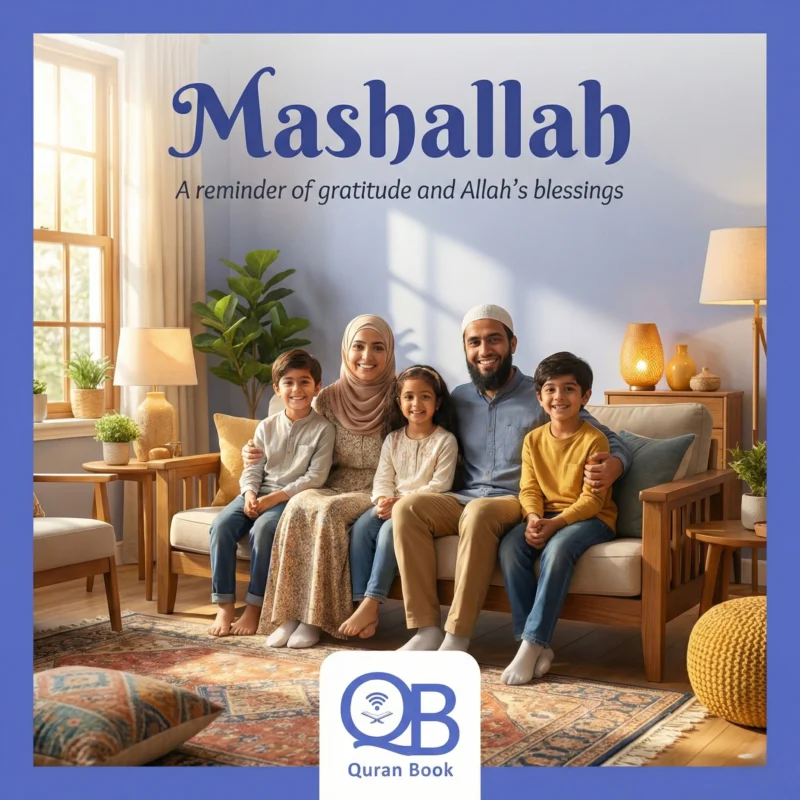
    Mashallah meaning — Muslim family expressing gratitude and blessings together
    Mashallah meaning — Muslim family expressing gratitude and blessings together

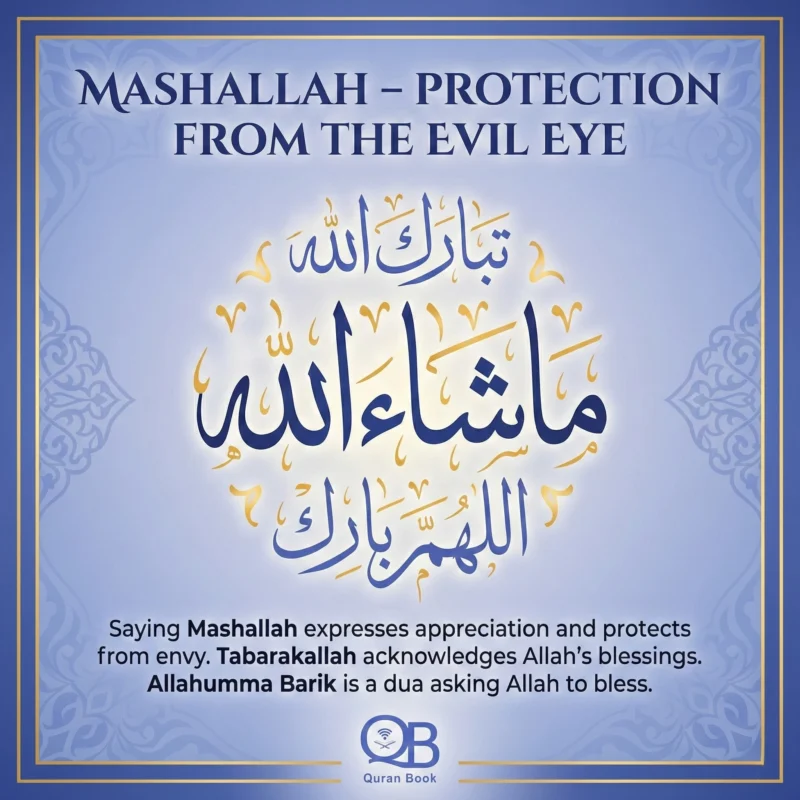
    Mashallah meaning in English is “God has willed it” or “What Allah has willed.” Muslims say Mashallah to express admiration, gratitude, and protection from the evil eye. Understanding its correct usage strengthens your daily Islamic practice and deepens your connection with Allah’s blessings.

    If you have ever felt unsure whether you are saying Mashallah at the right time, or worried about making mistakes with Arabic phrases, you are not alone. Thousands of new Muslims and non-Arabic speakers across the USA, UK, Canada, and Australia share the same concern.

    The fear of mispronunciation, cultural intimidation, and simply not knowing when to use certain expressions can feel overwhelming at first. But the good news is that learning the mashallah meaning is simpler than you think — and this guide will walk you through it step by step.

    Learning Islamic phrases is a journey, not a test. Every Muslim — whether born into the faith or a new revert — started by learning one word at a time.

    The mashallah meaning is deeply rooted in the Quran itself. In Surah Al-Kahf (18:39), Allah recounts the story of two men, where the righteous one advises his companion: “It was better for him to say, when he entered his garden: That which Allah wills (Mashallah)! There is no power but with Allah.”

    This verse reminds us that acknowledging Allah’s will is not just a cultural habit — it is a Quranic instruction and a shield of humility. By the end of this article, you will understand the full mashallah meaning, know exactly when and how to say it, and feel confident using it in your everyday conversations.

    Explore our full range of Islamic Courses for Kids and Adults at Quran Book Academy to deepen your understanding further.

    What Is the Actual Mashallah Meaning in English?

    The actual mashallah meaning is “What Allah has willed” or “God has willed it.” It comes from three Arabic words: “Ma” (what), “Sha” (willed), and “Allah” (God). Muslims say it to acknowledge that all good things come from Allah and to express wonder at His creation.

    This phrase carries a profound spiritual weight. When a Muslim says Mashallah, they are essentially declaring that whatever beauty, success, or goodness they see before them exists solely because Allah willed it. It removes arrogance from the heart and replaces it with gratitude and humility.

    Mashallah in Arabic Script and Transliteration
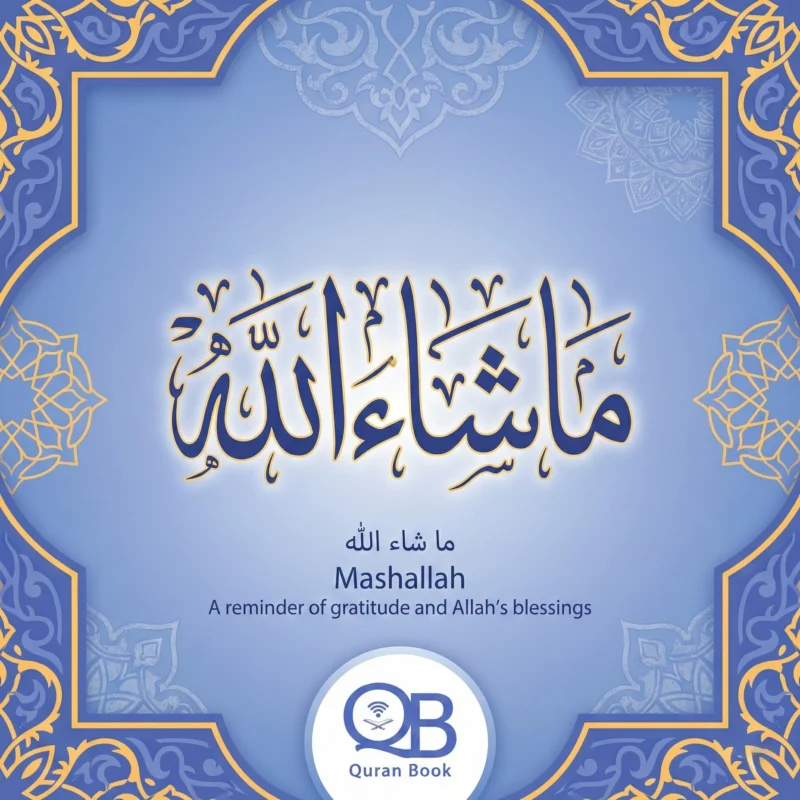
    Mashallah meaning transliteration guide showing Arabic script and English spellings
    Mashallah meaning transliteration guide showing Arabic script and English spellings

    Here is a quick reference for the correct way to write and spell Mashallah:

    Arabic Script Transliteration Common English Spellings
    ما شاء الله Mā shāʾ Allāh MashAllah, Masha’Allah, Ma Sha Allah

    Whether you write it as MashAllah, Masha’Allah, or Ma Sha Allah, the mashallah meaning remains the same. It is an expression of awe and recognition of Allah’s divine will.

    The Quranic Origin of Mashallah

    The mashallah meaning has its strongest roots in Surah Al-Kahf (18:39). The story tells of two men: one who owned a lush, prosperous garden and boasted about his wealth, and another who humbly reminded him that all blessings come from Allah.

    The righteous man told his companion that he should have said “Mashallah, La Quwwata Illa Billah” — meaning “What Allah has willed! There is no power except with Allah.”

    The lesson is timeless. Mashallah is not just a word of praise — it is a shield of humility and gratitude. It reminds us that no matter how impressive something appears, it exists only because Allah decreed it. This Quranic foundation makes the mashallah meaning much deeper than a simple cultural expression. Strengthen your understanding through our Online Quran Classes.

    How to Use Mashallah Correctly — 7 Everyday Situations
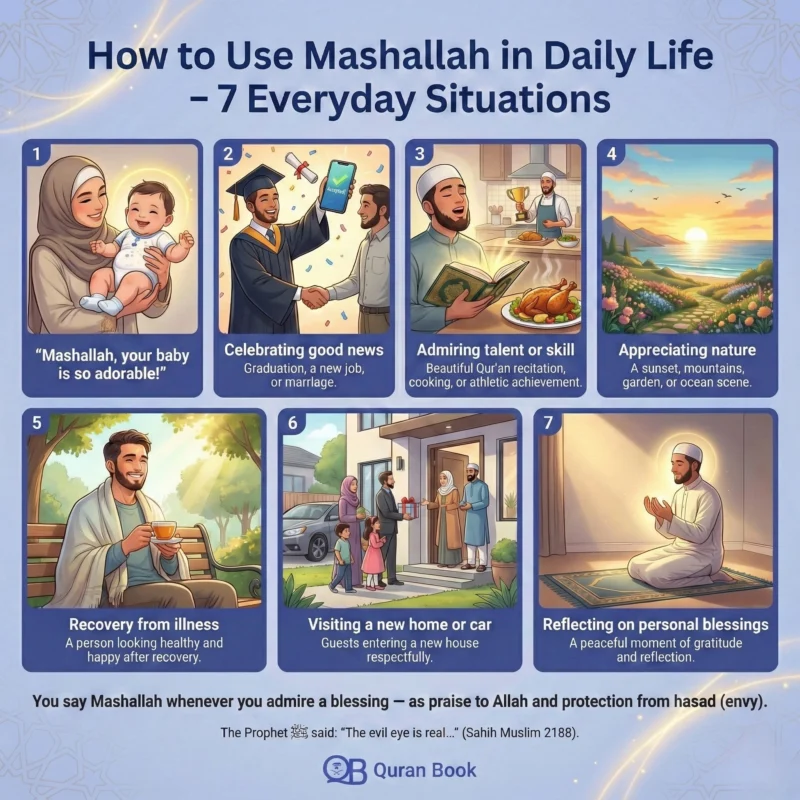
    How to use mashallah meaning correctly in 7 everyday Muslim life situations
    How to use mashallah meaning correctly in 7 everyday Muslim life situations

    You use Mashallah correctly by saying it whenever you admire something good — a child’s achievement, someone’s health, a new home, or any blessing. It serves as both praise to Allah and protection from the evil eye (hasad).

    Here are the seven most common everyday situations where saying Mashallah is appropriate:

    01

    When you see a beautiful child or baby

    Saying “Mashallah, your baby is so adorable!” is one of the most common uses. The mashallah meaning here combines admiration with a prayer of protection over the child.

    02

    When someone shares good news

    Whether it is a new job, a graduation, or a marriage announcement, responding with Mashallah shows you recognize Allah’s hand in their blessing.

    03

    When admiring someone’s talent or skill

    Hearing beautiful Quran recitation, tasting someone’s cooking, or watching an athletic achievement — all are perfect moments to say Mashallah.

    04

    When you see something beautiful in nature

    Sunsets, mountains, blooming gardens, the ocean — Allah’s creation constantly inspires the mashallah meaning in our hearts.

    05

    When someone recovers from illness

    Expressing “Mashallah, you look so much better!” conveys gratitude for Allah’s mercy in restoring their health.

    06

    When visiting someone’s new home or car

    Saying Mashallah when entering someone’s new space is both respectful and protective, guarding their blessing from envy.

    07

    When reflecting on your own blessings

    The mashallah meaning is not only for others. Looking at your own life and whispering Mashallah is a personal act of gratitude and spiritual protection.

    The Prophet Muhammad ﷺ confirmed the reality of the evil eye when he said: “The evil eye is real…” (Sahih Muslim 2188). Saying Mashallah is directly connected to protecting yourself and others from hasad (envy). It is a sunnah-based practice rooted in both Quran and Hadith.

    Enroll your children in our Islamic Studies for Kids program and join our Quran Book Academy Telegram Channel for daily practice support.

    How to Reply to Mashallah — The Complete Response Guide
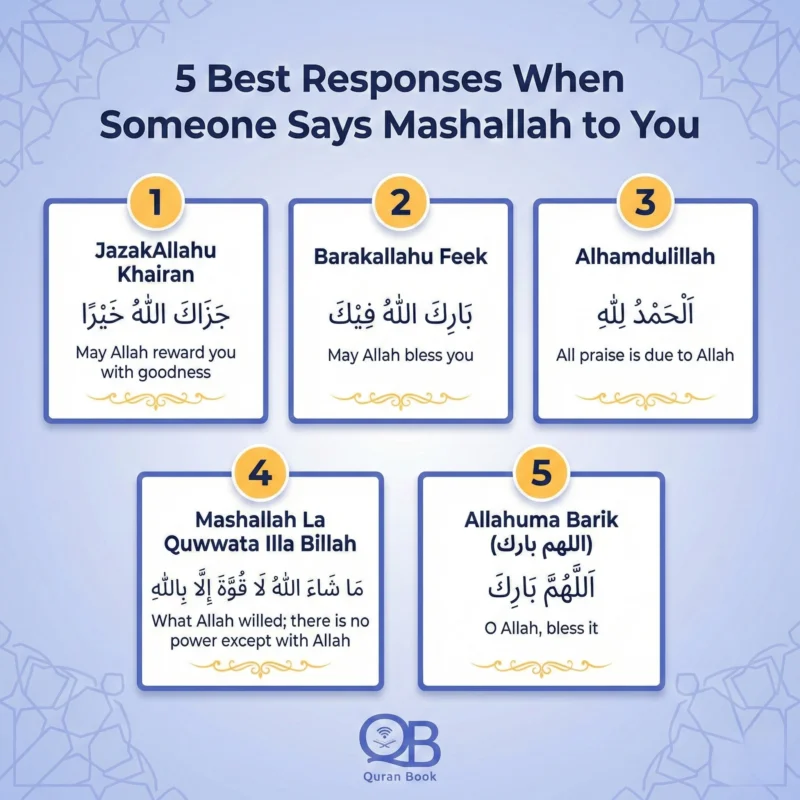
    How to reply to Mashallah meaning — best Islamic responses and phrases guide
    How to reply to Mashallah meaning — best Islamic responses and phrases guide

    When someone says Mashallah to you, the best replies are “JazakAllahu Khairan” (May Allah reward you), “Barakallahu Feek” (May Allah bless you), or simply “Alhamdulillah” (All praise is due to Allah). Each response shows gratitude and acknowledges the blessing.

    5 Best Responses When Someone Says Mashallah to You

    Understanding the mashallah meaning also means knowing how to respond gracefully. Here are the five best responses:

    # Response Arabic Meaning
    1 JazakAllahu Khairan جزاك الله خيرًا May Allah reward you with goodness
    2 Barakallahu Feek بارك الله فيك May Allah bless you
    3 Alhamdulillah الحمد لله All praise is due to Allah
    4 Mashallah La Quwwata Illa Billah ما شاء الله لا قوة إلا بالله What Allah willed; there is no power except with Allah
    5 Allahuma Barik اللهم بارك O Allah, bless it

    The most complete Quranic response is “Mashallah La Quwwata Illa Billah,” which directly mirrors the verse in Surah Al-Kahf. However, in daily conversation, any of these five responses is appropriate and beautiful. Learn proper Arabic pronunciation through our Arabic Language Course.

    Mashallah vs Inshallah vs Subhanallah vs Alhamdulillah — What’s the Difference?
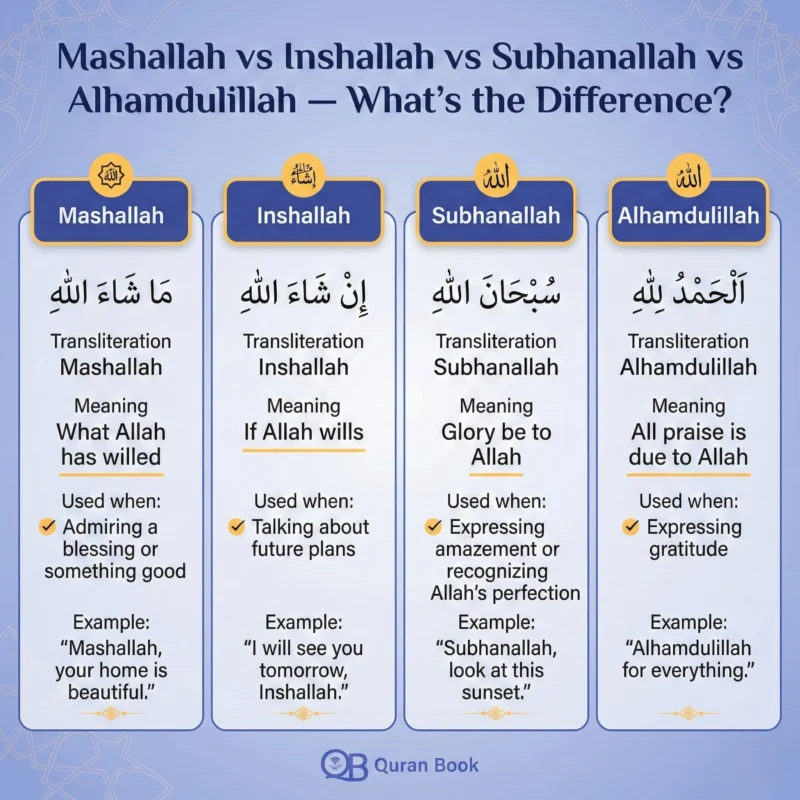
    Mashallah meaning vs Inshallah vs Subhanallah vs Alhamdulillah — differences explained
    Mashallah meaning vs Inshallah vs Subhanallah vs Alhamdulillah — differences explained

    Mashallah means “God has willed it” and is used for admiration. Inshallah means “If God wills” for future events. Subhanallah means “Glory be to God” for amazement. Alhamdulillah means “Praise be to God” for gratitude.

    Each phrase has a distinct purpose in a Muslim’s vocabulary. Many people confuse these expressions, so here is a clear comparison:

    Phrase Arabic Meaning When to Use
    Mashallahما شاء اللهWhat Allah has willedAdmiring something present
    Inshallahإن شاء اللهIf Allah willsSpeaking about the future
    Subhanallahسبحان اللهGlory be to AllahAmazement or glorification
    Alhamdulillahالحمد للهPraise be to AllahExpressing gratitude
    TabarakAllahتبارك اللهBlessed is AllahDeep admiration and glorification

    Understanding the mashallah meaning alongside these related phrases helps you speak with greater clarity and spiritual precision.

    What Is Mashallah TabarakAllah Meaning?

    The combined phrase “Mashallah TabarakAllah” translates to “What Allah has willed; Blessed is Allah.” Muslims use this expression when they witness something truly remarkable.

    It adds a layer of glorification on top of the admiration that Mashallah alone carries. In Arab culture, saying Mashallah TabarakAllah is common when seeing something exceptionally beautiful — such as a newborn, a stunning Quran recitation, or a life-changing accomplishment.

    The mashallah meaning becomes even more powerful when paired with TabarakAllah.

    Can I Say Subhanallah and Alhamdulillah Together?

    Yes, absolutely. Combining SubhanAllah and Alhamdulillah is a beautiful and recommended form of dhikr (remembrance of Allah).

    The Prophet Muhammad ﷺ said: “Two words which are light on the tongue, heavy on the Scale, and beloved to the Most Merciful: SubhanAllahi wa bihamdihi, SubhanAllahil-Azeem” (Sahih al-Bukhari 6406). Pairing these phrases in your daily remembrance earns tremendous reward and draws you closer to Allah.

    How Quran Book Academy Teaches Islamic Phrases the Right Way

    At Quran Book Academy, learning Islamic phrases like Mashallah, Inshallah, and Alhamdulillah does not feel overwhelming — it feels like a natural part of your spiritual growth. The teaching methodology is built on the principle of manageable psychological “chunks,” a proven educational technique where complex knowledge is broken into small, digestible lessons.

    Whether you are an adult learner juggling work and family, or a parent enrolling your child in Islamic Courses for Kids, every lesson is designed to remove the fear of failure and replace it with steady progress.

    Live sessions are conducted via Zoom with certified teachers, and every student’s journey is tracked through a custom LMS (Learning Management System) which sends detailed progress reports to parents and adult learners.

    Free downloadable resources are also available, including a Reward Chart for Salah, a Salah Lesson Plan for Kids, and a Prayer Chart for Kids in Islam — tools that make daily practice fun and structured. This is not just an online course — it is a complete Islamic learning ecosystem designed around how the brain actually learns.

    Explore our Online Quran Classes for Adults and join the Quran Book Academy YouTube Channel and Telegram Channel for ongoing support.

    What We Offer — Islamic Courses for Kids and Adults
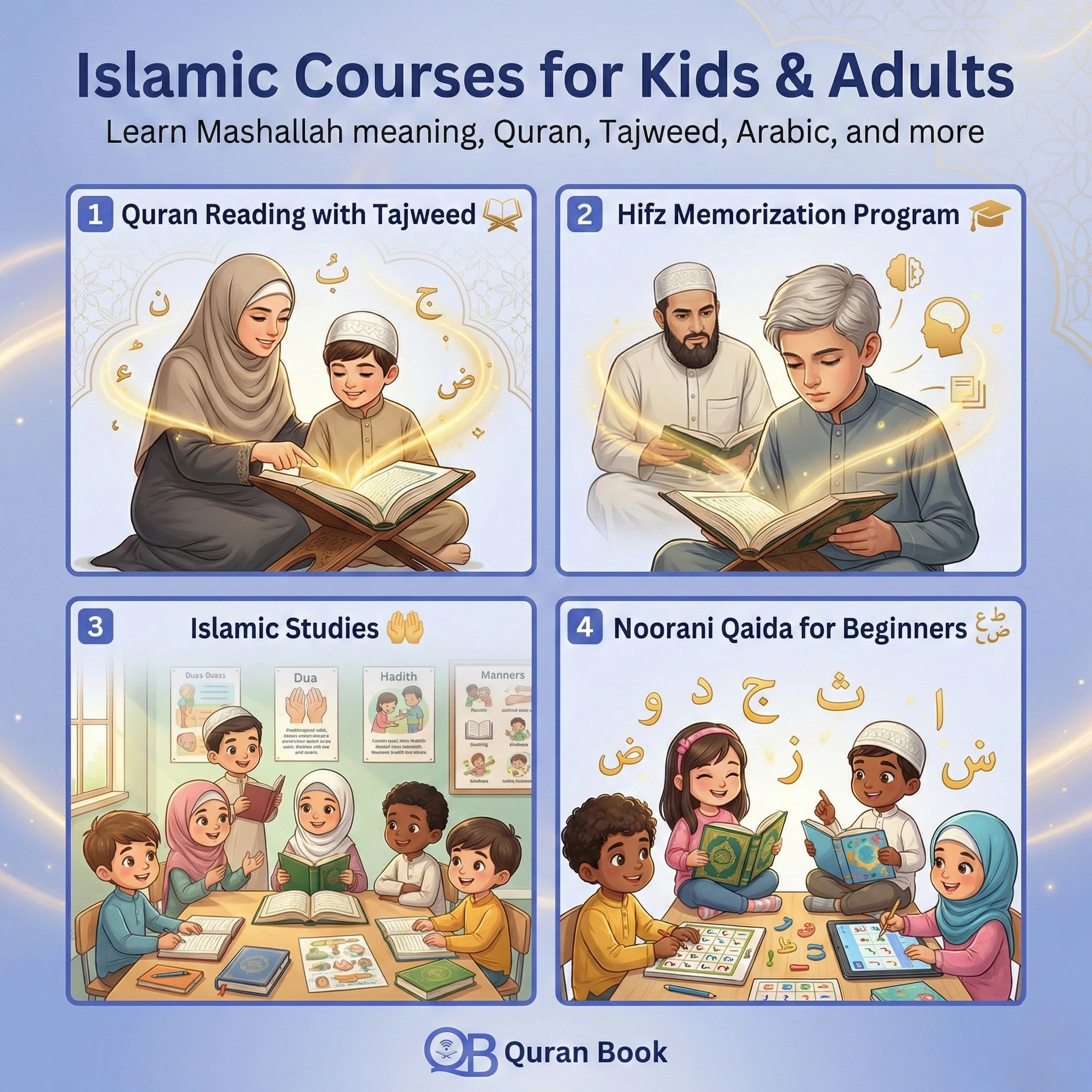
    Islamic courses for kids and adults — learn mashallah meaning, Quran, Tajweed, and Arabic
    Islamic courses for kids and adults — learn mashallah meaning, Quran, Tajweed, and Arabic

    Quran Book Academy offers a comprehensive range of courses designed for every level of learner. Available programs include Quran Reading with Tajweed, Quran Memorization (Hifz), Islamic Studies, Arabic Language, and Noorani Qaida for absolute beginners.

    Free resources such as the Reward Chart for Salah, Salah Lesson Plan for Kids, and Prayer Chart for Kids in Islam are included to support students between sessions.

    Our Tech Stack — How We Deliver World-Class Learning

    The Academy uses Zoom for live one-on-one and group sessions. A custom LMS tracks progress, attendance, and milestones automatically.

    Gmail reports are sent to parents weekly, and a dedicated Telegram Channel supports students in practicing Quran reading with Tajweed between sessions. This technology-powered approach ensures that learning the mashallah meaning — and the full Islamic curriculum — happens in a structured and supportive environment.

    Frequently Asked Questions About Mashallah Meaning

    Q. What is the actual meaning of Mashallah?

    Mashallah literally means “What Allah has willed.” It is used by Muslims to express admiration and gratitude while acknowledging that all good things come from Allah alone.

    The mashallah meaning also includes an element of protection from the evil eye, making it both a phrase of praise and a spiritual shield.

    Q. How to use Mashallah correctly?

    Say Mashallah when you admire something — a person’s beauty, a child’s achievement, someone’s health, or any blessing. It shows you recognize Allah’s will behind all good things.

    Always say it sincerely from the heart, and remember that the mashallah meaning is rooted in humility, not flattery.

    Q. How to reply to Mashallah?

    The best replies include “JazakAllahu Khairan” (May Allah reward you), “Barakallahu Feek” (May Allah bless you), or “Alhamdulillah” (All praise to Allah).

    The full Quranic response is “Mashallah La Quwwata Illa Billah,” which comes directly from Surah Al-Kahf.

    Q. What can I say instead of Masha Allah?

    You can say “TabarakAllah” (Blessed is Allah), “Allahuma Barik” (O Allah, bless it), or “SubhanAllah” (Glory to Allah). Each carries a similar spirit of acknowledging Allah’s blessings.

    However, the mashallah meaning remains the most specific expression for admiration.

    Q. What does “اللهم بارك” (Allahuma Barik) mean?

    Allahuma Barik means “O Allah, bless it.” It is often said alongside or instead of Mashallah to ask Allah to place blessings upon what is being admired.

    It functions as a dua (supplication) of goodwill and protection.

    Q. What is TabarakAllah?

    TabarakAllah means “Blessed is Allah” or “May Allah bless.” It is used to glorify Allah when you witness something beautiful or impressive.

    It is often paired with Mashallah as “Mashallah TabarakAllah,” combining admiration with glorification.

    Q. What is Hamdullah?

    Hamdullah is a casual shortening of Alhamdulillah, meaning “Praise be to Allah.” Both are used to express gratitude, especially after receiving good news, finishing a meal, or recovering from illness.

    Understanding the mashallah meaning alongside Hamdullah completes your essential Islamic vocabulary.

    Q. Is it Alhamdulillah or Hamdullah?

    Both are correct. “Alhamdulillah” (الحمد لله) is the full, formal Arabic phrase. “Hamdullah” is its shortened, colloquial version.

    In formal settings like prayer or Quran recitation, always use the full form Alhamdulillah.

    Q. Can I say Subhanallah and Alhamdulillah together?

    Yes, absolutely. Combining SubhanAllah and Alhamdulillah is a beautiful form of dhikr (remembrance of Allah).

    The Prophet Muhammad ﷺ said these words are light on the tongue, heavy on the Scale, and beloved to the Most Merciful (Sahih al-Bukhari 6406).

    Start Your Free Quran Lesson at Quran Book Academy Today

    Start your free Quran lesson today — learn mashallah meaning and more at Quran Book Academy
    Start your free Quran lesson today — learn mashallah meaning and more at Quran Book Academy

    Now that you understand the beautiful mashallah meaning and how to use it in your daily life, imagine what a full Islamic education could do for you or your child.

    At Quran Book Academy, a FREE trial lesson is offered with a certified teacher — no commitment, no pressure. Whether you are in the USA, UK, Canada, or Australia, Zoom-based live classes fit your schedule.

    Plus, download the free Reward Chart for Salah and Prayer Chart for Kids in Islam when you sign up. Do not let another day pass without growing closer to the Quran. The mashallah meaning is just the beginning of your journey.

    Book Your FREE Trial Lesson Now
    References & Sources

    © 2025 Quran Book Academy. All rights reserved.

    Understanding the mashallah meaning is just the beginning of your Islamic learning journey.

  • sunnah compliments etiquette

    Sunnah Compliments Etiquette: 7 Powerful Rules Every Muslim Should Know
    QB
    Quran Book Academy
    🎁 FREE Trial

    Sunnah Compliments Etiquette: 7 Powerful Rules Every Muslim Should Know

    ✍️ By Quran Book Academy | 📅 Islamic Manners Series

    Sunnah compliments etiquette -- Muslim greeting with kindness and respect
    Two Muslims exchanging kind words, embodying the Islamic manners of praise and appreciation

    Introduction

    Have you ever complimented someone and immediately wondered — was that okay Islamically? Or received praise and felt unsure how to respond without sounding arrogant? You are not alone. Many Muslims struggle with the etiquette of giving and receiving compliments because of the fear of giving the evil eye, showing off, or simply not knowing the right words to say.

    Understanding sunnah compliments etiquette removes this anxiety and replaces it with confidence rooted in prophetic guidance. The Quran itself encourages us to acknowledge blessings openly: “And as for the favor of your Lord, report it.” (Quran 93:11). This article breaks the topic into 7 clear rules backed by authentic hadith, so you can praise others — and receive praise — the way the Prophet ﷺ taught us.

    🌟 Want to deepen your understanding of Islamic manners?

    Explore Islamic Courses for Adults →

    What Does the Sunnah Teach About Compliments in Islam?

    The Sunnah teaches that compliments in Islam are permissible and even encouraged when done sincerely, moderately, and with attribution to Allah. The Prophet ﷺ himself praised companions for specific virtues but warned against excessive flattery that could lead to arrogance or harm the praised person’s faith.

    “If one of you must praise someone, he should say, ‘I consider that so-and-so is such-and-such.’ Allah is the One who will take account of him… and none can attest to someone’s character before Allah.”

    Sahih al-Bukhari 6162

    There is a clear distinction between encouraged and discouraged praise in Islam:

    Type of Praise Ruling Example
    Sincere, moderate appreciation Permissible / Recommended “Mashallah, I think you’re dedicated to your studies”
    Excessive flattery to someone’s face Discouraged / Disliked “You’re the best Muslim I’ve ever seen!”
    Praise with attribution to Allah Sunnah “Allahumma barik — what Allah has willed”
    Praise seeking personal gain Forbidden Flattering a boss dishonestly for a promotion

    Learning how to praise someone in Islam correctly is a core part of Islamic manners that every Muslim should master. For comprehensive guidance, consider exploring our complete course programs.

    Is It Sunnah to Compliment Someone? — 7 Prophetic Rules

    1 Attribute Every Good Quality to Allah First

    The Sunnah way is to say “Mashallah” or “Allahumma Barik” before or alongside any compliment. This Mashallah etiquette protects the praised person from the evil eye and keeps the heart humble. Allah says: “But you should have said, ‘What Allah willed [has occurred]; there is no power except in Allah.’” (Quran 18:39)

    2 Avoid Excessive Praise to Someone’s Face

    The hadith about praising someone excessively carries a strong warning. The Prophet ﷺ once heard a man over-praising another and said: “Woe to you! You have cut the neck of your companion!”Al-Adab Al-Mufrad 333. Excessive face-to-face flattery can breed arrogance and spiritual harm.

    3 Use Conditional Language (“I Consider…”)

    Following proper sunnah compliments etiquette means saying “I consider him/her to be…” rather than making absolute statements about someone’s character. Only Allah truly knows what lies in people’s hearts.

    4 Compliment Specific Actions, Not Just the Person

    The Prophet ﷺ praised specific qualities: the modesty of Uthman (RA) and the knowledge of Aisha (RA). When you learn how to compliment someone in Islam, focus on effort and behavior rather than sweeping character judgments. This approach is especially important when teaching Islamic manners to children.

    5 Say Mashallah to Protect from the Evil Eye

    Evil eye protection through compliments is a real concern in Islam. The Prophet ﷺ confirmed: “The evil eye is real.”Sahih Muslim 2188. Saying “Mashallah, Tabarakallah, Allahumma Barik” serves as a sunnah-based shield when admiring someone or their blessings.

    Saying Mashallah for evil eye protection -- praise in Islam
    The protective phrases: Mashallah, Tabarakallah, and Allahumma Barik

    6 Respond to Compliments with the Dua of Abu Bakr (RA)

    What do you say when someone compliments you in Islam? The best response is the dua of Abu Bakr (RA):

    “Allāhumma lā tu’ākhidhnī bimā yaqūlūn, wa’ghfir lī mā lā ya’lamūn, waj’alnī khayran mimmā yadhunnūn.”

    (O Allah, do not hold me accountable for what they say, forgive me for what they do not know, and make me better than what they think.)

    This dua perfectly balances gratitude, humility, and reliance on Allah.

    7 Return Compliments with Dua, Not Just Words

    The Sunnah teaches us to respond to kindness with supplication. The Prophet ﷺ said: “Whoever does you a favor, then reciprocate; if you cannot find anything to reciprocate, then supplicate for him.”Abu Dawud 1672. Learning how to respond to compliments in Islam means making dua for the one who praises you.

    How to Respond to Compliments Islamically — A Step-by-Step Guide

    1

    Say “JazakAllahu Khairan” (May Allah reward you with good).

    2

    Attribute the praise to Allah: “This is from the blessing of my Lord.”

    3

    Recite the Dua of Abu Bakr (RA) silently or aloud.

    4

    Make dua for the person who complimented you.

    5

    Avoid false modesty that denies Allah’s blessings upon you.

    Islamic humility does not mean denying your blessings — it means acknowledging their source. Praise in Islam is always directed back to the One who grants all good.

    Compliments in Islam — Common Mistakes to Avoid

    Making absolute character judgments — Only Allah knows someone’s true state.

    Praising someone to get something in return — This nullifies sincerity entirely.

    Forgetting Mashallah — Increases the risk of the evil eye, as taught in the Sunnah.

    Over-praising children publicly — Can create arrogance from a young age.

    Denying blessings out of false humility — The Quran says to “report” Allah’s favors (93:11).

    FAQ — Sunnah Compliments Etiquette

    Q1: Is it Sunnah to compliment someone?

    Yes, sincere and moderate compliments are part of Islamic etiquette. The Prophet ﷺ praised his companions for specific virtues. However, excessive flattery is discouraged. Always attribute every good quality to Allah by saying Mashallah or Allahumma Barik.

    Q2: Can Muslims give compliments?

    Absolutely. Islam encourages appreciation and encouragement. The prophetic guidance is to compliment sincerely, avoid exaggeration, use conditional language (“I consider him to be…”), and always attribute goodness to Allah.

    Q3: How do you respond to compliments Islamically?

    The Sunnah response is to say “JazakAllahu Khairan,” attribute the praise to Allah, and recite the dua of Abu Bakr (RA): “O Allah, do not hold me accountable for what they say, forgive me for what they do not know, and make me better than what they think.”

    Q4: What do Muslims say after complimenting someone?

    Muslims say “Mashallah” (What Allah has willed), “Tabarakallah” (Blessed is Allah), and “Allahumma Barik” (O Allah, bless it). These phrases protect from the evil eye and center all praise on Allah.

    Q5: What is the best response to a compliment in Islam?

    The best response combines gratitude and humility: thank the person, say “JazakAllahu Khairan,” acknowledge the blessing is from Allah, and make dua for the person who complimented you.

    Start Learning Islamic Etiquette the Right Way

    Understanding sunnah compliments etiquette is just one part of living Islam with confidence and beauty. At Quran Book Academy, certified teachers guide you through Quran recitation, Tajweed, and Islamic manners in live, one-on-one Zoom sessions — with a custom LMS to track your every milestone. Whether you are a beginner or a returning learner, we meet you where you are.

    👉 Book Your FREE Trial Lesson Now
    Also explore: Learn Quran OnlineAll Courses

    📚 References

  • duas for beginners

    How to Make Dua for Beginners: 7 Powerful Steps to Connect with Allah
    Beginner’s Guide

    How to Make Dua for Beginners: 7 Powerful Steps to Connect with Allah

    By Quran Book Academy — Your step-by-step path to heartfelt supplication

    how to make dua for beginners step by step with raised hands
    A Muslim raising hands in sincere supplication during golden hour — the essence of dua.

    Learning how to make dua for beginners can feel overwhelming — you might wonder if your Arabic is good enough, whether Allah will accept your words, or if you’re even doing it right. Here is the truth: you don’t need perfect Arabic to speak to your Creator. Allah invites every single one of us to call upon Him, and this guide gives you a clear, step-by-step path to do exactly that.

    “And when My servants ask you concerning Me, indeed I am near. I respond to the invocation of the supplicant when he calls upon Me.” Surah Al-Baqarah 2:186

    In this article, you will learn what dua truly means in Islam, how to make dua properly in 7 simple steps, 7 essential duas with Arabic text, transliteration, and English meaning, the best times to make dua, common mistakes to avoid, and how to download a free Duas PDF for daily practice.

    What Is Dua in Islam? (The Simple Truth Beginners Need to Know)

    Dua is a personal supplication or prayer to Allah (SWT). Unlike Salah (the five daily prayers), dua has no fixed format — you can make it anytime, anywhere, in any language. It is your direct, private conversation with your Creator. The Prophet Muhammad ﷺ called dua “the essence of worship” (Tirmidhi 3371).

    Many beginners confuse dua with Salah, but they serve different purposes. Here is a quick comparison:

    FeatureSalah (Prayer)Dua (Supplication)
    FormatFixed movements and recitationsFree-form, personal
    LanguageArabic onlyAny language
    Timing5 specific times dailyAnytime
    Required?Obligatory (Fard)Highly encouraged (Sunnah)
    PositionStanding, bowing, prostratingAny position

    Dua is not merely about asking for things. It is an act of worship in itself. When you raise your hands and call upon Allah, you are acknowledging His power, His mercy, and your complete dependence on Him. Allah tells us directly in Surah Ghafir 40:60: “Call upon Me; I will respond to you.”

    Learn the basics of Salah in our Islamic Courses for Kids and Adults →

    How to Make Dua Properly — 7 Steps for Beginners

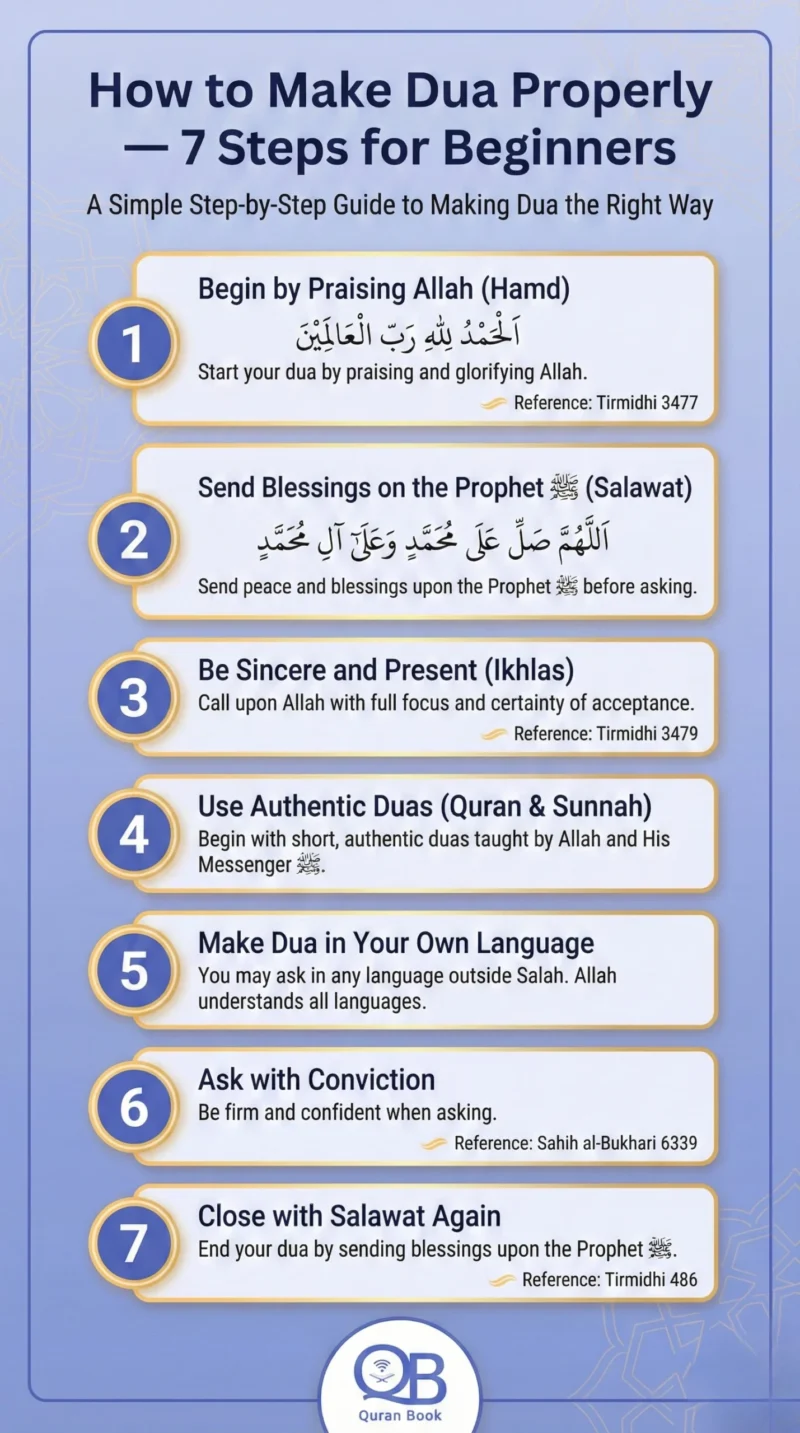
    dua steps infographic for Muslim beginners how to make dua properly
    Infographic: The 7 steps to make dua properly — from praising Allah to closing with Salawat.

    To make dua properly as a beginner, follow these 7 steps: start with praising Allah, send blessings upon the Prophet ﷺ, be sincere, ask with conviction, use both Arabic duas and your own words, repeat your dua, and close with blessings on the Prophet ﷺ again.

    1

    Begin by Praising Allah (Hamd)

    Every dua should begin with glorifying Allah. Start by saying “Alhamdulillahi Rabbil Aalameen” (All praise belongs to Allah, Lord of all worlds). The Prophet ﷺ said: “When any of you makes dua, let him begin by praising Allah, then send blessings on the Prophet, then ask for what he wishes.” (Tirmidhi 3477)

    2

    Send Blessings on the Prophet ﷺ (Salawat)

    After praising Allah, recite Salawat: “Allahumma salli ala Muhammad wa ala aali Muhammad” (O Allah, send peace and blessings upon Muhammad and the family of Muhammad). This opens the doors of dua acceptance and is a beloved Sunnah that draws you closer to the Prophet ﷺ.

    3

    Be Sincere and Present (Ikhlas)

    Sincerity is the soul of dua. The Prophet ﷺ said: “Call upon Allah while being certain of being answered.” (Tirmidhi 3479). Put your phone down, face the Qiblah if possible, raise your hands, and speak to Allah as if He is right there — because He is closer to you than your jugular vein.

    4

    Use Authentic Duas from the Quran and Sunnah

    Beginners should start with short, memorizable duas from the Quran and the Sunnah. These are the words that Allah Himself taught us or that the Prophet ﷺ used regularly. We cover 7 essential duas in the next section, and you can also download the free Duas PDF we provide for daily use.

    5

    Make Dua in Your Own Language Too

    One of the most common questions beginners ask is: “Is it OK to make dua in English?” The answer is yes. Scholars confirm that dua (outside of Salah) can be made in any language. Allah understands all languages. Start with the Arabic duas you have memorized, then pour your heart out in English, Urdu, Malay, or your mother tongue. What matters most is the sincerity of your heart, not the language on your tongue.

    6

    Ask with Conviction, Not Hesitation

    Never be timid in your dua. The Prophet ﷺ said: “None of you should say, ‘O Allah, forgive me if You wish.’ Rather, he should be firm in asking, for no one can compel Allah.” (Sahih al-Bukhari 6339). Ask Allah as if you are certain He will answer — because He promised He would.

    7

    Close with Salawat Again

    Just as you opened with blessings on the Prophet ﷺ, close the same way. Umar ibn al-Khattab (RA) said: “Dua is suspended between heaven and earth and none of it is taken up until you send blessings upon your Prophet ﷺ.” (Tirmidhi 486). This beautiful bookending ensures your supplication reaches its destination.

    Master proper Arabic pronunciation with our online Tajweed Course →

    7 Essential Duas Every Beginner Should Memorize (Arabic + English)

    The best duas for beginners are short, authentic supplications from the Quran and Sunnah that cover daily life — waking up, sleeping, eating, seeking forgiveness, and asking for guidance. Here are 7 duas you can start memorizing today.

    1 Dua When Waking Up

    الحَمْدُ لِلَّهِ الَّذِي أَحْيَانَا بَعْدَ مَا أَمَاتَنَا وَإِلَيْهِ النُّشُورُ

    Transliteration: Alhamdu lillahil-ladhi ahyana ba’da ma amatana wa ilayhin-nushur

    English: “All praise is for Allah who gave us life after having taken it from us, and to Him is the resurrection.”

    Source: Sahih al-Bukhari 6324

    2 Dua Before Sleeping

    بِاسْمِكَ اللَّهُمَّ أَمُوتُ وَأَحْيَا

    Transliteration: Bismika Allahumma amutu wa ahya

    English: “In Your name, O Allah, I die and I live.”

    Source: Sahih al-Bukhari 6324

    3 Dua Before Eating

    بِسْمِ اللَّهِ

    Transliteration: Bismillah

    English: “In the name of Allah.”

    Source: Abu Dawood 3767

    4 Dua for Forgiveness (Sayyid al-Istighfar)

    اللَّهُمَّ أَنْتَ رَبِّي لَا إِلَهَ إِلَّا أَنْتَ، خَلَقْتَنِي وَأَنَا عَبْدُكَ…

    Transliteration: Allahumma anta Rabbi la ilaha illa anta, khalaqtani wa ana ‘abduka…

    English: “O Allah, You are my Lord, there is no deity except You. You created me and I am Your servant…”

    Source: Sahih al-Bukhari 6306

    This is called the “master supplication for forgiveness.” The Prophet ﷺ said whoever recites it with conviction during the day and passes away that same day will enter Paradise. This dua for forgiveness is one of the most powerful supplications a Muslim beginner can learn.

    5 Dua When Leaving the House

    بِسْمِ اللَّهِ، تَوَكَّلْتُ عَلَى اللَّهِ، وَلَا حَوْلَ وَلَا قُوَّةَ إِلَّا بِاللَّهِ

    Transliteration: Bismillah, tawakkaltu ‘ala Allah, wa la hawla wa la quwwata illa billah

    English: “In the name of Allah, I place my trust in Allah, and there is no might nor power except with Allah.”

    Source: Abu Dawood 5095

    6 Dua for Guidance (Istikhara — Simplified)

    When facing an important decision — whether about marriage, a job, moving, or any life matter — the Prophet ﷺ taught the Istikhara prayer. It is a specific two-rak’ah prayer followed by a heartfelt dua asking Allah to guide you toward what is best. Learning how to make dua for guidance is essential for every Muslim beginner navigating life’s crossroads.

    Source: Sahih al-Bukhari 1166

    7 The Comprehensive Dua (Rabbana Atina)

    رَبَّنَا آتِنَا فِي الدُّنْيَا حَسَنَةً وَفِي الْآخِرَةِ حَسَنَةً وَقِنَا عَذَابَ النَّارِ

    Transliteration: Rabbana atina fid-dunya hasanatan wa fil-akhirati hasanatan wa qina ‘adhaban-nar

    English: “Our Lord, give us in this world that which is good and in the Hereafter that which is good, and protect us from the punishment of the Fire.”

    Source: Quran 2:201 — The Prophet ﷺ made this dua more than any other (Sahih Muslim 2690).

    📥 FREE Download: Duas for Beginners PDF

    All 7 duas with Arabic text, transliteration, and English translation on one printable page. Perfect for your fridge or bedside table.

    Download PDF
    Want to learn to read these duas in Arabic? Start with our Quran Reading Basics Course →

    What Are the Best Times to Make Dua? (When Allah Answers Most)

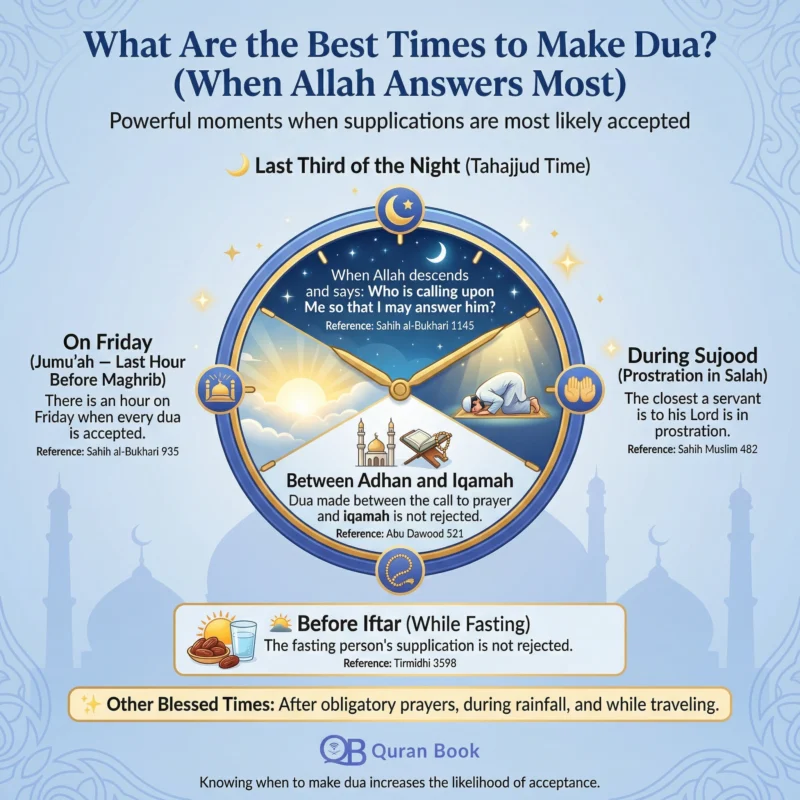
    best times to make dua in Islam for beginners
    Visual timeline showing the optimal times for dua — from Tahajjud to Friday afternoons.

    The best times to make dua in Islam are during the last third of the night, between the adhan and iqamah, while prostrating in Salah, on Friday afternoons, and while fasting before breaking the fast. Knowing when to make dua can dramatically increase the likelihood of acceptance.

    The last third of the night (Tahajjud time) is when Allah descends to the lowest heaven and asks: “Who is calling upon Me so that I may answer him?” (Sahih al-Bukhari 1145). Waking up even 15 minutes before Fajr to make dua is one of the most powerful habits a Muslim beginner can develop.

    While prostrating (Sujood) is another deeply blessed time. The Prophet ﷺ said that the closest a servant is to his Lord is during prostration, and he urged us to increase supplication in that position (Sahih Muslim 482). Learning how to make dua in sujood is a game-changer for your spiritual life.

    Between Adhan and Iqamah is a window that should never be wasted. A supplication made during this time is not rejected (Abu Dawood 521).

    On Friday (Jumu’ah), there is a special hour when every dua is accepted (Sahih al-Bukhari 935). Scholars differ on the exact time, but many say it falls in the last hour before Maghrib.

    While fasting, just before Iftar, the Prophet ﷺ said the fasting person’s supplication is never rejected (Tirmidhi 3598). Other blessed times include after obligatory prayers, during rainfall, and while traveling.

    What Makes Dua Not Accepted? (5 Mistakes Beginners Must Avoid)

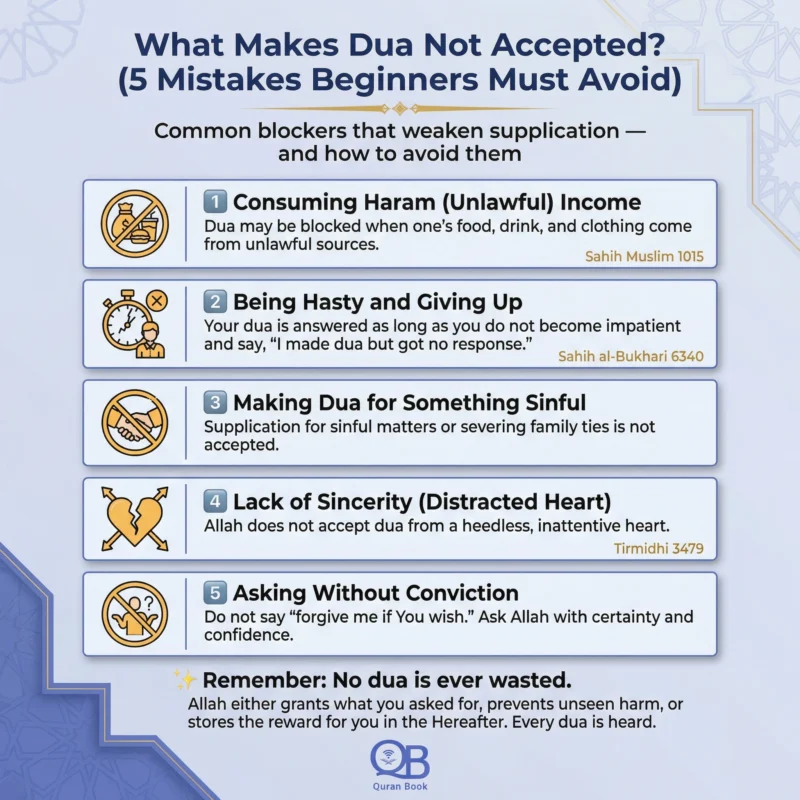
    mistakes that prevent dua acceptance in Islam beginners guide
    The 5 common mistakes that can hinder dua acceptance — and how to avoid them.

    Dua may not be accepted due to consuming haram (unlawful) income, being hasty and giving up, making dua for something sinful, lack of sincerity, or not having conviction while asking. Avoiding these pitfalls is just as important as learning how to make dua for beginners.

    Earning or consuming Haram is one of the most serious blockers. The Prophet ﷺ described a traveler, dusty and disheveled, raising his hands to the sky calling upon Allah — yet his food, drink, and clothing were all from unlawful sources, so how could his dua be answered? (Sahih Muslim 1015)

    Being hasty and giving up is another trap. The Prophet ﷺ said your supplication is answered as long as you do not become impatient and say “I made dua but got no response” (Sahih al-Bukhari 6340). Patience is part of the dua itself.

    Making dua for something sinful or for severing family ties is explicitly warned against.

    A distracted, heedless heart weakens dua. Allah does not accept supplication from a heart that is wandering and inattentive (Tirmidhi 3479). When you speak to Allah, be fully present.

    Lack of conviction — asking with an “if You want” mentality — contradicts the very spirit of supplication. Ask boldly. Ask with certainty.

    💡 The most encouraging perspective: unanswered dua is never wasted. Allah either gives you what you asked for, prevents a harm you could not see, or stores it as reward for you in the Hereafter. Every single dua is heard.

    The Academy Method — How Quran Book Academy Teaches Duas in Manageable Steps

    Islamic courses for beginners learning dua online with Quran Book Academy
    A student attending a live Zoom Quran lesson at Quran Book Academy — interactive, personal learning.

    At Quran Book Academy, we understand that learning Arabic duas can feel intimidating — especially for non-Arabic speakers in the USA, Canada, UK, and Australia. That is why we use a proven, psychology-backed teaching method that breaks learning into manageable chunks.

    The Chunking Technique: We teach 1–2 duas per week, not 20 at once. Educational psychology shows that spaced repetition of small units leads to lasting memorization. Our students retain what they learn because they practice it daily before moving on.

    The 3-Layer Approach: Every dua is taught in three stages — (1) Hear it pronounced correctly by a qualified teacher, (2) Read it with proper Tajweed, and (3) Use it in daily life so it becomes second nature.

    Live on Zoom: All lessons are conducted live via Zoom with qualified teachers — real-time correction of pronunciation, personalized feedback, and genuine human connection. These are not pre-recorded videos.

    Custom LMS Tracking: Our custom Learning Management System tracks every student’s progress. Parents and adult learners receive weekly Gmail progress reports showing mastery levels for each dua and Quran lesson.

    For Kids and Adults: We offer separate learning tracks — a gamified, visual approach for children and a structured, flexible scheduling option for adults. Whether you are learning how to make dua for the first time or refining your Arabic pronunciation, there is a track for you.

    📥 FREE Download: Duas for Beginners PDF

    We provide a Duas for Beginners PDF to every new student — download yours and start practicing today.

    Download PDF

    Can I Make Dua in English? In Bed? In My Own Words? (Common Beginner Questions Answered)

    Can I make dua in English? Yes, outside of Salah, you may make dua in any language. Allah understands all languages and hears every whisper of your heart. Start with the Arabic duas you know, then speak freely in English or your mother tongue.

    Can I make dua in bed? Yes. There are specific Sunnah duas for bedtime (like “Bismika Allahumma amutu wa ahya”), and you may also make personal dua while lying down. Allah’s door is never closed.

    Can I say my own dua? Absolutely. The Prophet ﷺ encouraged personal supplication alongside memorized Quranic and Sunnah duas. Speak to Allah about your worries, hopes, gratitude, and struggles in your own words.

    Can I say sorry to Allah? Yes, seeking repentance (Tawbah) is itself a dua. Say “Astaghfirullah” (I seek forgiveness from Allah) and sincerely intend not to repeat the sin. Allah is Al-Ghaffar — the Repeatedly Forgiving. He loves those who turn back to Him.

    What if my dua is not immediately answered? Be patient. The Prophet ﷺ said your dua is answered in one of three ways: you receive exactly what you asked for, a harm is prevented from reaching you, or it is stored as reward for you in the Hereafter (Musnad Ahmad 10749). No dua is ever lost.

    Frequently Asked Questions (FAQ)

    Q1: What are the basic duas of Islam?

    The most basic duas include Bismillah (before eating), Alhamdulillah (after eating), the dua for waking up, sleeping, entering and leaving the house, and seeking forgiveness (Astaghfirullah). These are short, easy to memorize, and recommended daily by the Prophet ﷺ.

    Q2: How do I begin my dua?

    Begin by praising Allah (saying Alhamdulillah or Subhanallah), then send blessings on the Prophet ﷺ (Allahumma salli ala Muhammad), then make your request with sincerity and conviction.

    Q3: Which dua brings provision and sustenance?

    The Quran teaches that Istighfar (seeking forgiveness) is a means of abundance. In Surah Nuh 71:10-12, Allah connects constant repentance with increased provision, rain, wealth, and children.

    Q4: What dua is for forgiveness of major sins?

    Sayyid al-Istighfar (the master supplication for forgiveness) reported in Sahih al-Bukhari 6306 is the most powerful dua for forgiveness. Sincere Tawbah (repentance) with a genuine intention not to repeat the sin is the door to Allah’s mercy.

    Q5: What are the best times to make dua?

    The best times include the last third of the night, during prostration (sujood), between adhan and iqamah, on Fridays, while fasting before iftar, and after obligatory prayers.

    Q6: What makes dua not accepted?

    Dua may be hindered by consuming haram income, being impatient, making dua for something sinful, or having a heedless and distracted heart. The Prophet ﷺ urged persistence and sincerity.

    Q7: Can I make dua for someone else?

    Yes, and it is highly virtuous. The Prophet ﷺ said that when a Muslim makes dua for a brother or sister in their absence, an angel says “Ameen, and for you likewise” (Sahih Muslim 2733).

    Start Your Dua Journey Today — Free Trial Lesson at Quran Book Academy

    how to make dua for beginners free trial Islamic courses online
    Join Quran Book Academy — live Zoom lessons with qualified teachers for kids and adults.

    You have now learned how to make dua for beginners — the steps, the etiquette, the best times, and 7 essential duas to start with. But reading is only the first step. The real transformation happens when you hear the Arabic pronounced correctly, practice it with a qualified teacher, and build it into your daily life.

    May Allah accept your duas, make this knowledge beneficial for you, and grant you and your family the best in this world and the Hereafter. Ameen.

    References

    1. 1. Surah Al-Baqarah 2:186 — “Indeed I am near…”
    2. 2. Tirmidhi 3371 — Dua is the essence of worship
    3. 3. Surah Ghafir 40:60 — “Call upon Me; I will respond”
    4. 4. Tirmidhi 3477 — Begin dua with praise
    5. 5. Tirmidhi 3479 — Certainty in dua
    6. 6. Sahih al-Bukhari 6339 — Ask with conviction
    7. 7. Tirmidhi 486 — Dua suspended until Salawat
    8. 8. Sahih al-Bukhari 6324 — Waking & sleeping duas
    9. 9. Abu Dawood 3767 — Dua before eating
    10. 10. Sahih al-Bukhari 6306 — Sayyid al-Istighfar
    11. 11. Abu Dawood 5095 — Leaving the house
    12. 12. Sahih al-Bukhari 1166 — Istikhara prayer
    13. 13. Quran 2:201 — Rabbana Atina
    14. 14. Sahih Muslim 2690 — Most frequent dua of the Prophet ﷺ
    15. 15. Sahih al-Bukhari 1145 — Last third of the night
    16. 16. Sahih Muslim 482 — Dua in sujood
    17. 17. Abu Dawood 521 — Between adhan & iqamah
    18. 18. Sahih al-Bukhari 935 — Friday dua
    19. 19. Tirmidhi 3598 — Fasting person’s dua
    20. 20. Sahih Muslim 1015 — Haram income blocks dua
    21. 21. Sahih al-Bukhari 6340 — Don’t be hasty in dua
    22. 22. Quran 71:10-12 — Istighfar for provision
    23. 23. Sahih Muslim 2733 — Dua for others

    Quran Book Academy

    Empowering Muslims worldwide to connect with the Quran and Sunnah — one dua at a time.

    © 2026 Quran Book Academy. All rights reserved.

  • islamic greetings guide

    The Complete Guide to Islamic Greeting: How to Say Assalamu Alaikum with Proper Pronunciation & Meaning
    ‘) repeat; opacity: 0.5;”>

    بِسْمِ اللهِ الرَّحْمٰنِ الرَّحِيْمِ

    The Complete Guide to Islamic Greeting

    How to Say Assalamu Alaikum with Proper Pronunciation & Meaning

    Master Arabic Greetings with Our Step-by-Step Guide for Beginners

    Islamic greeting Assalamu Alaikum written in beautiful Arabic calligraphy representing peace and blessings
    A visually stunning Arabic calligraphy artwork displaying “Assalamu Alaikum” in traditional Islamic script
    1

    The Beauty of Islamic Greeting

    The Islamic greeting “Assalamu Alaikum” (السلام عليكم) means “Peace be upon you” and represents one of the most beautiful expressions of goodwill in any language. This traditional Muslim greeting creates an instant bond of peace, respect, and brotherhood between people, regardless of their background. When you learn how to greet in Islam, you are not merely learning words—you are embracing a spiritual practice that has connected hearts for over 1,400 years.

    If you have ever felt hesitant to say Assalamu Alaikum because you worried about mispronouncing it or responding incorrectly, you are not alone. Many people, both Muslims and non-Muslims alike, share this concern. Understanding how to say hello in Arabic properly can feel daunting at first, but this guide will break down every aspect of the Islamic greeting into simple, manageable steps—so you can greet with confidence and spiritual intention.

    The Quran itself emphasizes the importance of greeting others with peace:

    When you are greeted with a greeting, greet in return with what is better than it, or at least return it equally.

    — Quran 4:86
    2

    What Does “Assalamu Alaikum” Mean?

    Assalamu Alaikum (السلام عليكم) is the standard Islamic greeting meaning “Peace be upon you.” The phrase comes from the Arabic root “S-L-M” (س-ل-م) which relates to peace, safety, and submission to Allah. It is the same root from which “Islam” and “Muslim” derive their names. When you understand what does Assalamu Alaikum mean, you realize it is not just a greeting—it is a prayer, a supplication (dua) that you offer to the person you are addressing.

    The word “Salam” (سلام) means peace, while “Alaikum” (عليكم) means “upon you.” Together, they form a powerful wish for the other person’s wellbeing, safety, and spiritual peace. This is why the Islamic greeting holds such deep significance in Muslim communities worldwide.

    Three Levels of the Islamic Greeting

    Arabic Transliteration Meaning
    السلام عليكم As-salamu Alaikum Peace be upon you
    السلام عليكم ورحمة الله As-salamu Alaikum wa Rahmatullah Peace and mercy of Allah be upon you
    السلام عليكم ورحمة الله وبركاته As-salamu Alaikum wa Rahmatullahi wa Barakatuh Peace, mercy, and blessings of Allah be upon you

    The Prophet Muhammad (ﷺ) encouraged using the complete form of the greeting. As reported in Sunan al-Tirmidhi (2689): “The best Islamic greeting is to say ‘As-salamu Alaikum wa Rahmatullahi wa Barakatuh.’”

    3

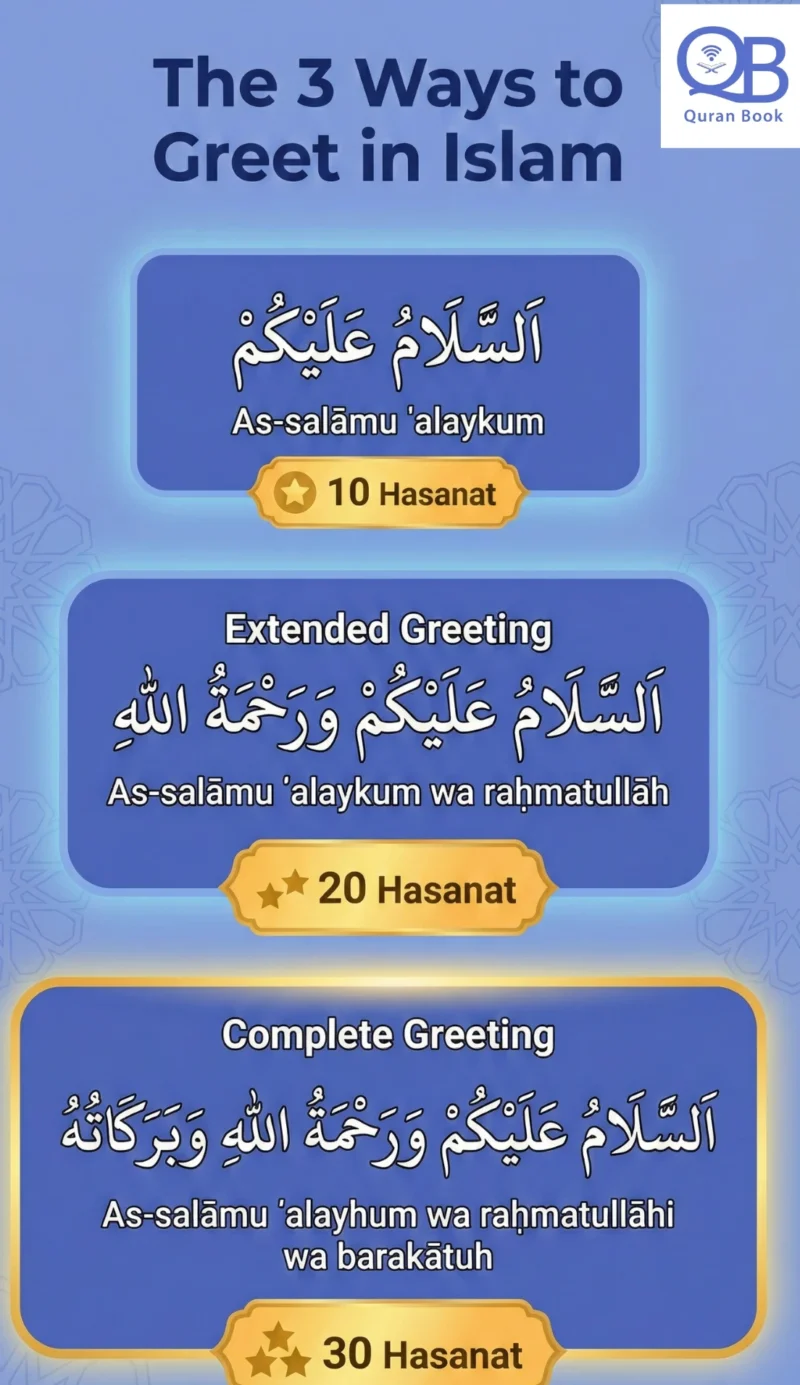
    What Are the 3 Ways to Greet in Islam?

    The 3 ways to greet in Islam - showing short, medium, and complete Islamic greeting with rewards for each level
    Three levels of Islamic greeting with their spiritual rewards

    The three ways to greet in Islam are: (1) The short greeting: “Assalamu Alaikum” (Peace be upon you), (2) The medium greeting: “Assalamu Alaikum wa Rahmatullah” (Peace and mercy of Allah be upon you), and (3) The complete greeting: “Assalamu Alaikum wa Rahmatullahi wa Barakatuh” (Peace, mercy, and blessings of Allah be upon you). Each form of the Islamic greeting carries spiritual rewards. Learn more about Understanding Hasanat and Good Deeds.

    10 Hasanat

    1. The Short Greeting (الأساسية)

    Phrase: Assalamu Alaikum

    Use: Quick, everyday greetings

    20 Hasanat

    2. The Extended Greeting (المتوسطة)

    Phrase: Assalamu Alaikum wa Rahmatullah

    Use: More respectful occasions

    30 Hasanat

    3. The Complete Greeting (الكاملة)

    Phrase: Assalamu Alaikum wa Rahmatullahi wa Barakatuh

    Use: Formal occasions, greeting elders, teachers

    “A man came to the Prophet (ﷺ) and said: ‘Assalamu Alaikum.’ The Prophet (ﷺ) responded and said: ‘Ten.’ Then another man came and said: ‘Assalamu Alaikum wa Rahmatullah.’ The Prophet (ﷺ) responded and said: ‘Twenty.’ Then another man came and said: ‘Assalamu Alaikum wa Rahmatullahi wa Barakatuh.’ The Prophet (ﷺ) responded and said: ‘Thirty.’”

    — Sunan al-Tirmidhi (2689)
    4

    How to Pronounce Assalamu Alaikum

    To pronounce “Assalamu Alaikum” correctly, break it into syllables: “As-sa-LA-mu A-LAY-kum.” Emphasize the “LA” in both words. The ending should sound like a soft “kum,” not a harsh sound. Learning how to say hello in Arabic becomes much easier when you master each syllable separately.

    Syllable Breakdown

    Syllable Pronunciation Guide
    As Like “us” but with “a”
    sa Like “sa” in “sat”
    LA Emphasized, like “lah” (stress here)
    mu Like “moo” (quick)
    A Short “a” sound
    LAY Like “lay” (stress here)
    kum Like “koom” (soft ending)

    Common Mistakes to Avoid

    • Do not rush the greeting—take your time with each syllable
    • Do not skip the “wa” in extended versions
    • Pronounce each Arabic letter distinctly for clarity
    5

    How to Respond to Assalamu Alaikum

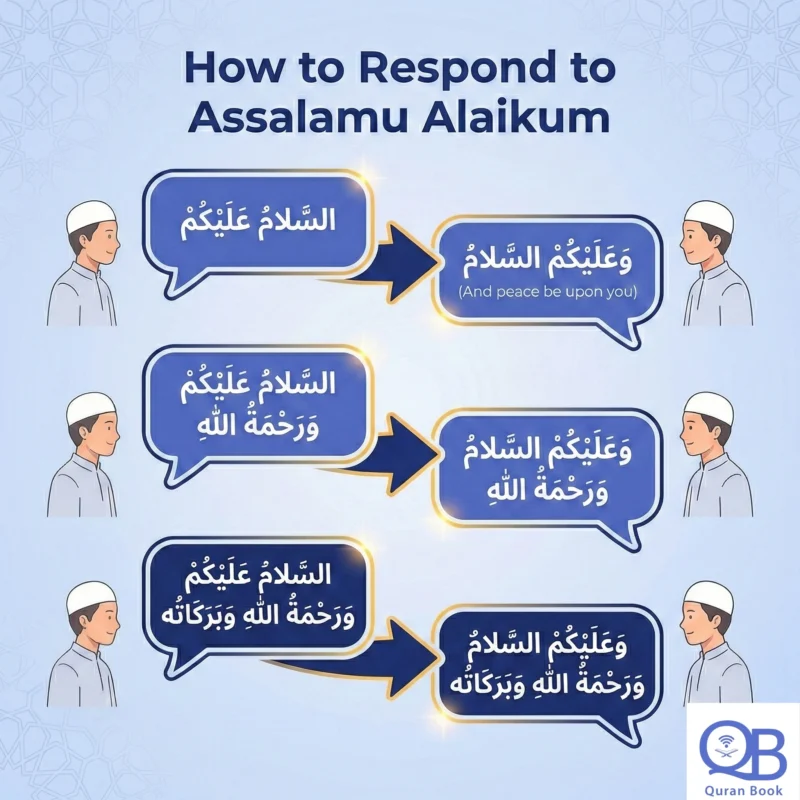
    How to respond to Assalamu Alaikum - complete guide showing greeting and response flowchart for proper Islamic etiquette
    Flowchart showing proper greeting exchange in Islamic etiquette

    The proper response to “Assalamu Alaikum” is “Wa Alaikum Assalam” (وعليكم السلام), meaning “And upon you be peace.” For a more complete response, say “Wa Alaikum Assalam wa Rahmatullahi wa Barakatuh” to return the Islamic greeting with equal or greater blessings. Knowing how to respond to Assalamu Alaikum is essential for proper Islamic etiquette.

    Response Table

    They Say You Respond Meaning
    Assalamu Alaikum Wa Alaikum Assalam And upon you be peace
    Assalamu Alaikum wa Rahmatullah Wa Alaikum Assalam wa Rahmatullah And upon you be peace and Allah’s mercy
    Assalamu Alaikum wa Rahmatullahi wa Barakatuh Wa Alaikum Assalam wa Rahmatullahi wa Barakatuh And upon you be peace, mercy, and blessings of Allah

    The Quran (4:86) instructs Muslims to return greetings with something equal or better. This means when someone gives you a basic salam, you can respond with the extended version to earn extra rewards while showing greater respect. It is obligatory (wajib) to return the Islamic greeting, and the response should be clear and audible.

    How to Respond in Text Messages

    • Full form: Wa Alaikum Assalam wa Rahmatullahi wa Barakatuh
    • Common abbreviations: W.S., WSWR, or simply “Wa Alaikum Assalam”
    • Emojis: 🤲 can accompany digital greetings
    6

    Islamic Greetings for Every Occasion

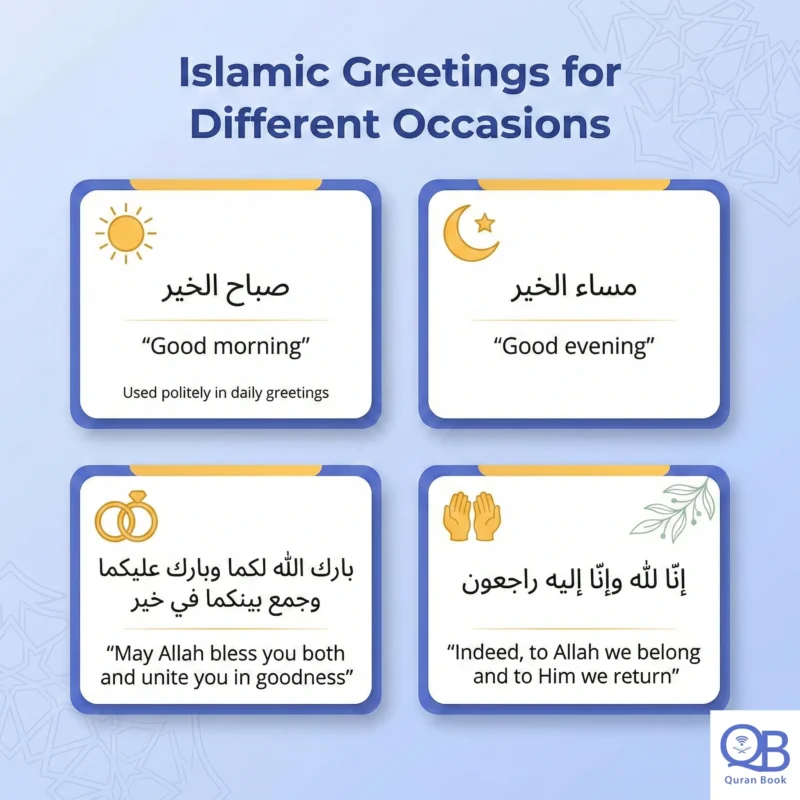
    Islamic greetings for different occasions - morning, evening, marriage, condolence Arabic phrases with translations
    Grid showing Islamic greetings paired with appropriate occasions

    Islamic greetings vary by occasion: say “Sabah al-Khair” (صباح الخير) for good morning, “Inna lillahi wa inna ilayhi raji’un” (إنا لله وإنا إليه راجعون) for condolences, and “Barakallahu lakuma” (بارك الله لكما) to congratulate newlyweds. Each greeting carries specific spiritual meaning and shows how to respect Muslim culture and beliefs appropriately. Explore more Essential Arabic Phrases.

    Comprehensive Greeting Table for Different Occasions

    Occasion Arabic Transliteration Meaning
    Morning صباح الخير Sabah al-Khair Good morning
    Evening مساء الخير Masa’ al-Khair Good evening
    Goodbye مع السلامة Ma’a as-Salamah Go with peace
    Condolence إنا لله وإنا إليه راجعون Inna lillahi wa inna ilayhi raji’un To Allah we belong and to Him we return
    Marriage بارك الله لكما Barakallahu lakuma May Allah bless you both
    New Baby بارك الله لك في الموهوب Barakallahu laka fil mawhub May Allah bless the gift given to you
    After Sneezing الحمد لله Alhamdulillah Praise be to Allah
    To Sneezer يرحمك الله Yarhamuk Allah May Allah have mercy on you

    Special Greeting for Visiting the Sick

    The Prophet (ﷺ) used to visit the sick and say: “La ba’s, tahur in sha Allah” (No harm, purification if Allah wills). This is recorded in Sahih al-Bukhari and demonstrates the compassionate nature of Islamic greetings for every life situation.

    7

    Can Non-Muslims Say Assalamu Alaikum?

    Yes, non-Muslims can say “Assalamu Alaikum” as a respectful greeting. Many scholars encourage this as a sign of goodwill and interfaith respect. Muslims should respond warmly with “Wa Alaikum Assalam” regardless of who initiates the Islamic greeting. This question about how to greet a Muslim as a non-Muslim is one of the most common inquiries we receive.

    The greeting itself is a prayer for peace—a universal concept that transcends religious boundaries. When non-Muslim friends, colleagues, or neighbors use the Islamic greeting, most Muslims deeply appreciate the effort and respect shown. Islam encourages kindness and good relations with people of all faiths.

    “Allah does not forbid you from those who do not fight you because of religion… from being kind to them and acting justly toward them.”

    — Quran 60:8
    8

    Master Islamic Greetings with The Academy Method

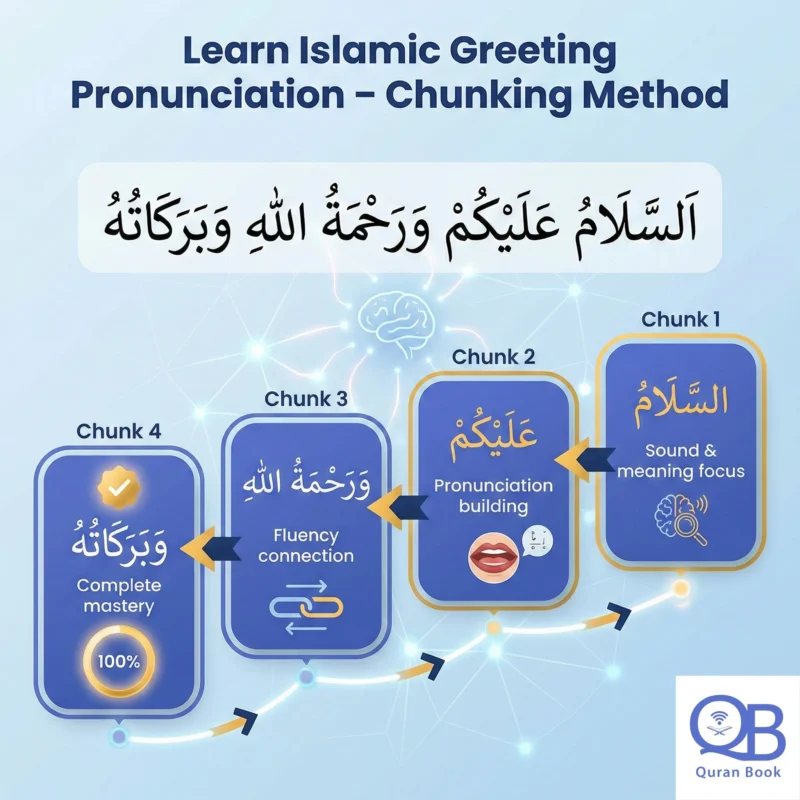
    Learn Islamic greeting pronunciation with Quran Book Academy - psychology-based chunking method for Arabic learning
    The Academy Method: Psychology-based chunking for effective Arabic learning

    The Academy Method at Quran Book Academy uses cognitive “chunking”—a proven psychological technique that breaks complex Arabic phrases into small, memorable units. This approach reduces overwhelm, builds confidence, and helps non-Arabic speakers master Quranic pronunciation and Islamic greetings in weeks, not years.

    At Quran Book Academy, we understand that learning Arabic greetings and Quranic Arabic can feel overwhelming—especially if you have never studied the language before. That is why we developed The Academy Method, a teaching approach rooted in educational psychology and designed specifically for non-Arabic speaking Muslims in the USA, Canada, UK, and Australia. Learn more about Our Teaching Methodology.

    How The Academy Method Works

    The human brain can only process 4-7 pieces of new information at a time. When you try to learn “Assalamu Alaikum wa Rahmatullahi wa Barakatuh” all at once, your working memory becomes overloaded. Our method breaks this phrase into psychological “chunks” that are easier to remember and perfect:

    Chunk 1 As-salamu (The peace)
    Chunk 2 Alaikum (Upon you)
    Chunk 3 wa Rahmatullah (And Allah’s mercy)
    Chunk 4 wa Barakatuh (And His blessings)

    Our Tech-Stack for Success

    📹
    Live Zoom Sessions One-on-one instruction with qualified teachers who understand your specific challenges
    📊
    Custom LMS Track your progress, revisit lessons, and see exactly where you are improving
    📧
    Weekly Gmail Reports Receive detailed progress reports directly to your inbox, keeping you accountable
    💬
    Telegram Community Join our Telegram channel for daily Tajweed practice and community support

    💡 Addressing Your Fears

    We know what holds you back. Fear of mispronunciation. Worry about looking foolish. Concern about finding time in your busy schedule. Our teachers have helped thousands of students just like you overcome these barriers. Every journey begins with a single step—and that first step is easier than you think.

    9

    Frequently Asked Questions

    Q1: What are the 3 ways to greet in Islam? +

    The three ways to greet in Islam are: (1) Assalamu Alaikum (Peace be upon you), (2) Assalamu Alaikum wa Rahmatullah (Peace and mercy of Allah be upon you), and (3) Assalamu Alaikum wa Rahmatullahi wa Barakatuh (Peace, mercy, and blessings of Allah be upon you). Each level of the Islamic greeting carries increasing spiritual reward.

    Q2: How do you respond to Assalamu Alaikum? +

    Respond to “Assalamu Alaikum” with “Wa Alaikum Assalam” (And upon you be peace). The Quran (4:86) encourages responding with an equal or better greeting, so you may also say “Wa Alaikum Assalam wa Rahmatullahi wa Barakatuh” to maximize blessings.

    Q3: Can non-Muslims say Assalamu Alaikum? +

    Yes, non-Muslims can respectfully say “Assalamu Alaikum.” It is a prayer for peace, and many Muslims appreciate when non-Muslim friends and colleagues use this Islamic greeting as a sign of respect and cultural understanding.

    Q4: How do you greet elders in Islam? +

    When greeting elders in Islam, use the full greeting “Assalamu Alaikum wa Rahmatullahi wa Barakatuh” to show maximum respect. You may also lower your gaze slightly, allow them to sit first, and wait for them to extend their hand before offering a handshake if appropriate.

    Q5: How do you greet a woman in Islam? +

    Men greeting unrelated women should use verbal greetings only: “Assalamu Alaikum.” Physical contact such as handshakes is generally avoided between non-mahram (non-related) men and women. The Islamic greeting itself remains the same beautiful prayer for peace.

    Q6: What does “Salam” mean in Arabic? +

    “Salam” (سلام) means “peace” in Arabic. It comes from the root S-L-M, the same root that gives us “Islam” (submission to peace with Allah) and “Muslim” (one who submits to peace). This connection shows why the Islamic greeting carries such deep spiritual significance.

    Q7: How do you greet someone who has lost a loved one in Islam? +

    Say “Inna lillahi wa inna ilayhi raji’un” (إنا لله وإنا إليه راجعون), meaning “To Allah we belong and to Him we return.” Follow with “May Allah grant them Jannah (Paradise)” and offer practical support to the grieving family. This is one of the most important Islamic greetings to learn for offering condolences.

    10

    Start Your Arabic Learning Journey Today

    You have just learned the beauty, meaning, and proper pronunciation of the Islamic greeting. But this is only the beginning of your journey into the rich world of Arabic and Quranic learning.

    At Quran Book Academy, we specialize in helping non-Arabic speakers like you master Quranic recitation, Arabic pronunciation, and Islamic knowledge—all from the comfort of your home. Whether you want to perfect your Islamic greeting or memorize the entire Quran, we have a program designed for you.

    ‘) repeat;”>

    What You Will Get in Your Free Trial:

    • 30-minute one-on-one session with a qualified teacher
    • Personalized assessment of your current level
    • Custom learning plan designed for your goals
    • Introduction to our proven Academy Method

    No obligation. No pressure. Just pure learning.

    🎓 BOOK YOUR FREE TRIAL LESSON NOW
    Learn Islamic greeting and Quran with free trial lesson at Quran Book Academy - start your Arabic learning journey
    Join thousands of students from the USA, Canada, UK, and Australia who transformed their relationship with the Quran

    📚 Learn More

    Expand your knowledge with these valuable resources from Quran Book Academy:

    📑 References & External Links

    Scholarly Resources

    • IslamQA – Scholarly Islamic reference
    • Sunnah.com – Hadith verification resource

    Community

    السلام عليكم ورحمة الله وبركاته

    Article prepared for quranbookonline.com | Quran Book Academy

    February 2026

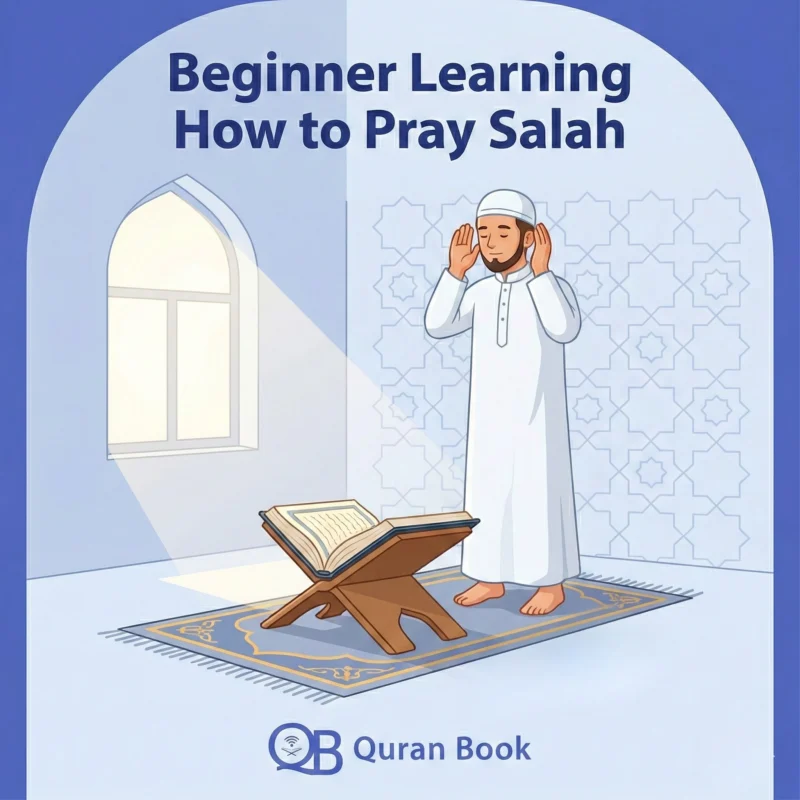
  • how to pray salah

    How to Pray Salah – Complete Step-by-Step Guide for Beginners | Quran Book Academy
    Complete Beginner’s Guide

    How to Pray Salah
    Step by Step for Beginners

    Learn the complete Muslim prayer — from wudu preparation to tasleem — with clear instructions, images, and expert tips from Quran Book Academy.

    Quick Summary

    To pray salah as a beginner, start by learning wudu (ablution), face the qibla, make your intention, say “Allahu Akbar,” then follow the step-by-step positions: standing (qiyam), bowing (ruku), prostrating (sujud), and sitting (tashahhud). Each prayer has a set number of cycles called rakats.

    A beginner learning how to pray salah reading a prayer guide at home
    A beginner sitting with a prayer guide — the first step in learning salah

    Why Learning How to Pray Salah Feels Overwhelming (And Why That’s Normal)

    Learning how to pray salah can feel overwhelming when you’re a beginner — and that is completely normal. Whether you are a new Muslim or someone returning to the faith after years away, the idea of praying five times a day in Arabic can seem like climbing a mountain. Three common fears hold people back: the fear of mispronouncing Arabic words, the feeling of being “too late” to start, and anxiety about fitting five prayers into a busy daily schedule.

    Here is the truth — salah is a journey. Even the Companions of the Prophet Muhammad ﷺ learned their prayers step by step. The Prophet ﷺ himself said: “Pray as you have seen me praying.” (Sahih al-Bukhari 631). He did not expect perfection from day one. He expected sincerity. And that is exactly where your prayer journey begins — with a sincere heart and a willingness to learn.

    If you are just beginning your Islamic journey, starting with foundational knowledge in Quran reading for beginners can make learning salah feel far more natural and achievable.

    What Is Salah and Why Is It the Most Important Pillar After Shahada?

    Salah is the second pillar of Islam and the most important act of worship after the declaration of faith (Shahada). It is a direct, private conversation between you and Allah — no intermediary, no priest, no confession booth. Just you and your Creator, five times a day.

    The significance of salah cannot be overstated. It will be the very first thing a Muslim is questioned about on the Day of Judgment. The Prophet ﷺ said: “The first matter that the slave will be brought to account for on the Day of Judgment is the prayer.” (Sunan an-Nasa’i 465). Allah also says in the Quran: “Indeed, prayer has been decreed upon the believers at specified times.” (Quran 4:103). For a deeper scholarly exploration, see IslamQA’s scholarly tafsir source.

    Four Categories of Prayer in Islam:

    Fard — the five obligatory daily prayers.

    Sunnah — additional prayers the Prophet ﷺ regularly performed.

    Wajib — prayers considered necessary by some scholars, such as Witr.

    Nafl — voluntary acts of devotion that bring you closer to Allah.

    When you learn how to pray salah, you are not just learning a ritual — you are establishing the strongest connection a human being can have with the Divine.

    What You Need Before You Pray: Wudu and Preparation Checklist

    Step-by-step wudu ablution before praying salah for beginners
    Performing wudu (ablution) — the essential purification before salah

    Before you learn how to pray salah, complete these 7 essential preparation steps:

    1. 1 Perform Wudu (ablution) — Wash your hands three times, rinse your mouth, clean your nose, wash your face, wash both arms up to the elbows, wipe your head, and wash both feet up to the ankles.
    2. 2 Wear clean, modest clothing — Men should cover from the navel to the knees plus the shoulders. Women should cover the full body except the face, hands, and feet.
    3. 3 Find a clean prayer space — This could be at home, in a mosque, at the office, or even outdoors.
    4. 4 Face the Qibla — This is the direction of the Ka’bah in Makkah. Use a Qibla compass app on your phone to find the correct direction from your location.
    5. 5 Confirm the prayer time has entered — Use a reliable prayer time app or website to ensure you are praying within the valid window.
    6. 6 Use a prayer mat — This is recommended for cleanliness but not a strict requirement.
    7. 7 Set your intention (niyyah) — Make your intention silently in your heart for the specific prayer you are about to perform. The niyyah is not spoken aloud.

    The Prophet ﷺ said: “The entire earth has been made a place of worship, except for graveyards and bathrooms.” (Sunan Abu Dawud 492). This means you have the flexibility to pray salah almost anywhere — your home, your office, a park — as long as the space is clean.

    Need help with Arabic pronunciation for wudu supplications? An Arabic course for beginners can make this much easier.

    How to Pray Salah Step by Step for Beginners (Complete Guide)

    Here is the complete step-by-step Muslim prayer guide on how to pray salah properly. Book a free trial lesson for personal guidance with a live teacher.

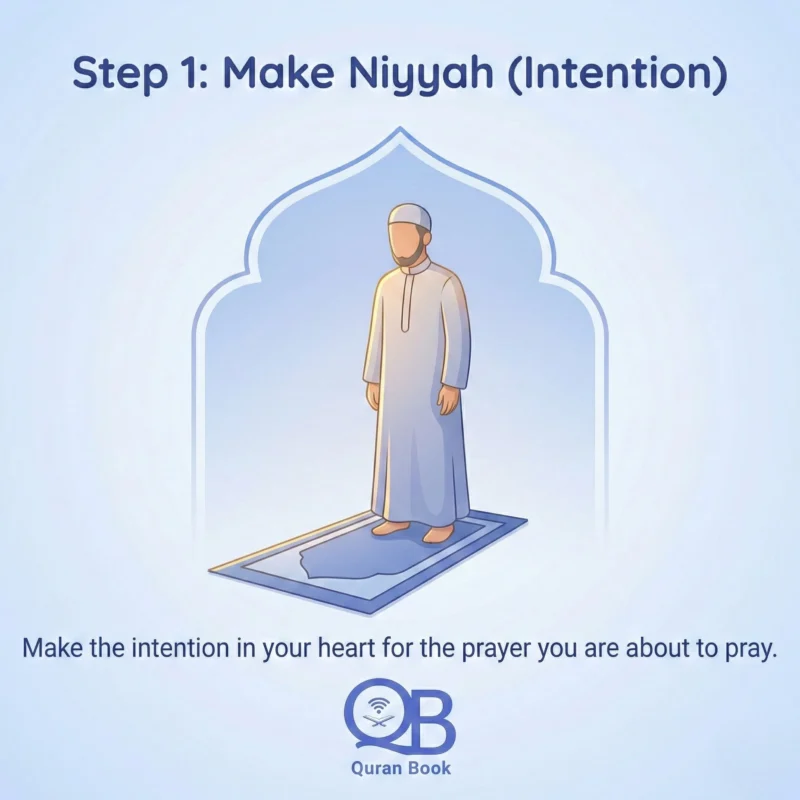
    Step 1 — Stand and Make Niyyah (Intention)

    First step in the prayer — standing with Niyyah (intention)
    Stand upright facing the Qibla and set your intention (Niyyah) in your heart

    Stand upright, face the Qibla, and make your intention in your heart for the specific prayer you are about to perform. The niyyah is silent — it is not spoken aloud.

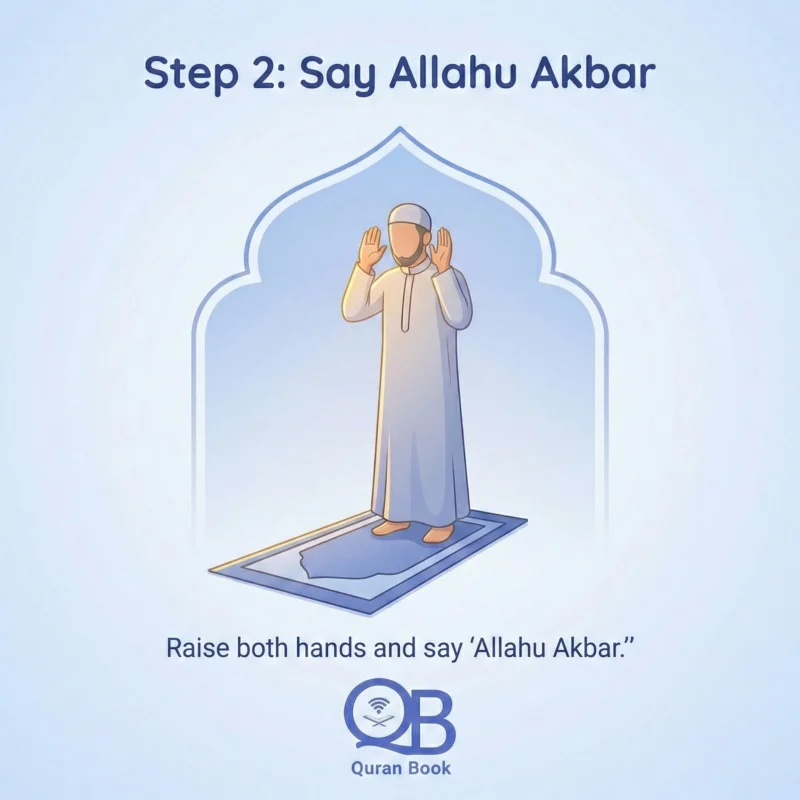
    Step 2 — Raise Hands and Say Takbir

    Second step in the prayer — Raise Hands and Say Takbir
    Raise both hands and say “Allahu Akbar” to begin the prayer

    Raise both hands to your ears (men) or shoulders (women) and say “Allahu Akbar” (Allah is the Greatest). This takbir officially begins your salah, and from this moment, you should not speak, look around, or engage in any worldly action.

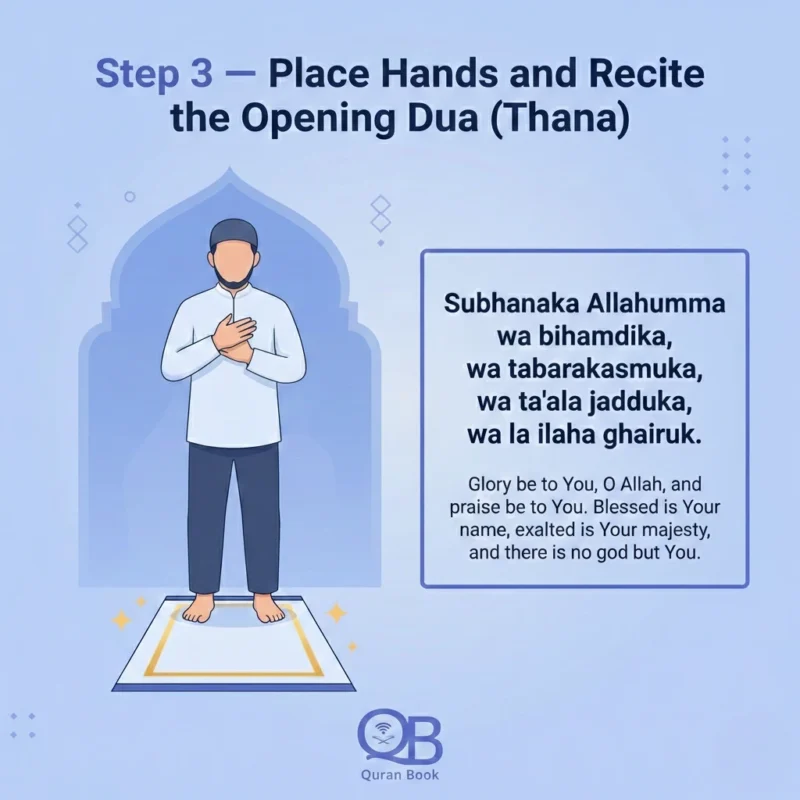
    Step 3 — Place Hands and Recite the Opening Dua (Thana)

    Place Hands and Recite the Opening Dua (Thana)
    Place right hand over left on your chest and recite the opening supplication

    Place your right hand over your left hand on your chest. Recite the opening supplication: “Subhanaka Allahumma wa bihamdika, wa tabarakasmuka, wa ta’ala jadduka, wa la ilaha ghairuk.” (Glory be to You, O Allah, and praise be to You. Blessed is Your name, exalted is Your majesty, and there is no god but You.)

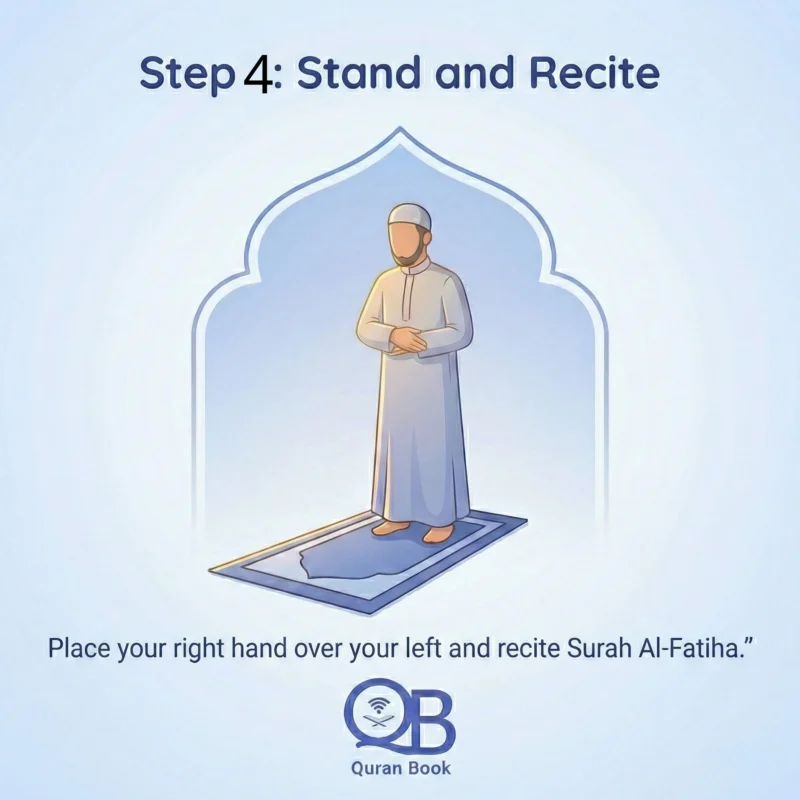
    Step 4 — Recite Surah Al-Fatiha

    Recite Surah Al-Fatiha during salah
    Recite the complete Surah Al-Fatiha — obligatory in every rakat

    This recitation is obligatory in every single rakat. Recite the complete Surah Al-Fatiha (Quran 1:1-7), then say “Ameen.”

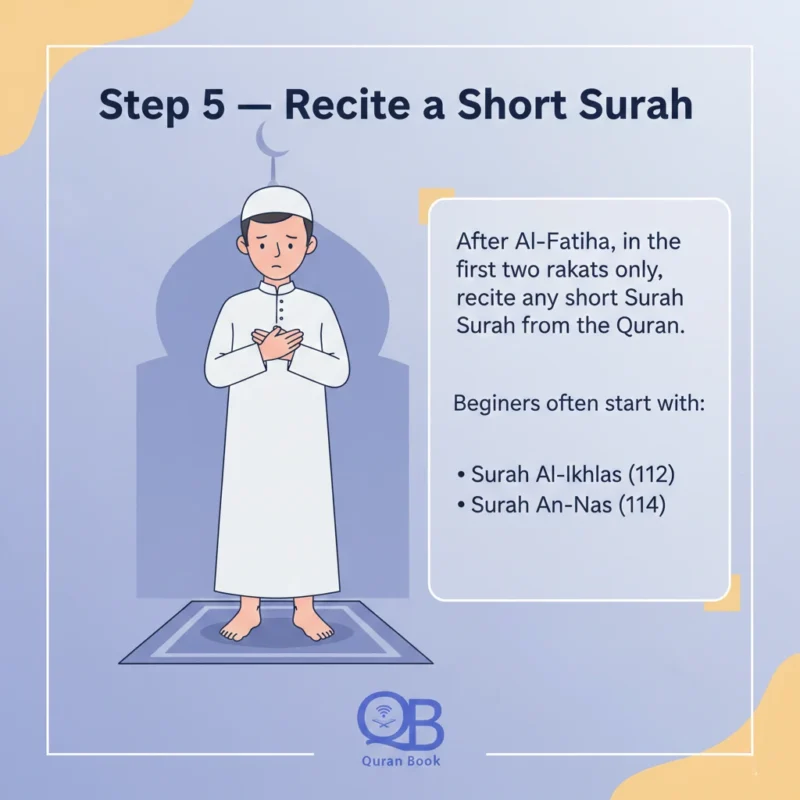
    Step 5 — Recite a Short Surah

    Recite a Short Surah after Al-Fatiha
    Follow Al-Fatiha with a short Surah in the first two rakats

    After Al-Fatiha, in the first two rakats only, recite any short Surah from the Quran. Beginners often start with Surah Al-Ikhlas (Quran 112), Surah Al-Falaq (Quran 113), or Surah An-Nas (Quran 114).

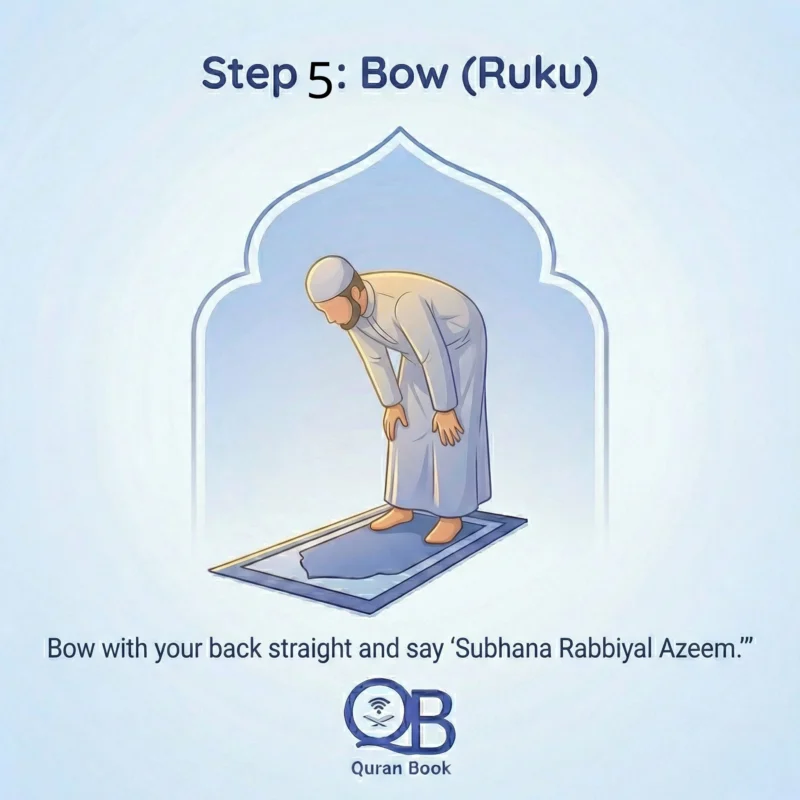
    Step 6 — Perform Ruku (Bowing)

    Perform Ruku — bowing position in salah
    Bow with your back straight and hands firmly on knees

    Say “Allahu Akbar” and bow forward. Keep your back straight and parallel to the ground, place your hands firmly on your knees, and say “Subhana Rabbiyal Adheem” three times (Glory to my Lord, the Most Great).

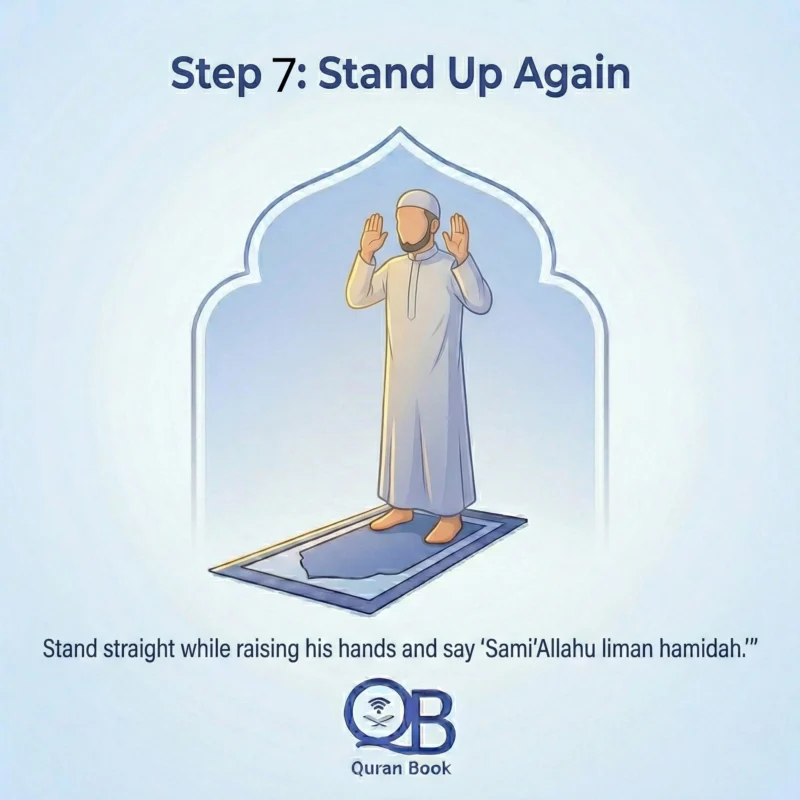
    Step 7 — Rise from Ruku

    Rise from Ruku — standing upright after bowing
    Stand fully upright after rising from ruku

    Stand fully upright and say “Sami’Allahu liman hamidah” (Allah hears those who praise Him). Once standing, say “Rabbana wa lakal hamd” (Our Lord, all praise is for You).

    Step 8 — Perform First Sujud (Prostration)

    Perform First Sujud — prostration in salah
    Prostrate with seven body parts touching the ground — the closest you get to Allah

    Say “Allahu Akbar” and go down into prostration. Seven body parts must touch the ground: your forehead, nose, both palms, both knees, and the toes of both feet. In this position, say “Subhana Rabbiyal A’la” three times (Glory to my Lord, the Most High). Sujud is the closest a servant gets to Allah — make dua here.

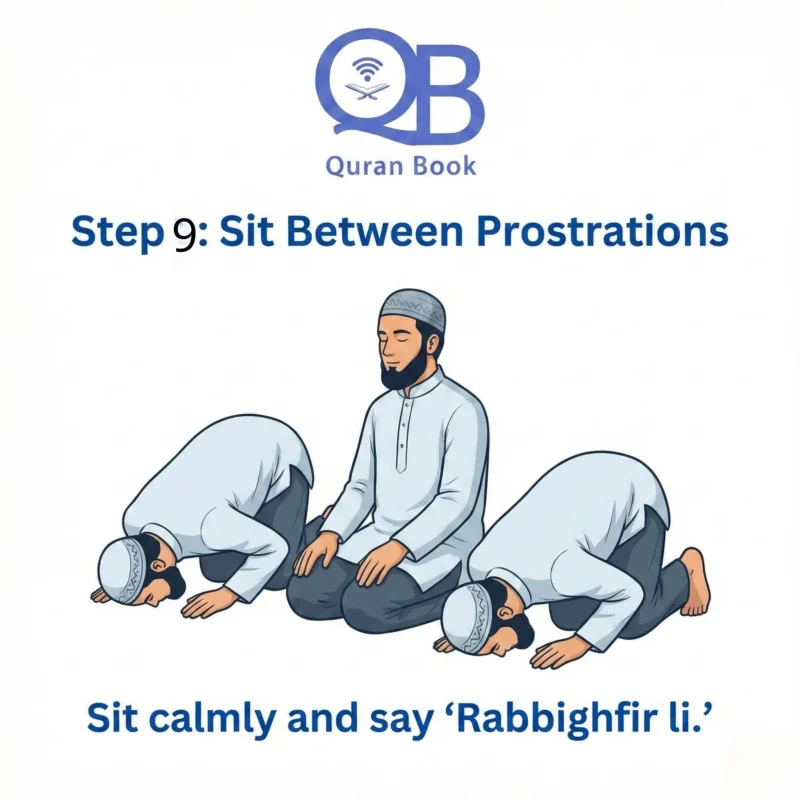
    Step 9 — Sit Between the Two Sujud

    Sit Between the Two Sujud
    Sit on your left leg with your right foot upright between prostrations

    Rise from sujud and sit on your left leg with your right foot upright. In this brief sitting, say “Rabbi ighfir li” (O my Lord, forgive me).

    Step 10 — Perform Second Sujud

    Perform Second Sujud — repeating prostration
    Repeat the prostration exactly as in Step 8

    Say “Allahu Akbar” and repeat the prostration exactly as in Step 8.

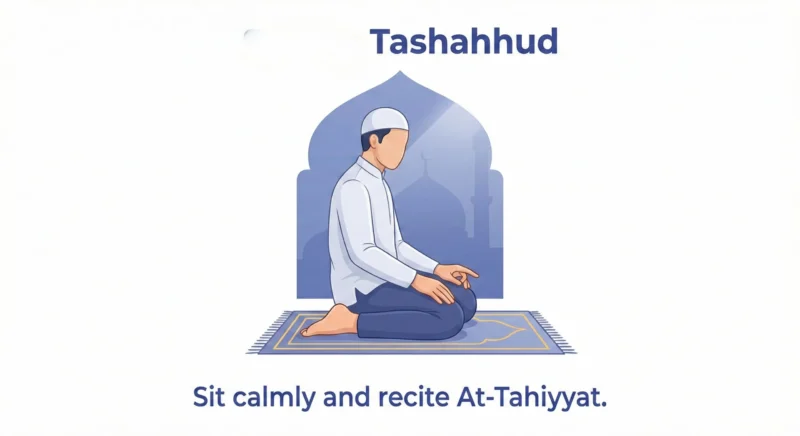
    Step 11 — Rise for the Next Rakat or Sit for Tashahhud

    Sitting for Tashahhud after completing two rakats
    Sit for Tashahhud (At-Tahiyyatu) after every two completed rakats

    If you have more rakats to pray, stand up saying “Allahu Akbar” and repeat from Step 4. After completing every two rakats, sit and recite the Tashahhud (At-Tahiyyatu). After the final rakat of the prayer, add the Salawat (blessings upon the Prophet ﷺ).

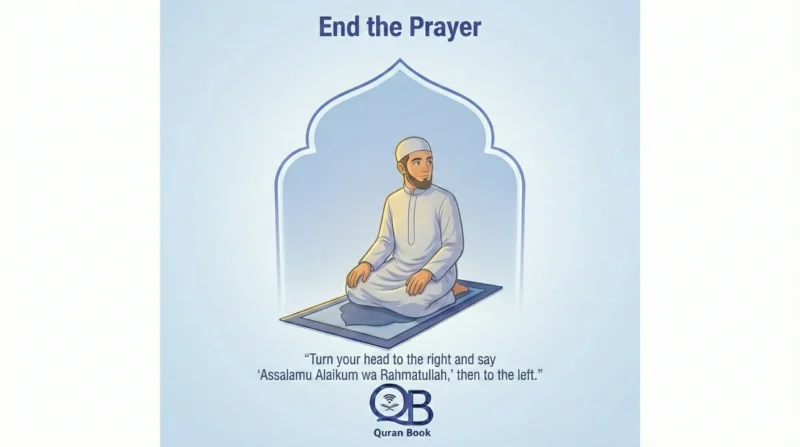
    Step 12 — End with Tasleem (Salam)

    End with Tasleem — turning head right and left for salam
    Turn your head right and left saying “Assalamu Alaikum wa Rahmatullah”

    Turn your head to the right and say “Assalamu Alaikum wa Rahmatullah” (Peace and mercy of Allah be upon you). Then turn your head to the left and repeat the same words. Your salah is now complete.

    “And establish prayer. Indeed, prayer prohibits immorality and wrongdoing.” (Quran 29:45)

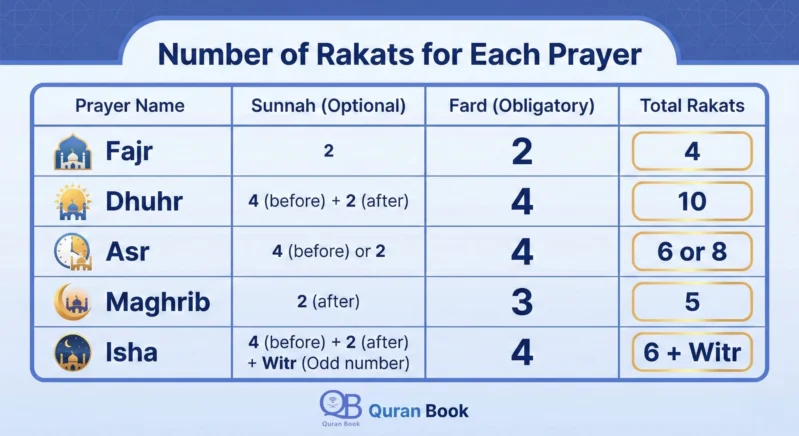
    How Many Rakats Are in All 5 Daily Prayers? (Full Rakat Table for 2026)

    Number of rakats for each of the 5 daily prayers in Islam — full rakat table
    Complete rakat breakdown for all five daily prayers
    Prayer Time Sunnah Before Fard (Obligatory) Sunnah After
    Fajr Dawn 2 2
    Dhuhr Midday 4 (or 2+2) 4 2
    Asr Afternoon 4 (optional) 4
    Maghrib Sunset 3 2
    Isha Night 4 2 + Witr (3 or 1)

    A common question many beginners ask is: “Is Asr 3 or 4 rakats?” Asr is always 4 fard rakats. There is no 3-rakat option for Asr. Maghrib is the only prayer with 3 obligatory rakats, which sometimes causes this confusion.

    In total, the five daily prayers include 17 obligatory (fard) rakats and approximately 12 Sunnah rakats, giving you a daily total of around 29 rakats when you include the voluntary prayers.

    Struggling to memorize this? An Islamic studies course for kids and adults can break this down into bite-sized, easy-to-remember chunks.

    How to Pray Each of the 5 Daily Salah

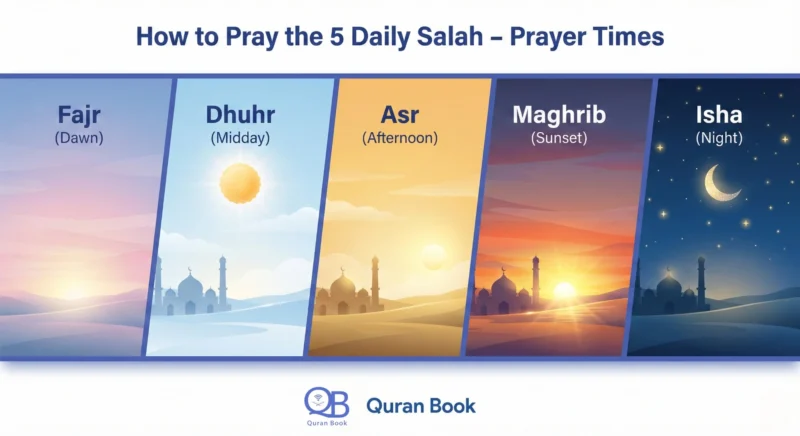
    How to pray the 5 daily salah — Fajr, Dhuhr, Asr, Maghrib, and Isha prayer times
    The five times of prayer — from dawn (Fajr) to night (Isha)

    How to Pray Fajr (Dawn Prayer — 2 Rakats)

    To pray Fajr, perform 2 Sunnah rakats followed by 2 Fard rakats. Both fard rakats are recited aloud. Fajr is prayed between the first light of dawn and just before sunrise. It is considered the most rewarding prayer to establish consistently. The Prophet ﷺ said: “Whoever prays the Fajr prayer, he is under the protection of Allah.” (Sahih Muslim 657). If you are just learning how to pray salah, start with Fajr — it is the shortest and simplest prayer.

    How to Pray Dhuhr (Noon Prayer — 4 Rakats)

    Dhuhr consists of 4 Sunnah rakats before, 4 Fard rakats, and 2 Sunnah rakats after. All fard rakats are recited silently. Dhuhr is prayed after the sun passes its zenith (highest point) until the shadow of an object equals its length. Think of Dhuhr as your midday spiritual reset — a moment to pause, reconnect with Allah, and refocus before the afternoon.

    How to Pray Asr (Afternoon Prayer — 4 Rakats)

    Asr has 4 Fard rakats, all recited silently. There are also 4 optional Sunnah rakats before the fard that some Muslims pray. The Quran emphasizes protecting Asr in particular: “Guard strictly your prayers, especially the middle prayer.” (Quran 2:238). Many scholars interpret “the middle prayer” as Asr. Praying Asr on time, before the sun turns orange, is critically important.

    How to Pray Maghrib (Sunset Prayer — 3 Rakats)

    Maghrib has 3 Fard rakats followed by 2 Sunnah rakats. The first 2 fard rakats are recited aloud, and the 3rd is recited silently. Maghrib begins immediately after sunset and has a relatively narrow time window compared to other prayers, so it should be prayed promptly. It is the only daily prayer with an odd number of obligatory rakats.

    How to Pray Isha (Night Prayer — 4 Rakats)

    Isha consists of 4 Fard rakats, 2 Sunnah rakats, and Witr (either 1 or 3 rakats). The first 2 fard rakats are recited aloud, and the last 2 are silent. Isha begins when the twilight (red or white afterglow) disappears from the sky. The Witr prayer after Isha is strongly recommended and is considered the last prayer of the night — a beautiful way to end your day in remembrance of Allah.

    Join our Telegram channel for daily Quran & Tajweed practice to strengthen your recitation alongside your prayer journey.

    What Should I Recite During Salah? (Recitations Made Simple)

    Knowing what to recite during salah is one of the biggest concerns for beginners. Here is a simplified breakdown of the recitations for each position:

    1

    Standing (Qiyam): Recite Surah Al-Fatiha (obligatory in every rakat), followed by any short Surah in the first two rakats.

    2

    Bowing (Ruku): Say “Subhana Rabbiyal Adheem” three times.

    3

    Rising from Ruku: Say “Sami’Allahu liman hamidah,” then “Rabbana wa lakal hamd.”

    4

    Prostration (Sujud): Say “Subhana Rabbiyal A’la” three times.

    5

    Sitting between Sujud: Say “Rabbi ighfir li.”

    6

    Tashahhud (Sitting after 2 rakats): Recite At-Tahiyyatu, followed by the Salawat on the Prophet ﷺ in the final sitting.

    7

    Tasleem (Ending): Say “Assalamu Alaikum wa Rahmatullah” turning right, then left.

    Beginner Tip: If you are just starting out, focus on memorizing Surah Al-Fatiha and Surah Al-Ikhlas (Quran 112:1-4). These two short surahs are all you need to cover the recitation requirements while you are still learning how to pray salah. As you grow more comfortable, gradually add more surahs to your repertoire.

    Our Quran memorization course helps you memorize these surahs with proper Tajweed pronunciation in just a few weeks.

    7 Common Mistakes Beginners Make in Salah (And How to Avoid Them)

    When you first learn how to pray salah, certain mistakes are very common. Being aware of them from the start will help you build a strong foundation:

    1. Rushing through the prayer without khushu (focus): Salah is a conversation with Allah, not a race. Slow down, feel each word, and be present in every position.

    2. Not straightening the back fully during ruku: Your back should be flat and parallel to the ground during bowing, not curved or hunched.

    3. Lifting the forehead before the nose in sujud: When coming up from prostration, lift your head naturally — the forehead and nose should rise together.

    4. Moving too quickly between positions: The Prophet ﷺ instructed that each limb must settle in its position before moving to the next. Rushing invalidates the quality of your prayer.

    5. Reciting Surah Al-Fatiha too quietly or skipping it entirely: Al-Fatiha is obligatory in every rakat. Even in silent prayers, you must recite it quietly to yourself.

    6. Forgetting to face the qibla direction: Always verify the qibla direction before starting your salah, especially when praying in a new location.

    7. Praying without valid wudu: The Prophet ﷺ said that prayer without wudu is not accepted (Sahih Muslim 224). If your wudu breaks, you must renew it before praying.

    The Prophet ﷺ warned: “The worst type of thief is the one who steals from his prayer” — meaning the one who does not complete the postures properly (Musnad Ahmad 22695).

    Bonus FAQs: Does crying break your salah? No — crying from emotion or fear of Allah does not break salah, though loud wailing with discernible words can invalidate it according to some scholars. Can you pray without wudu? No — wudu is an absolute prerequisite for the validity of salah.

    The Academy Method: How Quran Book Academy Teaches You to Pray Salah Online

    Learn how to pray salah online with Quran Book Academy — live Zoom classes for beginners
    Live Zoom classes with qualified teachers at Quran Book Academy

    At Quran Book Academy, we have developed a unique teaching approach called The Academy Method — designed specifically for beginners who want to learn how to pray salah with confidence and without stress.

    Psychological Chunking

    We break salah down into small, manageable “chunks.” You first learn wudu, then master just one rakat, then two, building your confidence step by step before adding complexity. This mirrors the evidence-based approach educational psychologists recommend for skill acquisition.

    Live Zoom Sessions

    Every student learns salah in real-time with a qualified teacher via Zoom — not through pre-recorded videos. You can ask questions on the spot, get your posture corrected live, and hear proper Arabic pronunciation directly from your instructor.

    Custom LMS Tracking

    Our proprietary Learning Management System tracks your progress lesson by lesson. Parents and adult learners receive detailed Gmail progress reports after each session, so you always know exactly where you stand and what comes next.

    For Kids and Adults

    We offer tailored Islamic courses for kids using engaging, age-appropriate methods, as well as comprehensive Islamic courses for adults — perfect for new Muslims and those reconnecting with their faith.

    Whether you want to learn how to pray salah properly or master Quran recitation with Tajweed, the Academy Method ensures no student is left behind. Explore our full course catalog — from Tajweed to Tafsir — and find the right path for your journey.

    FAQ — Your Salah Questions Answered

    Q: How do I pray as a beginner?

    Begin by learning wudu (ablution), then memorize Surah Al-Fatiha and one short Surah like Al-Ikhlas. Practice with a step-by-step guide or, ideally, with a live teacher. Start with Fajr — it has only 2 rakats and is the simplest prayer to learn.

    Q: How many rakats are in all 5 daily prayers?

    Fajr has 2, Dhuhr has 4, Asr has 4, Maghrib has 3, and Isha has 4 obligatory (fard) rakats. Including Sunnah prayers, the daily total is approximately 17 fard rakats and 12 Sunnah rakats.

    Q: Does discharge break salah?

    If seminal fluid (mani) is discharged, ghusl (full-body purification) is required before praying. Minor discharge (madhi) requires washing the affected area and renewing wudu only.

    Q: Is it permissible to smile during salah?

    A slight, involuntary smile does not invalidate salah. However, laughing audibly with sound does break the prayer according to the majority of scholars.

    Q: Can I wear glasses while praying in Islam?

    Yes, wearing glasses during salah is completely permissible. It does not affect the validity of your prayer in any way.

    Q: Is it haram to pray with eyes open?

    No, it is not haram. However, scholars recommend keeping your gaze directed at the place of sujud (prostration) during standing and at your lap during sitting to maintain khushu (focus and humility).

    Q: What should I recite during salah?

    Recite Surah Al-Fatiha in every rakat — this is obligatory. In the first two rakats, follow it with any short Surah or Quran verses. In ruku, say “Subhana Rabbiyal Adheem.” In sujud, say “Subhana Rabbiyal A’la.” In tashahhud, recite At-Tahiyyatu and the Salawat.

    Ready to Learn How to Pray Salah the Right Way?
    Start Your Free Trial Today

    You have already taken the most important step — seeking knowledge. Now let a qualified teacher guide you through every position, every word, and every prayer until it becomes second nature.

    At Quran Book Academy, we have helped thousands of beginners across the USA, Canada, UK, and Australia learn how to pray salah with confidence, patience, and personalized attention.

    Book Your FREE Trial Lesson

    No pressure. No judgment. Just a patient teacher and your first rakat.

    Still exploring? Read our complete guide to learning Quran online for all ages.

    References & Sources

    Hadith Collections:

    Sahih al-Bukhari 631 — “Pray as you have seen me praying.” — sunnah.com

    Sunan an-Nasa’i 465 — Accountability of prayer on the Day of Judgment — sunnah.com

    Sunan Abu Dawud 492 — The earth as a place of worship — sunnah.com

    Sahih Muslim 657 — Protection of Allah for those who pray Fajr — sunnah.com

    Sahih Muslim 224 — Prayer without wudu is not accepted — sunnah.com

    Musnad Ahmad 22695 — Warning against stealing from one’s prayer — sunnah.com

    Quranic References:

    Quran 4:103 — Prayer decreed at specified times — quran.com

    Quran 29:45 — Prayer prohibits immorality and wrongdoing — quran.com

    Quran 2:238 — Guard strictly your prayers — quran.com

    Quran 1:1-7 — Surah Al-Fatiha — quran.com

    Scholarly Resources:

    IslamQA — Scholarly tafsir and fatwas on the obligation of salah — islamqa.info

    Sunnah.com — Comprehensive hadith database — sunnah.com

  • Waswasa in prayer

    7 Proven Ways to Stop Waswas in Salah — A Powerful Guide for Every Muslim

    7 Proven Ways to Stop Waswas in Salah — A Powerful Guide for Every Muslim

    Published by Quran Book Academy  ·  Islamic Guidance  ·  12 min read

    Muslim praying with focus — overcoming waswas in salah
    A Muslim in prayer — finding focus and overcoming waswas in salah through faith and knowledge.

    Introduction

    If you’ve ever stood in salah and felt your mind race with random thoughts, doubts about your wudu, or confusion about how many rakat you’ve prayed — you’re not alone. Waswas in salah is one of the most common spiritual struggles Muslims face worldwide.

    The guilt, the frustration, the quiet fear that your prayer “doesn’t count” — these feelings are painfully real. But here’s what many people don’t realize: the Prophet ﷺ himself was asked about this very problem, and he gave direct, practical solutions.

    This guide shares 7 actionable, Quran-and-Sunnah-based methods to overcome waswas in salah, build khushu, and reclaim your focus in prayer — starting today.

    “Indeed, prayer prohibits immorality and wrongdoing.”

    Surah Al-Ankabut 29:45

    If your salah feels like a battlefield instead of a sanctuary, keep reading. The solution is closer than you think.

    What Is Waswas in Salah? Understanding Shaytan’s Whispers

    Waswas in salah refers to the intrusive, involuntary whispers and doubts that Shaytan places in a Muslim’s mind during prayer. These can include doubts about wudu, confusion about the number of rakat prayed, or distracting worldly thoughts that pull you away from connecting with Allah. In Arabic, the word “waswasa” (from the root و-س-و-س) literally means repeated whispering.

    Allah Himself describes Shaytan’s nature in Surah An-Nas (114:4–6), calling him “al-waswas” — the persistent whisperer who retreats when you remember Allah and returns when you become heedless.

    Here is the most reassuring part: the Prophet ﷺ said that experiencing waswas and hating it is actually a sign of sincere faith (Sahih Muslim 132). The fact that these whispers disturb you proves that your heart rejects them — and that is iman in action.

    Does Allah Forgive Waswas? What Islam Really Teaches

    Yes, Allah forgives waswas. Intrusive thoughts and whispers from Shaytan are not sinful as long as a Muslim does not act upon them or speak them aloud. The Prophet ﷺ confirmed this clearly: Allah has pardoned His ummah for the thoughts that cross their minds, so long as they do not act on them or verbalize them (Sahih al-Bukhari 5269).

    This is an incredibly important point for anyone struggling with distraction in salah. Waswas is a test from Allah — not a punishment. The very fact that it distresses you is living proof of your iman. Allah, in His infinite mercy, does not hold you accountable for what Shaytan throws into your mind. What matters is how you respond — and this guide is here to help you respond the right way.

    Actionable Methods

    7 Proven Ways to Get Rid of Waswas in Salah

    This is the section you’ve been waiting for. Whether you’re searching for how to get rid of waswas in salah or how to stop waswas in salah, these seven methods are rooted in authentic Islamic sources and practical psychology.

    1

    Seek Refuge in Allah (Say A’udhu Billah)

    The Prophet ﷺ gave a direct prescription for this. When a companion complained about experiencing waswas during prayer, the Prophet ﷺ instructed him to say “A’udhu Billahi min ash-Shaytan ir-Rajeem” and to spit dryly to his left three times. The companion did so, and the waswas left him (Sahih Muslim 2203).

    This is not just a ritual — it is a spiritual weapon. The moment you feel the whispers creeping in, turn to Allah immediately. Shaytan’s power is built on your attention; when you redirect that attention to Allah, the whispers lose their grip.

    2

    Learn the Meaning of What You Recite

    One of the biggest reasons for distraction in salah is not understanding the Arabic words being recited. When you pray without comprehension, your mind has nothing to anchor itself to — and Shaytan exploits that vacuum.

    When you understand the meaning of Al-Fatiha, your Tashahhud, and your dhikr, your mind naturally stays engaged. The words stop being sounds and start becoming a real conversation with your Creator. This single change can transform your entire prayer experience and help you build khushu in salah.

    3

    Focus Your Gaze on the Place of Sujood

    Scholars recommend fixing your eyes on the exact spot where your forehead will touch during prostration. This simple physical anchor reduces wandering thoughts significantly.

    Your body and your mind are deeply connected. When your eyes wander, your thoughts follow. But when you discipline your gaze, your attention stabilizes. This is one of the easiest and most immediate ways to how to focus in salah — no preparation needed, just conscious effort from the very first takbeer.

    4

    Prepare Before You Pray

    Complete your wudu calmly and deliberately. Choose a quiet, clean space. Remove your phone from the room — or at least put it on silent and out of sight. Take a few seconds to set your intention before raising your hands for takbeer.

    Mental preparation before salah significantly reduces waswas in salah and wudu doubts. Many people rush into prayer directly from a busy task, and then wonder why their mind is still racing. Treat the moments before salah as a transition — a conscious shift from dunya to the presence of Allah.

    5

    Ignore the Doubt — Do Not Repeat Your Prayer

    This is one of the most critical pieces of advice Islamic scholars unanimously agree on: do not restart your salah because of waswas. If you doubt how many rakat you prayed, build on the lesser number (the one you are certain of) and perform sujood as-sahw (the prostration of forgetfulness) at the end.

    “If one of you is unsure during his prayer and does not know how many he has prayed — three or four — let him cast aside the doubt and proceed on what he is sure of.”

    Sahih Muslim 571

    Repeating salah feeds the cycle of waswas. Ignoring it starves it. Every time you choose to continue despite the doubt, you weaken Shaytan’s hold over you.

    6

    Make Consistent Dhikr Outside of Salah

    Regular morning and evening adhkar create a powerful spiritual shield around your heart and mind. The more you remember Allah throughout your day, the easier it becomes to focus in salah.

    Think of dhikr as spiritual training. Athletes don’t just perform on game day — they train daily. Similarly, your ability to concentrate in salah is directly connected to how often you engage with Allah’s remembrance outside of prayer. Ayat al-Kursi before sleep, the morning adhkar after Fajr, and istighfar throughout the day all build a foundation that Shaytan finds much harder to penetrate.

    7

    Study Tajweed and Quran to Deepen Your Connection

    When your relationship with the Quran is active and growing, your salah transforms. Learning proper recitation with tajweed engages your mind, tongue, and heart simultaneously — leaving no room for Shaytan’s whispers.

    This is not just about pronunciation. Tajweed forces you to pay attention to every letter, every elongation, every pause. It turns recitation into an act of deep concentration. And when that level of engagement carries into your salah, waswas in salah simply cannot survive.

    Academy Spotlight

    The Academy Method: How Quran Book Academy Helps You Build Khushu

    Quran Book Academy online Tajweed class — building khushu in salah
    Quran Book Academy — live online Tajweed classes with certified teachers, building khushu one lesson at a time.

    At Quran Book Academy, the approach to Quran education is built on a psychology-informed, chunk-based learning method. Each lesson is designed around manageable, focused segments that prevent cognitive overload — especially for non-Arabic speakers and beginners. This directly combats the root cause of waswas in salah: a lack of understanding and confidence in what you’re reciting.

    Here is what makes the Academy Method different. Students attend live Zoom sessions with certified teachers who provide real-time correction — not pre-recorded videos where mistakes go unnoticed. A custom Learning Management System (LMS) tracks each student’s progress lesson by lesson, ensuring nothing is skipped or rushed. Parents and students receive weekly Gmail progress reports showing exactly where improvement is happening.

    Whether you’re an adult returning to the Quran after years away, a parent enrolling your child in their first Islamic studies course, or a teenager preparing for confident recitation — Quran Book Academy has structured courses designed for every level: Islamic Courses for Kids, Islamic Courses for Adults, and comprehensive Online Quran Classes.

    Join the Telegram channel for daily Quran recitation practice with Tajweed and become part of a growing community of learners.

    Waswas in Salah vs. Genuine Mistakes: Know the Difference

    Understanding the difference between waswas and a genuine mistake is essential. Here is a clear breakdown:

    Factor Waswas (Shaytan’s Whispers) Genuine Mistake
    Nature Repetitive, irrational doubt Occasional, clear error
    Solution Ignore and continue Perform Sujood As-Sahw
    Frequency Happens almost every prayer Happens rarely
    Feeling Anxiety, obsessive loop Simple forgetfulness
    Islamic Ruling Not sinful — do not repeat salah Corrected with prostration

    If your doubts follow a pattern of anxiety and repetition, that is waswas. If you genuinely made a clear, one-time error (like forgetting to recite Al-Fatiha), that is a mistake corrected by sujood as-sahw.

    Common Questions

    FAQ — Waswas in Salah

    Can I ignore waswas in salah?

    Yes, Islamic scholars advise that the best response to waswas is to completely ignore it and continue your prayer. The Prophet ﷺ specifically instructed this approach. Paying attention to waswas only strengthens it. The key is to keep praying, keep reciting, and refuse to engage with the doubt.

    Does waswas break wudu?

    No, waswas does not break wudu. Doubt caused by Shaytan’s whispers is not a valid reason to repeat wudu. Your wudu remains valid unless you are certain it was broken through a known, specific cause — such as passing gas or using the restroom. If you are merely unsure, continue with your prayer.

    How do I deal with waswas about the number of rakat?

    If you are unsure whether you prayed 3 or 4 rakat, proceed based on the number you are certain of (the lower number), then perform sujood as-sahw at the end of your prayer. This is the clear guidance of the Prophet ﷺ, and it prevents the obsessive cycle of forgetting rakat in salah from taking over.

    What does waswasa mean in Islam?

    Waswasa means the whispering or insinuating thoughts from Shaytan that aim to create doubt and confusion in a Muslim’s worship, particularly during prayer and wudu. The word comes from the Arabic root و-س-و-س and is used in the Quran in Surah An-Nas to describe Shaytan’s primary tactic.

    How can I get khushu in salah?

    Khushu in salah comes from understanding what you recite, preparing mentally before salah, learning tajweed, and building a daily relationship with the Quran. It is not a switch you flip — it is a skill you build through consistent effort. Enrolling in a structured Quran course like those offered by Quran Book Academy accelerates this process dramatically.

    Take the First Step: Your Free Trial Lesson at Quran Book Academy

    Book a free trial lesson at Quran Book Academy — overcome waswas in salah
    Start your journey — book a free trial lesson with Quran Book Academy and experience the difference khushu makes.

    Waswas in salah often begins with a lack of understanding of what you’re reciting. When you learn to read and understand the Quran with proper tajweed, your salah becomes a conversation with Allah — not a battle with Shaytan.

    At Quran Book Academy, certified teachers guide beginners and children through personalized, live Zoom sessions — tracked through a custom LMS with weekly Gmail progress reports sent directly to you.

    👉 Book Your Free Trial Lesson Now
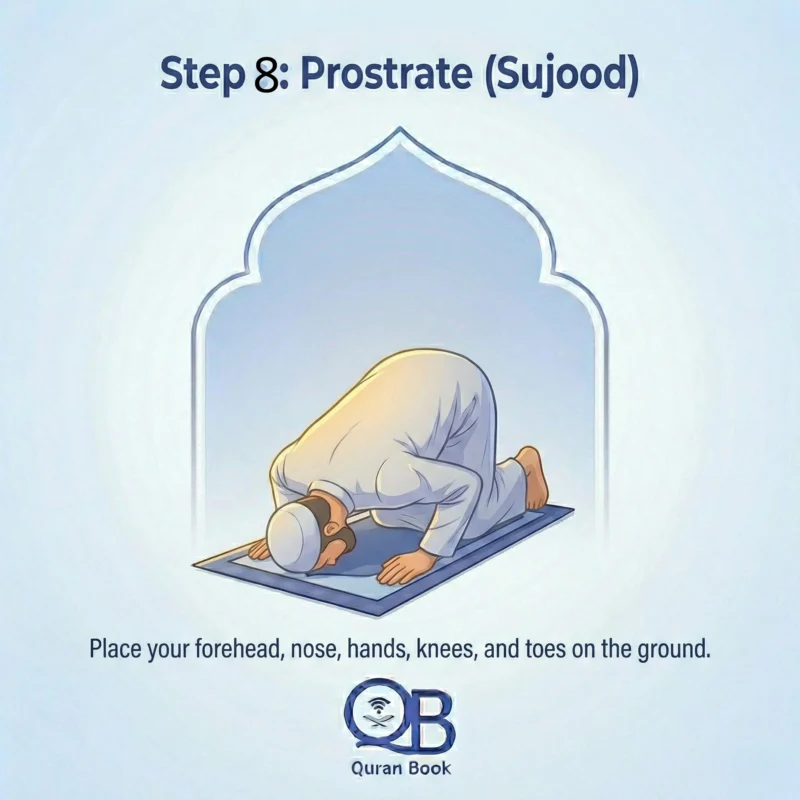
    Experience the difference khushu makes in your salah.

    Start Free Trial

    References

    Source Link
    Quran 29:45 quran.com/29/45
    Quran 114:4-6 (Surah An-Nas) quran.com/114/4
    Sahih Muslim 132 — Waswas is a sign of faith sunnah.com/muslim/1/259
    Sahih al-Bukhari 5269 — Thoughts are forgiven sunnah.com/bukhari/68/19
    Sahih Muslim 2203 — Khanzab hadith (A’udhu Billah) sunnah.com/muslim/39/43
    Sahih Muslim 571 — Doubt in rakat sunnah.com/muslim/5/130
    Quran Book Academy Telegram Channel t.me/maqraquranbookonline