7 Proven Steps to Learn Quran for Beginners
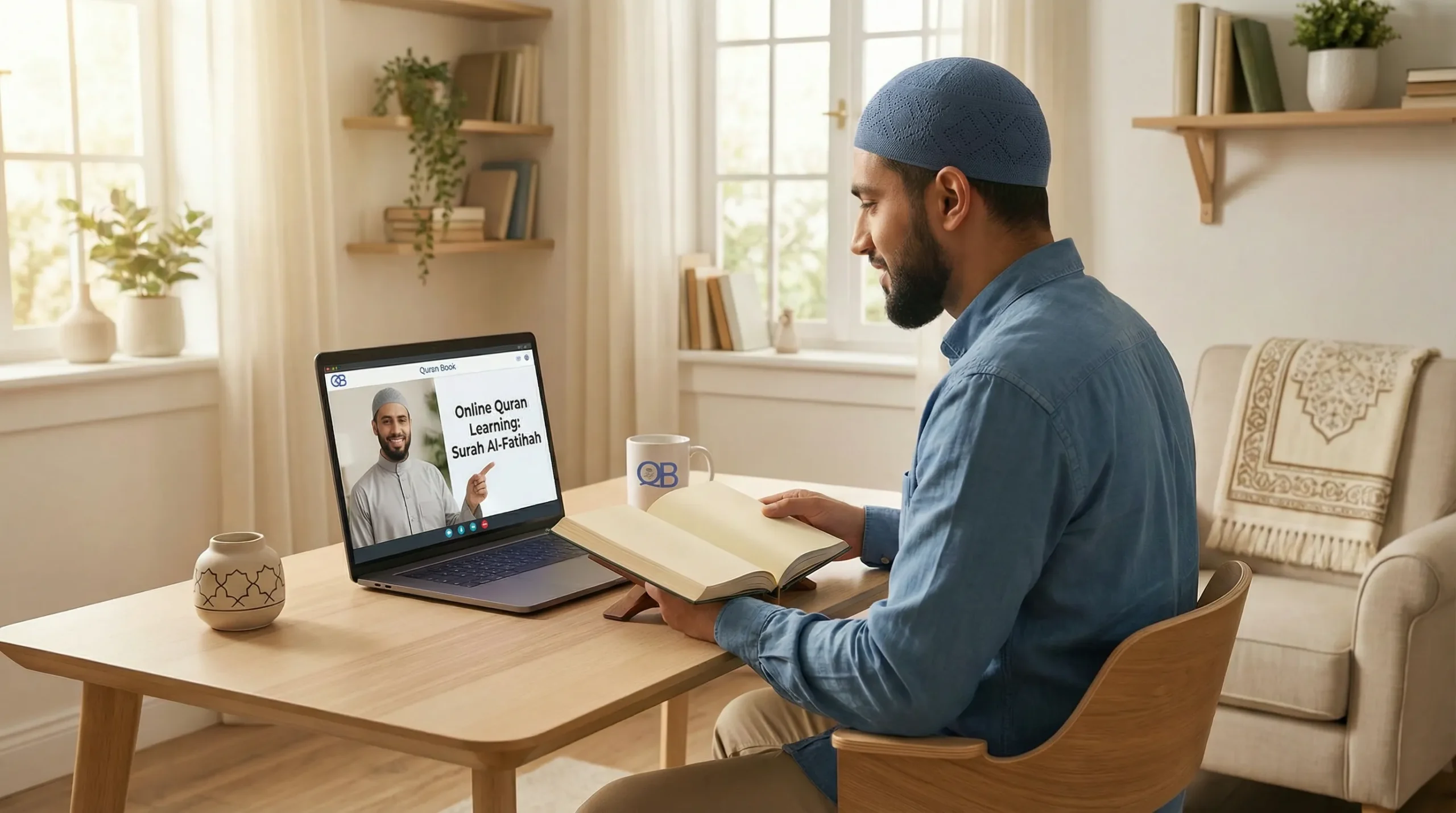
Are you ready to learn Quran for beginners but feeling overwhelmed by where to start? You’re not alone. Many non-Arabic speaking Muslims in the USA, Canada, UK, and Australia share the same fear — the Arabic script looks foreign, Tajweed rules seem complex, and finding time in a busy schedule feels impossible.
At Quran Book Academy, we understand these barriers because we’ve helped many students overcome them. The fear of failure, embarrassment about mispronunciation, concerns about managing a busy schedule, lack of foundational Arabic, and memories of previous unsuccessful attempts — these are all common barriers that a compassionate, structured approach addresses head-on.
The reassuring truth? Learning to read the Quran is simpler than you think when you have the right guidance, the right method, and patient teachers who understand your journey. As Allah says in the Quran:
“And We have certainly made the Quran easy to remember. So is there anyone who will be mindful?”
— Surah Al-Qamar 54:17
Why Learning Quran as a Beginner Feels Overwhelming (And How to Overcome It)
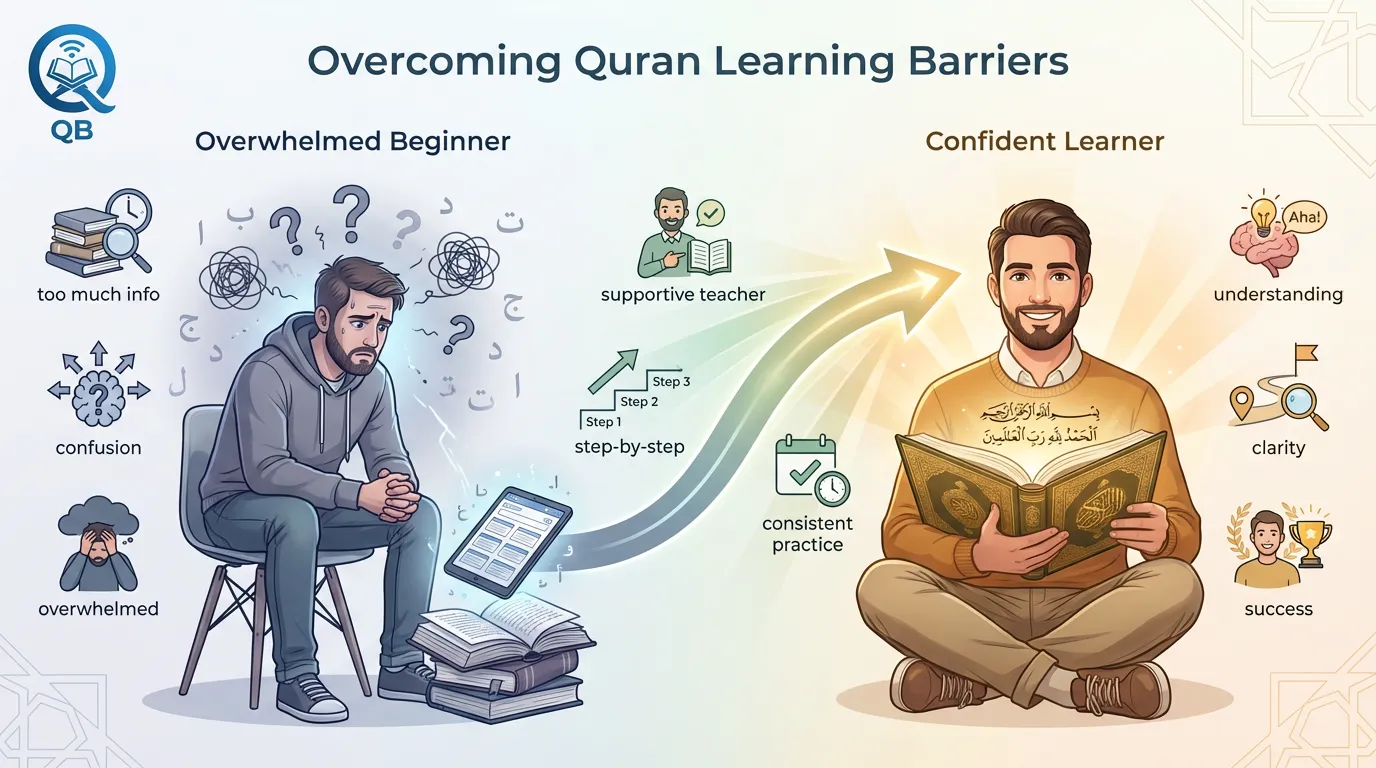
Learning Quran for beginners feels overwhelming due to three main barriers: unfamiliar Arabic script, complex Tajweed rules, and lack of structured guidance. The solution is a step-by-step approach with patient native Arabic tutors who break down lessons into small, manageable chunks.
Understanding why you feel overwhelmed is the first step toward overcoming it. Here are the most common barriers that stop beginners before they start:
✦ Barriers You May Experience
“The one who is proficient in the recitation of the Quran will be with the honourable, obedient scribes, and the one who recites it with difficulty, doing his best, will have two rewards.”
— Sahih al-Bukhari 4937
A structured beginner path addresses each of these fears with patience, clear steps, and steady feedback — so the “fix” for every mistake is always obvious.
What Makes a Great Beginner Quran Course Online?
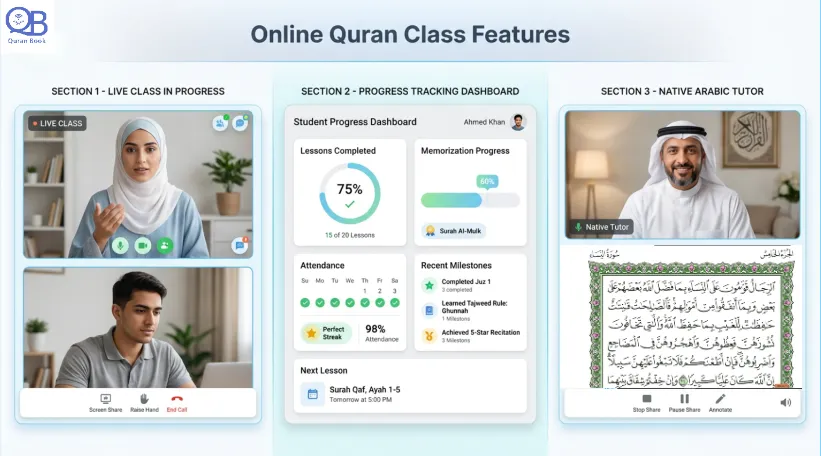
A great beginner Quran course online includes live one-on-one sessions with native Arabic tutors, visual Arabic alphabet learning, interactive lessons, flexible scheduling, and progress tracking. The best courses break complex concepts into stress-free, manageable steps.
✦ 7 Essential Features of Quality Quran Education
- 1Native Arabic-Speaking Tutors: authentic pronunciation only native speakers can provide.
- 2One-on-One Live Sessions: personalized attention and immediate feedback.
- 3Visual Arabic Alphabet Learning: starting from absolute zero with letter recognition and formation.
- 4Step-by-Step Tajweed Introduction: learning rules gradually, not all at once.
- 5Flexible Scheduling: classes that fit your timezone in the USA, Canada, UK, or Australia.
- 6Progress Tracking & Reports: knowing exactly where you stand.
- 7Supportive Environment: no judgment, only encouragement and patience.
✦ Comparison: What to Look For
| Feature | Quran Book Academy | Other Platforms |
|---|---|---|
| Live 1-on-1 Classes | ✅ Yes | Often pre-recorded |
| Native Arabic Tutors | ✅ Certified | Varies |
| Custom LMS Tracking | ✅ Full Reports | Limited |
| Arabic Alphabet Focus | ✅ Visual Method | Sometimes skipped |
| Free Trial Lesson | ✅ Available | Not always |
The Academy Method: How We Break Down Arabic for Beginners
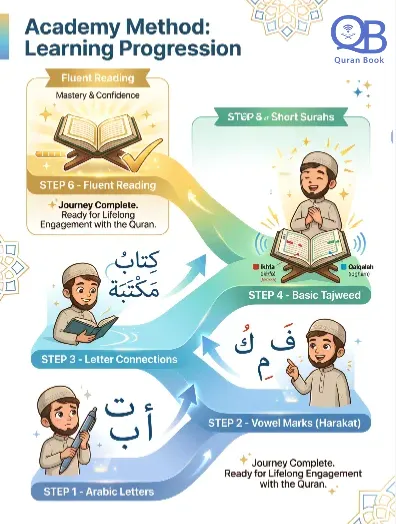
The Academy Method uses psychological “chunking” to teach Arabic reading for beginners. Instead of overwhelming you, it breaks complex Quranic concepts into small, digestible lessons — mastering one skill before moving to the next.
For example, instead of teaching all 28 Arabic letters in one session, tutors introduce three or four letters per class with visual aids and immediate practice. Each lesson builds on the previous one: letters, then connecting letters, then short vowels (Harakat), then Sukoon and Tanween — so you never feel lost.
This gradual approach mirrors the Islamic tradition of tadarruj (learning step by step), and it works because confidence is built as steadily as competence.
🎯 The Academy Method in 3 Words: Patience. Progress. Praise.
Step-by-Step Guide to Learn Quran for Beginners
To learn Quran for beginners, follow these steps: (1) master the Arabic alphabet, (2) learn vowel marks, (3) practice connecting letters, (4) study foundational Tajweed, (5) begin reading short Surahs, (6) practice daily with guidance, (7) join a supportive community.
✦ The 7-Step Beginner Roadmap
Master the Arabic Alphabet
Learn all 28 letters with proper pronunciation and each letter’s articulation point (Makhraj). This foundation takes roughly 4–8 weeks with consistent practice.
Understand Vowel Marks (Harakat)
Learn Fatha (a), Kasra (i), Damma (u), and Sukoon. These marks tell you how to pronounce each letter in context.
Practice Letter Connections
Arabic letters change shape by position (initial, medial, final, isolated). Recognising these forms is crucial for reading fluency.
Introduction to Tajweed Basics
Start with foundational rules like Noon Sakinah and Meem Sakinah, which govern how certain letters interact. Our Tajweed course covers these in depth.
Begin Reading Short Surahs
Start with Al-Fatiha, Al-Ikhlas, Al-Falaq, and An-Nas. These short chapters let you practice while building a spiritual connection.
Daily Practice with Feedback
Consistency plus expert correction is the key to progress. Even 15–20 minutes daily makes a significant difference.
Join a Supportive Community
Practice with fellow learners, share experiences, and stay motivated. Our free Telegram community is open to everyone.
Arabic Alphabet for Beginners: Your First Building Block
📱 FREE RESOURCE: Our YouTube channel teaches the Arabic alphabet from scratch — each letter with visual diagrams of tongue and lip positions, native-speaker audio, and practice with Quranic examples.
The Arabic alphabet for beginners consists of 28 letters, each with a unique shape and sound. Start with isolated letter forms and their articulation points (Makharij), then practice how they connect. Visual methods and repetition are essential for mastery.
Many students rush past the alphabet, eager to read the Quran immediately — this is a mistake. A strong foundation prevents struggles later. Think of it like building a house: without solid foundations, everything else becomes unstable.
✦ What You Will Learn
- ● All 28 letters in isolated, initial, medial, and final forms
- ● Proper articulation points (Makharij al-Huroof) for authentic pronunciation
- ● Common beginner mistakes and how to avoid them
👋 Learning as an Adult? It’s Never Too Late
If you’re starting in your 30s, 40s, 50s or beyond, know this: your age is a blessing, not a barrier. Adults bring motivation, discipline, and clear purpose that make learning highly effective — and the Prophet ﷺ promised a double reward for those who find recitation difficult yet persevere.
Because adult learners have their own questions about age, timelines, and fitting study around a busy life, we’ve written a dedicated guide just for them:
➡️ Read our complete guide: Learn to Read Quran for Adults →
Our Technology: Live Zoom Classes, Custom LMS & Progress Reports
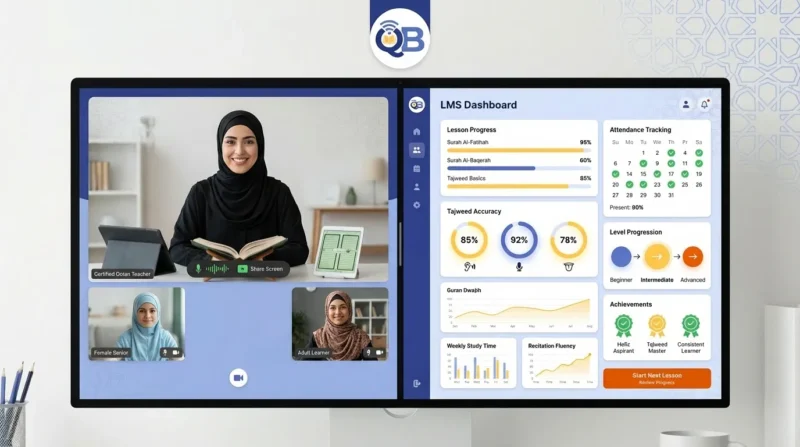
| Technology | Purpose | Student Benefit |
|---|---|---|
| Zoom | Live 1-on-1 sessions | Real-time interaction, screen sharing, whiteboard |
| Custom LMS | Progress tracking | See your journey from lesson 1 to completion |
| Email Reports | After each class | Know what you learned and what to practice |
Unlike pre-recorded courses or apps, live sessions let your teacher correct your pronunciation instantly. The LMS tracks your progress through each module — alphabet, vowel marks, Tajweed, and Surah reading — and after every class you get a detailed report of what you learned and what to practice next.
Frequently Asked Questions
How long does it take to learn Quran for beginners?
Most beginners can learn basic Quran reading in 6–12 months with consistent practice. The Arabic alphabet takes 4–8 weeks, basic Tajweed 2–3 months, and fluent recitation develops with continued practice. Timelines vary based on your pace and availability.
Can I learn to read Quran if I don’t know Arabic at all?
Absolutely. A good beginner course is designed for students with zero Arabic knowledge. You start from the very first letter (Alif) and build step by step. Most successful students began exactly where you are now.
Is learning Quran online as effective as in-person classes?
Yes, and often more so. Live one-on-one classes give attention that’s rare in group settings, an LMS tracks your progress, and you learn from home at a time that suits your zone.
What age is best to start learning Quran?
Any age is perfect. Children as young as five can begin with letter recognition, while adults of all ages — including seniors — regularly enroll and succeed. We have classes for kids and adults alike.
How much do beginner Quran classes cost?
We offer affordable packages with flexible payment options, based on how many classes per week you take. See current rates, or book a free trial with no obligation.
What if I’m too busy to commit to regular classes?
We offer flexible scheduling designed for busy professionals and parents, seven days a week across multiple time zones. You choose the schedule that works for you.
Do you provide Tajweed certification?
Yes. On completing our intermediate and advanced courses you receive a certificate of completion. For Ijazah (an authorized transmission chain), we offer specialized programs. Learn about our Tajweed course →
Start Your Free Trial Lesson Today
Every expert was once a beginner. Every hafiz once learned their first letter. Your journey to Allah’s Book starts with a single step — and that step is today.
Book Your FREE Trial Lesson →✅ 30-min live session · ✅ Level assessment · ✅ Learning plan · ✅ No card required