Introduction: Why This Guide Matters
You open an Arabic textbook for your child, and within five minutes, frustration takes over. The letters look foreign, the sounds feel impossible, and you wonder: Am I failing my child’s Islamic education? If this sounds familiar, you are not alone. Thousands of Muslim parents across the USA, Canada, the UK, and Australia face this exact struggle every single day.
The good news is that learning Arabic at home is achievable with the right approach, even if you do not speak Arabic yourself. In this guide, we walk through the 7 best methods to teach Arabic to kids at home — practical approaches drawn from everyday classroom experience, educational research, and Islamic learning traditions. Whether your child is 4 or 14, these ideas can help make Arabic practice feel more like something your child looks forward to than a chore. Progress will always vary from one child to another.
Allah (SWT) says in the Quran:
“Indeed, We have made this Qur’an easy to remember. Is there anyone who will be mindful?”
— Surah Al-Qamar 54:17
This verse encourages Muslims to engage with, remember, and reflect on the Quran. Learning Arabic can help children build a closer understanding of the language of the Quran. Here is how to make that learning practical at home.
Why Starting Arabic Early Can Help
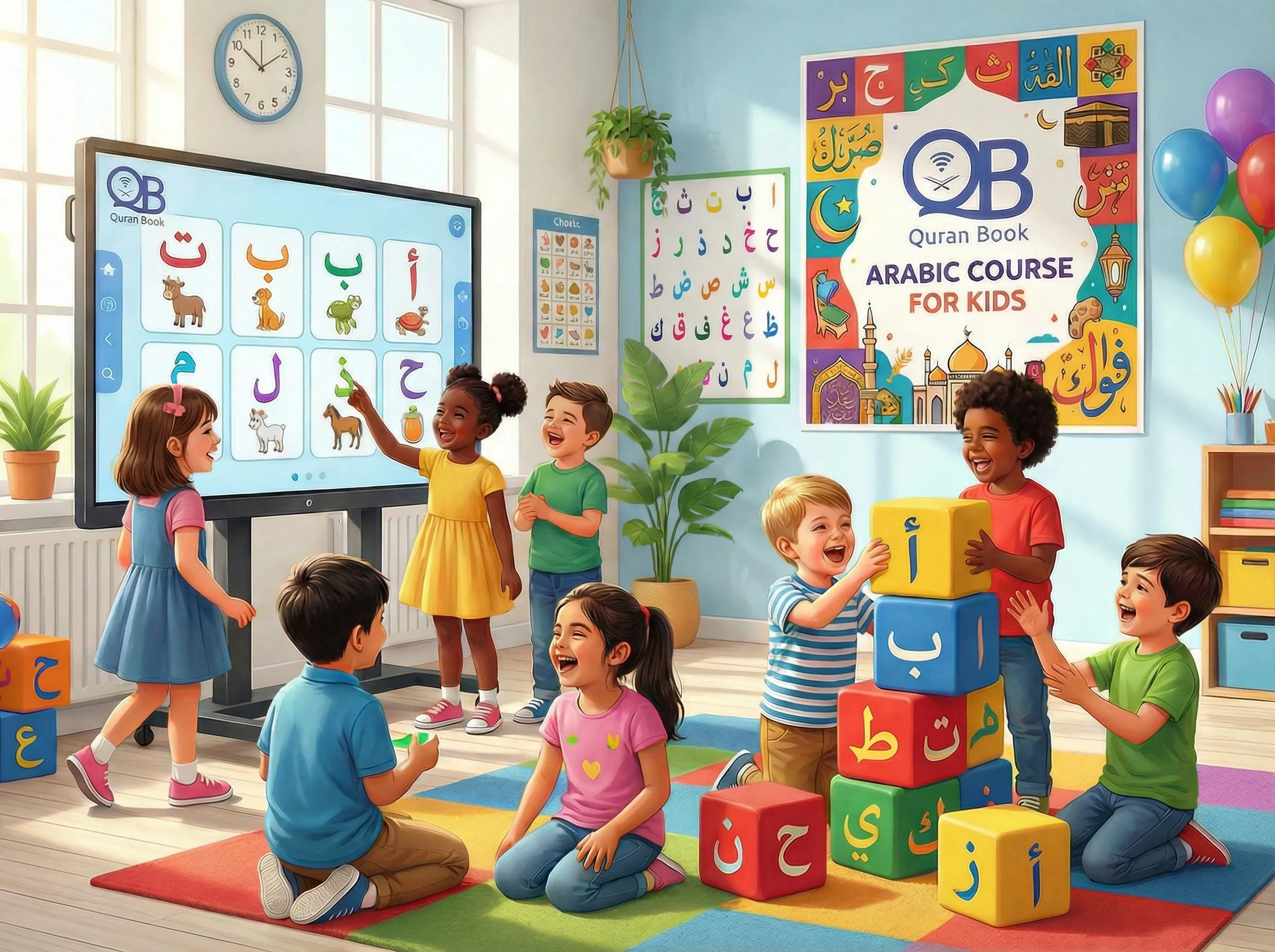
Early childhood can be an advantageous time to introduce a second language, particularly for developing familiarity with new sounds — and Arabic has several sounds that do not exist in English. That said, language learning remains possible and effective at later ages, and many children (and adults) start Arabic much later and do very well with structured instruction and consistent practice.
Cognitive Benefits
Research on bilingualism suggests that children who regularly use more than one language may develop advantages in areas such as attention and working memory, although findings vary between studies. What is clear is that working with a second writing system gives children valuable practice in noticing detail and patterns.
Spiritual Foundation
Arabic is the language of Salah, the Quran, and Du’a. When a child understands what they are reciting in prayer, it can turn a routine act into a deeply personal conversation with Allah (SWT). That connection often becomes an anchor of their Islamic identity.
Early Exposure to Sounds
Young children are often comfortable imitating unfamiliar sounds without self-consciousness, which can help with Arabic’s throat and emphatic letters. There is no single mandatory starting age, and older learners can reach the same accuracy with focused pronunciation practice.
Cultural Identity
Arabic bridges children to their heritage and connects them to the global Muslim Ummah. It fosters a sense of belonging that transcends borders.
The Prophet Muhammad (ﷺ) emphasized the importance of Quran education:
“The best of you are those who learn the Qur’an and teach it.”
— Sahih al-Bukhari 5027
7 Best Methods to Teach Arabic to Kids
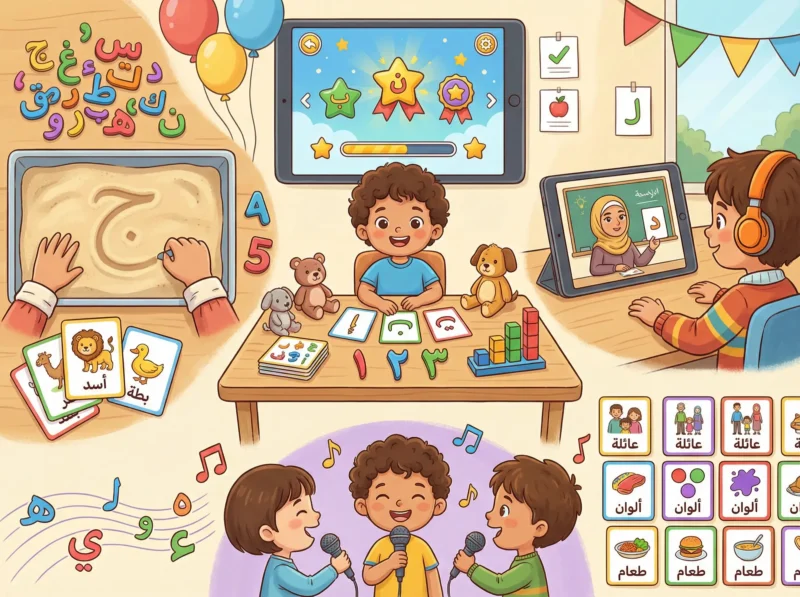
The seven approaches below cover games, short daily practice, visual aids, the Nour El Bayan phonics method, the chunking technique, live online classes, and storytelling with Islamic themes. Each one is widely used in language teaching and fits naturally with Islamic learning at home.
Gamification — Turn Every Arabic Lesson Into a Game
Turning practice into play is one of the simplest ways to make Arabic lessons for children feel enjoyable rather than forced. Games hold attention, and attention is what practice depends on. Many parents find that a child who resists a worksheet will happily play the same content as a challenge.
Start with simple, hands-on games: Arabic Bingo, where children match Arabic letters to called-out sounds; Letter Treasure Hunts, where flashcards are hidden around the house; and Memory Card Matching, where kids pair Arabic letters with pictures. For digital learners, apps and browser games that use badges, points, and streaks can help keep momentum between lessons.
Quran Book Academy uses the same idea: progress and milestones are tracked in our student learning platform so children can see how far they have come in their Arabic and Tajweed courses. You can also try our free Arabic alphabet game at home, with no signup required.
Consistency Over Intensity — The Value of Short, Distributed Practice
One of the most overlooked parts of teaching Arabic to children at home is simply keeping it regular. Educational research on distributed practice and spaced repetition suggests that spreading review across several shorter sessions can support memory better than concentrating the same material into one block. We call our version the 10-Minute Arabic Rule: short, consistent sessions can make regular review easier and may be more manageable for young learners than relying only on occasional long sessions.
The two patterns are not identical in total time, so treat this as a comparison of habits rather than a controlled experiment:
| Factor | Short Distributed Practice | One Long Weekly Session |
|---|---|---|
| Practice pattern | Spread throughout the week | Concentrated in one session |
| Review opportunities | Frequent | Less frequent |
| Fatigue risk | Usually lower | May increase during a long session |
| Routine building | Easier to integrate regularly | Depends on family schedule |
For busy working parents, this framing is liberating. Even on a hectic day, ten minutes is usually achievable — and a routine you can actually keep is worth more than an ambitious plan you abandon by week three. Many families combine both: short daily practice at home plus one longer live lesson each week.
Visual Aids — Colors, Animation & the Power of Images
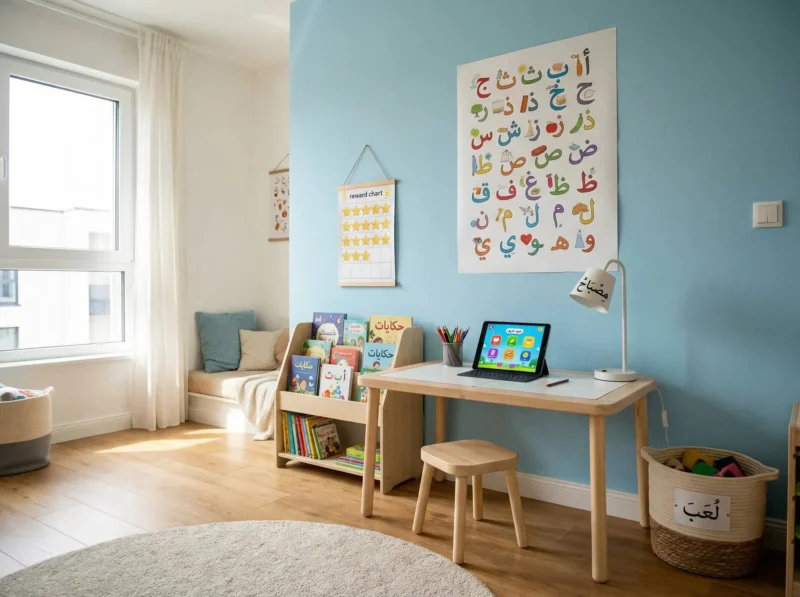
Colour, images and movement give children an extra hook for remembering an unfamiliar shape or sound. That is why visual aids are so widely used when teaching children the Arabic alphabet — pairing a letter with something a child can picture makes it easier to recall later.
Start with color-coded Arabic letters. For instance, use different colors for similar-looking letters like ب, ت, and ث to help children distinguish between them at a glance. Pair each letter with a relatable image: ج for جمل (camel), ب for بيت (house). Arabic flashcards with vibrant illustrations are inexpensive to make and easy for children to use independently.
For animated learning, the Quran Book Academy YouTube channel offers Arabic letter videos that children enjoy. Adding a short video into your child’s daily routine gives them a second way to meet the same letters — hearing, seeing, and then saying them.
The Nour El Bayan Method — A Proven Phonics-First Approach
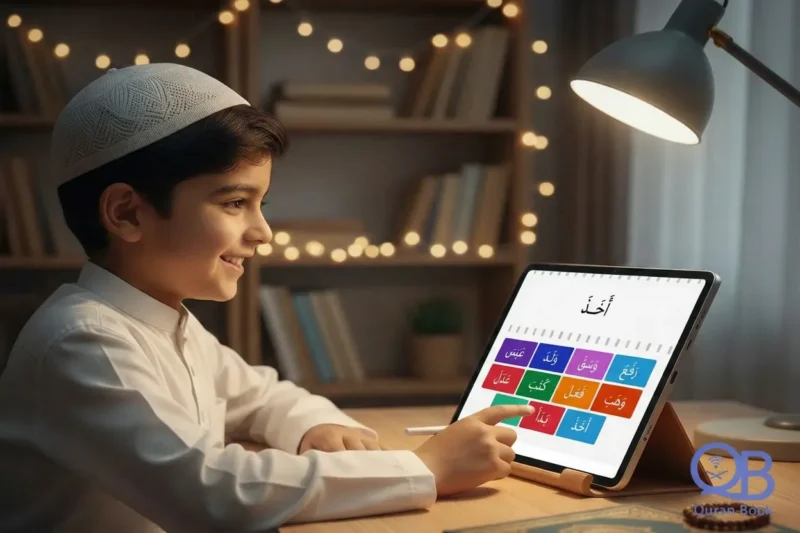
The Nour El Bayan method is a structured phonics-based approach that teaches children Arabic letter sounds before their names. This phonics-first sequence is widely used in Arabic classrooms because it aims at actual reading ability rather than memorising letter shapes.
The method follows a clear progression: individual sounds, then connected letters, then short words, and finally Quran verses. By starting with sounds, children build a decoding foundation that makes Quran reading with Tajweed feel more natural when they reach it.
Quran Book Academy offers a full Nour El Bayan course on our YouTube channel for free practice, and our live Zoom classes follow this method with certified Quran and Arabic teachers who guide each child through the progression at their own pace.
🎮 Try It: Interactive Nour El Bayan Arabic Game
Give your child a quick interactive practice break. This activity is part of Quran Book Academy’s Nour El Bayan learning resources and lets children practise Arabic letter recognition in a game-based format. It focuses on Alif and Madd-related letter practice, so it is one exercise within the wider Nour El Bayan progression rather than the whole course.
The Chunking Technique — Manageable Psychological Chunks
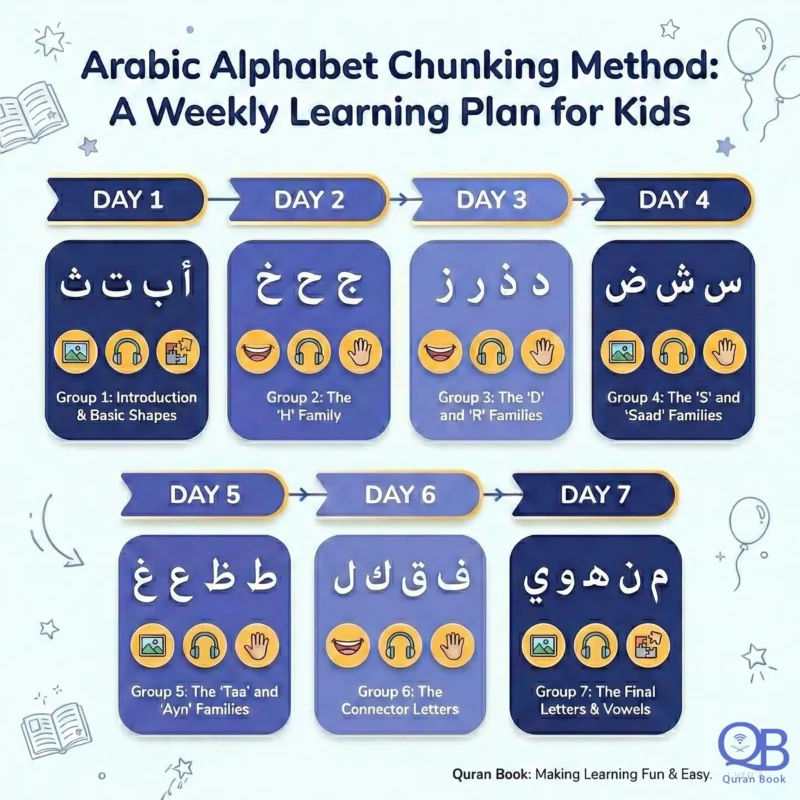
The idea of “chunking” goes back to cognitive psychologist George Miller’s often-cited 1956 paper, which suggested that people can hold only a small number of new items in working memory at once. Applied to Arabic learning, the practical takeaway is simple: do not try to teach all 28 letters at once. Break them into groups of 3 to 5 letters, and pair each group with a visual cue, a sound, and a hands-on activity.
For example, in Week 1, you might introduce ا (Alif), ب (Ba), and ت (Ta), pairing each with a picture, a short song, and a clay-molding activity where children shape the letters with their hands. Working this way, many children move through the full alphabet over a couple of months without the overwhelmed feeling that makes kids want to stop. The pace varies from child to child.
This is also how Quran Book Academy structures its Arabic homeschool curriculum: live Zoom sessions are broken into roughly 15-minute focus chunks with interactive exercises, and progress through those chunks is tracked in our student learning platform, with progress updates sent to parents by email.
Smaller steps help avoid cognitive overload. Instead of thinking “I will never learn this,” children experience small, meaningful wins they can see. Separately from the educational side, Islam encourages consistency in good deeds:
“The most beloved deeds to Allah are those done consistently, even if they are small.”
— Sahih al-Bukhari 6464
Interactive Online Arabic Classes — Live, Personal & Effective
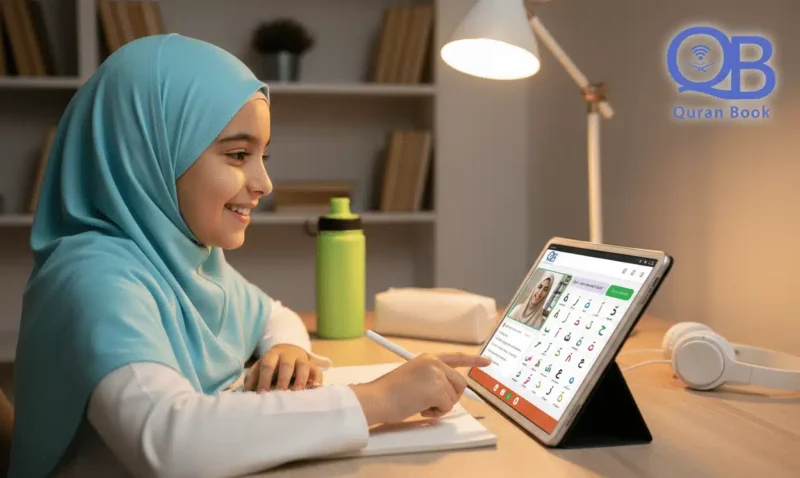
Live classes matter most for one thing pre-recorded lessons cannot do: correcting pronunciation in the moment. A teacher can hear a mispronounced letter, model it again, and adjust the pace to the child in front of them — and the weekly appointment itself adds accountability that home practice often lacks.
Quran Book Academy’s approach combines live Zoom sessions with certified Quran and Arabic teachers, a student learning platform that tracks lessons, assignments and attendance, plus progress updates sent to parents by email. Whether your family is in the USA, Canada, the UK, or Australia, your child can learn from home with zero commute.
The social element matters too. Group classes with other Muslim kids create peer motivation, friendly competition, and a sense of community that keeps children engaged in their Arabic and Quran journey.
Storytelling & Islamic Themes — Making Arabic Meaningful
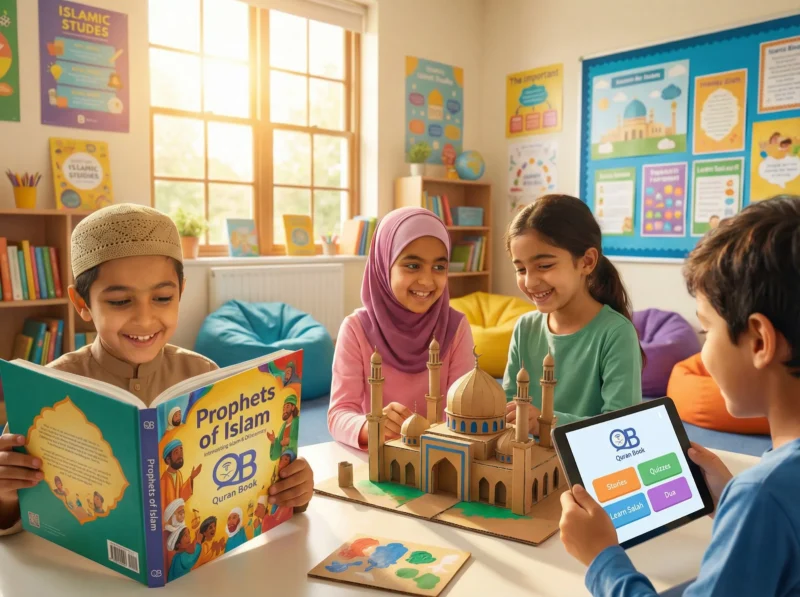
The final approach is storytelling rooted in Islamic themes. When children meet Arabic vocabulary through the stories of the Prophets, through daily Islamic phrases and adhkar such as Bismillah, Alhamdulillah, and SubhanAllah, and through simple Nasheeds, the language carries meaning instead of feeling like an isolated school subject.
Arabic stories for kids drawn from the Quran teach vocabulary in context. A story about Prophet Yusuf (AS) naturally introduces words for family, patience, trust, and faith. The phrases and adhkar a child says several times a day quietly build vocabulary through repetition. And simple Islamic Nasheeds with repeated Arabic words add rhythm and melody, which many children find easier to recall than plain word lists.
Once children have learned the letters through stories and songs, moving on to short Surahs usually feels like a natural next step. Allah (SWT) tells us:
“We relate to you the best of stories through this Qur’an.”
— Surah Yusuf 12:3
The Academy Method — How Quran Book Academy Teaches Arabic & Tajweed

Quran Book Academy combines the approaches above into one programme: live Zoom sessions, a student learning platform, and the Nour El Bayan phonics method, delivered in manageable chunks with real-time feedback and progress updates for parents.
Our Methodology
Every student receives live one-on-one and group Zoom sessions with certified Quran and Arabic teachers, including teachers with Al-Azhar backgrounds. Lessons follow the Nour El Bayan phonics progression, so children build reading skills step by step from day one.
Tajweed Integration
Every Arabic lesson connects directly to Quran reading with proper Tajweed rules. Children do not just learn letters; they work toward reciting the Quran correctly.
Our Tech Stack
Zoom provides live interaction with instant feedback. Our student learning platform tracks lessons, assignments and attendance, and parents can follow their child’s learning progress there and through progress updates sent by email.
Psychological Approach
Lessons are broken into roughly 15-minute focus chunks, milestones are recognised, and positive reinforcement helps children stay confident. Our YouTube channel also offers free resources including Arabic letter animations and a complete Nour El Bayan course.
Arabic Alphabet for Kids — A Step-by-Step Starter Guide
To teach the Arabic alphabet at home, start with phonics by teaching sounds before letter names, introduce 3 to 5 letters per week using visual aids and hands-on activities, and use songs and games to reinforce learning daily.
🎯 Milestone: With consistent daily practice of 10 to 15 minutes, many children work through all 28 Arabic letters within a few months. Progress varies by child, by age, and by how much Arabic they hear around them — so treat this as a guide, not a deadline.
Building an Arabic Homeschool Curriculum That Works
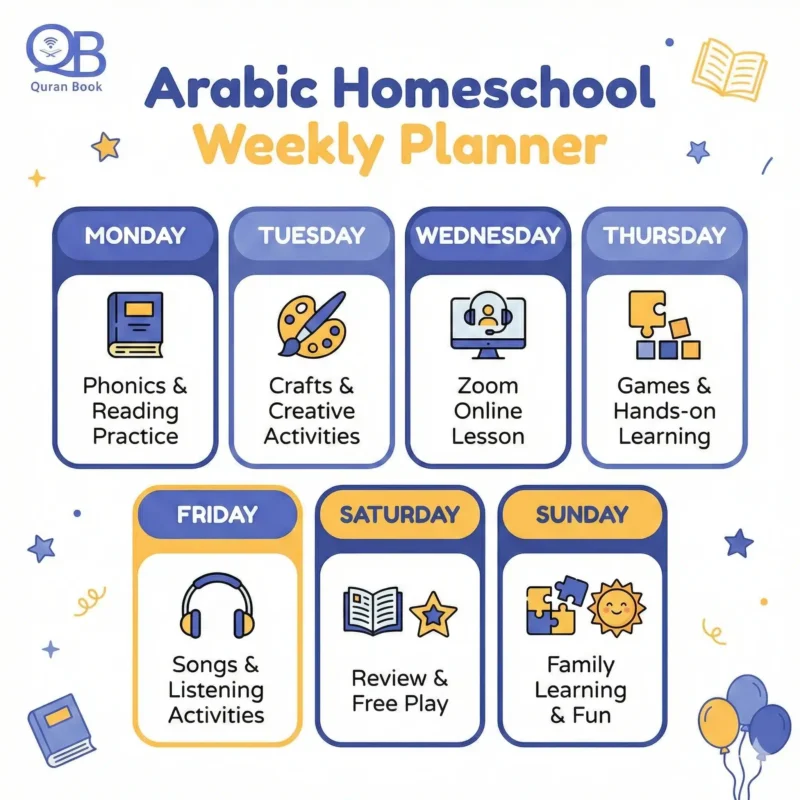
A workable Arabic homeschool curriculum combines structured phonics lessons, short daily practice of 10 to 15 minutes, visual aids, live online classes, and Islamic storytelling. Here is a sample weekly schedule you can start using today:
| Day | Activity (10–15 min) | Resource |
|---|---|---|
| Mon | New letters (phonics + visuals) | Nour El Bayan YouTube |
| Tue | Arabic handwriting practice + clay letters | Printable worksheets |
| Wed | Live Zoom class with teacher | Quran Book Academy |
| Thu | Arabic games + flashcards | Free alphabet game |
| Fri | Quran listening + short Surah review | Quran.com + academy platform |
| Sat | Storytelling + Islamic Nasheeds | YouTube + Islamic books |
| Sun | Review week’s progress + fun quiz | Student learning platform |
This Arabic homeschooling schedule is flexible. Adjust the activities to your child’s energy levels, and remember: consistency matters more than perfection. Even following this plan three or four days a week gives your child regular contact with the language.
Frequently Asked Questions About Teaching Arabic to Kids
Quick Quiz: Which Arabic Learning Method Fits Your Child?
Answer five quick questions about your child’s routine and preferences, and we will point you to the approach worth trying first. This is a quick parent guide, not a formal learning-style assessment — children benefit from a mix of all these methods, and what works can change over time.
1. Does your child enjoy games and challenges?
2. Does your child stay focused better during short activities?
3. Does your child enjoy stories and nasheeds?
4. Does your child need regular pronunciation correction?
5. Is keeping a consistent home-learning routine difficult?
Free Arabic Practice Resources for Parents
Three simple tools make home practice easier to keep up. Printable versions are being prepared; in the meantime you can use the weekly schedule already provided in this article as your practice plan, and browse the academy’s free learning resources.
7-Day Arabic Practice Plan
A day-by-day starter plan for a child’s first week of Arabic letters, based on the weekly schedule above.
Printable version coming soonArabic Alphabet Progress Tracker
A simple sheet to tick off each of the 28 letters as your child recognises its sound and shape.
Printable version coming soonWeekly Arabic Practice Checklist
One page per week: new letters, review, handwriting, listening, and a short game session.
Printable version coming soonStart Your Child’s Arabic Journey Today — Free Trial Lesson

Your child deserves to connect with the Quran in the language it was revealed. At Quran Book Academy, certified Quran and Arabic teachers teach live on Zoom, following a structured Nour El Bayan progression, with progress tracked in the student learning platform. Book a free trial lesson and see how your child responds to live, structured Arabic instruction.
🟢 BOOK YOUR FREE TRIAL LESSON
Live Online Classes | Certified Teachers | Interactive Learning | Free Trial Lesson
quranbookonline.com — Start FreeReferences & Sources
Quranic References
- Surah Al-Qamar 54:17 — quran.com/54/17
- Surah Yusuf 12:3 — quran.com/12/3
Hadith References
- Sahih al-Bukhari 5027 — sunnah.com/bukhari:5027
- Sahih al-Bukhari 6464 — sunnah.com/bukhari:6464
Academy Resources
- Quran Book Academy Homepage — quranbookonline.com
- Meet Our Certified Teachers — Certified Quran & Arabic Teachers
- Student Learning Platform — sys.quranbookonline.com/student
- Arabic for Kids Course — Arabic Online for Kids
- Quran Reading & Tajweed Course — Learn Quran with Tajweed
- Nour El Bayan Course — Quran Reading for Beginners
- Free Arabic Alphabet Game — Interactive alphabet practice
- Free Learning Resources — get-free-sources
- About the Academy — About Us
- YouTube Channel — Quran Book Academy on YouTube
- Telegram Channel (Tajweed Practice) — t.me/maqraquranbookonline
Leave a Reply