Tajweed for Kids
Interactive 1-to-1 Tajweed Learning Built Around Your Child
Watch a rule, hear it recited, try it yourself — then get corrected live by a teacher. Free trial, no card needed.
- 1-to-1 Lessons
- Interactive Games
- Personalized Learning
- Practice Between Classes
- Parent Progress Visibility
What Is Tajweed for Kids?
Tajweed is the set of rules that govern correct Quranic pronunciation — giving every letter its proper sound, place and length. It starts with المخارج (makharij): where in the mouth and throat each letter is produced. From there children learn recitation rules such as Noon Sakinah, Qalqalah and Madd.
For tajweed beginners the path is progressive: sounds first, then one rule at a time, applied to short verses the child can already read. Nothing is memorised as theory before the child can hear it and say it. See our full Tajweed rules guide for the complete reference, or start with Quran reading for beginners if your child is still learning the letters.
Try Your First Tajweed Challenge
Look at the highlighted letter, pick the rule, get the answer explained instantly.
Makharij for Kids: Where Quran Sounds Begin
Correct recitation begins with knowing where each letter is produced — the lips, the tongue, the throat. Get the articulation point right and the rules that follow become much easier.
Makharij explained — the articulation points behind every Quranic letter.
Listen & Choose
Play the verse, listen to the highlighted word, then pick the rule you hear.
You can replay it as many times as you like.
Well listened!
Recitation audio: Sheikh Mahmoud Khalil Al-Husary — Hafs ʿan ʿAsim.
Basic Tajweed Rules for Kids
Three rules children meet early. Read the short explanation, look at the examples, then try the challenge or listen for the difference.
Noon Sakinah and Tanween
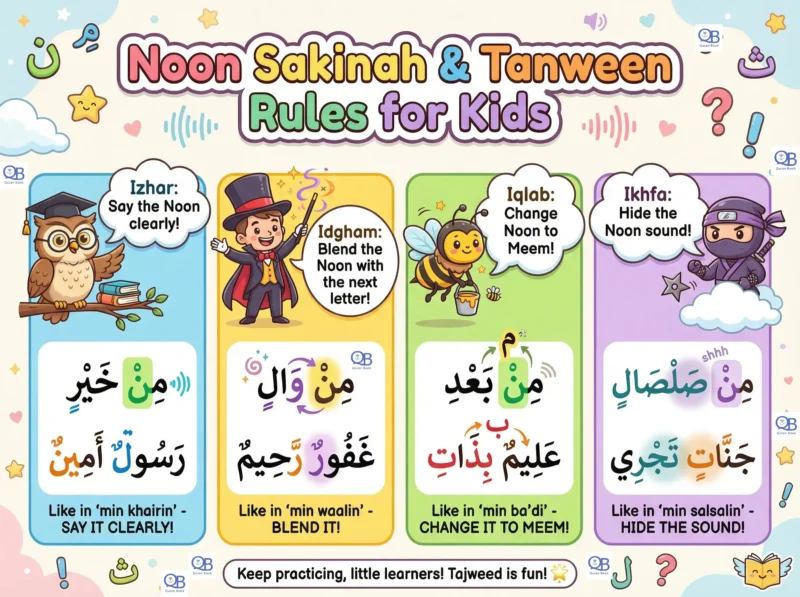
A نْ with sukoon — and tanween, which ends in the same sound — is not always pronounced the same way. The letter that comes next decides it. There are four states: pronounced clearly (Izhar), merged into the next letter (Idgham), changed to an م sound (Iqlab), or hidden with a nasal sound held in the nose (Ikhfa).
- مِنْ عِلْمٍIzhar
- مَنْ يَقُولُIdgham
- مِنْ بَعْدِIqlab
- مِنْ قَبْلُIkhfa
The full breakdown of all four states, with every letter listed, is in our Tajweed rules guide.
Qalqalah
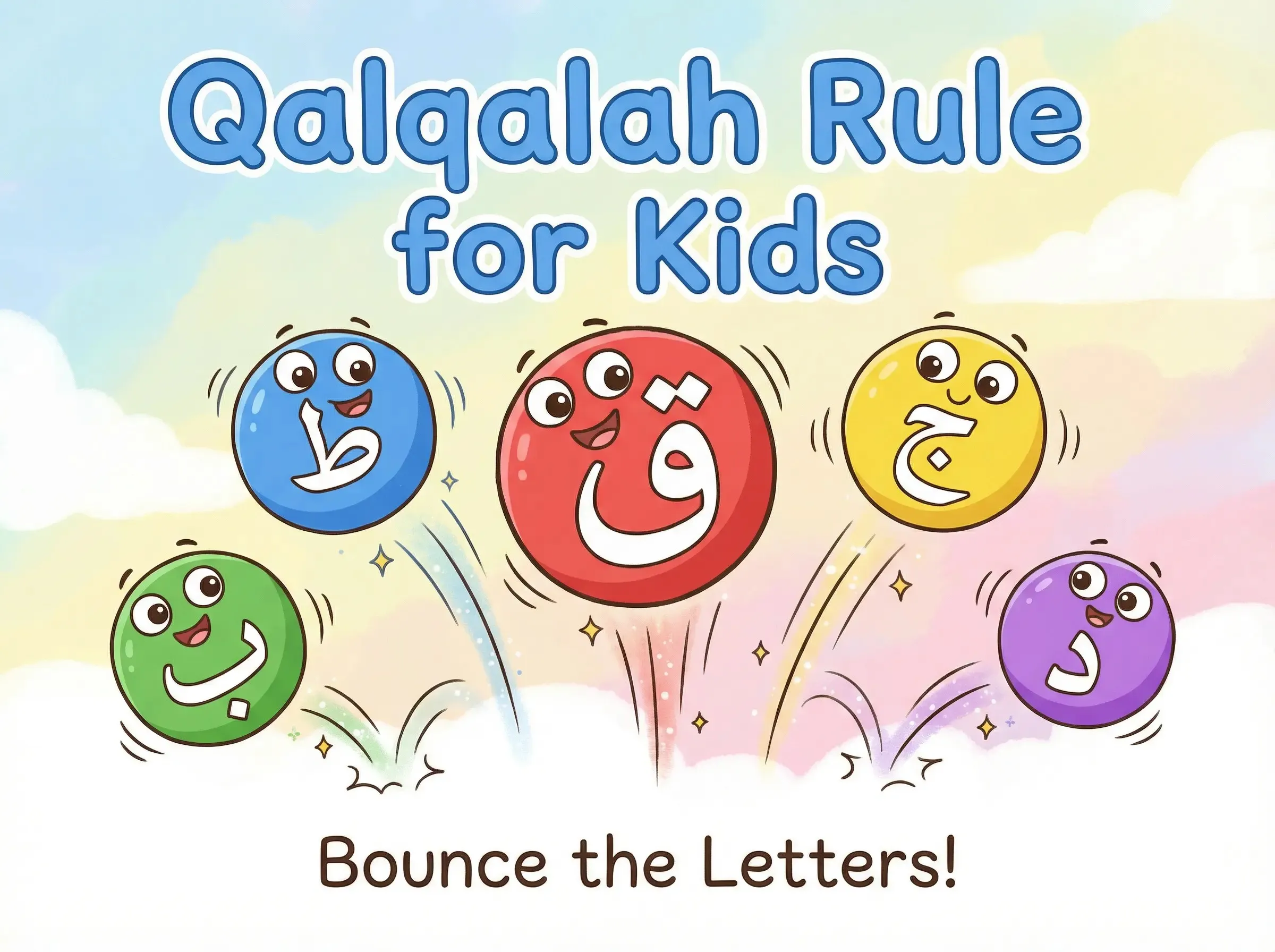
Five letters — ق ط ب ج د — get a short, sharp echo when they carry sukoon. The echo is made at the letter’s own articulation point as it is released: no vowel is added after it, and it is not a sound made in the throat.
It happens in the middle of a word (يَجْعَلُونَ, أَبْصَارِهِمْ) and at the end when you stop (أَحَدْ, الْفَلَقْ) — and the echo is stronger when stopping.
- يَجْعَلُونَmid-word
- يَقْطَعُونَmid-word
- قُلْ هُوَ اللَّهُ أَحَدْwhen stopping
Madd (Lengthening)
Madd means holding a vowel sound longer than usual. It is not the case that every ا, و or ي is lengthened — each has a condition:
- قَالَا after fatha
- يَقُولُو sakinah after damma
- قِيلَي sakinah after kasra
When those conditions are met you get the natural madd, held for a short, steady count. Longer lengths belong to specific cases — such as a hamza or a sukoon coming after the madd letter — and the exact length depends on the rule and the way of recitation, so children learn them one at a time with a teacher’s ear, not by counting on their own.

Watch Tajweed in Action
Single rules are only half the picture. Here they are applied inside real recitation.
How to Learn Tajweed Easily
Every rule goes through the same five steps, in the same order, in every lesson.
-
1
See
The rule is shown on screen — highlighted inside a real word, with a clear example.
-
2
Hear
The teacher recites it slowly, then at normal pace, so the child hears the target sound.
-
3
Try
The child repeats it, or completes a short challenge on the shared screen.
-
4
Correct
Immediate 1-to-1 feedback — the mistake is fixed in the same minute it happens.
-
5
Practice
Short interactive homework in our learning system keeps the rule alive until the next class.
How Our Tajweed Course for Kids Works
Our online Tajweed course for kids is built around one child at a time — here is what actually happens from the first lesson onward.
Understand the Child
The first lesson is diagnostic. The teacher checks the current reading level, which letters are already solid, which sounds slip, and — just as important — how the child responds: what holds attention, what causes hesitation.
- Reading level
- Letter sounds
- Confidence
- Attention span
Teach 1-to-1
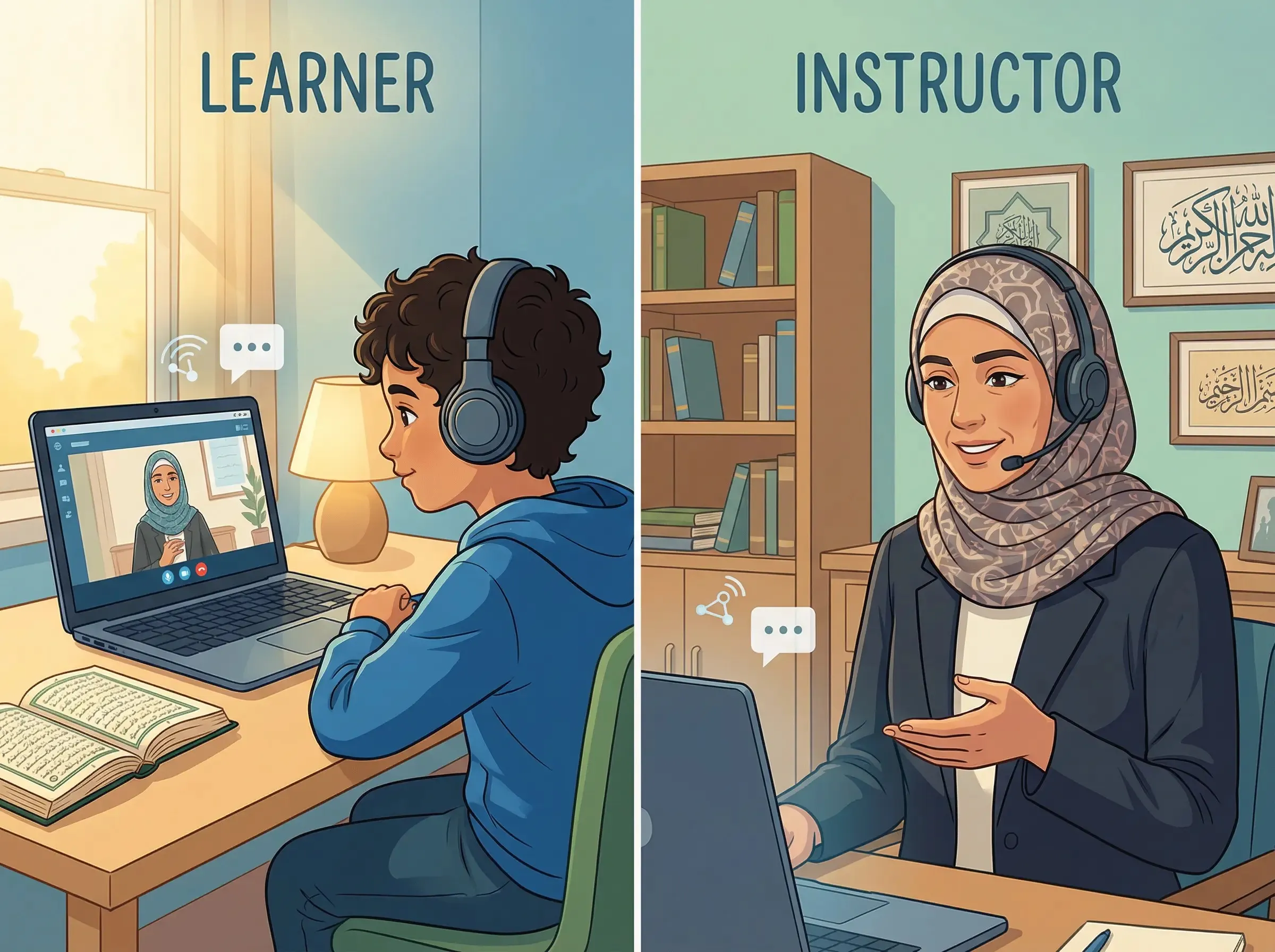
A live private class with a friendly teacher — no group, no waiting turn. Every minute of recitation is heard and responded to. Meet the people who teach it on our teachers page.
Adapt the Lesson
The plan is the same; the route is not. Mid-lesson, the teacher switches approach based on how the child is responding right then.
- Visual cues
- Short challenges
- Guided repetition
- Interactive games
- Step-by-step explanation
- Encouragement
Practice Between Classes
Tajweed is a habit of the tongue, so it needs short repetition between lessons — a few minutes, not an hour. Homework is assigned inside our learning system and works on a phone or tablet.
- Interactive homework
- Tajweed games
- Mobile-friendly
- Reminders
Track Progress
After each lesson the teacher records what improved and what needs another pass, so the next class starts exactly where the last one stopped — and parents can see the same picture.
- Strengths
- Needs attention
- Next focus
- Lesson progress
- Parent visibility
A Complete Learning System Around Your Child
Your child is not assigned a teacher and forgotten. Five parts stay connected.
Teacher
Runs the live 1-to-1 lesson and corrects in real time.
Educational Supervisor
Reviews lesson quality and the child’s plan, not just attendance.
Learning System
Homework, games and practice the child can open any day.
Your Child
Everything above is coordinated around one learner.
Parent
Kept in the loop with clear, jargon-free updates.
Progress Tracking
Strengths, what needs attention, and the next focus — after every lesson.
What Happens Between Classes
The lesson ends; the learning does not. Two sides, one system.
For the child
Short practice, on any device
- Interactive homework set by the teacher
- Tajweed games tied to the rule just learned
- Short daily practice — minutes, not hours
- Access to the learning system app
- Gentle reminders before the next class
For the parent
You can see what is happening
- Progress visible without chasing anyone
- Strengths recorded after each lesson
- Needs attention — flagged early, not at term end
- Next focus for the coming class
- Regular reports in plain language
This Is How We Turn Tajweed Rules Into Practice
See it with your own child — one free lesson, no card required.
Tajweed for Kids: Frequently Asked Questions
Is Tajweed obligatory?
Scholars generally distinguish between two things. The first is reciting the Quran without clear errors that change a letter or distort a word’s meaning — this is widely held to be required of every Muslim who recites. The second is the formal study and mastery of the detailed rules of Tajweed as a discipline, which many scholars treat as recommended for the individual, while the knowledge itself is preserved by the community of scholars.
Opinions differ in the details, so for a ruling that fits your situation, ask a qualified scholar you trust. For children, the practical goal is simple: recite clearly and correctly, and build the rules gradually from there.
What age can a child start learning Tajweed?
There is no fixed age. Readiness depends on the child, and usually on four things:
- How long the child can hold attention in a short lesson
- Their Quran reading foundation — can they read letters and words yet?
- How comfortably they imitate sounds they hear
- How well the teacher adapts to that particular child
A child still learning to read letters usually starts with Noorani Qaida for kids, where correct pronunciation is built in from the first letter. Tajweed rules then layer on top of reading the child can already manage.
Can Tajweed beginners learn online?
Yes — Tajweed is taught by listening and correcting, and both work over a live video call. In a 1-to-1 online class the teacher hears every word the child recites, shares the text on screen with the rule highlighted, and corrects immediately. For beginners that direct attention is often better than a crowded room where each child recites for a minute.
How can children learn Tajweed easily?
By keeping every rule to the same short loop: See the rule highlighted in a real word, Hear the teacher recite it, Try it aloud, get it Corrected on the spot, then Practice it in short bursts before the next class. One rule at a time, applied to verses the child can already read — that is what makes it feel easy.
Can non-Arabic-speaking children learn Tajweed in English?
Yes. Our teachers explain the Tajweed rules for kids in English while the recitation itself stays in Arabic. The rule is named in Arabic, explained in English, and then demonstrated in sound — so a child in the US, UK, Canada or Australia who does not speak Arabic at home can still pronounce correctly.
Children starting from zero usually begin with Quran reading for beginners, and many families later combine Tajweed with Quran memorization for kids so that what is memorised is pronounced correctly from the start.
What happens in an online Tajweed course for kids?
The first class is a friendly assessment of your child’s reading. After that, each lesson follows the same loop — see, hear, try, correct — with the teacher switching between visual cues, short challenges and games depending on how your child is responding. Between classes, short interactive homework is assigned in our learning system, and progress notes (strengths, what needs attention, next focus) are recorded after every lesson for you to see.
Help Your Child Recite with Confidence
Book a free 1-to-1 trial lesson and see how your child responds — no card, no commitment.
Book a Free Trial- 1-to-1
- Personalized
- Interactive
- Parent Progress Visibility