Live one-on-one lessons on Zoom
Tafseer for Kids: Online Quran Tafseer Classes for Ages 5–15
Your child recites Al-Fatihah in every prayer. Tafseer for kids helps them understand what those verses mean — in simple English, with engaging explanations and age-appropriate activities.
No card required · 30 minutes · Your child meets the teacher first.
- Al-Azhar certified teachers
- 1-on-1 on Zoom
- Female teachers for girls
- Ages 5–15
-
Simple EnglishVerses explained in clear, child-friendly language.
-
Engaging explanationsExamples, questions and context that keep children curious.
-
Age-appropriate activitiesWord matching, surah cards and listening practice.
What Your Child Gains from Tafseer for Kids
In our online Quran tafseer classes, your child studies selected surahs one passage at a time with a teacher: hearing the verses, learning key words, understanding the meaning in simple English, and talking about how it applies to daily life.
-
Understand the surahs they study
Your child learns what each surah in their level is about: its main message and the meaning of its key verses.
-
Learn selected Quranic vocabulary
Important Quranic words are introduced with their meanings, so your child starts recognising them during recitation.
-
Discuss meanings with the teacher
Lessons are a conversation. Your child asks questions, answers them, and explains ideas in their own words.
-
Connect lessons to everyday behavior
Each lesson links the verses to real life — honesty, kindness, gratitude and good manners at home and at school.
What Is Tafsir al-Quran? A Simple Explanation of Tafseer for Kids and Parents
Tafseer means explaining what Allah’s words mean — the meaning of each word, why a verse was revealed, and how it applies to life. The Arabic word tafsir comes from a root meaning “to uncover,” so tafsir al-Quran is simply uncovering the meaning behind the text your child already recites.
Quran tafsir meaning, in one sentence: tafsir (also spelled tafseer) is the explanation of the Quran — what its words mean, why its verses were revealed, and how they guide our lives.
That is also why you will see this subject called both tafsir for kids and tafseer for kids: the spelling changes, the meaning does not.
Translation is not tafseer
Many parents are surprised by this difference. A tarjama (translation) swaps Arabic words for English ones. A tafseer explains them. You can compare any verse’s translation on Quran.com with what your child learns in a lesson and see the difference immediately.
A practical example: Surah Al-Fil
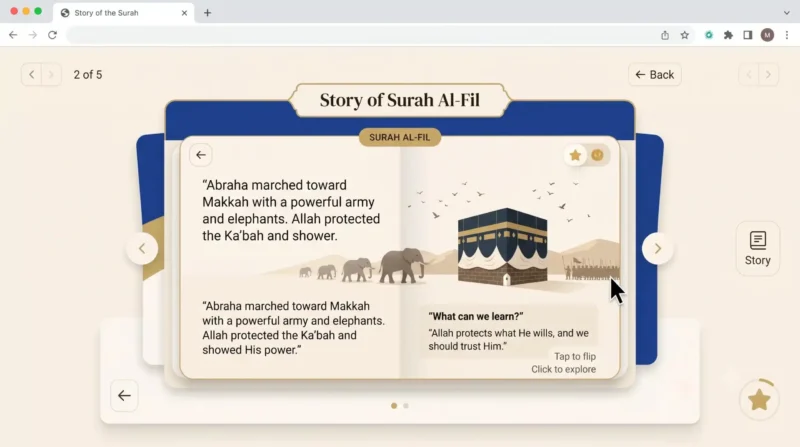
A translation of Surah Al-Fil gives your child an army and an elephant. Tafseer tells them who the army was, what it came to destroy, and how Allah protected the Kaaba with small birds carrying stones. Then the teacher asks a question that helps the lesson stick — “Who protected the Kaaba? And who protects you?”
Same verses — but now your child knows what they are about. That shift, from words to meaning, is the whole point of tafseer for kids.
Why We Pair Memorization with Tafseer for Kids
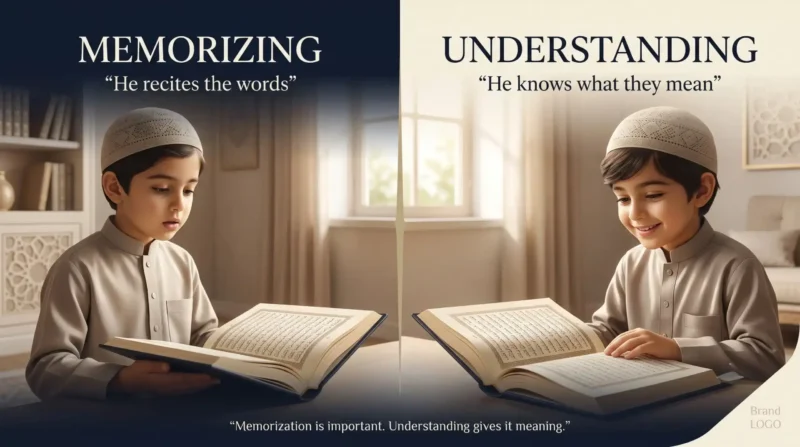
Memorizing the Quran is a beautiful achievement, and every surah your child learns is worth celebrating. Tafseer for kids adds understanding to that effort: alongside the words, your child learns what they mean.
When children know what a surah is about, recitation becomes more personal. They can follow what they are saying in salah, ask thoughtful questions, and talk with you about what they learned.
Understanding also gives lessons a natural link to daily life. Verses about honesty, patience with parents and kindness to neighbours become conversations about real situations at home and at school.
- Memorization and meaning grow together
- Hifz feels connected to everyday life
- Character lessons come from the verses themselves
- A child who can answer “what did you just read?”
This is why we recommend running tafseer for kids alongside memorization, so your child understands what they memorize rather than after it.
What Your Child Will Learn (Curriculum by Level)
Our Quran tafseer classes for kids run in three levels. Each level pairs what your child recites with what it means, using material suited to their age. The ages below are a guide: placement depends on a short assessment during the free trial as well as age — by ability, not just by age.
Suggested age: 5–8
Level 1 — Short Surahs of Juz Amma
Topics covered
- The short surahs of Juz Amma, explained simply
- Al-Fil, Quraysh, Al-Ma’un, Al-Kawthar and Al-Masad
- Key Quranic words in simple English
- One idea from each lesson to share at home
Skill developed
Retelling the main message of each surah studied, in their own words.
Suggested age: 9–12
Level 2 — Meaning & Vocabulary
Topics covered
- Ayat al-Kursi and the last two verses of Al-Baqarah
- Selected passages from Surah Al-Kahf
- Frequently repeated Quranic words
- Finding the meaning of a verse with guidance
Skill developed
Using known vocabulary to work out the meaning of the verses studied, with the teacher’s support.
Suggested age: 13–15
Level 3 — Context & Reflection
Topics covered
- Asbab al-nuzul — why a verse was revealed
- Linking verses to the Seerah
- Tadabbur: reflection and personal application
- Answering real questions about faith from the text
Skill developed
Explaining the context of a passage studied and reflecting on how it applies today.
Every tafseer for kids level includes a written report to you after each lesson, and your child keeps the same teacher throughout — with the tajweed rules they’ll need reinforced along the way.
Not sure which tafseer for kids level fits your child?
The free trial includes a short placement assessment. You’ll get the teacher’s honest recommendation, whether you enroll or not.
Book Your Free TrialWatch & Learn with Your Child
Four free videos to watch together. Pause along the way, ask what your child noticed, and talk about it — the same kind of conversation a tafseer lesson builds. These are learning videos, not recordings of our classes.
-

What Are the Holy Books in Islam? The Story of Wahi (Revelation) for Kids
-
Watch & Learn: Video 2
-

How to Make Wudu for Kids: Step-by-Step Islamic Animation
-

Watch & Learn: Video 4
Videos open in a pop-up player, and only one plays at a time.
Try Tafseer for Kids Activities Free (No Signup)
Here is what interactive learning looks like in practice. The first three activities come from our tafseer lessons; the fourth is a short game about kind actions. No email, no signup — sit with your child, choose an activity, and talk about the answers together.
Progress in the first three activities saves on this device, so your child can come back and finish later.
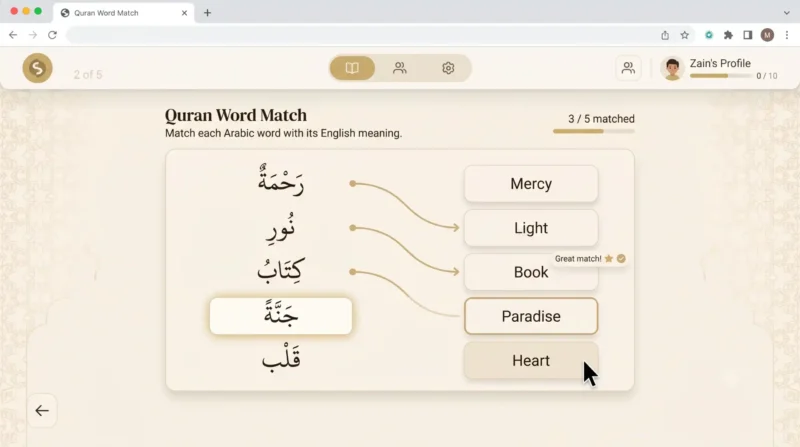
Activity 1 — What Does This Word Mean?
Eight important words your child will meet in the Quran. Tap an Arabic word, then tap its meaning. Selecting a word reads it aloud where your device supports it.
0 of 8 matched
Arabic
Meaning
All eight matched! Your child just learned eight words they will meet again and again in the Quran.
Activity 2 — Surah Cards & Quiz
Five short surahs from Juz Amma. Open each card for a short summary, then answer four questions.
الفيل
Al-Fil — The Elephant
A king named Abraha marched an army with elephants to destroy the Kaaba. The lead elephant knelt down and refused to walk toward it. Allah sent small birds carrying stones, and the army was destroyed before it ever arrived.
قريش
Quraysh
The tribe of Quraysh travelled to trade in winter and in summer. They were safe on those journeys and never went hungry. Allah reminds them: the One who fed you and kept you safe is the One you should worship.
الماعون
Al-Ma’un — Small Kindnesses
The surah describes someone who denies the Day of Judgement: they push away the orphan and do not encourage feeding the poor. It then warns those who are careless about their prayer, who show off, and who refuse even small kindnesses. Real faith shows in how we pray and how we treat people.
الكوثر
Al-Kawthar — Abundance
The Prophet ﷺ lost his sons, and his enemies mocked him, saying his name would not last. Allah told him He had given him al-Kawthar — abundant good — and that it is the one who hates him who is truly cut off.
المسد
Al-Masad — The Rope
Abu Lahab was the Prophet’s own uncle, and one of his fiercest enemies. His wealth and his status did not protect him. The surah teaches that being related to a righteous person is not enough — actions are what count.
Question 1 of 4
Activity 3 — Listen & Understand
Hear a verse recited by Sheikh Al-Husary, then choose what it means. Replay as many times as you like. Audio courtesy of EveryAyah.com.
Verse 1 of 6
Activity 4 — Choose the Kind Action
Five everyday situations. For each one, choose the kind action — then read why it matters. There is no timer, so take your time.
Enjoyed the activities? Continue with a teacher
These activities are the warm-up. In a real tafseer for kids lesson, a certified teacher walks your child through the meaning of the verses they study — and tells you what they understood.
Book Your Free TrialHow the Classes Work
- One-on-one on Zoom. No group classes — your child is never the quiet one at the back.
- Your timezone, not ours. Lessons are scheduled around school and bedtime in the US, UK, Canada and Australia.
- A report after every lesson. What was covered, what your child understood, what needs review at home.
- You can sit in. Any lesson, any time, no notice needed.
- Female teachers for girls. Requested by default for daughters.
- Same teacher every week. Consistency is most of what makes a child open up.
Tafseer for kids lessons are 30 minutes for younger children and 45 minutes for ages 9 and up — matched to how long a child that age can actually stay focused.

How to Study Quran Tafseer with a Child: Our Lesson Routine
If you are wondering how to study Quran tafseer with a child, small, regular steps with someone to guide them work well. Each of our lessons follows a simple routine:
- ListenHear the verses recited correctly, so meaning starts from accurate recitation.
- Learn key wordsA few important Arabic words, each with its meaning in English.
- UnderstandThe teacher explains the passage in simple English, adding context where it helps.
- DiscussYour child answers questions and explains the meaning in their own words.
- Connect & reviewLink the lesson to daily life, then revisit it at home using the lesson report.
At home, keep it light: ask your child what today’s surah was about, or spend a few minutes on the activities above to review the words they learned.
Meet Your Child’s Teacher
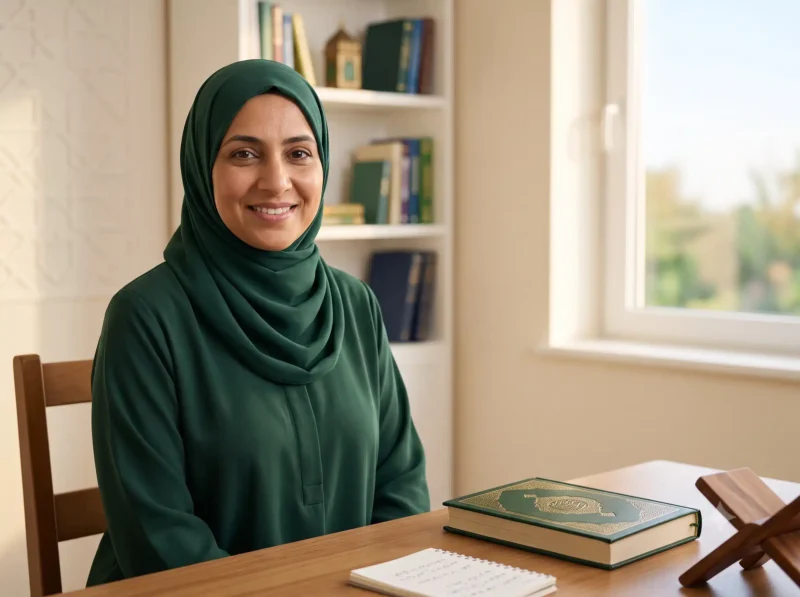
Every teacher who delivers tafseer for kids on our team is Al-Azhar certified, holds an ijazah in Quran recitation, and has taught children specifically — not adults, and not as a side skill.
They speak fluent English, so your child never loses the meaning in translation, and they are trained to explain a verse three different ways until one of them lands.
Before any teacher is assigned to a child, they pass an aqeedah review and a teaching demo. We’d rather turn a teacher away than put a wrong explanation in front of a seven-year-old.
Which Tafseer Sources Do We Teach From?
Before enrolling in any tafseer for kids programme, parents ask us two questions: what is the aqeedah, and what is the source. Here are both, in the open.
We teach according to Ahl as-Sunnah wal-Jama’ah. Our teachers explain the Quran from established classical tafseer — never from personal opinion, and never from Israiliyyat (unverified narrations from earlier scriptures). If a question falls outside a teacher’s knowledge, the answer your child gets is “let me check,” not a guess.
Tafsir As-Sa’di — our main source for children
The clearest and most accessible of the major works. Sheikh Abdur-Rahman as-Sa’di explains meaning directly, without heavy technical language — which is why we use it as our main source for young learners and beginners.
Tafsir Ibn Kathir
The most widely known tafseer, built on narration: explaining the Quran by the Quran, then by hadith, then by the understanding of the Companions. We use it for context and asbab al-nuzul in Levels 2 and 3.
Tafsir Al-Jalalayn
Very brief — often a few words per verse. Useful for quick word-level meaning with older students, always alongside a fuller source.
All three works are available in English translation, and the hadith we reference can be checked on Sunnah.com. Older students who want to read these works in the original are welcome to learn Arabic and read tafseer directly.
Choosing the best Quran tafseer in English for your child
Parents often ask us for the best Quran tafseer in English to use at home. There isn’t one single answer — the right choice depends on your child’s age and how you will use it. A few practical guidelines:
- Choose an English translation of an established classical work, not a collection of personal opinions.
- For younger children, use an abridged or simplified edition and read it together.
- Check who translated and published it, and ask a qualified teacher if you are unsure.
- Read short passages slowly and talk about them, rather than covering a lot at once.
Islamic Learning for Kids
Short vertical videos for quick learning moments — a few minutes after school or before bed. Tap a video to play it; nothing plays until you choose.
-
Islamic Learning Short 1
-

Islamic Learning Short 2
-

Islamic Learning Short 3
-

Islamic Learning Short 4
Explore Our Kids’ Courses
Tafseer can be taken on its own or alongside your child’s other learning. These courses cover the other building blocks of Quran and Islamic education.
-
Quran Reading / Noorani Qaida
Step-by-step reading, from Arabic letters and correct sounds to joining letters and reading from the Mushaf.
View Course: Quran Reading and Noorani Qaida for kids → -
Tajweed for Kids
One rule at a time, with live correction from the teacher, so recitation becomes clear and correct.
View Course: Tajweed for Kids → -
Quran Memorization
Personalized targets, a structured revision routine and teacher correction in every live lesson.
View Course: Quran Memorization for kids → -
Arabic for Kids
Reading, writing, speaking and listening, so your child meets the Quran in its own language.
View Course: Arabic for Kids → -
Islamic Studies for Kids
Aqeedah, Salah, Seerah, stories of the Prophets and Islamic manners, in age-appropriate English.
View Course: Islamic Studies for Kids →
Tajweed and Arabic Letters Videos for Kids
Seven short videos on two building blocks of Quran learning: tajweed (reciting correctly) and the Arabic letters. Filter by topic, then swipe or use the arrows to browse.
-
Tajweed

Tajweed Short 1
-
Tajweed

Tajweed Short 2
-
Tajweed

Tajweed Video
-
Arabic Letters

Arabic Letters Short 1
-
Arabic Letters

Arabic Letters Short 2
-
Arabic Letters

Arabic Letters Short 3
-
Arabic Letters

Arabic Letters Short 4
Pricing & Free Trial
$10 / hour
One-on-one tafseer for kids lessons with a certified teacher. Monthly plans available. Cancel any time.
Start with a free trial lesson No card required. If it isn’t right for your child, you owe nothing.Unhappy after paying? Read our refund policy — it’s short, and it’s written in plain English.
Frequently Asked Questions
Around age five, using simple explanations and stories. At that age, tafseer for kids is not analysis — it is hearing what a surah is about in language a child understands. From around age nine, children can handle vocabulary and context, and from thirteen they can work with reasons for revelation and reflection. Your child’s level is set by a short assessment as well as age.
Yes. Tafseer for kids is taught in English, and Arabic words are introduced gradually alongside their meanings. Most of our students speak English far better than Arabic — the curriculum was built for exactly that child, not adapted for them.
A 30-minute lesson in which your child meets the teacher first, including a short placement assessment. You’ll get the teacher’s honest recommendation on the right level, whether you enroll or not. No card is required.
You receive a written report after every lesson: what was covered, what your child understood, and what needs review at home. Your child keeps the same teacher every week, so progress builds from one lesson to the next.
Yes, any lesson, without asking first. Many parents attend the first few sessions and then step back once their child is comfortable. Some stay for every lesson because they are learning too — that’s welcome.
Mainly Tafsir As-Sa’di, which is the clearest for children, supported by Tafsir Ibn Kathir for context and Tafsir Al-Jalalayn for quick word meanings with older students. The methodology follows Ahl as-Sunnah wal-Jama’ah, with no personal opinion and no Israiliyyat.
Tafseer means explanation. It comes from an Arabic root meaning to uncover or clarify, so Quran tafseer means uncovering the meaning of the Quran: what the words mean, why a verse was revealed, and how it applies. It is the difference between reciting a verse and knowing it.
If you are looking for an online Quran tafseer course free of charge, here is the honest answer: there is no full free tafseer for kids course, and we won’t pretend otherwise. What is free: the interactive activities on this page, our free Quran games portal, and your first trial lesson with a teacher. The full course is paid, because live one-on-one teaching costs money to deliver.
A translation replaces Arabic words with English ones. Tafseer explains them: who was involved, why a verse was revealed, and what the words carry that no translation holds. Translation gives your child the sentence; tafseer gives them the meaning behind it.
Help Your Child Understand What They Recite
Every surah your child learns is a gift. Tafseer for kids helps them understand it too — in simple English, with a teacher who explains each verse patiently and makes room for their questions. Start with one free lesson and see how your child responds.
Book Your Free TrialBetween lessons, your child can keep going with our free interactive Quran games and the Pillars of Iman animated series on our YouTube channel.
Video