
Before you read a single line about it, test yourself. Pinch your nostrils shut and say إِنَّ. If the sound chokes off, you are making Ghunnah. If it carries on unchanged, you are making a throat hum that only resembles it — and most learners fail this test the first time, after years of reciting.
That is what makes this rule different. Ghunnah (الغنة) is not a rule you apply to Noon and Meem — it is a sound that already lives inside them. Both letters carry it at all times, and the whole Noon and Meem chapter of Tajweed rules is simply a set of instructions about how much of it to let out. In its complete form it is held for two counts.
Also written Ghunna or ghunnah tajweed; in Arabic الغنة, in English usually translated as nasalisation or simply nasal sound. All counts on this page follow the riwayah of Hafs ‘an ‘Asim by the way of Ash-Shatibiyyah.
⚡ The 30-second version: two letters carry it (ن and م) · it leaves through the nasal passage, not the throat · four rulings hold it for two counts — shaddah, Idgham bi-Ghunnah, Ikhfa (including Ikhfa Shafawi) and Iqlab · in Izhar and on vowelled letters it is present but never held · and in Idgham bila Ghunnah (before ل and ر) it is dropped altogether.
What Is Ghunnah in Tajweed?
Ghunnah (الغنة) is a nasal sound that comes out of the nasal passage (khayshoom) and is a permanent quality of the two letters Noon (ن) and Meem (م). It is present in both letters at all times, and is held for two full counts when either letter carries a shaddah, or is merged with Ghunnah, hidden, or converted.
One word in that definition changes everything: permanent. In Arabic it is called a sifah lazimah (صفة لازمة) — an inseparable attribute. You could not remove the Ghunnah from a Noon or a Meem if you tried; take it away and the letter stops being that letter. Which means the Tajweed rules never add Ghunnah to anything. Ikhfa does not create it, Idgham does not create it, Iqlab does not create it. They only tell you how much of it to release and how long to hold it. Once that clicks, the entire Noon and Meem chapter reorganises itself in your head: one sound, a small set of settings.
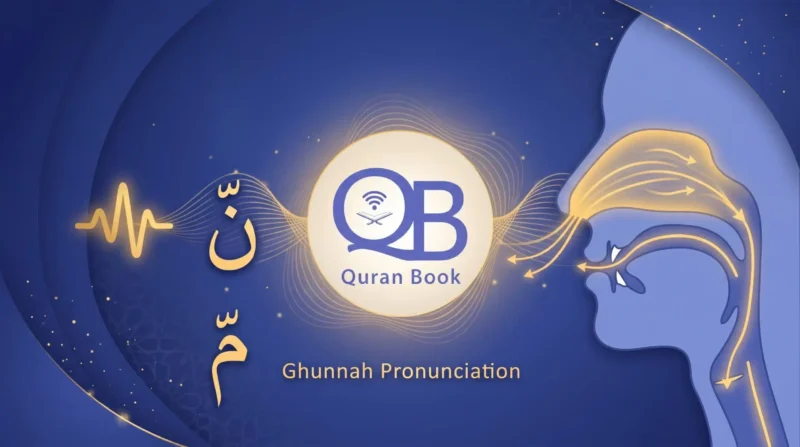
Its source is the khayshoom (الخيشوم) — the nasal cavity. In Tajweed the Ghunnah is attributed to the khayshoom rather than to any point of articulation in the mouth or the throat, and that single fact is why the pinch test works: block the exit and the sound has nowhere to go.
Ghunnah meaning: literal and technical
The literal Ghunnah meaning in Arabic is a soft, resonant sound made through the nose — the classical books compare it to the sound a deer makes when calling her young. The technical meaning is the definition boxed above: the nasal quality carried by Noon and Meem, held for two counts in specific positions. Two senses, one idea, and the second is just the first with a stopwatch attached.
📖 Riwayah note: every count on this page follows Hafs ‘an ‘Asim by the way of Ash-Shatibiyyah, the reading printed in the standard Madani mushaf.
The Ghunnah Letters
There are exactly two Ghunnah letters: ن and م. No third letter carries it, in any state, anywhere in the Quran. That is the whole list, and there is nothing to memorise beyond it.
Now the correction that almost no English page makes. Tanween is not a third Ghunnah letter. Tanween is a Noon Sakinah in sound — the mushaf writes it as a doubled vowel, but your mouth produces a silent Noon. That is the entire reason خَيْرًا يَرَهُ behaves exactly like مَن يَقُولُ. Learners who treat tanween as a separate topic end up memorising the same four rules twice.
🧠 Memory hook: every held Ghunnah in the Quran is a Noon or a Meem wearing a different hat. Find the hat — shaddah, sukoon with a merge, a hidden letter, tanween — and you have found the rule.
إِنَّ
Al-Baqarah 2:6 · one word, Al-Husary · this is the reference Ghunnah for the whole page
How to Pronounce Ghunnah (4 Steps)
This is the part every other page skips. “Make a nasal sound” describes the output and says nothing about the source, so learners produce a throat hum with a nasal colour and have no reliable way of knowing they are wrong — an incorrect nasal-sounding voice can resemble the correct one closely, especially from inside your own head. Here is the physical method, and then the test.
1. Close the sound path in the mouth
For Noon, the tip of the tongue meets the gum ridge behind the upper teeth. For Meem, the two lips close. Nothing at all escapes forward — that closure is what forces the air upwards.
2. Let the sound out through the nose
Not a hum “with a nasal feel” — the air genuinely leaves through your nostrils. Put a fingertip lightly on the side of your nose and you should feel it vibrate.
3. Hold it level for two counts
Keep the Ghunnah steady and natural for the required duration, with no rise or fall in pitch. The Ghunnah sound in Tajweed is resonance, not volume — it should never be louder than the letters around it.
4. Run the pinch test
Block your nostrils in the middle of the sound. A correct Ghunnah chokes off immediately and audibly, because you have just closed its only exit. If nothing changes, the sound is coming from your throat — go back to step 2.
Listen to it at full speed, then slowed down. Tap the Slow speed button in the walkthrough below and replay this clip to hear the two counts stretch out.
إِنَّ الَّذِينَ
Al-Baqarah 2:6 · inna-lladhīna · “Indeed, those who…” · the held Noon is the first word
How Many Counts Is Ghunnah?
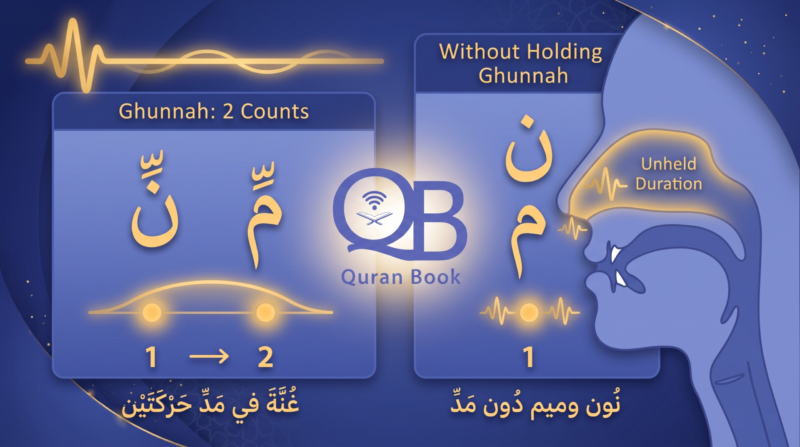
A 2 count Ghunnah — harakatayn — in its complete form. That is the same unit used for madd: roughly the time it takes to fold one finger at a steady pace, or to say “one-two” at recitation speed. It is a relative measure, not a stopwatch reading, so a slow recitation has a longer Ghunnah than a fast one. What must stay constant is the ratio: whatever your two counts sound like, they should sound the same on every held Ghunnah in the same recitation. The same clock governs the Madd rules, which is why training one improves the other.
But “Ghunnah is 2 counts” is only part of the picture, and the missing part is where accuracy lives:
That last row is the one most learners never meet. In مِن رَّبِّهِمْ and مِن لَّدُنْهُ the Noon does not merely lose its length — it hands over completely to the ر or the ل and the nasal sound disappears. Compare that with مَن يَقُولُ, where the Noon also disappears but the Ghunnah carries the join for two counts. Same word shape, opposite treatment.
Holding a Ghunnah where the rule does not ask for one is as much an error as dropping one where it does.
Over-nasalising every Noon and Meem in the ayah is the beginner signature, and almost no page warns about it. Hear the difference for yourself — the two clips below are the same reciter in the same session.
إِنَّ
Al-Baqarah 2:6 · Noon with shaddah · 2 counts
لَكُمْ دِينُكُمْ
Al-Kafirun 109:6 · Meem Sakinah before د (Izhar Shafawi) · nothing held
Ghunnah Rules: When Is It Held for Two Counts?
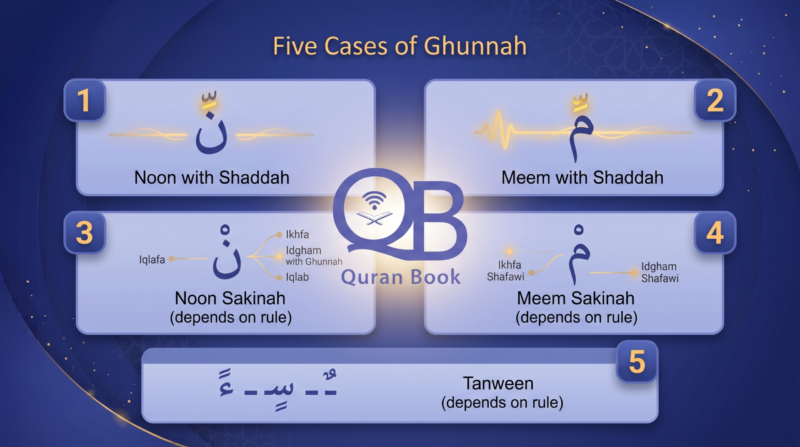
These are the Ghunnah rules in Tajweed, grouped by where you actually meet the sound on the page. Read them as six doorways into four rulings, not as six separate laws — a Noon Mushaddadah, for instance, appears under “with shaddah” and under “with Noon” because it is the same event seen from two angles.
Held for two counts: shaddah · Idgham bi-Ghunnah · Ikhfa and Ikhfa Shafawi · Iqlab.
Not held: Izhar Halqi and Izhar Shafawi, and any vowelled Noon or Meem.
Dropped entirely: Idgham bila Ghunnah, before ل and ر.
Each clip below is a single word or phrase in Sheikh Al-Husary’s voice.
1 · Ghunnah with Shaddah
The strongest and simplest case. Any نّ or مّ takes a full two-count Ghunnah — no conditions, no exceptions, anywhere it appears, in the middle of a word or at the start of one. ✅ إِنَّ · ثُمَّ · جَنَّاتٍ · مُحَمَّدٌ. Master this case first: it is the only one you can identify without knowing any other rule.
إِنَّا
Al-Kawthar 108:1 · Noon Mushaddadah
2 · Ghunnah with Noon
Noon carries the nasal quality in every state it can be in — vowelled, silent, doubled — but it is only lengthened in the rulings listed above. The held form you hear most often is Noon Mushaddadah, as in آمَنَّا, where the tongue stays pressed to the gum ridge while the sound runs out through the nose.
آمَنَّا
Al-Baqarah 2:8 · Noon Mushaddadah · āmannā
3 · Ghunnah with Meem
Same story at the lips. Meem Mushaddadah (ثُمَّ · عَمَّ) is held for two counts, and so is the merging of a silent Meem into a following Meem — Idgham Mutamathilain, as in قُلُوبِهِم مَّرَضٌ. In both, the lips close once and the sound leaves through the nose.
قُلُوبِهِم مَّرَضٌ
Al-Baqarah 2:10 · Idgham Mutamathilain · one closure, two counts · see the Rules of Meem Sakinah
4 · Ghunnah with Noon Sakinah
A silent Noon meets the next letter, and the letter decides what happens to the Ghunnah. It is held in Ikhfa (أَندَادًا), held in Idgham bi-Ghunnah (مَن يَقُولُ), held in Iqlab (لَيُنبَذَنَّ), not held in Izhar Halqi (أَنْعَمْتَ), and dropped altogether in Idgham bila Ghunnah (مِن رَّبِّهِمْ). Which letters trigger which rule is a separate lesson: the Noon Sakin rules page carries you across.
أَندَادًا
Al-Baqarah 2:22 · Ikhfa · the tongue never touches, and the Ghunnah carries the join
5 · Ghunnah with Meem Sakinah
The Meem half of the same idea. Ikhfa Shafawi (silent Meem before ب) and Idgham Mutamathilain both hold the Ghunnah for two counts; Izhar Shafawi — every other letter — does not. Full treatment on the Rules of Meem Sakinah.
تَرْمِيهِم بِحِجَارَةٍ
Al-Fil 105:4 · Ikhfa Shafawi · the Meem is concealed before Baa while the Ghunnah is held for two counts
6 · Ghunnah with Tanween
Tanween behaves exactly like a Noon Sakinah, because in pronunciation it is one. So it is shown clearly with no held Ghunnah when the next letter is a throat letter (عَلِيمًا حَكِيمًا — Izhar before ح), it is hidden with a held Ghunnah in Ikhfa, it merges with a held Ghunnah before ي ن م و (هُدًى مِّن), it converts with a held Ghunnah in Iqlab (سَمِيعٌ بَصِيرٌ), and it loses the Ghunnah completely before ل and ر (غَفُورٌ رَّحِيمٌ). Nothing extra to learn — the details live on the Noon Sakin rules page.
هُدًى مِّن
Al-Baqarah 2:5 · tanween merging into م · Idgham bi-Ghunnah, 2 counts
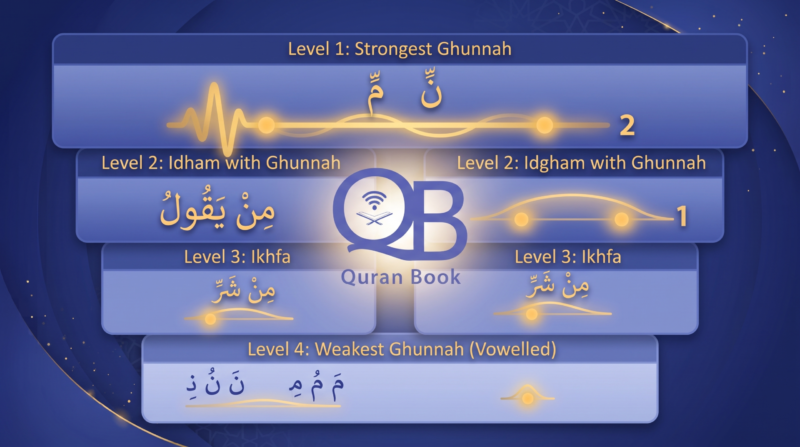
The Levels of Ghunnah (Marātib al-Ghunnah)
Here is the piece that the “Ghunnah is 2 counts” summary hides. Ghunnah in Quran recitation has degrees — marātib al-ghunnah (مراتب الغنة) — five of them, from a full held sound down to a trace you never lengthen. The Ghunnah inside an Ikhfa does not carry the same weight as the Ghunnah of نَّ, and even a plain vowelled Noon still has some of it in there.
One thing the ladder does not include: Idgham bila Ghunnah. Before ل and ر the Noon is not weakened to a lower level — it is gone, and the Ghunnah goes with it. That is why it sits outside the five degrees rather than beneath them.
One honest note, because you will meet the disagreement sooner or later: the books do not all order levels 2 and 3 the same way — some place the hidden Ghunnah above the merged one. The practical takeaway is untouched either way. The top three are held for two counts; the bottom two are never lengthened at all. That is the line that matters when you are reciting, and it is worth more to you than any ranking of the middle.
Ghunnah Examples in the Quran
Reading about a sound only takes you so far. Everything below is Sheikh Mahmoud Khalil Al-Husary, and it is cut word by word: tap any single word and you hear that word on its own, at teaching pace. Letters marked in orange carry a held Ghunnah; letters marked in blue have the nasal quality but nothing to lengthen.
Ghunnah examples in Surah An-Nas — the word-by-word map
Six short ayat you almost certainly know by heart already, and they are dense with Noon Mushaddadah — النَّاسِ alone appears five times. That makes Surah An-Nas the best forty-second Ghunnah drill in the Quran. Tap a word to isolate it, or press Play word by word to walk through the ayah one word at a time.
One held Ghunnah: النَّاسِ — Noon with a shaddah, two counts.
Same word, same two counts. Compare your hold on this one against ayah 1.
Three ayat, three identical holds — consistency is the whole exercise.
Two held Ghunnahs of different kinds: مِن before ش is Ikhfa, الْخَنَّاسِ is a shaddah. Same length, different mouth.
Four words with no held Ghunnah at all, then one that has it. Resist the urge to hum through the rest.
Note the first word: مِنَ has a vowelled Noon — the Ghunnah is in there, but you never hold it.
Ten Ghunnah Tajweed examples across the Quran
One clip per situation, ordered from the simplest to the hardest to hear. Read the last two rows carefully — one has nothing to hold, and one contains a held Ghunnah and an unheld Noon side by side. Both are there on purpose.
إِنَّ الَّذِينَ كَفَرُوا
Al-Baqarah 2:6 · Noon Mushaddadah · the reference length for this page
عَمَّ يَتَسَاءَلُونَ
An-Naba 78:1 · Meem Mushaddadah · one word, all lips and nose
إِنَّا أَعْطَيْنَاكَ الْكَوْثَرَ
Al-Kawthar 108:1 · Noon Mushaddadah opening a surah you recite often
مِنَ الْجِنَّةِ وَالنَّاسِ
An-Nas 114:6 · two held Ghunnahs in one short ayah
مَن يَقُولُ
Al-Baqarah 2:8 · Idgham bi-Ghunnah · the Noon disappears, the sound does not
أَندَادًا
Al-Baqarah 2:22 · Ikhfa · listen for the gap where the Noon should be
لَيُنبَذَنَّ
Al-Humazah 104:4 · Iqlab, then a Noon Mushaddadah — two held Ghunnahs in one word
تَرْمِيهِم بِحِجَارَةٍ
Al-Fil 105:4 · Ikhfa Shafawi · a Meem you never quite close
خَيْرًا يَرَهُ
Az-Zalzalah 99:7 · tanween merging into ي · proof that tanween is a Noon in disguise
لَكُمْ دِينُكُمْ
Al-Kafirun 109:6 · Izhar Shafawi · no held Ghunnah — the Meem is clear and quick
بِشَيْءٍ مِّنْ عِلْمِهِ
Al-Baqarah 2:255 · both in one word. The tanween of بِشَيْءٍ merges into the Meem — held, 2 counts. The Noon Sakinah that follows meets ع — Izhar, nothing held. Judge the letter, not the word.
🎧 Why the last two rows matter: a page about Ghunnah that only plays Ghunnah teaches your ear to nasalise everything. One clean negative, and one word that holds a Ghunnah and drops one within the same three syllables, do more for your accuracy than three more positives would.
Tap any word or row to hear it.
6 Common Ghunnah Mistakes
1. Making the sound in the throat instead of the nose
The single biggest error, and the only one that is completely invisible from the inside. The pinch test tells you whether the nasal resonance is there at all; a qualified teacher listening to you is what confirms the sound is right.
2. Over-nasalising every Noon and Meem
The “everything hums” habit — vowelled letters included. Ghunnah is present in all of them; it is only held in four rulings.
3. Inconsistent length
A long Ghunnah on إِنَّ and a clipped one on ثُمَّ in the same ayah. Wherever it is held, it is the same two counts.
4. Turning it into a pitch bend
Sliding the note up or down to sound melodic. Keep the Ghunnah steady, without deliberately changing its pitch; the melody belongs to the recitation, not to this sound.
5. Holding a Ghunnah in Izhar — or keeping one in Idgham bila Ghunnah
أَنْعَمْتَ and هُمْ فِيهَا take no hold at all, and مِن رَّبِّهِمْ takes no Ghunnah whatsoever. Both are the mirror image of dropping one where it belongs, and just as much an error.
6. Releasing the mouth position early
The tongue or the lips open while the nasal sound is still running, so the Ghunnah leaks forward and picks up a vowel colour. Hold the closure until the two counts are done.
Practise Ghunnah
The 2-count timer: make the length visible
Length is the part you cannot judge from the inside — it always feels right. Play إِنَّ once for reference, then press and hold the bar while you recite it yourself, releasing exactly when your nasal hold ends. Green means you landed inside a plausible two-count window for a normal recitation pace.
إِنَّ
Hold it for two counts at your own natural recitation pace.
A guide, not a ruling: the count is relative to your own pace, so a slow tahqiq reading fills more of the bar than a fast one. What matters is that yours is the same every time.
Hold it or not? A 10-word decision drill
Ghunnah for beginners comes down to one repeated judgement: does this Noon or Meem get two counts, or not? Play the clip, look at the highlighted letter only, then choose. The feedback names the rule and points you to the page that owns it.
Listen, then decide whether the highlighted letter is held.
Play: Catch the Ghunnah Bee (Free Game)
Spotting a Ghunnah on a page and spotting one under time pressure are two different skills. Catch only the words that carry a held Ghunnah and let the rest fly past. It works on phones and tablets, and no account is needed.
Game not loading? Open it in a new tab · or browse all our free Tajweed games.
Learn More
Ghunnah is a quality of two letters. Qalqalah and Raa are qualities of others. The Noon and Meem pages are where Ghunnah is actually applied, and Madd is where you reuse the same counting — so read them in that order.
All of them sit inside the wider set of Tajweed rules, and all are taught step by step in our Tajweed for adults and Tajweed for kids classes.
Ghunnah FAQ
May Allah beautify your recitation and accept it from you. 🤲
Hafidha of the Quran · Arabic Language Graduate · Writer on Islamic Sciences
Jehad Mahmoud is a graduate of the Arabic Language department and a Hafidha of the Quran who writes the Islamic educational content at Quran Book Academy.
She writes with a focus on Tajweed, Quranic recitation and the sharia sciences, making technical rules accessible to English-speaking Muslim families.
Her articles are educational, not fatwa. For a ruling on a specific personal situation, readers are advised to consult a qualified scholar or mufti.
References & Sources
1. Al-Azhar Al-Sharif — azhar.eg
2. The chapter on Ghunnah in the classical primers Tuhfat al-Atfal and Al-Muqaddimah al-Jazariyyah.
3. Surah An-Nas 114 — Quran.com · Surah Al-Baqarah 2 — Quran.com
4. Encyclopedia of Arabic Language and Linguistics — Brill Reference Works
5. Recitation — Sheikh Mahmoud Khalil Al-Husary (Hafs, murattal), audio via EveryAyah.com; word-level timings via the Quran.com audio segment data.
© 2026 Quran Book Academy. All rights reserved.
Book Your Free Trial · Empowering Muslims Worldwide to Connect with the Quran