🏠 Home About
🕌 About Us ⚙️ How It Works 👨‍🏫 Meet Our Teachers
🧒 For Kids
Fiqh for Kids Arabic Online for Kids Islamic School for Kids Tajweed Made Easy Quran Memorization Nour El Bayan Noorani Qaida
👨 For Adults
Tajweed for Adults Islamic School for Adults Quran Memorization Arabic Online Online Quran for Adults
🧕 Ladies Section
Online Quran for Ladies Islamic Studies for Sisters Female Quran Teachers
✨ More Programs
Online Islamic School Quran with Tajweed Quranic Arabic Ijaza in Quran Online Quran Classes Qiraat Course Online Hifz Course Quran Memorization Course New Muslim Programs
📝 Articles 💰 Price 🎁 Free Trial

Author: rabieabdo06841@gmail.com

  • allahumma barik meaning guide

    Allahumma Barik: Complete Guide to Meaning, Proper Usage & How to Respond
    Allahumma Barik: Complete Guide to Meaning, Proper Usage & How to Respond

    Introduction

    Allahumma Barik means “May Allah bless you” or “O Allah, bless it.” This powerful Arabic phrase is used by Muslims worldwide to invoke Allah’s blessings upon someone or something they admire.

    Unlike MashAllah, which acknowledges Allah’s will, Allahumma Barik is a direct supplication asking Allah to protect and increase blessings. Understanding this beautiful dua connects you more deeply to Islamic traditions.

    If you’ve ever hesitated to say Allahumma Barik because you weren’t sure when to use it, you’re not alone. Many non-Arabic speaking Muslims feel uncertain about proper pronunciation and context.

    The good news is that learning to use Allahumma Barik correctly is simpler than you might think. Mastering it will enrich your daily Islamic practice and strengthen your connections with fellow Muslims.

    “And when you are greeted with a greeting, greet [in return] with one better than it or [at least] return it [in a like manner].” Quran 4:86

    What Does Allahumma Barik Mean? — The Complete Definition
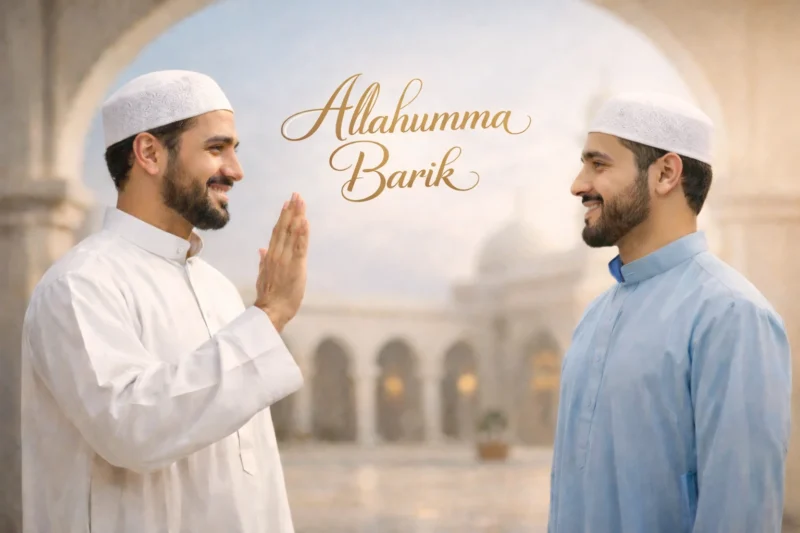
    Muslims exchanging Allahumma Barik blessing greeting
    Two Muslims exchanging heartfelt greetings representing the tradition of saying Allahumma Barik.

    Allahumma Barik translates to “O Allah, bless it” or “May Allah bless.” It combines “Allahumma” (اللَّهُمَّ) meaning “O Allah” with “Barik” (بَارِكْ) meaning “bless.”

    This phrase forms a supplication requesting divine blessings and protection from the evil eye. Muslims say Allahumma Barik to ask Allah to preserve and increase the blessings they see in someone.

    The word “Barik” comes from the Arabic root “baraka,” which signifies blessing, prosperity, and divine favor. When you say Allahumma Barik, you are actively making a dua to Allah.

    The phrase carries protective qualities against the evil eye (hasad). The Prophet Muhammad (ﷺ) emphasized:

    “The evil eye is real. If anything could outpace the divine decree, it would be the evil eye.” Sahih Muslim 2188

    Is Allahumma Barik a Dua?

    Yes, Allahumma Barik is absolutely a dua (supplication). When you say it, you are directly asking Allah to bestow His blessings.

    This makes it both a form of dhikr (remembrance of Allah) and an active prayer for someone’s wellbeing. The phrase demonstrates your recognition that all good things come from Allah.

    How to Write Allahumma Barik in Arabic (With Pronunciation Guide)

    Allahumma Barik is written in Arabic as: اللَّهُمَّ بَارِكْ. The phrase is pronounced “Al-laa-hum-ma Baa-rik.”

    Place emphasis on the double “m” in Allahumma and add a slight pause before Barik. Mastering this pronunciation helps you speak the phrase with confidence.

    Arabic Writing Reference Table

    Phrase Arabic Script Transliteration Meaning
    Allahumma Barik اللَّهُمَّ بَارِكْ Al-laa-hum-ma Baa-rik O Allah, bless (it/them)
    Allahumma Barik Lahu اللَّهُمَّ بَارِكْ لَهُ Al-laa-hum-ma Baa-rik la-hu O Allah, bless him
    Allahumma Barik Laha اللَّهُمَّ بَارِكْ لَهَا Al-laa-hum-ma Baa-rik la-ha O Allah, bless her
    Allahumma Barik Feek اللَّهُمَّ بَارِكْ فِيكَ Al-laa-hum-ma Baa-rik fee-ka May Allah bless you

    Pronunciation Tips for Non-Arabic Speakers

    🎬 Watch: How to pronounce Allahumma Barik correctly

    • Break it down: Al-laa-HUM-ma (pause) BAA-rik
    • The “h” in Allahumma comes from deep in the throat
    • The double “m” should be held slightly longer
    • Practice slowly, then gradually increase speed

    Join our Telegram community for daily Quran reading practice and pronunciation support.

    When to Say Allahumma Barik — 7 Common Situations
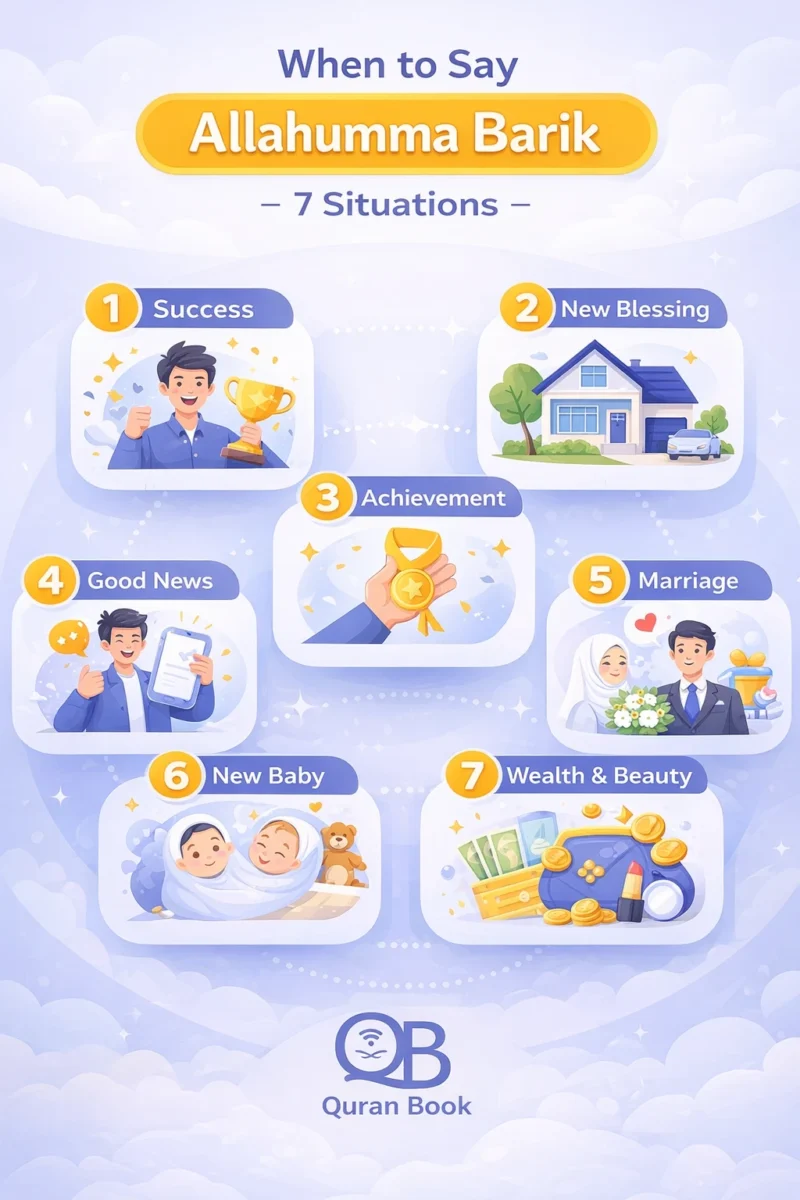
    When to say Allahumma Barik - 7 situations infographic for Muslims
    Colorful infographic illustrating 7 situations when Muslims should say Allahumma Barik.

    Knowing when to say Allahumma Barik is essential for using this phrase appropriately. Here are seven common situations where you should use it, as guided by the Sunnah of giving compliments:

    1. When complimenting someone’s appearance: “Your daughter is beautiful, Allahumma Barik!”
    2. When admiring children: Children are especially vulnerable to hasad.
    3. When praising achievements: “You graduated with honors, Allahumma Barik!”
    4. When seeing a beautiful home: Shows gratitude and invokes protection.
    5. When congratulating good news: New job, marriage, or pregnancy announcements.
    6. When admiring talents: “Your recitation is beautiful, Allahumma Barik!”
    7. General admiration: Any blessing you witness in someone’s life.
    “If one of you sees something in himself or his brother that he likes, let him pray for blessing for him, for the evil eye is real.” Ibn Majah 3509

    MashAllah vs Allahumma Barik — What’s the Difference?
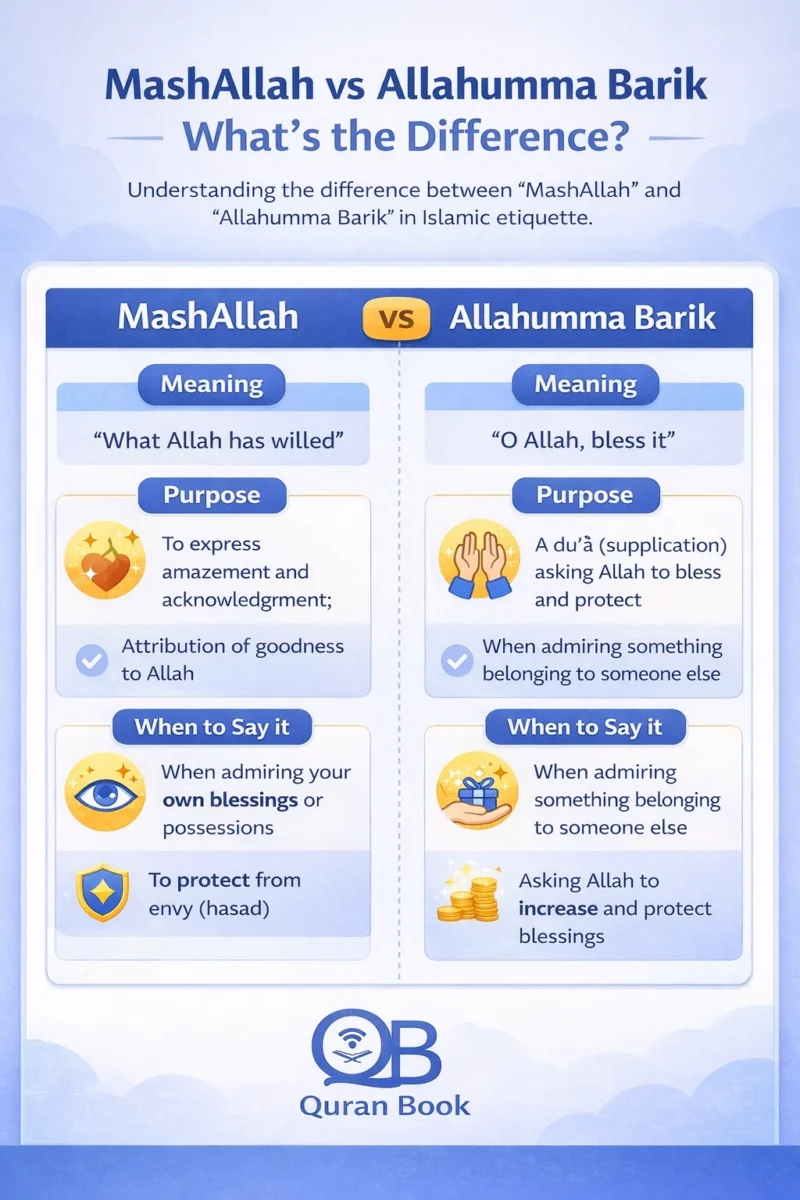
    MashAllah vs Allahumma Barik difference comparison chart
    Side-by-side comparison showing differences between MashAllah and Allahumma Barik with usage context.

    Understanding the difference between MashAllah vs Allahumma Barik is crucial for proper Islamic etiquette. These phrases serve different purposes.

    MashAllah means “What Allah has willed” and acknowledges that all good comes from Allah. It’s an expression of acknowledgment and amazement.

    Allahumma Barik means “O Allah, bless it” and is a direct prayer. It asks Allah to protect and increase blessings actively.

    Key Distinction

    Mā shā’ Allāh is used when you see something admirable in yourself or your possessions. It attributes the blessing to Allah and protects from envy.

    Allāhumma Bārik is specifically for when you admire something belonging to someone else. It asks Allah to place blessing in that person or thing.

    Should I Say MashAllah or Allahumma Barik First?

    Scholars recommend saying “MashAllah, Allahumma Barik” together. This acknowledges Allah’s will first, then asks for His continued blessing.

    This combination provides comprehensive spiritual protection. The Quran supports this in Surah Al-Kahf:

    “It was better for you to say, when you entered your garden: ‘What Allah willed.’” Quran 18:39

    How to Respond to Allahumma Barik — Proper Islamic Replies

    When someone says Allahumma Barik to you, knowing how to respond to Allahumma Barik properly completes the exchange of blessings.

    You can respond with “Ameen” (آمين) to accept the dua. Another option is “Barakallahu Feek” (بَارَكَ اللهُ فِيكَ) meaning “May Allah bless you.”

    You may also say “Jazakallahu Khairan” (جَزَاكَ اللهُ خَيْرًا) meaning “May Allah reward you with good.” Any of these responses appropriately returns the blessing. Learn more common Arabic phrases with our courses.

    Response Options Table

    Response Arabic Meaning
    Ameen آمِين Accept the supplication
    Barakallahu Feek بَارَكَ اللهُ فِيكَ May Allah bless you (male)
    Barakallahu Feeki بَارَكَ اللهُ فِيكِ May Allah bless you (female)
    Jazakallahu Khairan جَزَاكَ اللهُ خَيْرًا May Allah reward you with good
    Wa Feeka Barakallah وَفِيكَ بَارَكَ اللهُ And may Allah’s blessing be upon you

    Gender-Specific Responses

    • Responding to a male: “Barakallahu Feek” (فِيكَ)
    • Responding to a female: “Barakallahu Feeki” (فِيكِ)
    • Responding to a group: “Barakallahu Feekum” (فِيكُم)

    Can You Say Allahumma Barik to Yourself?

    Yes, you can say Allahumma Barik for yourself. When you admire your health, accomplishments, or blessings, this phrase asks Allah to preserve them.

    This practice shows humility by acknowledging that all good comes from Allah. It also protects you from self-admiration that could invite the evil eye upon yourself.

    Making dua for yourself is not only permissible but encouraged in Islam. When you recognize blessings in your life, saying Allahumma Barik demonstrates gratitude.

    Common Variations of Allahumma Barik Explained

    Understanding the different variations of Allahumma Barik helps you use the phrase appropriately. Arabic grammar has masculine, feminine, and plural forms.

    These variations allow you to tailor your blessing to the specific person or group. See the complete guide below.

    Complete Variation Guide

    Variation Arabic Meaning When to Use
    Allahumma Barik Lahu اللَّهُمَّ بَارِكْ لَهُ O Allah, bless him For a male person
    Allahumma Barik Laha اللَّهُمَّ بَارِكْ لَهَا O Allah, bless her For a female person
    Allahumma Barik Lahum اللَّهُمَّ بَارِكْ لَهُم O Allah, bless them For a group
    Allahumma Barik Feek اللَّهُمَّ بَارِكْ فِيكَ May Allah bless you Direct to male
    Allahumma Barik Feeki اللَّهُمَّ بَارِكْ فِيكِ May Allah bless you Direct to female
    Allahumma Barik Lana اللَّهُمَّ بَارِكْ لَنَا O Allah, bless us For yourself & others

    Understanding Arabic Grammar (Simplified)

    • “Lahu/Laha” = for him/her (third person)
    • “Feek/Feeki” = in you (direct address)
    • “Lana” = for us (including speaker)

    The Academy Method — Learning Arabic Phrases with Confidence
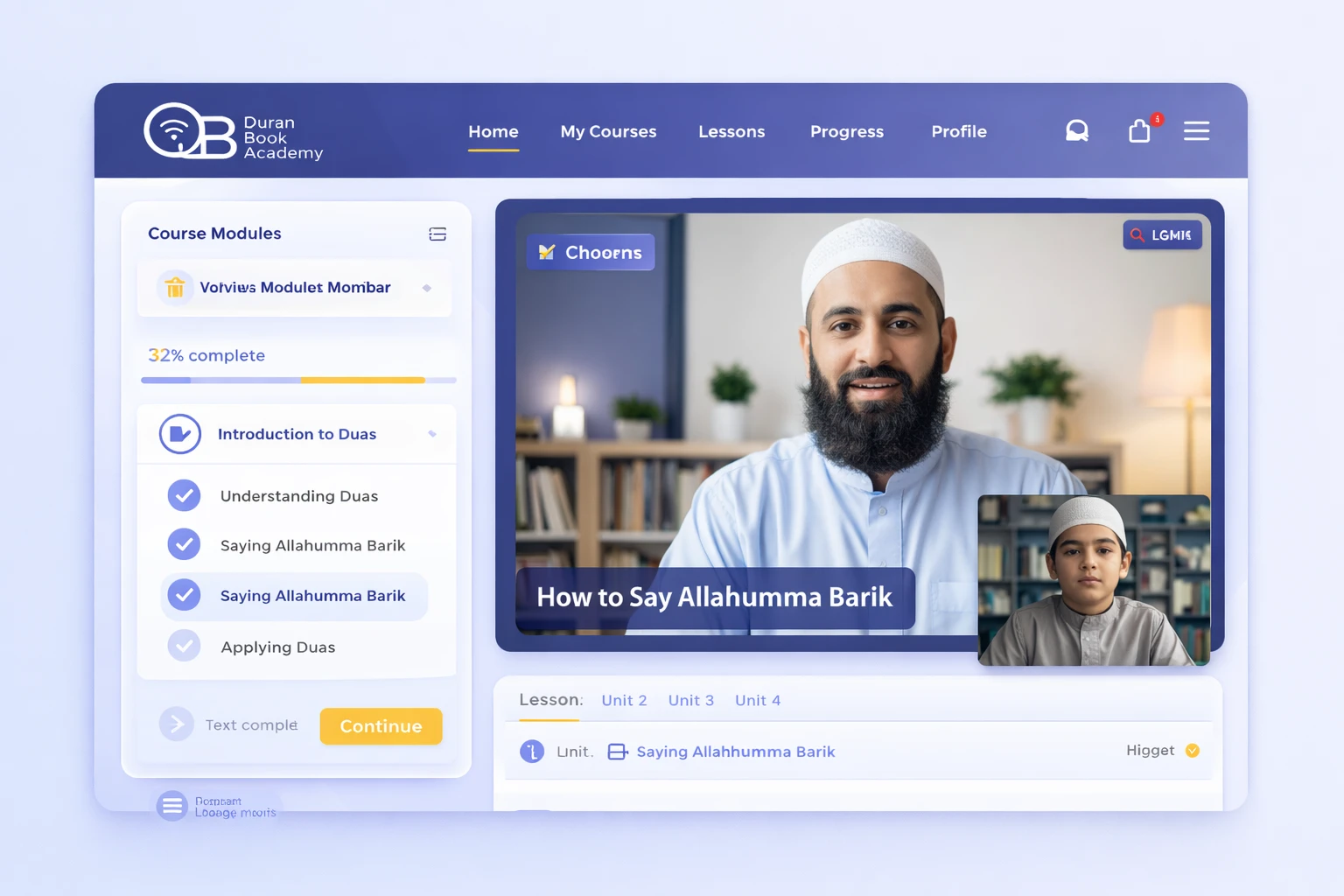
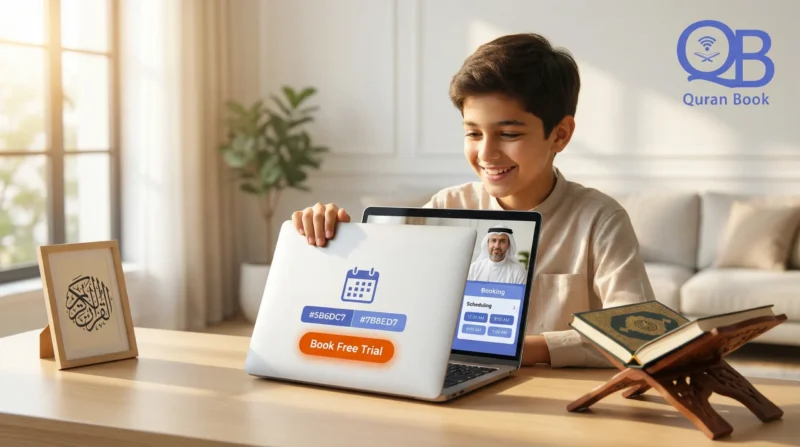
    Quran Book Academy online platform for learning Allahumma Barik
    Screenshot of Quran Book Academy’s learning interface with Zoom session and LMS dashboard.

    At Quran Book Academy, we understand that learning Arabic phrases like Allahumma Barik goes far beyond memorization. It requires understanding context and proper pronunciation.

    Our teaching methodology was developed over years of working with non-Arabic speaking Muslims. We serve students across the USA, Canada, UK, and Australia.

    Our approach is built on the psychological principle of “chunking.” We break down complex Arabic concepts into small, manageable pieces that your brain can easily process.

    We’ve seen how this approach transforms hesitant beginners into confident practitioners. Our students gain the confidence to use Islamic expressions naturally in daily life.

    Our live Zoom sessions allow for real-time pronunciation correction. Our custom LMS tracks your progress through each module, ensuring no lesson is missed.

    After each session, you receive detailed Gmail reports. These show your advancement, areas for improvement, and personalized recommendations.

    This systematic approach addresses two major barriers: fear of mispronouncing sacred phrases and finding consistent practice time. Our 30-minute sessions fit into busy schedules.

    We’ve helped hundreds of students move from “I’m afraid to say it wrong” to confidently using phrases like Allahumma Barik daily. The transformation is both linguistic and spiritual.

    Our Tech-Enabled Learning Approach

    • Live Zoom Sessions: Real-time pronunciation feedback
    • Custom LMS Platform: Track progress through modules
    • Gmail Progress Reports: Detailed feedback after each lesson
    • Flexible Scheduling: 30-minute sessions for busy lifestyles
    • Community Practice: Telegram channel for daily recitation

    FAQ — Your Questions About Allahumma Barik Answered

    Q1: What does Allahumma Barik mean in English?

    A: Allahumma Barik translates to “O Allah, bless it” or “May Allah bless.” It’s a supplication asking Allah to bestow blessings and protection.

    Q2: How do you reply when someone says Allahumma Barik?

    A: Respond with “Ameen,” “Barakallahu Feek,” or “Jazakallahu Khairan.” Any of these appropriately returns the blessing.

    Q3: Is it better to say MashAllah or Allahumma Barik?

    A: Both serve different purposes. Scholars recommend saying “MashAllah, Allahumma Barik” together for complete protection.

    Q4: Can I say Allahumma Barik for myself?

    A: Yes, you can say Allahumma Barik for yourself. This shows humility and asks Allah to preserve your blessings.

    Q5: What is the difference between Allahumma Barik Lahu and Laha?

    A: “Lahu” (لَهُ) is for males and “Laha” (لَهَا) is for females. It’s grammatical gender in Arabic.

    Q6: Is Allahumma Barik mentioned in the Quran?

    A: The exact phrase isn’t in the Quran, but the concept of asking for barakah is. Multiple hadith encourage saying Allahumma Barik.

    Q7: When should I NOT say Allahumma Barik?

    A: There’s no prohibition. It’s most meaningful when you genuinely observe a blessing you want Allah to protect.

    Start Your Journey — Learn Arabic Phrases the Right Way

    Now that you understand the beautiful meaning of Allahumma Barik, imagine using this phrase confidently every day. Picture yourself pronouncing it correctly in the right context.

    At Quran Book Academy, we’re committed to helping you achieve exactly that. Our personalized approach makes learning Arabic phrases simple and enjoyable.

    • One-on-one Zoom sessions with native Arabic teachers
    • Start with everyday Islamic phrases
    • Track progress through our custom LMS
    • Flexible scheduling for your busy life
    • Join our Telegram practice community
    🎯 Book Your FREE Trial Lesson Today!
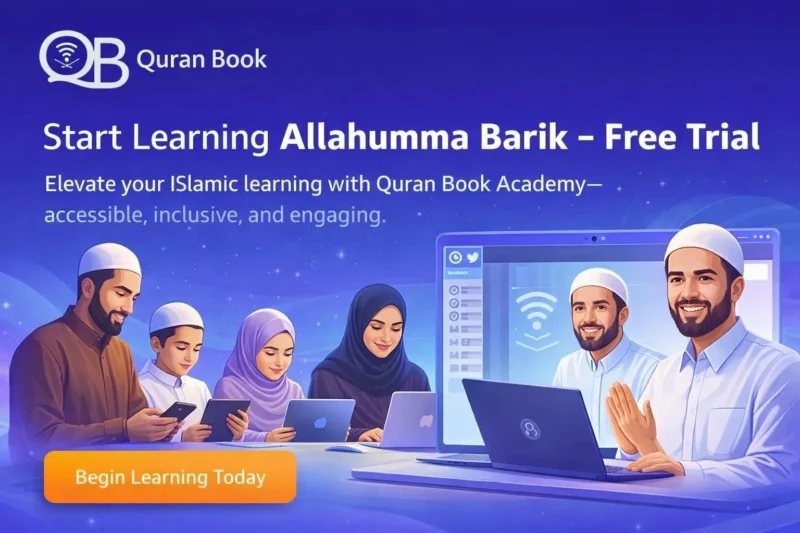
    Start learning Allahumma Barik - Quran Book Academy free trial
    CTA banner for Quran Book Academy featuring diverse Muslim learners.

    Closing Dua: May Allah bless your journey in learning His beautiful words.

    Allahumma Barik lakum wa barik feekum. Ameen.

    📚 Learn More

    Explore more resources to deepen your understanding of Islamic expressions and etiquette.

    References & Internal Links

  • fiqh curriculum children

    Islamic Studies Curriculum for Kids: 7 Proven Steps to Raise Confident Muslims
    📖
    Quran Book Academy
    Free Trial

    Islamic Studies Curriculum for Kids: 7 Proven Steps to Raise Confident Muslims

    By Quran Book Academy | Expert Islamic Education for Western Families

    Child learning Quran memorization course with proper Tajweed - Islamic Studies Curriculum for Kids
    A young Muslim child engaged in Quran memorization – the cornerstone of Islamic Studies for Kids

    Introduction

    An Islamic studies curriculum for kids is a structured program that teaches children the foundations of Islam—including Quran, fiqh (Islamic jurisprudence), salah, wudu, and Islamic manners—in age-appropriate, engaging ways.

    You want your children to grow up as practicing Muslims, but finding the right curriculum feels overwhelming. Between school, activities, and screen time, you worry Islamic education is slipping through the cracks. Many parents in the USA, UK, Canada, and Australia struggle to find qualified teachers who understand Western-raised children.

    The good news? A proven 7-step Islamic curriculum for children exists that addresses these exact concerns. At Quran Book Academy, we’ve helped over 1,000 families establish strong Islamic foundations for their kids through our Quran Classes for Kids.

    📖

    “O you who believe, protect yourselves and your families from a Fire…”

    Surah At-Tahrim 66:6

    What Should an Islamic Studies Curriculum for Kids Include?

    A complete Islamic studies curriculum for kids should include five core areas:

    📖

    Quran with Tajweed

    🕌

    Fiqh (Worship)

    💫

    Aqeedah (Beliefs)

    🌟

    Seerah (Biography)

    💝

    Akhlaq (Character)

    The difference between random lessons and a structured curriculum is profound. Random YouTube videos or occasional weekend classes create knowledge gaps that leave children confused about their faith. A proper Islamic curriculum for children builds progressively, ensuring each concept reinforces the previous one while preparing for what comes next. This systematic approach dramatically improves retention and helps children internalize Islamic values naturally.

    Why Your Child Needs a Structured Islamic Curriculum for Children

    Child taking online assessment for Islamic Studies curriculum - structured learning approach
    Structured online assessments help track your child’s progress in Islamic education

    A structured Islamic curriculum for children ensures consistent learning, prevents gaps in knowledge, and builds confidence through measurable progress—unlike scattered weekend classes or YouTube videos alone.

    ☪️

    “Teach your children to pray when they are seven years old, and discipline them for it when they are ten.”

    — The Prophet Muhammad ﷺ, Sunan Abu Dawud 495

    This hadith emphasizes timing and structure in Islamic education. Consistency builds habits that last a lifetime. When children learn fiqh questions for kids in a systematic way, the knowledge becomes second nature.

    Benefits of Structured Learning:

    • Professional teachers correct pronunciation and practice mistakes early
    • Structured progress keeps children motivated through visible achievements
    • Parents receive clear updates on their child’s development
    • Knowledge retention improves dramatically with systematic approach

    The 7 Core Pillars of Our Islamic Studies Curriculum for Kids

    Our Islamic studies curriculum for kids is built on seven essential pillars that create well-rounded, confident young Muslims:

    1

    Quran Recitation & Tajweed

    Proper pronunciation from day one ensures children develop beautiful recitation skills that stay with them forever. Explore our Tajweed Course for Kids.

    2

    Fiqh Foundations

    This includes wudu for kids, salah steps for kids, and understanding halal and haram for kids in practical, relatable terms. Learn more about How to Teach Salah to Children.

    3

    Aqeedah (Beliefs)

    Children learn who Allah is, the role of Angels, stories of the Prophets, and awareness of the Day of Judgment in age-appropriate language.

    4

    Seerah

    Stories of Prophet Muhammad ﷺ inspire character development and provide role models children can relate to.

    5

    Akhlaq & Adab

    Islamic manners including honesty, kindness, respect for elders, and caring for others become daily practice.

    6

    Dua & Adhkar

    Daily supplications children can memorize empower them to connect with Allah independently.

    7

    Seasonal Learning

    Special modules cover Ramadan fiqh for kids, Hajj awareness, and Eid traditions, making Islamic celebrations meaningful learning opportunities.

    How We Teach Fiqh, Salah & Wudu for Kids

    We teach fiqh for kids using visual demonstrations, step-by-step practice, and gentle repetition. Children learn salah steps through live demonstration, and wudu through interactive video guides—making worship feel natural, not overwhelming.

    Salah Steps for Kids

    1. Stand facing Qibla with intention (Niyyah)
    2. Raise hands and say “Allahu Akbar” (Takbir)
    3. Recite Al-Fatiha and a short Surah
    4. Bow (Ruku) with back straight
    5. Stand and say “Sami Allahu liman hamidah”
    6. Prostrate (Sujood) with 7 body parts touching ground
    7. Sit, then prostrate again
    8. Complete with Tashahhud and Salam

    “Pray as you have seen me praying.”

    — The Prophet ﷺ, Sahih al-Bukhari 6008

    This hands-on approach to teaching wudu for kids and salah steps for kids transforms what could feel like a chore into a beloved daily routine.

    The Academy Method: How Quran Book Academy Delivers Results

    At Quran Book Academy, our Islamic studies curriculum for kids is built on educational psychology and traditional Islamic scholarship working hand-in-hand.

    💻

    Live Zoom Sessions

    Real-time interactive learning with certified teachers—not pre-recorded videos

    📊

    Progress Tracking LMS

    Weekly automated reports keep parents informed of their child’s development

    ⏱️

    25-30 Min Sessions

    Designed to match children’s attention spans for maximum retention

    🌍

    Global Accessibility

    Serving families in USA, Canada, UK, and Australia with flexible scheduling

    Whether your child is learning halal and haram for kids, mastering wudu steps, or memorizing salah positions, our curriculum grows with them. This isn’t just Islamic education; it’s a complete Islamic curriculum for children that builds confident, practicing Muslims who love their Deen. We also offer Islamic Courses for Adults so the whole family can learn together. Join our Telegram Community for daily Islamic reminders!

    Age-Appropriate Islamic Studies Curriculum Breakdown

    Age Group Focus Areas Key Outcomes
    Ages 4-6 Basic duas, Allah’s names, simple stories Love for Islam, basic Arabic sounds
    Ages 7-9 Quran reading, wudu, salah basics, short surahs Independent prayer, Quran recitation
    Ages 10-12 Tajweed rules, fiqh details, Seerah depth Beautiful recitation, understanding worship
    Ages 13+ Advanced Tajweed, Islamic history, contemporary fiqh Confident Muslim identity, leadership skills

    This progressive approach ensures children master fundamentals before advancing, building genuine confidence in their Islamic practice.

    FAQ: Common Questions About Islamic Studies Curriculum for Kids

    Q1: What age should children start Islamic studies? +

    Children can begin basic Islamic learning at age 4-5 with simple duas and Allah’s names. Formal curriculum with fiqh and Quran should start by age 7.

    Q2: How long does it take to complete an Islamic curriculum? +

    A foundational Islamic studies curriculum for kids typically spans 2-3 years with weekly classes, covering Quran basics, fiqh essentials, and Islamic character.

    Q3: What are the 5 pillars taught in fiqh for kids? +

    Children learn Taharah (purification), Salah (prayer), Sawm (fasting), Zakat (charity concept), and Hajj (basic awareness).

    Q4: Can non-Arabic speaking kids learn effectively? +

    Absolutely. Our curriculum is designed specifically for English-speaking Muslim children in the USA, UK, Canada, and Australia, with Arabic taught progressively alongside understanding.

    Start Your Child’s Islamic Education Journey

    Free Trial Lesson Available!

    Every Muslim child deserves a strong foundation. Give yours the gift of knowledge.

    Book your free Quran trial lesson - Islamic Studies Curriculum for Kids CTA

    What You Get:

    • Free 30-minute live Zoom trial with a certified teacher
    • Personalized assessment of your child’s current level
    • Custom learning roadmap via our LMS
    • Flexible scheduling for USA, UK, Canada & Australia time zones

    “My Lord, increase me in knowledge.”

    Surah Ta-Ha 20:114

    References

    1. Quran, Surah At-Tahrim 66:6 – Command to protect families from the Fire through Islamic education.
    2. Sunan Abu Dawud 495 – Hadith on teaching children prayer at age seven.
    3. Sahih al-Bukhari 6008 – Hadith: “Pray as you have seen me praying.”
    4. Quran, Surah Ta-Ha 20:114 – Dua for increase in knowledge.
    5. Quran Book Academy Curriculum Documentation – Proprietary 7-pillar Islamic education framework.
    📖
    Quran Book Academy

    Serving Muslim families in USA, UK, Canada & Australia

    © 2026 Quran Book Academy. All rights reserved.

  • Benefits of Early Islamic Education

    7 Powerful Benefits of Early Islamic Education for Kids in 2026
    📖
    Islamic Kids Academy
    Free Trial

    7 Powerful Benefits of Early Islamic Education for Kids in 2026

    Nurturing Faith, Character, and Knowledge from the Earliest Years

    📅 Published: February 2026 | ⏱️ 8 min read
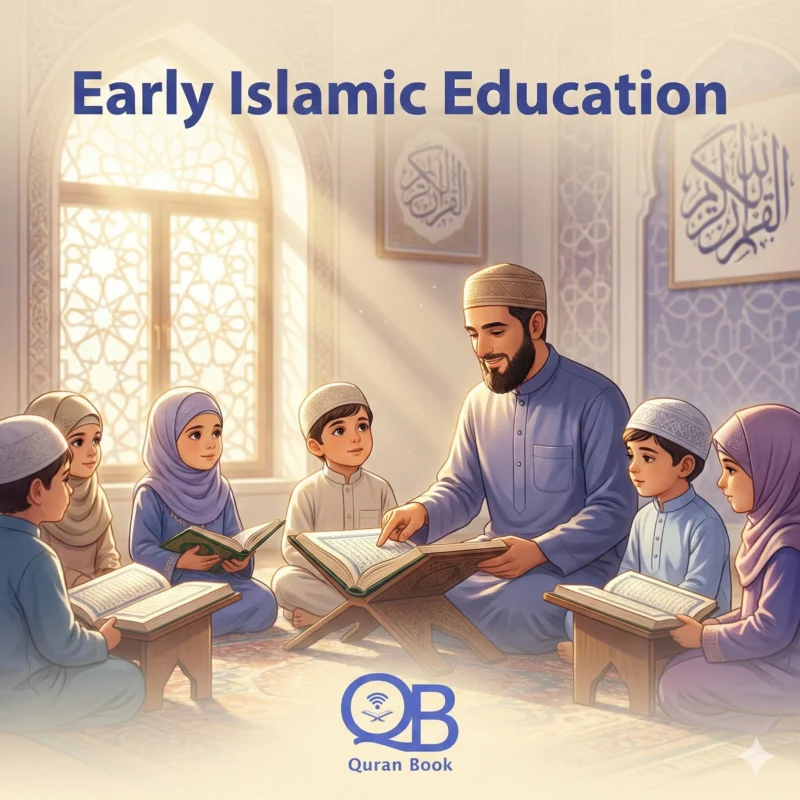
    Early Islamic education for children learning Quran
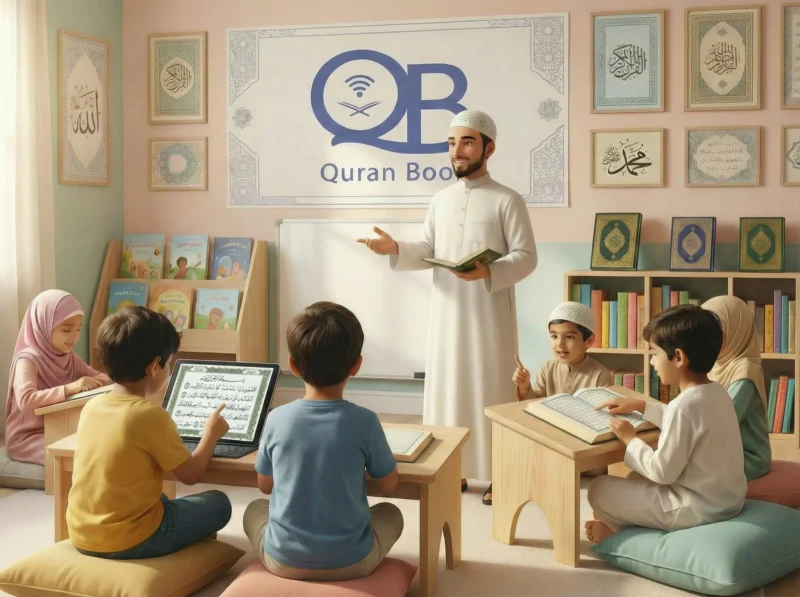
    Young children engaged in Quranic learning with their teacher in a nurturing classroom environment

    Introduction

    Early Islamic education provides children with a strong spiritual foundation, moral compass, and lifelong connection to Allah. Starting Quranic learning at a young age shapes character, builds discipline, and instills values that guide children through every stage of life.

    You may worry whether your child is too young to begin Islamic Studies for Kids. Perhaps you’re concerned about balancing Islamic education with their regular schoolwork, or time management feels overwhelming with your busy family schedule. These are valid concerns that many Muslim parents share across the USA, Canada, UK, and Australia.

    The good news is that early Islamic education uses age-appropriate, manageable “chunks” designed by educational psychologists to reduce overwhelm and build confidence gradually. When structured correctly, Islamic education for children becomes a joyful experience rather than an additional burden. This approach ensures that the importance of Islamic education is realized without sacrificing your child’s happiness or family harmony.

    What Is Early Islamic Education?

    Islamic early childhood education classroom with young students
    Children aged 4-8 engaged in an interactive Islamic studies lesson with colorful learning materials

    Early Islamic education refers to structured religious learning introduced to children during their formative years, typically between ages 3-10. It encompasses Quran recitation, Arabic basics, Islamic manners (Akhlaq), stories of the Prophets, and foundational beliefs (Aqeedah)—building spiritual identity before external influences take root.

    The importance of education in Islam has deep historical roots. From the earliest days of Islamic civilization, learning was valued from infancy. The Quran itself begins with the command “Read!” in Surah Al-Alaq (96:1-5), emphasizing knowledge as fundamental to faith. The Prophet Muhammad (peace be upon him) encouraged Muslims to “Seek knowledge from the cradle to the grave,” highlighting that Islamic upbringing should commence as early as possible.

    This foundation creates a strong spiritual identity that children carry throughout their lives, making early intervention crucial for Muslim families worldwide. Discover how you can help your child Learn Quran Online with expert guidance.

    7 Key Benefits of Early Islamic Education

    1

    Builds a Strong Spiritual Foundation

    Children who learn about Allah, prayer, and the Quran early develop an unshakeable spiritual identity. This foundation protects them from confusion and peer pressure later in life. When children understand their relationship with their Creator from a young age, they navigate challenges with confidence and clarity.

    As the Prophet Muhammad (peace be upon him) stated: “Every child is born upon the Fitrah (natural disposition)…” This hadith from Sahih Muslim reminds us that nurturing this natural inclination through early Islamic education is essential for preserving their innate connection to Allah.

    2

    Develops Excellent Moral Character (Akhlaq)

    Early Islamic education teaches honesty, kindness, patience, and respect—values that shape children into compassionate adults. Through stories of the Prophets and companions, children learn practical examples of noble character that they can emulate in their daily lives.

    The Quran beautifully states: “And We have certainly honored the children of Adam…” (Surah Al-Isra, 17:70). This verse reminds us of the inherent dignity Allah has bestowed upon humanity.

    3

    Enhances Cognitive and Memory Skills

    Memorizing Quran activates multiple brain regions, improving memory retention, focus, and linguistic abilities. Educational psychology research confirms that structured memorization during childhood creates neural pathways that enhance overall academic performance. Islamic early childhood education that includes Quran memorization provides children with cognitive advantages that extend far beyond religious knowledge, benefiting their performance in mathematics, languages, and critical thinking.

    4

    Creates Lifelong Love for Learning

    When Islamic education feels joyful and achievable, children associate learning with positive emotions. This positive association fosters curiosity that extends to all academic areas. Children who experience success in their Islamic Courses for Kids often develop greater confidence in tackling other educational challenges. The importance of Islamic education lies not only in the knowledge gained but in cultivating an attitude of lifelong learning that the Prophet Muhammad (peace be upon him) encouraged throughout his teachings.

    5

    Strengthens Family and Community Bonds

    Families who learn together grow together. Early Islamic education creates shared rituals, conversations, and values that unite households. When parents participate in their children’s Islamic upbringing, they strengthen intergenerational bonds and create beautiful family traditions. Community connections also deepen as families join Islamic learning circles, attend mosque programs, and celebrate religious milestones together. These relationships provide children with a supportive network that reinforces their Islamic identity.

    6

    Provides Protection from Negative Influences

    In today’s digital age, children face unprecedented exposure to conflicting messages through social media and peer networks. Children grounded in Islamic values develop internal filters to navigate these challenges with wisdom and confidence. Early Islamic education equips children with critical thinking skills rooted in faith, helping them distinguish between beneficial and harmful influences. This protection becomes increasingly valuable as children grow into teenagers and young adults.

    7

    Establishes Consistent Worship Habits

    Habits formed early become second nature. Children introduced to Salah, dua, and Quran recitation carry these practices effortlessly into adulthood. The importance of education in Islam includes building these consistent worship routines that sustain faith throughout life’s various stages. When prayer and Quran recitation become normal parts of daily life from childhood, maintaining these practices requires less effort and feels more natural as children mature.

    How to Start Your Child’s Early Islamic Education Journey

    Beginning your child’s Islamic education journey requires thoughtful planning and commitment. Here are practical steps to ensure success:

    1

    Assess Readiness

    Children as young as 3 can begin with short duas and Islamic stories tailored to their developmental stage.

    2

    Choose a Qualified Program

    Look for certified teachers experienced in child-focused Islamic pedagogy who understand developmental psychology. Learn more About Our Methodology.

    3

    Set Realistic Goals

    Start with 15-20 minute sessions, three times weekly, gradually increasing as your child’s capacity grows.

    4

    Create a Learning Environment

    Dedicate a quiet, comfortable space for online or in-person classes free from distractions.

    5

    Stay Involved

    Review lessons together and celebrate small milestones to reinforce your child’s motivation and progress.

    6

    Book a Free Trial

    Experience quality Islamic early childhood education programs firsthand before committing.

    Frequently Asked Questions

    Q1: What are the benefits of Islamic education?

    Islamic education builds spiritual identity, moral character, cognitive skills, and lifelong worship habits while connecting children to their faith community and heritage.

    Q2: Why is Islamic education important for children?

    Children are most receptive during their early years. Islamic education during this period shapes their worldview, values, and relationship with Allah before external influences dominate.

    Q3: What was the education of early Islam?

    Education in early Islam emphasized Quran memorization, Arabic literacy, Hadith study, and moral development—often beginning in childhood within family and mosque settings.

    Q4: Why is teaching Islamic Studies important in the modern era?

    In an age of information overload and competing ideologies, Islamic Studies provides children with a clear moral framework, identity, and critical thinking skills rooted in faith.

    Q5: How can I teach my child Islam at home?

    Combine daily routines like duas before meals and bedtime stories of Prophets with structured online classes from qualified academies for comprehensive learning.

    Begin Your Child’s Islamic Education Today

    Your child deserves a strong spiritual foundation that lasts a lifetime. Early Islamic education, when delivered through engaging, age-appropriate methods, transforms children’s relationship with their faith and prepares them for life’s challenges.

    The importance of Islamic education cannot be overstated in our modern world. By investing in your child’s Islamic upbringing today, you give them the greatest gift—a connection to Allah that guides them through every stage of life.

    Start Your Free Trial Lesson

    📚 References

    Quranic Sources

    Hadith Sources

    📖

    Nurturing the next generation of Muslims through quality Islamic education

    © 2026 Islamic Kids Academy. All rights reserved.