Islamic Education Guide
Fiqh for Kids: 7 Powerful Ways to Teach Islamic Rules Your Children Will Love
By Quran Book Academy | Comprehensive Guide for Muslim Parents
Introduction: Your Journey to Teaching Fiqh for Kids Starts Here
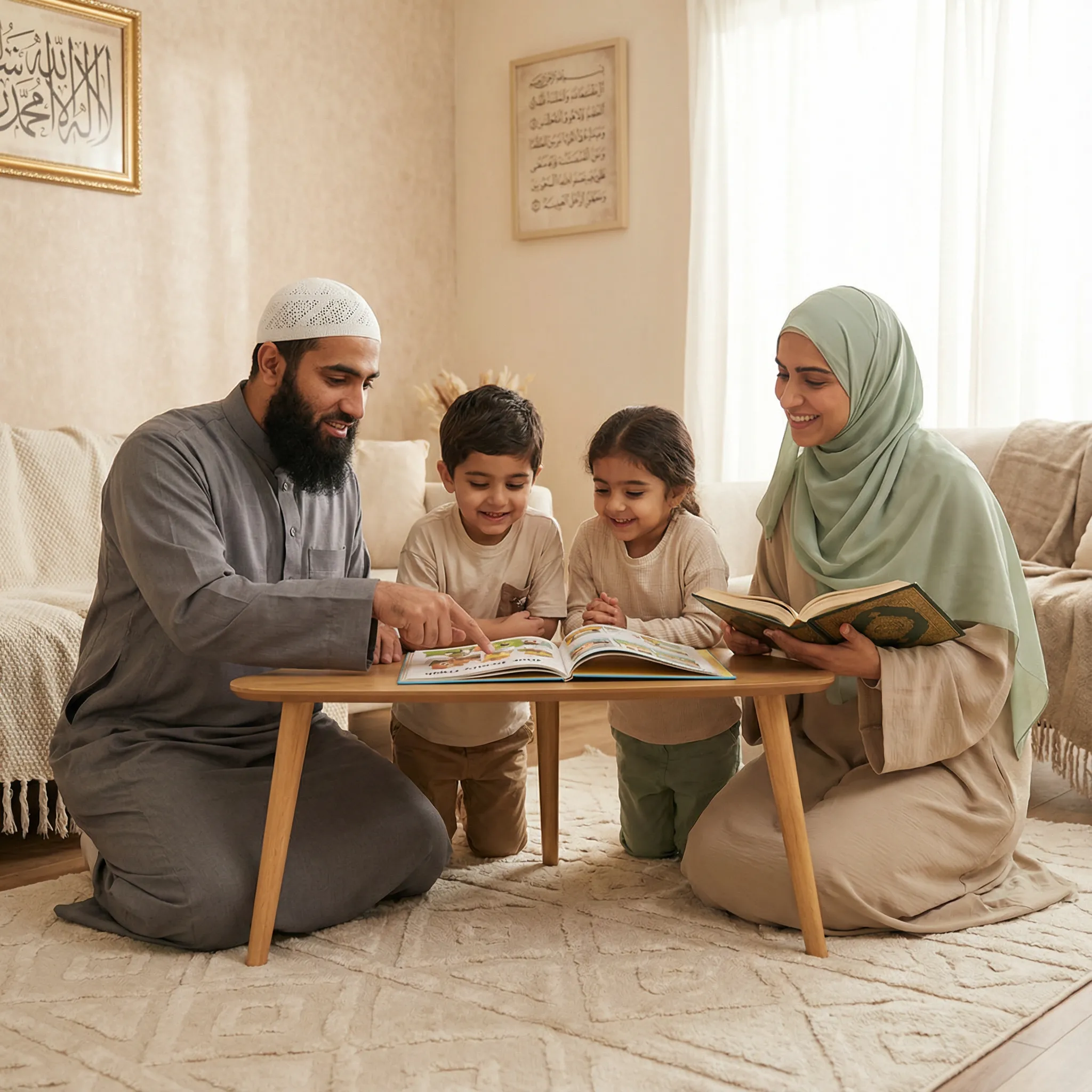
As a Muslim parent living in the West, you’ve probably felt that familiar knot in your stomach. You want your children to understand their faith deeply—to know not just what to do, but why Islam guides us the way it does. Yet between busy schedules, limited resources, and the fear that you might not explain things correctly, teaching fiqh for kids can feel overwhelming. You’re not alone. Thousands of parents across the USA, Canada, UK, and Australia share this exact struggle.
But here’s the beautiful truth: Teaching fiqh for kids doesn’t require you to be a scholar. With the right approach—one that breaks complex concepts into small, digestible pieces—you can raise children who understand and love practicing their faith. This comprehensive guide will show you exactly how. For more on Islamic Education for Children, explore our dedicated resources.
“O you who believe! Protect yourselves and your families from a Fire…”
— Surah At-Tahrim (66:6)
This verse reminds us that Islamic education isn’t optional—it’s our sacred responsibility as parents.
What is Fiqh for Kids? A Simple Explanation
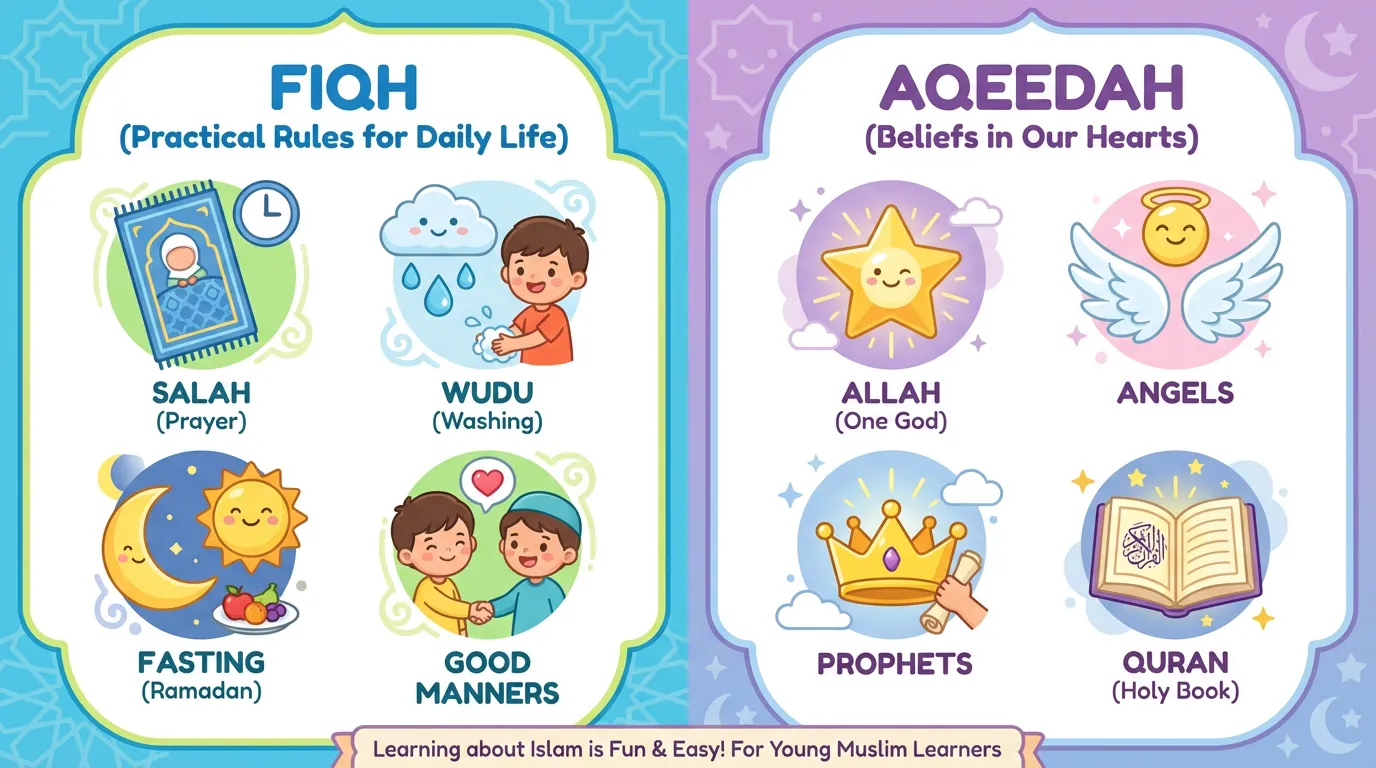
Fiqh for kids is the simplified teaching of Islamic jurisprudence designed specifically for children. It covers the practical rules of worship including prayer (salah), purification (wudu), fasting (sawm), and daily Islamic etiquette—all presented in age-appropriate, engaging ways that help young Muslims understand and practice their faith confidently.
Fiqh vs. Aqeedah: What’s the Difference?
Understanding the distinction between fiqh and aqeedah is essential for any Islamic education journey. Aqeedah refers to what we believe—the core tenets of our faith and creed. Fiqh, on the other hand, teaches how we practice—the actions and rules that guide our daily worship. Both are essential components for raising well-rounded Muslim children. Learn more about How to Teach Salah to Kids.
Fiqh for kids focuses on practical application—teaching children not just to memorize rules, but to understand the wisdom (hikmah) behind Islamic practices. When children grasp the “why” behind each action, they develop a deeper connection to their faith.
“Teach your children to pray when they are seven years old, and discipline them for it when they are ten.”
— Sunan Abu Dawud 495 (Graded Sahih)
Why Your Child Needs Fiqh for Kids Education Early

Early fiqh education builds a strong Islamic identity, creates lifelong worship habits, and gives children the confidence to practice Islam anywhere in the world. Research shows that religious habits formed before age 10 are most likely to continue into adulthood. Discover the Benefits of Early Islamic Education.
5 Powerful Benefits of Teaching Fiqh for Kids Early
1. Builds Unshakeable Islamic Identity
Children who learn fiqh early develop genuine pride in their Muslim identity. This creates natural confidence when navigating diverse environments, from school to social gatherings. They don’t feel different—they feel special.
2. Forms Lifelong Worship Habits
Habits formed during childhood become automatic behaviors in adulthood. When children learn salah for kids early, prayer transforms from a chore into a comfort—a natural part of their daily rhythm.
3. Develops Strong Moral Reasoning
Understanding the “why” behind Islamic rules builds character. Children learn to make halal choices independently, not because they’re told to, but because they understand the wisdom behind Allah’s guidance.
4. Strengthens Family Bonds
Shared worship creates beautiful memories that last a lifetime. Parents and children learning together—whether practicing wudu for kids or praying side by side—builds connections that transcend typical family activities.
5. Prepares for Real-World Challenges
Children equipped with fiqh knowledge can explain their faith confidently to curious classmates. They’re prepared to handle questions about prayer, fasting, and dietary restrictions with grace and certainty.
“And We have certainly made the Quran easy for remembrance, so is there any who will remember?”
— Surah Al-Qamar (54:17)
The 5 Core Topics Every Fiqh for Kids Curriculum Must Cover
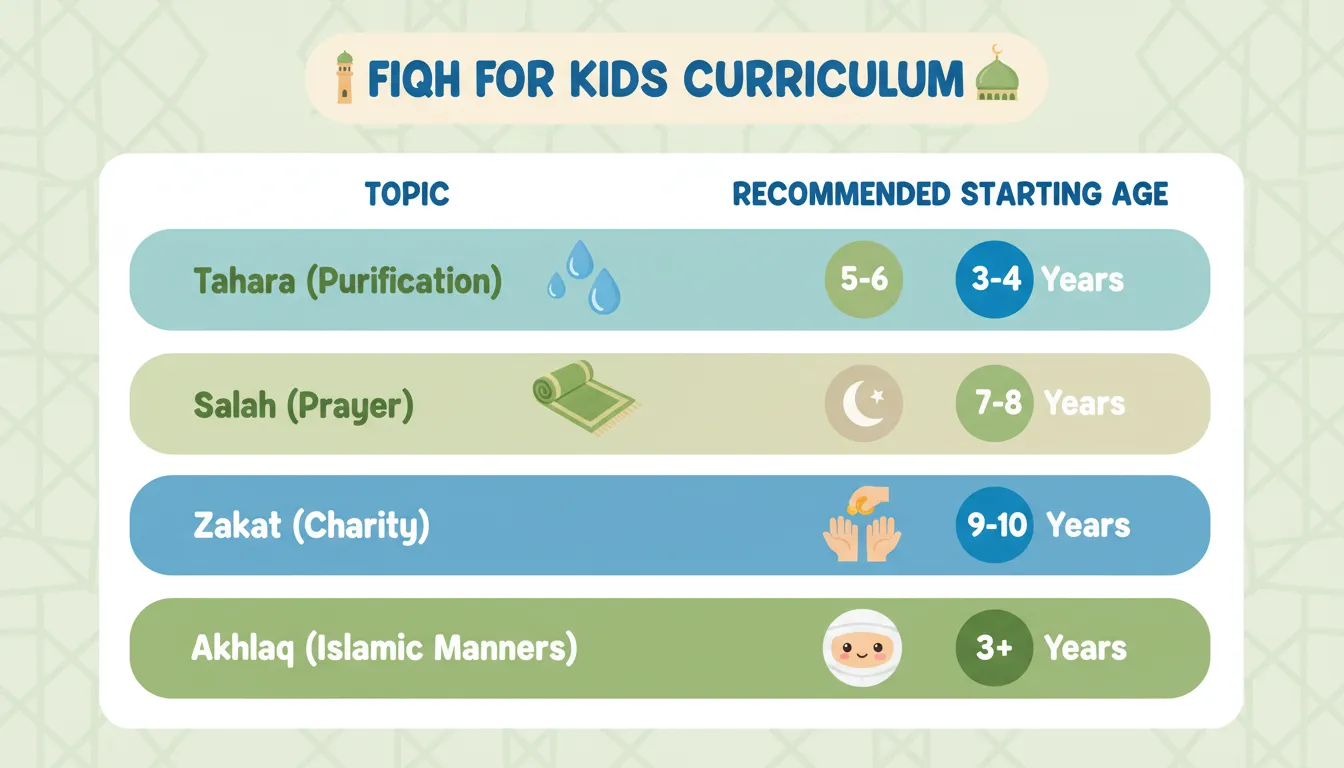
A complete fiqh for kids curriculum covers five essential areas: Tahara (purification and wudu), Salah (the five daily prayers), Sawm (fasting basics), Zakat (charity and sharing), and Akhlaq (Islamic manners and ethics). For a detailed overview, see our Complete Fiqh Curriculum for Children.
Why This Order Matters
At Quran Book Academy, we follow the natural developmental stages of children when teaching fiqh to children. We don’t teach fasting details to a 5-year-old, just as we don’t delay teaching basic manners until age 10. Each topic builds upon the previous one, creating a solid foundation of Islamic knowledge that grows with your child.
“Every one of you is a shepherd and is responsible for his flock.”
— Sahih al-Bukhari 7138
7 Powerful Methods to Teach Fiqh for Kids (The Academy Method)
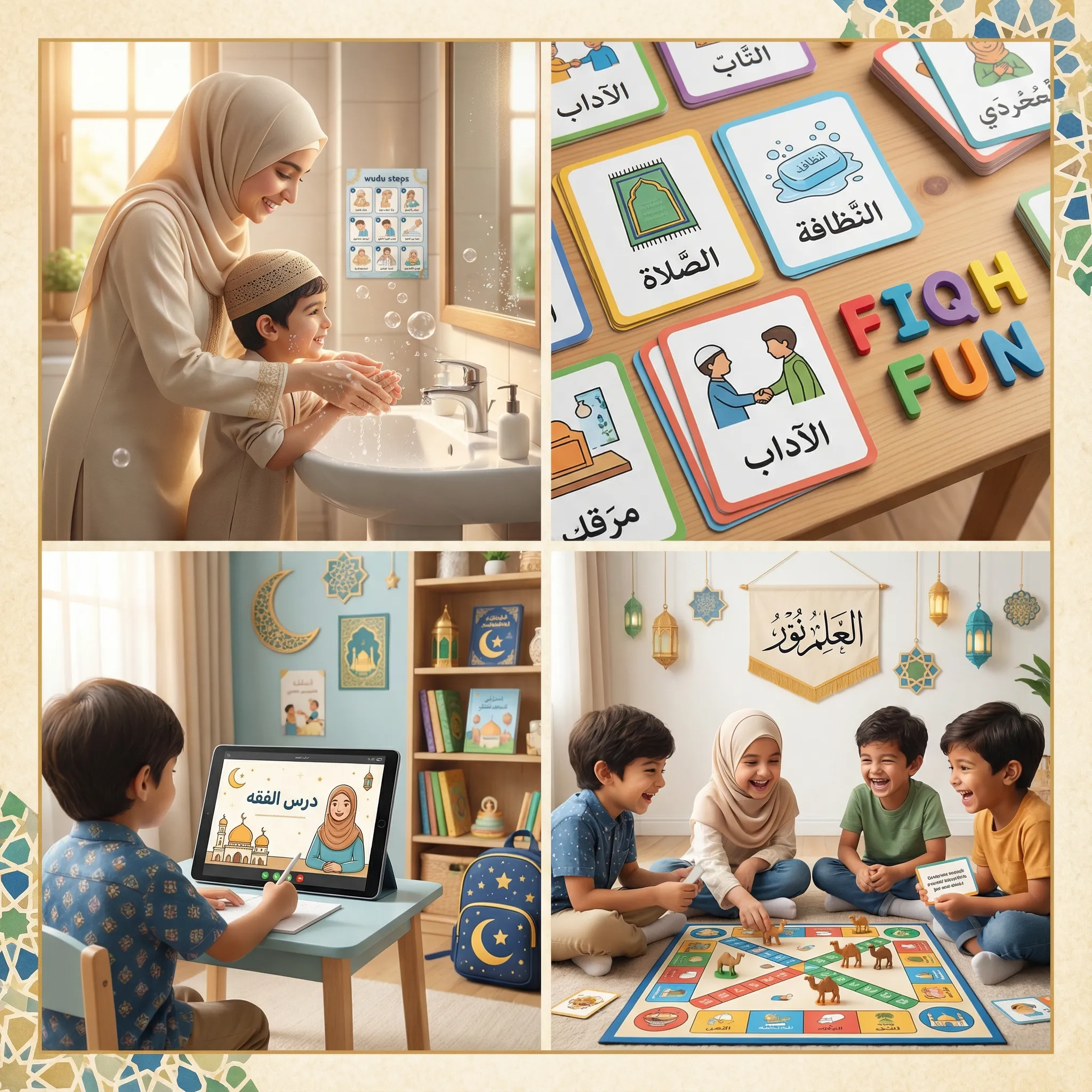
The most effective methods to teach fiqh for kids include storytelling with Prophetic examples, hands-on practice, visual learning aids, age-appropriate games, consistent daily routines, positive reinforcement, and breaking complex concepts into small psychological “chunks.”
The Academy Method: Our Proven Teaching Approach
At Quran Book Academy, we’ve developed what we call “The Academy Method”—a teaching approach built on educational psychology and traditional Islamic pedagogy. The core principle is simple but powerful: we break down every complex Arabic and Quranic concept into small, manageable psychological “chunks.”
This isn’t just a teaching preference—it’s backed by cognitive science. Research shows that the human brain can only process 4-7 new pieces of information at once (Miller’s Law). When we try to teach children everything about wudu in one session, we overwhelm their cognitive capacity, leading to frustration and forgetting.
Every lesson is delivered through live Zoom sessions where your child interacts directly with their teacher. Progress is tracked through our custom Learning Management System (LMS), and parents receive detailed Gmail reports showing exactly what was covered, what was mastered, and what needs more practice at home.
The 7 Methods in Detail
Storytelling with Prophetic Examples
Children remember stories far better than abstract rules. Use stories of Prophet Muhammad ﷺ and the Companions to bring fiqh concepts to life. When teaching about honesty, share stories of the Prophet’s truthfulness. For charity, tell stories of Abu Bakr’s generosity.
Hands-On Practice (Learn by Doing)
The best way to teach wudu for kids is to practice together at the sink. Pray side-by-side with your child. Physical practice creates muscle memory that lasts a lifetime.
Visual Learning Aids
Colorful posters, illustrated books, and video demonstrations help visual learners grasp concepts quickly. Our Academy provides printable resources that parents can use at home.
Age-Appropriate Games
Wudu sequence matching games, prayer position flashcards, and Islamic trivia make learning enjoyable. When fiqh for kids feels like play, children engage naturally.
Consistent Daily Routines
Schedule the same time each day for Islamic learning. Short 10-15 minute sessions are more effective than occasional long sessions. Consistency builds habits.
Positive Reinforcement
Celebrate small wins enthusiastically. Never shame mistakes—they’re part of learning. A child who feels successful wants to continue learning.
Psychological Chunking (The Academy Method)
Teach one concept at a time. Master each step before moving forward. This science-backed approach ensures deep understanding rather than surface memorization.
“Make things easy and do not make them difficult. Give good news and do not drive people away.”
— Sahih al-Bukhari 6125
Common Challenges Parents Face Teaching Fiqh for Kids (And How We Solve Them)

The biggest challenges parents face when teaching fiqh for kids include lack of time, feeling unqualified, children losing interest, and not knowing where to start. Professional Islamic education programs solve these by providing structured curricula, qualified teachers, and engaging methods.
If you’ve felt any of these challenges, please know—you’re not failing as a parent. You’re doing the most important thing: seeking solutions. And that’s exactly what good Muslim parents do.
How Quran Book Academy Teaches Fiqh for Kids Online
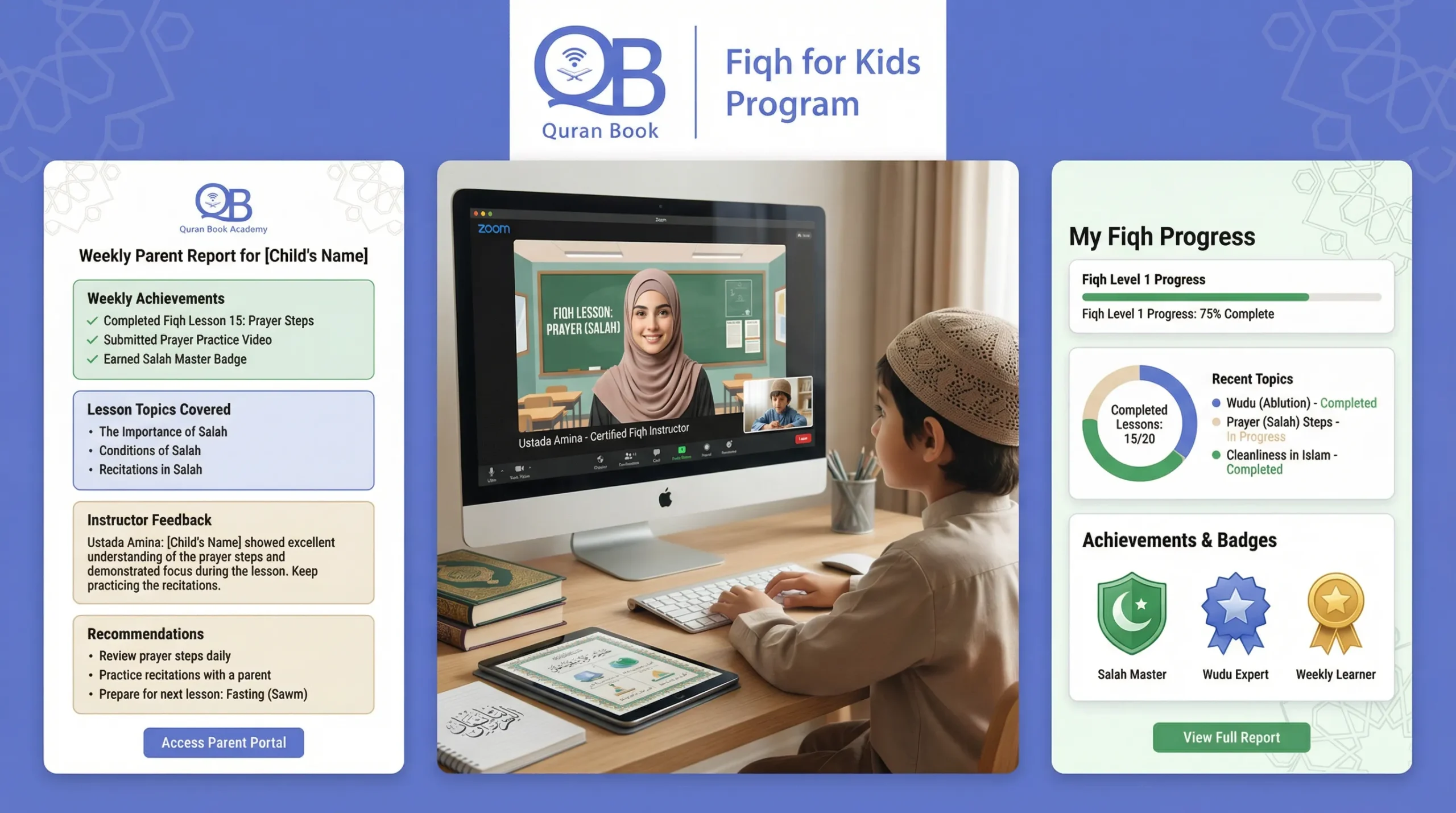
Quran Book Academy teaches fiqh for kids online through live one-on-one Zoom sessions with certified instructors, using our proven “Academy Method” of psychological chunking. Progress is tracked via our custom LMS, and parents receive regular Gmail reports detailing their child’s achievements.
Our Complete Fiqh for Kids Program Includes:
Live 1-on-1 Zoom Sessions
Personal attention for your child with flexible scheduling (24/7 availability) and native English-speaking instructors.
Structured Curriculum
Age-appropriate lesson plans following the Tahara → Salah → Sawm → Zakat → Akhlaq progression, with visual aids and printable worksheets.
Custom LMS Tracking
Monitor your child’s progress anytime. See completed lessons, upcoming topics, and mastery levels at a glance.
Regular Parent Reports
Weekly Gmail updates with detailed session summaries and home practice recommendations.
★ Over 2,000 families across the USA, Canada, UK, and Australia trust Quran Book Academy for their children’s Islamic education. ★
Age-by-Age Fiqh for Kids Learning Milestones
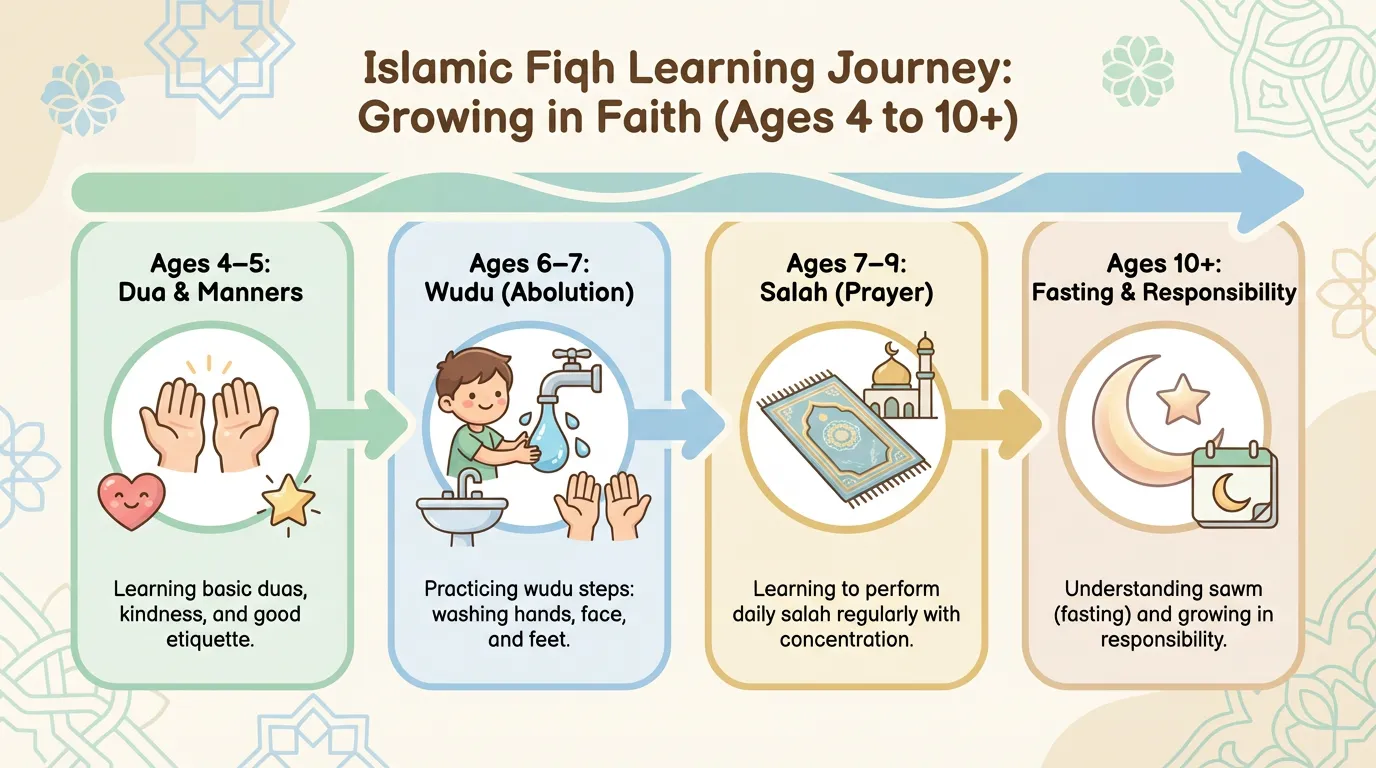
Fiqh education milestones vary by age: ages 4-5 focus on basic Islamic manners and duas, ages 6-7 introduce wudu and prayer awareness, ages 7-9 teach full salah performance, and ages 10+ cover fasting, zakat concepts, and deeper fiqh understanding.
Basic duas (eating, sleeping, bathroom), Islamic manners (salam, bismillah), simple stories of prophets
Complete wudu independently, begin learning salah movements, short surahs for prayer
Perform 5 daily prayers (with reminders), understand prayer times, introduction to Ramadan fasting (partial)
Full salah without assistance, complete Ramadan fasting, zakat and charity concepts, deeper fiqh understanding
“Command your children to pray when they become seven years old, and discipline them for it when they become ten years old.”
— Sunan Abu Dawud 495
Free Resources to Start Teaching Fiqh for Kids Today
Start teaching fiqh for kids today with free resources including printable wudu step posters, salah position flashcards, Islamic manners charts, and video tutorials available through Quran Book Academy and our Telegram community channel.
📥 Free Downloads
📱 Join Our Free Community
- ● Telegram Channel for daily Quran practice
- ● Live Q&A sessions with instructors
- ● Parent support community
🎥 Free Video Resources
Frequently Asked Questions About Fiqh for Kids
Start Your Child’s Fiqh Journey Today — Free Trial Lesson
Your child deserves an Islamic education that builds their confidence, strengthens their connection to Allah, and prepares them for life as a practicing Muslim—no matter where in the world they live.
Here’s what happens when you book your FREE trial:
- ✓ Meet your child’s dedicated instructor via Zoom
- ✓ Experience our Academy Method firsthand
- ✓ Receive a personalized learning assessment
- ✓ Get a custom curriculum recommendation
- ✓ No obligation—just see if we’re the right fit
Don’t let another day pass wondering if you’re doing enough. Give your child the gift of understanding their beautiful faith.
📚 BOOK YOUR FREE TRIAL LESSON NOW“And whoever is guided is only guided for [the benefit of] himself.”
— Surah Al-Isra (17:15)
References & Sources
Quranic References:
- 1. Surah At-Tahrim (66:6) — On protecting families from the Fire
- 2. Surah Al-Qamar (54:17) — On the ease of remembering the Quran
- 3. Surah Al-Isra (17:15) — On guidance benefiting oneself
Hadith References:
- 4. Sunan Abu Dawud 495 — On teaching children to pray at age seven
- 5. Sahih al-Bukhari 7138 — On everyone being a shepherd responsible for their flock
- 6. Sahih al-Bukhari 6125 — On making things easy and giving good news
Educational Resources:
- 7. Miller, G.A. (1956). “The Magical Number Seven, Plus or Minus Two” — Cognitive psychology research on chunking
- 8. Quran Book Academy YouTube Channel — Video tutorials and demonstrations
- 9. Quran Book Academy Telegram Community — Daily Quran practice resources