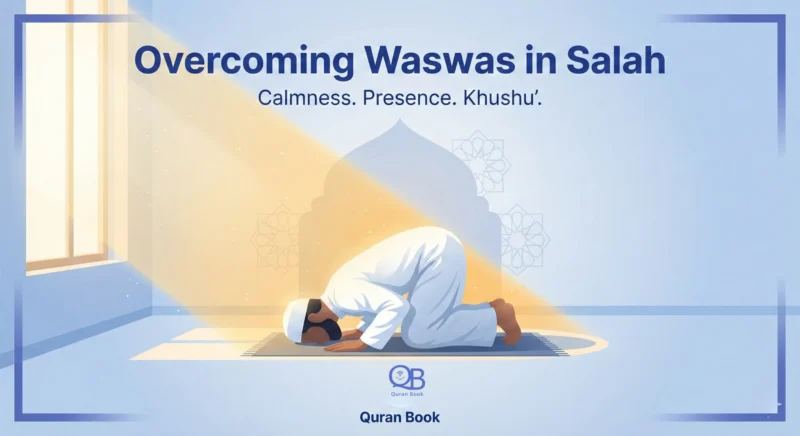
A Muslim in prayer — finding focus and overcoming waswas in salah through faith and knowledge.
Introduction
If you’ve ever stood in salah and felt your mind race with random thoughts, doubts about your wudu, or confusion about how many rakat you’ve prayed — you’re not alone. Waswas in salah is one of the most common spiritual struggles Muslims face worldwide.
The guilt, the frustration, the quiet fear that your prayer “doesn’t count” — these feelings are painfully real. But here’s what many people don’t realize: the Prophet ﷺ himself was asked about this very problem, and he gave direct, practical solutions.
This guide shares 7 actionable, Quran-and-Sunnah-based methods to overcome waswas in salah, build khushu, and reclaim your focus in prayer — starting today.
❝
“Indeed, prayer prohibits immorality and wrongdoing.”
If your salah feels like a battlefield instead of a sanctuary, keep reading. The solution is closer than you think.
What Is Waswas in Salah? Understanding Shaytan’s Whispers
Waswas in salah refers to the intrusive, involuntary whispers and doubts that Shaytan places in a Muslim’s mind during prayer. These can include doubts about wudu, confusion about the number of rakat prayed, or distracting worldly thoughts that pull you away from connecting with Allah. In Arabic, the word “waswasa” (from the root و-س-و-س) literally means repeated whispering.
Allah Himself describes Shaytan’s nature in Surah An-Nas (114:4–6), calling him “al-waswas” — the persistent whisperer who retreats when you remember Allah and returns when you become heedless.
Here is the most reassuring part: the Prophet ﷺ said that experiencing waswas and hating it is actually a sign of sincere faith (Sahih Muslim 132). The fact that these whispers disturb you proves that your heart rejects them — and that is iman in action.
Does Allah Forgive Waswas? What Islam Really Teaches
Yes, Allah forgives waswas. Intrusive thoughts and whispers from Shaytan are not sinful as long as a Muslim does not act upon them or speak them aloud. The Prophet ﷺ confirmed this clearly: Allah has pardoned His ummah for the thoughts that cross their minds, so long as they do not act on them or verbalize them (Sahih al-Bukhari 5269).
This is an incredibly important point for anyone struggling with distraction in salah. Waswas is a test from Allah — not a punishment. The very fact that it distresses you is living proof of your iman. Allah, in His infinite mercy, does not hold you accountable for what Shaytan throws into your mind. What matters is how you respond — and this guide is here to help you respond the right way.
Actionable Methods
7 Proven Ways to Get Rid of Waswas in Salah
This is the section you’ve been waiting for. Whether you’re searching for how to get rid of waswas in salah or how to stop waswas in salah, these seven methods are rooted in authentic Islamic sources and practical psychology.
1
Seek Refuge in Allah (Say A’udhu Billah)
The Prophet ﷺ gave a direct prescription for this. When a companion complained about experiencing waswas during prayer, the Prophet ﷺ instructed him to say “A’udhu Billahi min ash-Shaytan ir-Rajeem” and to spit dryly to his left three times. The companion did so, and the waswas left him (Sahih Muslim 2203).
This is not just a ritual — it is a spiritual weapon. The moment you feel the whispers creeping in, turn to Allah immediately. Shaytan’s power is built on your attention; when you redirect that attention to Allah, the whispers lose their grip.
2
Learn the Meaning of What You Recite
One of the biggest reasons for distraction in salah is not understanding the Arabic words being recited. When you pray without comprehension, your mind has nothing to anchor itself to — and Shaytan exploits that vacuum.
When you understand the meaning of Al-Fatiha, your Tashahhud, and your dhikr, your mind naturally stays engaged. The words stop being sounds and start becoming a real conversation with your Creator. This single change can transform your entire prayer experience and help you build khushu in salah.
3
Focus Your Gaze on the Place of Sujood
Scholars recommend fixing your eyes on the exact spot where your forehead will touch during prostration. This simple physical anchor reduces wandering thoughts significantly.
Your body and your mind are deeply connected. When your eyes wander, your thoughts follow. But when you discipline your gaze, your attention stabilizes. This is one of the easiest and most immediate ways to how to focus in salah — no preparation needed, just conscious effort from the very first takbeer.
4
Prepare Before You Pray
Complete your wudu calmly and deliberately. Choose a quiet, clean space. Remove your phone from the room — or at least put it on silent and out of sight. Take a few seconds to set your intention before raising your hands for takbeer.
Mental preparation before salah significantly reduces waswas in salah and wudu doubts. Many people rush into prayer directly from a busy task, and then wonder why their mind is still racing. Treat the moments before salah as a transition — a conscious shift from dunya to the presence of Allah.
5
Ignore the Doubt — Do Not Repeat Your Prayer
This is one of the most critical pieces of advice Islamic scholars unanimously agree on: do not restart your salah because of waswas. If you doubt how many rakat you prayed, build on the lesser number (the one you are certain of) and perform sujood as-sahw (the prostration of forgetfulness) at the end.
“If one of you is unsure during his prayer and does not know how many he has prayed — three or four — let him cast aside the doubt and proceed on what he is sure of.”
Repeating salah feeds the cycle of waswas. Ignoring it starves it. Every time you choose to continue despite the doubt, you weaken Shaytan’s hold over you.
6
Make Consistent Dhikr Outside of Salah
Regular morning and evening adhkar create a powerful spiritual shield around your heart and mind. The more you remember Allah throughout your day, the easier it becomes to focus in salah.
Think of dhikr as spiritual training. Athletes don’t just perform on game day — they train daily. Similarly, your ability to concentrate in salah is directly connected to how often you engage with Allah’s remembrance outside of prayer. Ayat al-Kursi before sleep, the morning adhkar after Fajr, and istighfar throughout the day all build a foundation that Shaytan finds much harder to penetrate.
7
Study Tajweed and Quran to Deepen Your Connection
When your relationship with the Quran is active and growing, your salah transforms. Learning proper recitation with tajweed engages your mind, tongue, and heart simultaneously — leaving no room for Shaytan’s whispers.
This is not just about pronunciation. Tajweed forces you to pay attention to every letter, every elongation, every pause. It turns recitation into an act of deep concentration. And when that level of engagement carries into your salah, waswas in salah simply cannot survive.
Academy Spotlight
The Academy Method: How Quran Book Academy Helps You Build Khushu
Quran Book Academy — live online Tajweed classes with certified teachers, building khushu one lesson at a time.
At Quran Book Academy, the approach to Quran education is built on a psychology-informed, chunk-based learning method. Each lesson is designed around manageable, focused segments that prevent cognitive overload — especially for non-Arabic speakers and beginners. This directly combats the root cause of waswas in salah: a lack of understanding and confidence in what you’re reciting.
Here is what makes the Academy Method different. Students attend live Zoom sessions with certified teachers who provide real-time correction — not pre-recorded videos where mistakes go unnoticed. A custom Learning Management System (LMS) tracks each student’s progress lesson by lesson, ensuring nothing is skipped or rushed. Parents and students receive weekly Gmail progress reports showing exactly where improvement is happening.
Whether you’re an adult returning to the Quran after years away, a parent enrolling your child in their first Islamic studies course, or a teenager preparing for confident recitation — Quran Book Academy has structured courses designed for every level: Islamic Courses for Kids, Islamic Courses for Adults, and comprehensive Online Quran Classes.
Join the Telegram channel for daily Quran recitation practice with Tajweed and become part of a growing community of learners.
Waswas in Salah vs. Genuine Mistakes: Know the Difference
Understanding the difference between waswas and a genuine mistake is essential. Here is a clear breakdown:
Factor
Waswas (Shaytan’s Whispers)
Genuine Mistake
Nature
Repetitive, irrational doubt
Occasional, clear error
Solution
Ignore and continue
Perform Sujood As-Sahw
Frequency
Happens almost every prayer
Happens rarely
Feeling
Anxiety, obsessive loop
Simple forgetfulness
Islamic Ruling
Not sinful — do not repeat salah
Corrected with prostration
If your doubts follow a pattern of anxiety and repetition, that is waswas. If you genuinely made a clear, one-time error (like forgetting to recite Al-Fatiha), that is a mistake corrected by sujood as-sahw.
Common Questions
FAQ — Waswas in Salah
Can I ignore waswas in salah?
Yes, Islamic scholars advise that the best response to waswas is to completely ignore it and continue your prayer. The Prophet ﷺ specifically instructed this approach. Paying attention to waswas only strengthens it. The key is to keep praying, keep reciting, and refuse to engage with the doubt.
Does waswas break wudu?
No, waswas does not break wudu. Doubt caused by Shaytan’s whispers is not a valid reason to repeat wudu. Your wudu remains valid unless you are certain it was broken through a known, specific cause — such as passing gas or using the restroom. If you are merely unsure, continue with your prayer.
How do I deal with waswas about the number of rakat?
If you are unsure whether you prayed 3 or 4 rakat, proceed based on the number you are certain of (the lower number), then perform sujood as-sahw at the end of your prayer. This is the clear guidance of the Prophet ﷺ, and it prevents the obsessive cycle of forgetting rakat in salah from taking over.
What does waswasa mean in Islam?
Waswasa means the whispering or insinuating thoughts from Shaytan that aim to create doubt and confusion in a Muslim’s worship, particularly during prayer and wudu. The word comes from the Arabic root و-س-و-س and is used in the Quran in Surah An-Nas to describe Shaytan’s primary tactic.
How can I get khushu in salah?
Khushu in salah comes from understanding what you recite, preparing mentally before salah, learning tajweed, and building a daily relationship with the Quran. It is not a switch you flip — it is a skill you build through consistent effort. Enrolling in a structured Quran course like those offered by Quran Book Academy accelerates this process dramatically.
Take the First Step: Your Free Trial Lesson at Quran Book Academy
Start your journey — book a free trial lesson with Quran Book Academy and experience the difference khushu makes.
Waswas in salah often begins with a lack of understanding of what you’re reciting. When you learn to read and understand the Quran with proper tajweed, your salah becomes a conversation with Allah — not a battle with Shaytan.
At Quran Book Academy, certified teachers guide beginners and children through personalized, live Zoom sessions — tracked through a custom LMS with weekly Gmail progress reports sent directly to you.
👉 Book Your Free Trial Lesson Now
Experience the difference khushu makes in your salah.
Rooted in authentic Hadith · Written with compassion for every Muslim sister
By Quran Book Academy
Introduction — Why Ghusl for Women Feels Overwhelming (But Shouldn’t)
A comprehensive guide to ghusl for women — purification rooted in the Sunnah of the Prophet (ﷺ)
Ghusl for women is one of the most frequently searched yet least confidently understood topics among Muslim sisters around the world. If you have ever stood under running water thinking, “Am I doing this correctly? Will my prayer even count?” — know that you are not alone, and there is absolutely no shame in seeking clarity.
The truth is, many women grow up without clear, compassionate guidance on how to make ghusl for women properly. That gap in knowledge can create unnecessary anxiety around worship. This guide exists to close that gap once and for all.
Over the next few sections, you will learn the exact ghusl steps for women rooted in authentic Hadith, discover when ghusl becomes obligatory, and build the confidence to stand before Allah (SWT) knowing your purification is sound. Whether you are a revert finding your footing, a teenager learning for the first time, or a busy mother seeking a reliable refresher — consider this your trusted resource.
What Is Ghusl? Understanding the Importance of Purification in Islam
Ghusl is the full-body ritual bath that Islam requires to remove major ritual impurity, known in Arabic as hadath akbar. It is far more than an ordinary shower — ghusl for women demands a sincere intention (niyyah) in the heart and the assurance that water touches every single part of the body without exception.
Without a valid ghusl, a Muslim woman cannot perform Salah, recite the Quran directly from the mushaf, or make Tawaf around the Ka’bah. The stakes are real, which is why understanding this act of worship matters so deeply.
Allah (SWT) reminds us in the Quran:
“Indeed, Allah loves those who are constantly repentant and those who purify themselves.”
— Surah Al-Baqarah 2:222
The importance of purification in Islam extends beyond the physical. It is a spiritual reset — a deliberate act of renewing your relationship with your Creator. The Prophet Muhammad (ﷺ) reinforced this beautifully when he said:
“Cleanliness is half of faith.”
— Sahih Muslim 223
When you internalize this meaning, ghusl transforms from a routine task into a rewarding act of worship. Every drop of water carries the potential for ajr (divine reward).
When Is Ghusl Required for a Woman? (5 Obligatory Situations)
Understanding exactly when is ghusl required for a woman eliminates guesswork and protects the validity of your worship. Ghusl becomes fard (obligatory) in the following five situations:
1. After Menstruation (Hayd): Once bleeding stops completely, ghusl for women after period must be performed before resuming Salah, fasting, or recitation of the Quran.
2. After Post-Natal Bleeding (Nifas): Following childbirth, a woman must perform ghusl once the post-natal bleeding has fully ceased.
3. After Sexual Intercourse (Janabah): Ghusl is obligatory regardless of whether ejaculation occurred. The Prophet (ﷺ) said: “When the two circumcised parts meet, ghusl becomes obligatory.” — Sahih Muslim 349. Understanding janabah in Islam is essential for every married Muslim woman.
4. After Ejaculation or Sexual Discharge: Whether this occurs during sleep (a wet dream) or while awake, the release of mani (sexual fluid) with desire necessitates ghusl.
5. Upon Accepting Islam: A new Muslim is strongly recommended to perform ghusl as a purifying act upon entering the faith.
Beyond these obligatory situations, ghusl is also recommended (Sunnah) before Friday prayer (Jumu’ah), before the two Eid prayers, and before entering the state of Ihram for Hajj or Umrah.
7 Ghusl Steps for Women — The Complete Sunnah Method
This section answers the core question: how to make ghusl for women the right way. Aisha (RA) narrated the Prophet’s (ﷺ) method in detail, and the steps below follow that authentic Sunnah with additional notes specifically for sisters.
1
Make Your Intention (Niyyah)
Before water touches your body, intend sincerely in your heart to perform ghusl for the removal of major impurity, seeking the pleasure of Allah alone. No verbal declaration is needed — niyyah lives in the heart.
2
Say “Bismillah”
Begin by quietly saying “In the name of Allah” to consecrate the act as one of worship.
3
Wash Your Hands Three Times
Wash both hands thoroughly up to the wrists, ensuring any physical impurities are completely removed before proceeding.
4
Wash the Private Parts
Using the left hand, clean the private areas carefully to remove all traces of impurity or discharge. This step prepares the body for the wudu that follows.
5
Perform Complete Wudu
Perform full ablution exactly as you would for prayer — washing the face, both arms to the elbows, wiping the head, and washing both feet. You may delay washing your feet until the very end if water pools on the bathroom floor.
6
Pour Water Over Your Head Three Times
Ensure water reaches your scalp and penetrates to the roots of your hair. Run your fingers through your hair to guarantee every root is moistened.
Umm Salamah (RA) asked the Prophet (ﷺ): “O Messenger of Allah, I am a woman who braids her hair tightly. Must I undo it for ghusl from janabah?” He replied: “No, it is enough for you to pour three handfuls of water over your head.”
— Sahih Muslim 330
7
Wash the Entire Body
Begin with the right side of your body, then move to the left. Make sure water reaches every concealed area — behind the ears, under the arms, inside the navel, between the toes, and behind the knees. No part of the body should remain dry.
📌 Reference Hadith: Aisha (RA) described the complete method of the Prophet’s (ﷺ) ghusl — Sahih al-Bukhari 248 and Sahih Muslim 316.
Ghusl for Women After Period — Special Considerations
Ghusl for women after period involves a few additional Sunnah practices that set it apart from ghusl performed after janabah. When Asma (RA) asked the Prophet (ﷺ) about bathing after menstruation, he instructed women to use water mixed with lotus leaves (or soap in the modern context), scrub thoroughly, and then apply a cloth scented with musk to the area where blood had been present — Sahih Muslim 332.
There are two key distinctions sisters should be aware of regarding post-menstrual ghusl. First, scholars recommend extra care when washing the hair after menstruation. While undoing braids is not obligatory for ghusl from janabah (as the hadith of Umm Salamah confirms), many scholars advise being more meticulous after the period ends to ensure water fully saturates the scalp and roots.
Second, applying a small piece of cotton or cloth with musk (or a mild fragrance) to the private area after completing ghusl is a Sunnah practice unique to post-menstrual purification. This is what Aisha (RA) quietly explained to Asma (RA) when the Prophet (ﷺ) said “purify yourself with it.”
Once ghusl is properly completed, the woman may immediately resume all acts of worship — including Salah, fasting, Quran recitation, and physical intimacy with her husband.
Fard vs. Sunnah Ghusl for Women — Quick Comparison
Knowing whether your ghusl is fard or Sunnah removes unnecessary anxiety. When in doubt, performing fard ghusl for women using the complete sunnah method of ghusl covers all bases and earns maximum reward.
Aspect
Fard (Obligatory)
Sunnah (Recommended)
When
After period, nifas, janabah, wet dream
Before Jumu’ah, Eid, Hajj/Umrah
Minimum Requirement
Niyyah + water on entire body
Same method as fard ghusl
Prayer Without It
❌ Salah is NOT valid
✅ Salah is valid without it
Hair
Water must reach the roots
Water must reach the roots
Reward
Fulfills the obligation
Earns extra reward
5 Common Mistakes That Invalidate Your Ghusl
Even when you know the correct ghusl steps for women, small oversights can quietly invalidate your entire purification. Avoid these five common errors:
1. Skipping the Intention (Niyyah): Without a conscious intention to perform ghusl for the sake of Allah, the bath is merely a regular shower — not a ritual act of worship. Your Salah would not be valid afterward.
2. Leaving Parts of the Body Dry: The areas most commonly missed include behind the ears, inside the navel, between the toes, and under skin folds. Every square inch of the body must be reached by water.
3. Not Removing Physical Barriers: Nail polish, waterproof makeup, heavy creams, and even some hair products create a seal that blocks water from reaching the skin beneath. These must be fully removed before beginning ghusl.
4. Rushing Through the Hair: Quickly wetting the surface of your hair is not sufficient. Water must reach the scalp and the roots of every strand. Take your time and use your fingers to massage water through thoroughly.
5. Assuming a Regular Shower Counts: Even the longest, most thorough shower in the world is not ghusl unless you made niyyah and consciously ensured full-body water coverage. The intention is what separates worship from hygiene.
The Academy Method — Learn Islamic Purification the Right Way
At Quran Book Academy, we recognize that learning sensitive Islamic topics like ghusl for women requires privacy, patience, and qualified female teachers. That is precisely what our platform delivers.
Our teaching approach is grounded in psychological chunking — we break complex fiqh topics into small, digestible lessons that build confidence gradually. Rather than overwhelming you with marathon lectures, we teach purification, prayer, and Quran recitation in focused 25–30 minute sessions designed to fit seamlessly into your daily routine.
Here is what sets the Academy apart:
Live Zoom Sessions — One-on-one classes with certified female instructors for sisters, creating a completely comfortable and private learning space.
Custom Learning Management System (LMS) — Tracks your progress through every module, so you always know exactly where you stand and what is coming next.
Weekly Gmail Progress Reports — Receive learning milestone updates directly in your inbox to stay motivated and on track.
Courses for All Ages — From Quran memorization with Tajweed to comprehensive fiqh and Islamic studies, our curriculum is thoughtfully designed for non-Arabic speakers in the USA, Canada, UK, and Australia.
We do not simply tell you what to do — we help you understand why, so every act of worship becomes deeply meaningful.
FAQ — Your Ghusl Questions Answered
Q1
How do I perform proper ghusl for women?
Proper ghusl for women involves making niyyah in the heart, saying Bismillah, washing the hands and private parts, performing full wudu, pouring water over the head three times ensuring it reaches the roots, and then washing the entire body starting from the right side then the left — making certain no area remains dry.
Q2
What are the three mandatory requirements for ghusl?
The three fard (obligatory) elements of ghusl are: making the intention (niyyah), rinsing the mouth and nose (according to the majority of scholars), and ensuring water reaches every part of the body including the scalp and all skin surfaces.
Q3
Can I just wash my private parts and count it as ghusl?
No. Washing only the private areas does not constitute a valid ghusl. The ritual requires washing the entire body with the intention of purification. Partial washing qualifies only as istinja (cleaning after using the restroom).
Q4
Does a woman need to perform ghusl if she gets wet?
If a woman experiences sexual discharge (mani) accompanied by desire — whether while awake or during sleep — ghusl becomes obligatory. However, normal vaginal moisture (rutubah) does not require ghusl; it only necessitates fresh wudu.
Q5
How many types of ghusl exist for women?
There are two primary categories: fard ghusl (obligatory — after menstruation, nifas, or janabah) and sunnah ghusl (recommended — before Jumu’ah, Eid, or Hajj). The washing method is identical for both; only the Islamic ruling differs.
Q6
Can a husband assist his wife with ghusl?
Yes. Spouses may help each other with ghusl. Aisha (RA) narrated that she and the Prophet (ﷺ) used to bathe from the same vessel — Sahih al-Bukhari 250.
Q7
Does a wife touching her husband break wudu?
This is a recognized point of scholarly difference. The Hanafi school holds that mere touch does not break wudu, while the Shafi’i school considers skin-to-skin contact with the opposite gender to be a nullifier. Follow the position of your trusted scholar or madhhab.
Take the Next Step — Your Free Trial Lesson Awaits
Book a free trial lesson and continue your Islamic learning journey
You have just learned the complete ghusl steps for women — but this is only the beginning of your Islamic learning journey. At Quran Book Academy, we offer personalized, one-on-one online classes for sisters and families who want to deepen their understanding of Islam from the comfort of their own homes.
🎁 Book Your FREE Trial Lesson Today and experience:
✦ A private session with a qualified female instructor
✦ A personalized learning plan tailored to your goals
✦ Immediate access to our LMS so you can track progress from day one
What is wudu — ablution in Islam explanation for beginners
Learning how to make wudu can feel overwhelming when you’re a new Muslim or someone returning to practice — especially if you didn’t grow up learning it as a child. You might worry about doing it wrong, forgetting a step, or feeling embarrassed to ask. You’re not alone; thousands of adult converts and born Muslims across the USA, Canada, UK, and Australia search for this exact guide every single day.
Here’s the truth: wudu is not complicated. It is a simple, beautiful act of purification that Allah made accessible to everyone, regardless of age, background, or experience. The fact that you’re here looking for answers shows sincerity — and that’s what matters most. This guide will walk you through all 8 steps of ablution with complete clarity, including the commonly forgotten step of wiping the ears. Whether you’re a complete beginner or brushing up on your knowledge, Quran Book Academy has helped hundreds of learners just like you build confidence in their worship.
“O you who believe! When you rise for prayer, wash your faces and your hands up to the elbows…”
Wudu (also spelled wudhu or wuḍūʾ) is the Islamic ritual of ablution — a specific washing of the body parts before prayer (salah). The wudu meaning comes from the Arabic root word for cleanliness and radiance. In Islam, wudu is a prerequisite for the five daily prayers and for touching the Quran. It consists of 8 specific washing and wiping steps performed in a set order.
But understanding what is wudu goes beyond just physical washing. Ablution in Islam is a holistic act — it purifies the body and the soul simultaneously. Every time a wudu Muslim washes their hands, face, and feet, they are symbolically shedding minor sins and preparing to stand before their Creator in a state of cleanliness and humility.
It’s important to note that wudu in Islam is classified as the “minor ablution” (al-wudu al-asghar). It is different from ghusl (the major ablution), which involves washing the entire body and is required after specific states such as sexual intercourse or menstruation. For daily prayers, however, wudu is all you need.
Wudu is far more than hygiene. It is a spiritual reset — a moment of mindfulness before you stand in conversation with Allah. Each time you perform wudu, you are transitioning from the noise of daily life into a sacred state of worship. This is why learning how to make wudu properly matters so deeply.
“My ummah will be called on the Day of Resurrection with bright faces and bright hands and feet from the traces of wudu.”
Imagine that — the water you use today for ablution becomes light on your face, hands, and feet on the Day of Judgment. This is the reward Allah has prepared for those who take wudu seriously and perform it with sincerity.
“Indeed, Allah loves those who are constantly repentant and loves those who purify themselves.”
Wudu is your gateway to being among those beloved to Allah. Every drop of water that falls from your limbs during ablution washes away minor sins, as authentic hadith narrations confirm.
Before you begin learning how to perform wudu, make sure you have the following in place:
Niyyah (Intention) — Make the intention in your heart to perform wudu for the sake of Allah. It does not need to be spoken aloud. The intention distinguishes an act of worship from ordinary washing.
Clean Water — The water must be pure (tahir) and not previously used for purification. Tap water, well water, and rain water are all acceptable.
A Clean Space — Preferably a bathroom, ablution area, or any clean place where you can comfortably wash.
Say “Bismillah” — Begin by saying “Bismillah” (In the name of Allah) before starting your wudu. This is a confirmed Sunnah practice.
Without a sincere intention, the physical steps of wudu alone are not sufficient for valid worship. Niyyah is what transforms a routine act of washing into a powerful spiritual practice.
How to Make Wudu Step by Step — The 8 Steps of Ablution ⭐
To make wudu step by step, follow these 8 steps of ablution in order: wash your hands, rinse your mouth, clean your nose, wash your face, wash your arms, wipe your head, wipe your ears, and wash your feet. Each step is performed with the intention of purifying yourself before prayer.
Here is the complete wudu step by step process:
Step 1
Wash Both Hands Up to the Wrists (×3)
Start with the right hand, then the left. Make sure water reaches between the fingers and covers the entire hand up to and including the wrist. This step removes physical impurities and prepares you for the remaining steps of wudu.
Step 2
Rinse the Mouth (×3)
Take water into your mouth with the right hand, swirl it around thoroughly, and spit it out. This is called “madmadah.” Ensure the water reaches all areas inside the mouth, including the gums and between the teeth. Using a miswak (tooth stick) or toothbrush before this step is a recommended Sunnah.
Step 3
Clean the Nose (×3)
Sniff water gently into the nostrils with the right hand and blow it out with the left hand. This is called “istinshaq” (inhaling) and “istinthar” (expelling). Be gentle — there’s no need to inhale water deeply. Just enough to cleanse the inner part of the nostrils.
Step 4
Wash the Entire Face (×3)
Wash from the hairline to the chin, and from ear to ear. Ensure water covers every part of the face, including the eyebrows and the area around the nose. If you have a beard, run wet fingers through it so water reaches the skin beneath. This is one of the most important steps of ablution.
Step 5
Wash Both Arms Up to and Including the Elbows (×3)
Start with the right arm, then the left. Water must run over the elbows completely — do not stop just below the elbow. This is one of the most common mistakes beginners make when learning how to make wudu. Make sure no dry patches remain on the forearms or around the elbow joints.
Step 6
Wipe the Head (×1)
Wet your hands and wipe them from the front of the head (hairline) to the back of the head (nape of the neck), then return them to the front. This step is done only once, not three times. You do not need to drench your hair — a light wipe with wet hands is sufficient.
Step 7
Wipe the Ears (×1)
Immediately after wiping the head, wipe the ears. Insert the tips of your index fingers into the ear openings and use your thumbs to wipe the back of the ears simultaneously. The ears are considered part of the head in Islamic jurisprudence, but they are a distinct step that many beginners forget.
Wash Both Feet Up to and Including the Ankles (×3)
Start with the right foot, then the left. Use your little finger to wash between the toes thoroughly. Make sure water reaches the ankles, the soles of the feet, and the heels.
Understanding the Details: The order of these steps (known as “tartib”) is essential for a valid wudu according to the Shafi’i and Hanbali schools, while the Hanafi school is more lenient on exact ordering. Washing each body part three times is the Sunnah of the Prophet ﷺ, but washing once is the minimum obligation (fard) — so if you only wash once, your wudu is still valid.
The four major schools of Islamic jurisprudence — Hanafi, Shafi’i, Maliki, and Hanbali — all agree on these core obligatory steps of ablution, with minor differences only in the recommended (sunnah) acts surrounding them. Some scholars count the ears as part of the head-wiping step, while others list them separately. We’ve listed them as a separate step here because beginners frequently forget them, and giving the ears their own step ensures nothing is missed.
As a beginner, do not stress about perfection. Allah values your sincerity and consistency far more than flawless technique. Learn the 8 steps of wudu, practice them regularly, and trust that your effort is accepted.
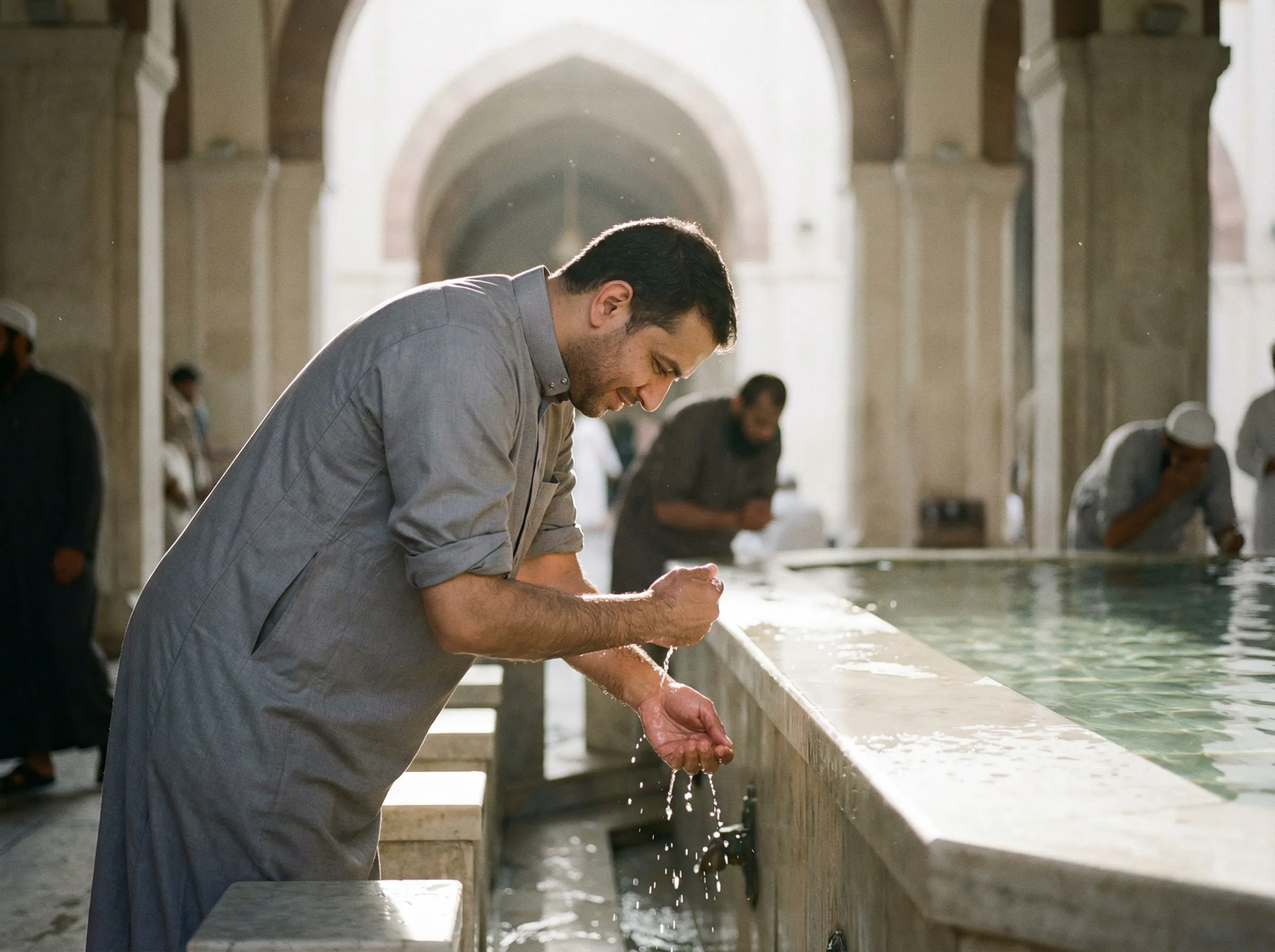
The Prophet ﷺ performed wudu washing each part three times.
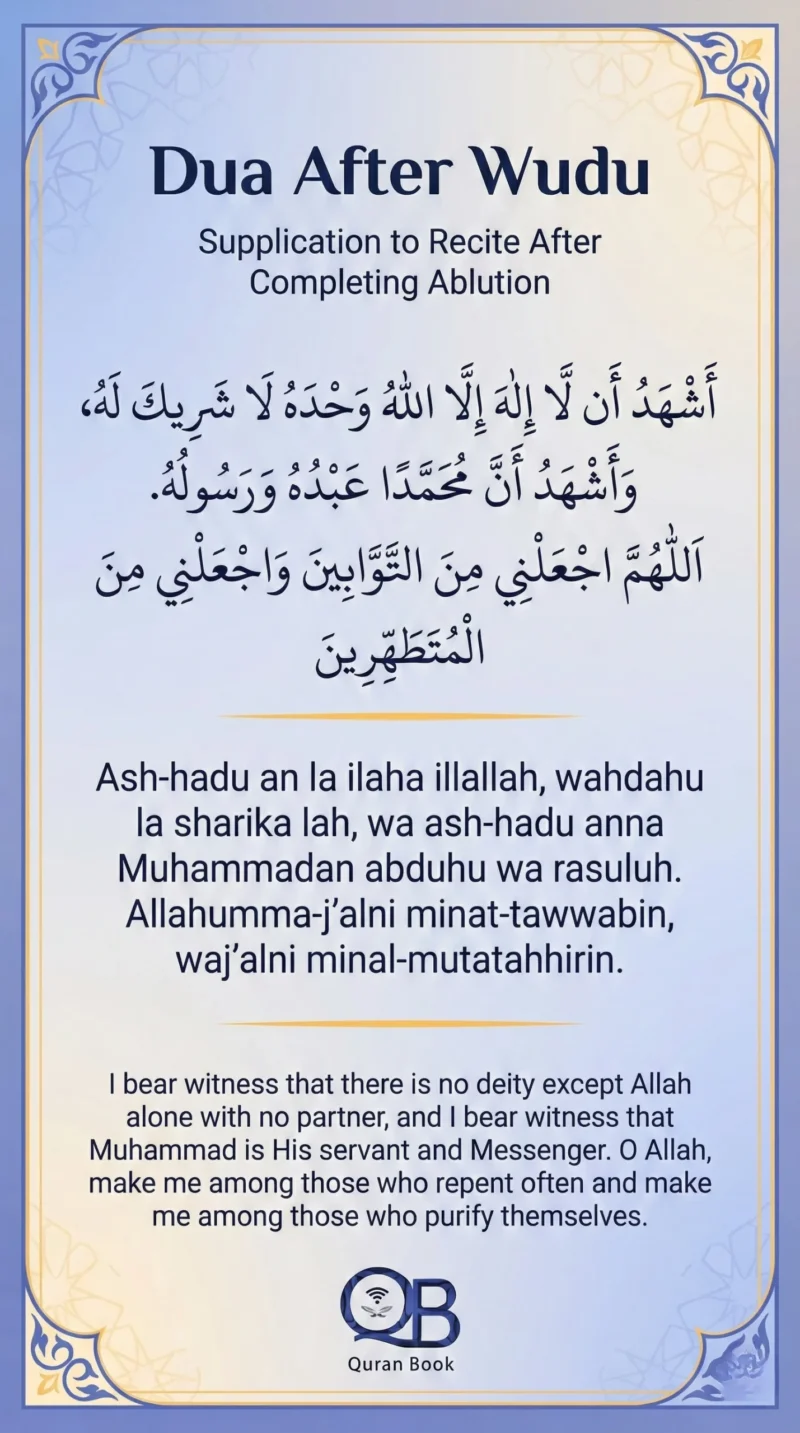
Ash-hadu an la ilaha illallah, wahdahu la sharika lah, wa ash-hadu anna Muhammadan abduhu wa rasuluh. Allahumma-j’alni minat-tawwabin, waj’alni minal-mutatahhirin.
“I bear witness that there is no god but Allah alone, with no partner, and that Muhammad is His servant and messenger. O Allah, make me among those who repent and those who purify themselves.”
“None of you performs wudu and does it perfectly, then says [this dua], except that the eight gates of Paradise are opened for him.”
Making this dua after every wudu is a simple habit that can earn you access to all eight gates of Jannah. Memorize it, practice it, and never skip it.
What Breaks Wudu? 8 Common Mistakes Beginners Make
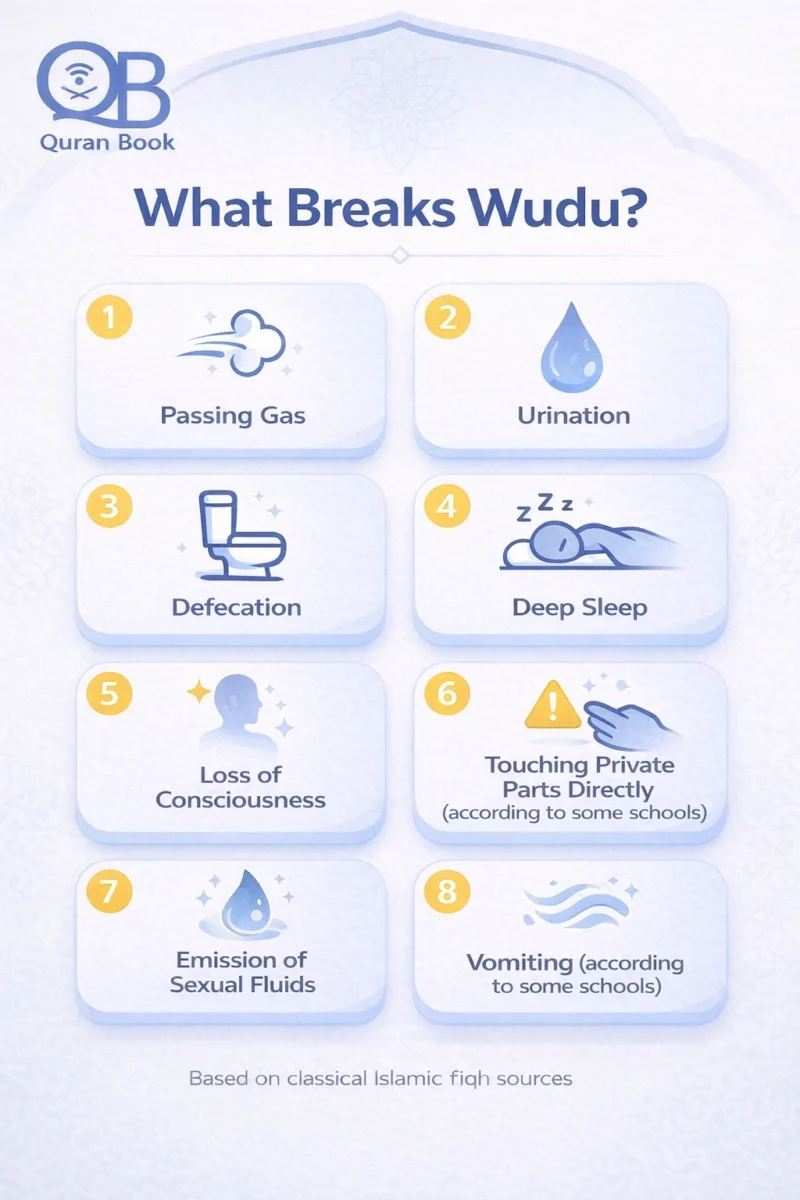
What breaks wudu — 8 common mistakes beginners make in ablution
Wudu is broken (invalidated) by several specific occurrences. If any of these happen after you’ve completed your ablution, you must perform wudu again before praying. Here are the 8 most common nullifiers every beginner should know:
Using the restroom — Any discharge of urine or stool completely invalidates wudu. This is agreed upon by all scholars.
Passing gas (flatulence) — Whether silent or audible, passing wind breaks wudu according to the consensus of Islamic scholars.
Deep sleep — Light dozing while sitting upright may not break wudu according to some scholars, but deep sleep (lying down or leaning heavily) invalidates it because you lose awareness of bodily functions.
Loss of consciousness — Fainting, being under anesthesia, or any state where you lose awareness of your body breaks wudu.
Bleeding or pus discharge — According to the Hanafi school, flowing blood from a wound or pus that spreads beyond the wound site invalidates wudu. The Shafi’i school does not consider this a nullifier.
Vomiting a mouthful — If you vomit an amount that fills your mouth, your wudu is broken according to the Hanafi school.
Touching private parts with the bare hand — The Shafi’i and Hanbali schools hold that direct skin contact with one’s own private parts breaks wudu, based on hadith evidence.
Eating camel meat — Based on an authentic hadith, some scholars (particularly the Hanbali school) hold that consuming camel meat breaks wudu.
Frequently Asked Inline Questions
Does crying invalidate wudu? — No. Crying, whether from sadness, joy, or pain, does not break wudu. There is no evidence in the Quran or Sunnah that tears invalidate ablution.
Does using lotion break wudu? — No, applying lotion does not invalidate wudu. However, ensure it doesn’t create a waterproof barrier that prevents water from reaching the skin during your next wudu.
“Allah does not accept the prayer of anyone who has broken their wudu until they perform wudu again.”
The steps of wudu for women are exactly the same as for men. There is no difference in how women perform ablution in Islam. The only practical consideration is that women do not need to remove their hijab during wudu — they simply wipe over the visible portion of their hair during the head-wiping step (Step 6).
Here are a few additional notes specifically for women learning how to make wudu:
Nail polish: Standard nail polish creates a waterproof barrier that prevents water from reaching the nails. It must be removed before performing wudu for the ablution to be valid. However, “breathable” or “wudu-friendly” nail polish brands claim to allow water penetration — scholars differ on whether these are truly acceptable, so it’s best to err on the side of caution.
Menstruation (Hayd): Wudu is not required during menstruation because women are exempt from prayer during this time. However, this is actually an excellent period to study and memorize the 8 steps of wudu so you’re fully prepared when you resume prayer.
Long sleeves and clothing: When making wudu, ensure that water reaches the skin of your arms up to the elbows. Roll up sleeves fully so that no fabric blocks water flow during washing.
The Academy Method — How Quran Book Academy Teaches Wudu & Islamic Foundations
Quran Book Academy online Quran classes via Zoom — learn wudu and Islamic foundations
At Quran Book Academy, we don’t just hand you a textbook — we walk beside you. Learning how to make wudu is often the first step in a much larger journey of Islamic education, and our Academy Method is designed to make every step feel manageable, supportive, and rewarding.
Live Zoom Sessions: Every student learns through one-on-one or small-group live classes via Zoom with certified teachers from Al-Azhar and other reputable Islamic institutions. You receive real-time correction and real-time encouragement — not just a pre-recorded video.
Custom LMS (Learning Management System): Our proprietary platform tracks every student’s progress — from wudu basics to advanced Tajweed rules. Parents and adult learners receive detailed Gmail progress reports after each session, so you always know exactly where you stand.
Psychological Chunking: We break down Islamic education into small, manageable “chunks” based on educational psychology. Instead of overwhelming a beginner with everything at once, we teach wudu first, then prayer, then short surahs, then Tajweed rules — progressively and at your own pace.
Islamic Courses for Kids & Adults: Whether your child is 5 years old or you’re a 45-year-old revert, our courses adapt to your level, goals, and learning pace. No one is left behind at Quran Book Academy.
As part of this article, we’ve also prepared a free “How to Make Wudu PDF” — a beautifully designed, printable reference card that you can keep near your bathroom mirror for daily use.
Ready to learn with a live teacher? Book your Free Trial Lesson today →
We’ve created a beautifully designed, printable How to Make Wudu PDF that you can download completely free. It includes all 8 steps of ablution with clear illustrations, the dua after wudu in Arabic and transliteration, and a quick-reference checklist of what breaks wudu.
Print it out, stick it near your bathroom mirror, and never second-guess yourself again.
To take wudu step by step, start by saying “Bismillah” and making your intention (niyyah). Then wash your hands three times, rinse your mouth three times, clean your nose three times, wash your face three times, wash your arms to the elbows three times, wipe your head once, wipe your ears once (insert index fingers inside and thumbs behind), and wash your feet to the ankles three times. Always start with the right side before the left.
Can I pray without wudu if I showered?
A regular shower does not count as wudu unless you specifically made the intention (niyyah) for wudu and performed all the required steps in the correct order during the shower. If you intentionally did so, your wudu is valid alongside the shower.
What is the major sin related to wudu?
The major sin related to wudu is being careless or neglectful about it — particularly not ensuring water reaches all required areas. The Prophet ﷺ warned: “Woe to the heels from the Hellfire!” — Sahih al-Bukhari 165, referring to those who leave parts of the feet dry during wudu.
Can I kiss my wife if I have wudu?
This is a matter of scholarly difference. According to the Hanafi school, kissing one’s spouse does not break wudu. The Shafi’i school holds that direct skin-to-skin contact with the opposite gender does break wudu. Follow the school of thought you adhere to, or consult a local scholar for guidance.
Is touching the Quran without wudu a sin?
The majority of scholars hold that one must be in a state of wudu to touch the physical Mushaf (printed Quran). However, reading from a phone app or reciting from memory without wudu is permissible according to most scholars.
Does crying invalidate wudu?
No. Crying — whether from sadness, joy, or pain — does not break wudu. There is no evidence in the Quran or Sunnah that tears invalidate ablution.
What is a full wudu vs. a short wudu?
A full wudu includes all 8 steps with the sunnah (recommended) acts like washing each part three times, using miswak before starting, and saying the dua after completion. A short wudu includes the same 8 obligatory (fard) steps but washing each part only once. Both are completely valid for prayer.
Does using lotion break wudu?
No, using lotion does not break wudu. However, if the lotion creates a waterproof barrier (like certain heavy creams or petroleum-based products), ensure it is washed off before your next wudu so water can properly reach the skin.
Start Your Quran Journey Today — Free Trial Lesson at Quran Book Academy
Quran Book Academy free trial lesson — learn how to make wudu and pray with a live teacher
You’ve just learned how to make wudu — the first step toward a deeper connection with Allah. But why stop here? At Quran Book Academy, our expert teachers will guide you through wudu, prayer, Quran recitation with Tajweed, and full Islamic studies — all from the comfort of your home.
🎓 Book Your FREE Trial Lesson
Join thousands of students across the USA, Canada, UK, and Australia who started exactly where you are today.
One-on-one live session via Zoom with a certified teacher
Personalized assessment of your current level
A customized learning plan tailored to your goals
Access to our LMS dashboard with full progress tracking