5 Engaging Islamic History for Kids Lessons That Inspire Faith & Pride
By Quran Book Academy | Islamic Education Experts
✦ Diverse Muslim children engaged in learning Islamic history together
Introduction
Islamic history for kids opens a window to 1,400 years of inspiring stories, remarkable achievements, and faith-building lessons that every Muslim child deserves to know. These powerful narratives connect children to their heritage while building lasting pride in their identity as Muslims.
As parents, you face a significant challenge today. Your child grows up surrounded by Western history in school, rarely hearing about the scholars, explorers, and leaders who shaped Islamic civilization. Many parents worry their children feel disconnected from their Muslim roots or find history lessons boring and irrelevant to their modern lives.
The truth is that Islamic history for children doesn’t have to be dull memorization of dates and names. When taught correctly, the history of Islam for kids becomes an exciting adventure filled with heroes, discoveries, and miraculous events. At Quran Book Academy’s Islamic Studies Course for Kids, thousands of families across the USA, Canada, UK, and Australia have transformed Islamic education from a chore into an unforgettable journey.
This comprehensive guide shares five essential Islamic history lessons for kids, proven teaching methods, and practical ways to make learning both memorable and meaningful for your child.
What Is Islamic History? A Simple Explanation for Kids
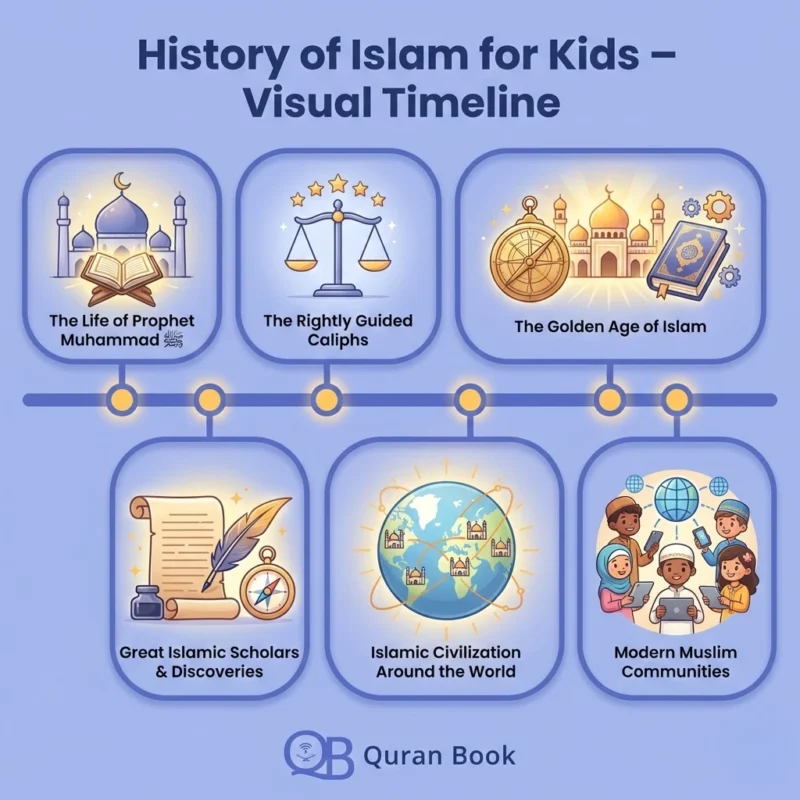
Visual timeline showing key events in Islamic history
Islamic history is the incredible story of how Islam began with Prophet Muhammad ﷺ and grew into a worldwide civilization known for faith, knowledge, and remarkable achievements. For children, understanding this story provides context for their beliefs and practices.
Children benefit from viewing history as a living story rather than memorizing dates. When kids see themselves as part of this continuing narrative, Islamic history becomes personal and relevant.
Three Eras of Islamic History for Kids
Era
Time Period
Key Events
Early Islam
610-661 CE
Prophet Muhammad ﷺ, Divine Revelation, Rashidun Caliphs
This verse inspires children to understand that they belong to an exceptional community with a rich heritage worth knowing and celebrating.
Why Should Kids Learn Islamic History?
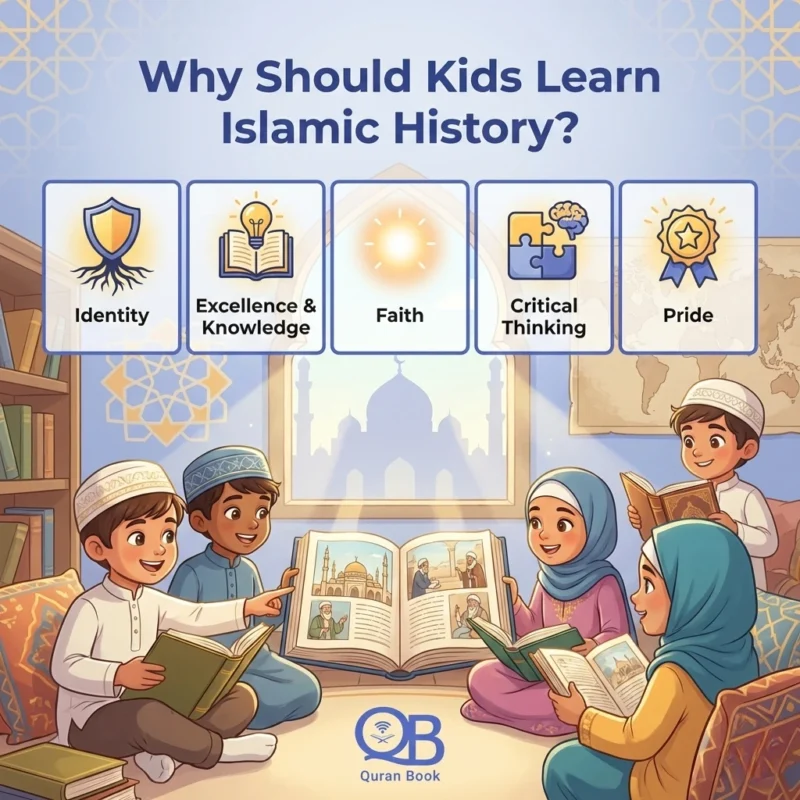
Young Muslim children discovering the wonders of Islamic heritage
Learning Islamic history builds children’s Muslim identity, teaches valuable life lessons, and connects them to a legacy of faith and excellence spanning fourteen centuries. This isn’t just education—it’s identity formation.
5 Powerful Benefits of Teaching History of Islam for Kids
1
Building Muslim Identity
Children understand who they are and where they come from. This foundation creates confidence in diverse environments.
2
Inspiring Excellence
Stories of Muslim scholars like Ibn Sina and Al-Khwarizmi motivate academic achievement. Children learn that intellectual pursuit is part of their heritage.
3
Strengthening Faith
Historical examples demonstrate Allah’s plan unfolding through generations. Kids see how patience and trust in Allah led to success.
4
Developing Critical Thinking
Analyzing historical events builds reasoning skills that benefit children academically and personally.
5
Creating Lasting Pride
Children feel confident about their heritage when they know the achievements of Muslim civilization.
“The best of you are those who learn the Quran and teach it.”
Who Were the First Muslims? The Companions’ Stories
The brave companions who accepted Islam in the early days
The first Muslims were the brave companions who accepted Islam in Makkah, including Khadijah (RA), Abu Bakr (RA), Ali (RA), and Bilal (RA). Each faced tremendous hardship with unwavering faith, providing children with relatable heroes. You can explore more inspiring narratives through our Stories of the Prophets series.
✦
Khadijah (RA) — The First Believer
The Prophet’s ﷺ beloved wife was the first person to accept Islam. Her unwavering support and sacrifice teach children about loyalty, courage, and standing by truth even when facing opposition. She was a successful businesswoman who used her resources to support the early Muslim community.
✦
Bilal (RA) — The Voice of Courage
An enslaved man who endured severe torture for his faith, Bilal (RA) became the first muezzin (caller to prayer). His incredible story teaches children about perseverance, dignity, and the equality that Islam established. When other companions purchased his freedom, he dedicated his life to serving Islam.
✦
The Young Companions
Children like Ali (RA), who accepted Islam at approximately ten years old, demonstrate that age doesn’t limit faith or courage. These young companions proved themselves as devoted Muslims, showing today’s children that they too can make meaningful contributions to their faith community.
The Islamic Golden Age — When Muslims Led the World
The Islamic Golden Age represents one of history’s most remarkable periods of human achievement, spanning roughly five centuries from 750 to 1258 CE. During this extraordinary era, while much of Europe experienced the Dark Ages, the Muslim world blazed with intellectual brilliance.
Muslim scholars translated Greek, Persian, and Indian texts into Arabic, preserving ancient knowledge while making groundbreaking discoveries of their own. Baghdad’s House of Wisdom (Bayt al-Hikmah) functioned as the world’s greatest library and research center, attracting scholars from every corner of the known world regardless of their religious background.
Children learning about this period discover that Muslims invented algebra—the word itself comes from the Arabic “al-jabr.” Muslim scientists developed sophisticated surgical techniques still studied today, mapped the stars with remarkable precision, and created algorithms that power modern computers.
Ibn Sina (Avicenna) wrote medical textbooks used in European universities for over 600 years. Al-Khwarizmi’s mathematical works gave us the word “algorithm.” Muslim architects designed buildings that still inspire awe worldwide, from the Alhambra in Spain to the magnificent mosques of Istanbul and beyond.
This wasn’t merely borrowing from other civilizations—it was an explosion of original creativity driven by the Quranic command to seek knowledge. Understanding this heritage helps children realize that pursuing education and scientific inquiry fulfills a sacred Islamic tradition. Enrolling in our Online Quran Classes can complement historical learning with foundational knowledge.
Muslim Achievements Kids Should Know
Field
Muslim Scholar
Achievement
Mathematics
Al-Khwarizmi
Invented Algebra
Medicine
Ibn Sina
Canon of Medicine
Geography
Al-Idrisi
World Maps
Astronomy
Al-Battani
Star Calculations
Optics
Ibn al-Haytham
Scientific Method
“Seeking knowledge is an obligation upon every Muslim.”
How to Teach Islamic History to Kids: 5 Proven Methods
Teaching Islamic history to kids effectively requires engaging methods that match how children naturally learn—through stories, visuals, activities, and connection to their daily lives. Here are five proven approaches:
📖
Start with Stories
Begin with exciting narratives before introducing dates and facts. Children remember stories long after they forget statistics.
🗺️
Use Visual Aids
Maps, timelines, and illustrations make history tangible. Visual learners especially benefit from seeing where events happened.
🔗
Connect to Today
Show how Islamic innovations affect modern life. When children use mathematics, they’re using Muslim discoveries.
🎯
Make It Interactive
Quizzes, crafts, and discussions deepen understanding. Active participation increases retention significantly.
⏱️
Chunk Information
Divide lessons into 15-20 minute segments. This matches children’s natural attention spans and prevents overwhelm.
The Academy Method — How We Teach Islamic History Online
Engaging online Islamic history class with expert teachers
At Quran Book Academy, we transform Islamic history for kids into an adventure through our proven methodology designed specifically for young learners.
Our Technology Stack
▸Live Zoom Sessions — Face-to-face interaction with expert teachers who specialize in children’s Islamic education.
▸Custom LMS Platform — Track progress with detailed reports sent weekly via email to parents.
▸Interactive Resources — Digital timelines, maps, and engaging activities keep children interested.
Our Teaching Approach
▸Psychological Chunking — We divide lessons into 15-20 minute segments matching children’s natural attention spans.
▸Story-Based Learning — Every historical period becomes an adventure children understand and remember.
▸Connection to Faith — We link historical events to Quranic verses and Hadith, reinforcing both knowledge and iman.
Islam began in 610 CE when Prophet Muhammad ﷺ received the first revelation from Allah through Angel Jibreel. From Makkah, Islam spread throughout Arabia and eventually across continents, creating a civilization known for faith, knowledge, and justice.
Who was the first child born in Islam?
+
Abdullah ibn al-Zubayr (RA) is widely recognized as the first child born among the Muhajirun (emigrants) in Madinah after the Hijrah. His birth brought great joy to the Muslim community.
Who were Prophet Ibrahim’s wives?
+
Prophet Ibrahim (AS) had two wives: Sarah (RA), his first wife, and Hajar (RA). Both women play significant roles in Islamic history, with Hajar’s story connected to the sacred rituals of Hajj.
How can I make Islamic history interesting for my child?
+
Use storytelling, visual timelines, interactive activities, and connect historical achievements to things your child uses daily. Online courses with engaging teachers also help tremendously. Our Islamic Studies Curriculum makes learning both fun and meaningful.
What is Islamic history today?
+
Islamic history today refers to the ongoing story of 1.8 billion Muslims worldwide, including Muslim nations, preserved scholarship, and Muslims contributing to every field of human endeavor.
Start Your Child’s Islamic History Journey Today
Joyful Muslim child engaged in online Islamic history learning
Your child deserves to know the inspiring history that shaped their faith and civilization. Every day without this knowledge is a missed opportunity to build their identity and pride.
7 Best Quran Memorization Techniques That Actually Work in 2026
A Complete Beginner’s Guide to Hifz for Non-Arabic Speakers
Published by Quran Book Academy · Updated February 2026 · 18 min read
A serene, well-lit image of a student sitting with an open Quran (Mushaf), highlighting the spiritual journey of Hifz
Introduction: Your Quran Memorization Journey Starts Here
If you have ever opened the Mushaf, tried to memorize an ayah, and felt like your brain just would not hold it…you are not alone. Millions of non-Arabic speaking Muslims around the world share the same struggle. The good news? Memorizing the Quran is a learnable skill, not a talent reserved for a chosen few. With the right best Quran memorization techniques, anyone can begin and sustain their Hifz journey—regardless of age, language background, or schedule.
The Prophet Muhammad (ﷺ) received the Quran gradually over 23 years—a divine methodology of incremental learning. This teaches us that memorization is not about rushing; it is about consistency and the right approach. Allah Himself reassures us in the Quran:
“And We have certainly made the Quran easy for remembrance, so is there any who will remember?”
In this comprehensive guide, we will walk you through the 7 best Quran memorization techniques that actually work for beginners and non-Arabic speakers. Each method is backed by Islamic tradition, cognitive science, or both—and every single one is actionable from day one. Whether you are looking for tips to memorize Quran or searching for structured hifz classes for beginners, this article will give you everything you need to start today.
Why Is Quran Memorization Hard for Non-Arabic Speakers?
Quran memorization presents unique challenges for non-Arabic speakers. Understanding these obstacles is the first step toward overcoming them. The primary difficulty lies in the language barrier itself—unfamiliar Arabic phonetics, a completely different script, and sounds that do not exist in English or other Western languages make the initial learning curve steep.
Beyond the language challenge, most beginners attempt memorization without a structured methodology. They try random approaches—listening to a reciter here, reading a page there—without any system to build upon. This lack of structure leads to inconsistency and frustration. Add to that the psychological overwhelm of facing 6,236 ayahs across 604 pages, and it becomes clear why so many aspiring Huffaz give up before they truly begin.
The absence of accountability and tracking makes self-study particularly difficult. Without a teacher or a structured hifz program to hold you accountable, it is easy to skip days, forget review sessions, and gradually lose what you have already memorized. That is exactly why having proven, structured best Quran memorization techniques is essential for anyone serious about completing their Hifz.
7 Best Quran Memorization Techniques for Beginners
This is the heart of the article. Each of the following techniques has been used successfully by thousands of students worldwide. Choose the method that fits your learning style, or combine multiple approaches for maximum retention. These are the tips to memorize Quran that scholars, teachers, and cognitive scientists agree on.
1
The 3×3 Repetition Method
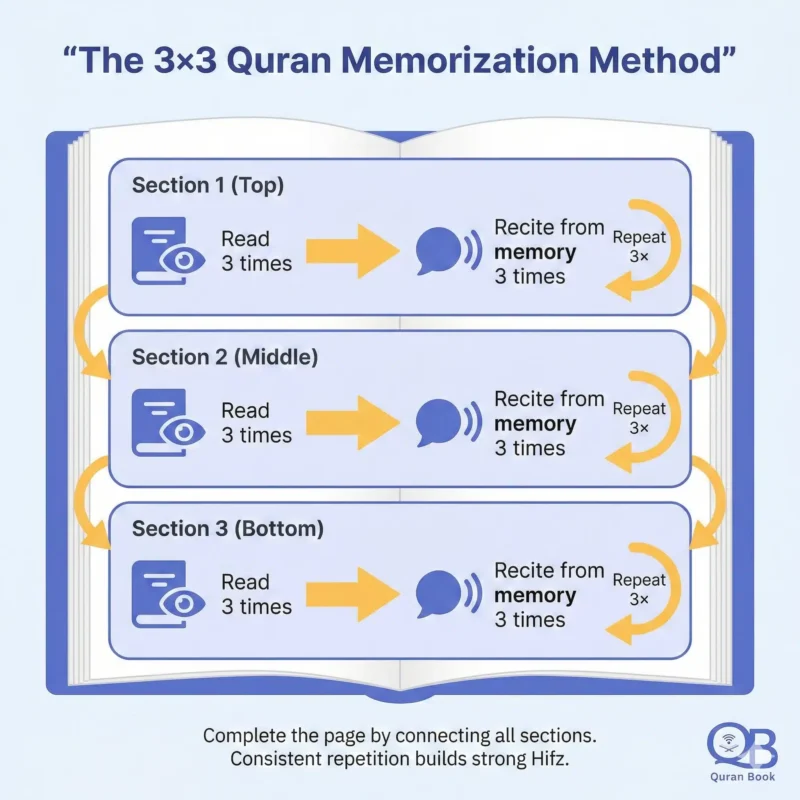
An infographic showing a Quran page divided into 3 sections with the 3x read, 3x recite cycle
The 3×3 Repetition Method is one of the most popular and beginner-friendly best Quran memorization techniques used in Hifz circles worldwide. It works by dividing each page of the Quran into three equal sections. You read the first section three times while looking at the Mushaf, then attempt to recite it three times from memory. Once the first section is solid, you move to the second and third sections using the same approach, then connect all three sections together.
Best For: Visual learners & beginners
“The one who recites the Quran and learns it by heart will be with the noble righteous scribes.”
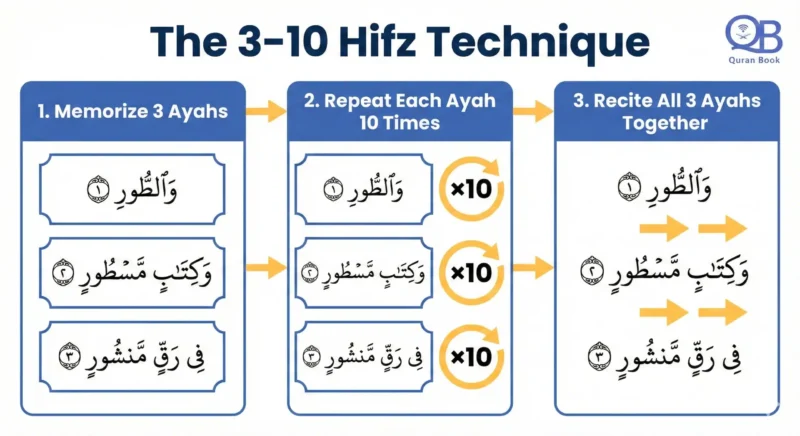
A numbered visual guide showing the 3-10 cycle: 3 ayahs, 10 repetitions each, then combined recitation
The 3-10 Hifz Technique is an excellent method for memorizing the Quran efficiently, especially for surahs with longer ayahs. Here is how it works: memorize three ayahs at a time. Repeat each individual ayah ten times, then recite all three ayahs together ten times. Once you can recite the set of three flawlessly, move to the next set and repeat the process. At the end of your session, connect all the sets together.
Best For: Auditory learners & longer surahs
Pro Tip: Pair this technique with a qualified teacher on Zoom for real-time Tajweed correction. This is exactly how Quran Book Academy structures its live Hifz sessions in its hifz program, ensuring every student receives personalized guidance.
3
The 6446 Structured Method
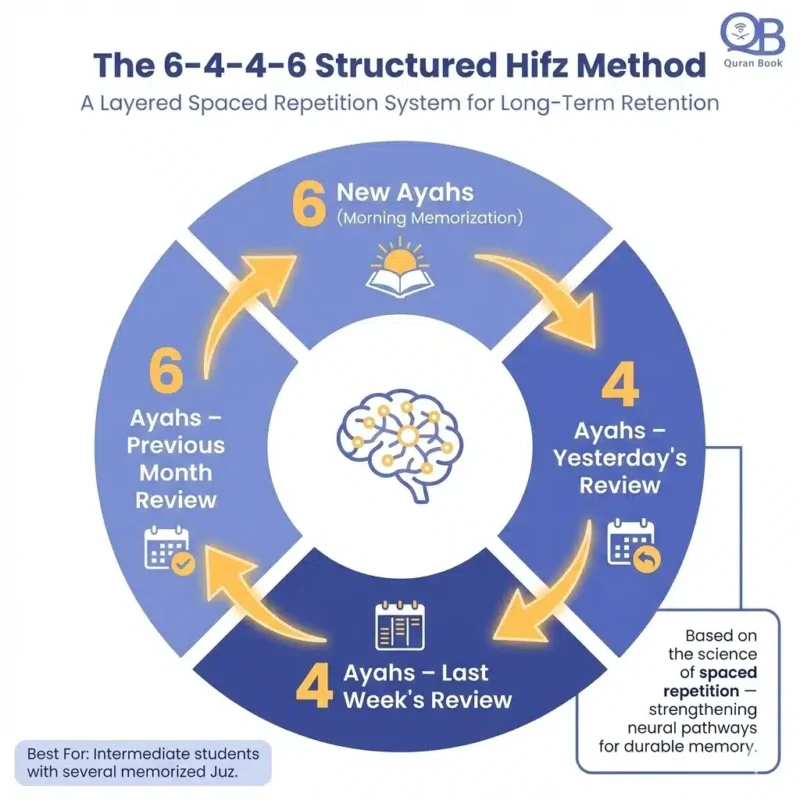
A calendar/cycle diagram showing the 6-4-4-6 daily structure with color-coded sections for new memorization and review
The 6446 Structured Method is a powerful approach for intermediate students who already have a foundation in memorization. It follows a daily cycle: memorize 6 new ayahs in the morning, review 4 ayahs from yesterday, review 4 ayahs from last week, and review 6 ayahs from the previous month. This layered system builds long-term retention through spaced repetition.
The science behind this technique mirrors what cognitive psychologists call “spaced repetition”—a learning strategy proven to boost long-term memory retention by over 200% compared to massed practice. By cycling through new and old material at calculated intervals, your brain strengthens neural pathways for each ayah, making recall faster and more reliable over time. This is one of the most effective tips to memorize Quran for serious students.
Best For: Intermediate students with several Juz memorized
4
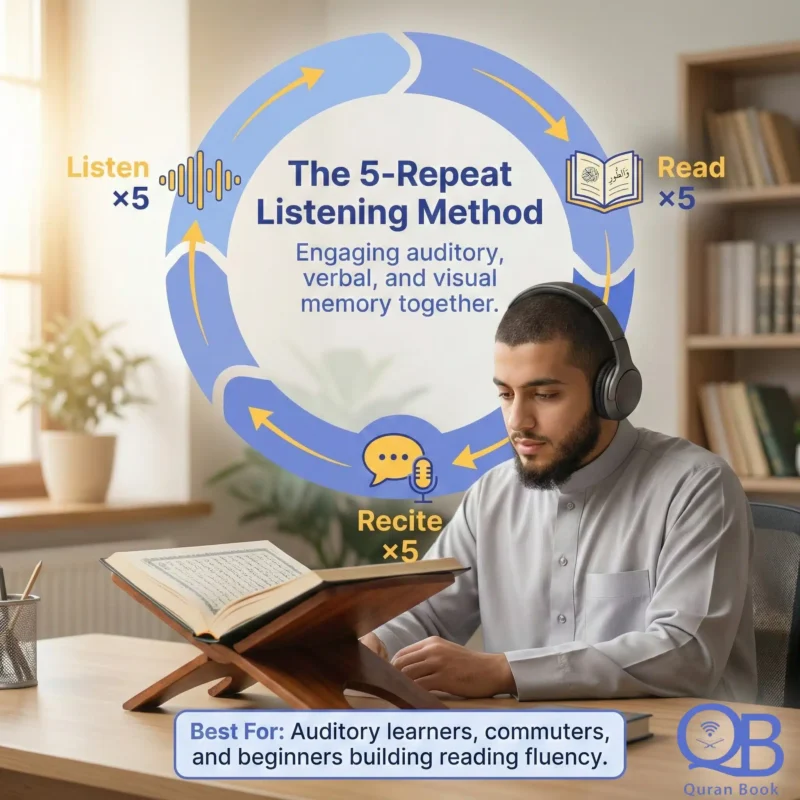
The 5-Repeat Listening Method
A person wearing headphones with a Quran nearby, representing the listening-reciting-reading cycle
The 5-Repeat Listening Method is ideal for auditory learners and those who have limited Arabic reading fluency. The process is straightforward: listen to a Qari recite the ayah five times, then repeat it aloud five times yourself without looking at the Mushaf, and finally read it five times from the Mushaf to reinforce visual memory. This triple-layered approach—listening, speaking, and reading—engages multiple learning channels simultaneously.
Best For: Auditory learners, commuters & beginners
If your reading fluency is not yet strong, we highly recommend starting with a Quran Reading and Tajweed course before jumping into full memorization. Building phonetic familiarity first makes these best Quran memorization techniques dramatically more effective.
5
The Chunking Method (Psychological Approach)
A mind-map illustration showing Quranic themes branching into smaller chunks for meaning-based memorization
The Chunking Method takes a cognitive science approach to Quran memorization. Instead of breaking pages into arbitrary ayah segments, you divide them into meaning-based “chunks.” First, you understand the theme and Tafsir (interpretation) of each chunk, then you memorize it. The brain retains meaningful groups of information far better than random sequences, making this one of the most intellectually satisfying techniques available.
The educational psychology behind chunking traces back to George Miller’s “Magic Number 7” theory, which found that working memory processes information in groups of five to nine items. By organizing Quranic ayahs into thematic clusters, you reduce cognitive load and allow your brain to form stronger associations. Quran Book Academy applies this principle by training students to read with Tajweed first—building phonetic familiarity through the Nour El Bayan course—before introducing memorization. This phased approach reduces cognitive overload and makes memorization up to three times faster. We call this “The Academy Method,” and it is the foundation of our hifz classes for beginners.
Best For: Analytical minds & non-Arabic speakers
6
Writing & Visual Mapping
The Writing and Visual Mapping technique engages your motor memory through the physical act of writing. Write each ayah by hand three to five times, then create a visual mind map connecting ayahs by theme, surah, or narrative flow. The combination of handwriting and spatial visualization creates multiple memory anchors that reinforce retention from different cognitive angles.
This technique also doubles as a beautiful act of worship—many scholars throughout Islamic history were known for copying the Quran by hand as a form of devotion and memorization combined. It remains one of the most time-tested tips on memorizing the Quran.
Best For: Kinesthetic learners & writing-oriented students
7
The Recitation Partner (Mushafahah) Method
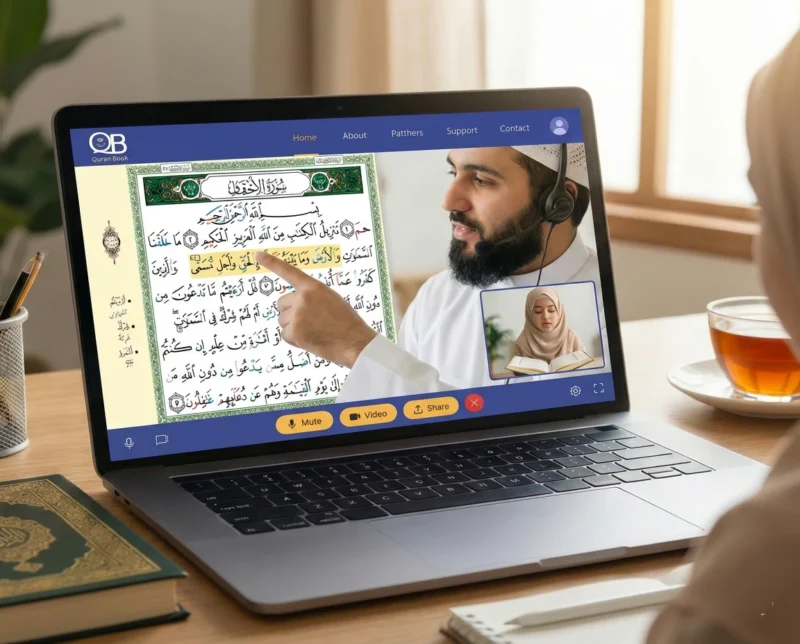
A split-screen Zoom session showing a student reciting to a teacher — the modern Mushafahah tradition
The Mushafahah Method is the gold standard of Quran memorization and the closest to the Sunnah of the Prophet (ﷺ). It involves reciting to a partner or teacher face-to-face (or via Zoom). The teacher listens carefully, corrects any Tajweed errors, and confirms the accuracy of your memorization. This real-time feedback loop is irreplaceable—no app or recording can substitute for a qualified human ear.
Jibreel (‘alayhi al-salam) used to review the entire Quran with the Prophet (ﷺ) every Ramadan.
Quran Book Academy’s hifz program is built around the Mushafahah method, with live 1-on-1 Zoom sessions led by certified Huffaz teachers. If you are serious about learning how to memorize the holy Quran easily, having a teacher guide you through this method is the single most impactful step you can take.
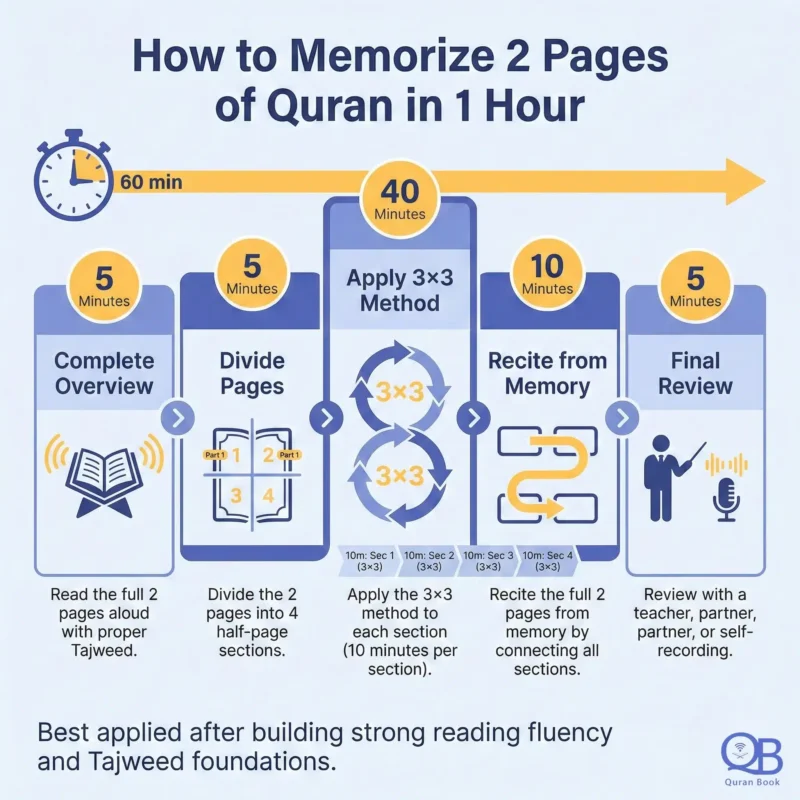
How to Memorize 2 Pages of the Quran in 1 Hour
A timeline infographic showing the 5-step, 60-minute memorization process with time allocations
Many students wonder if it is truly possible to memorize two full pages of the Quran in just one hour. The answer is yes—with the right approach. Here is a step-by-step process that combines several of the best Quran memorization techniques into a focused one-hour session:
1
Read the full 2 pages aloud with proper Tajweed (5 minutes). This gives your brain a complete overview of the material.
2
Divide the 2 pages into 4 half-page sections. Each section becomes a manageable unit.
3
Apply the 3×3 method to each section. Spend approximately 10 minutes per section (40 minutes total).
4
Connect all 4 sections by reciting the full 2 pages from memory (10 minutes).
5
Review by reciting to a teacher, study partner, or recording yourself for self-assessment (5 minutes).
This process works best after you have built foundational reading fluency. If you find yourself stumbling over pronunciation, consider enrolling in a Quran Reading and Tajweed course first to build the skills that make memorization effortless.
Comparison Table: Which Hifz Technique Is Best for You?
Use this quick-reference table to find the best Quran memorization techniques that match your learning style, available time, and experience level.
Technique
Best For
Difficulty
Time/Day
Teacher?
Key Benefit
3×3 Repetition
Visual learners
Easy
30–45 min
Optional
Simple, structured approach
3-10 Hifz
Auditory learners
Easy
30 min
Recommended
Strong ayah-level retention
6446 Structured
Intermediate
Medium
45–60 min
Optional
Built-in spaced repetition
5-Repeat Listening
Auditory / Beginners
Easy
20–30 min
Optional
Multi-sensory engagement
Chunking (Psych.)
Analytical minds
Medium
30–45 min
Recommended
Deep meaning-based retention
Writing & Mapping
Kinesthetic learners
Easy
30–40 min
No
Motor memory activation
Mushafahah
Everyone
Varies
20–30 min
Required
Real-time teacher correction
The Academy Method: How Quran Book Academy Teaches Hifz
A professional image showing a Zoom lesson in progress at Quran Book Academy — the modern, tech-enabled approach to Hifz
At Quran Book Academy, we do not start with memorization. We start with reading fluency. Our approach is grounded in a simple principle: students who can read Arabic fluently and with correct Tajweed memorize three times faster than those who jump straight into Hifz without foundational skills. This is The Academy Method, and it is what sets our hifz program apart from any other online Quran school.
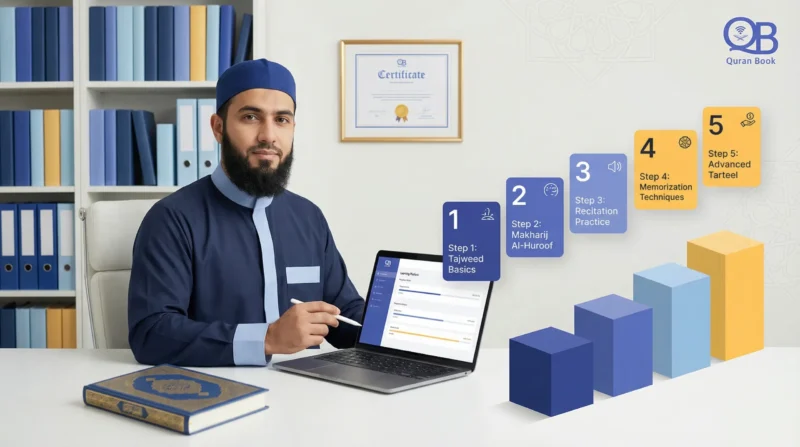
Students first master Tajweed rules and Makhraj (articulation points) through our structured Nour El Bayan course. This builds the phonetic foundation that eliminates the biggest bottleneck in memorization—struggling with pronunciation. Once students graduate from this phase, they enter our Hifz program with confidence and fluency.
Our live sessions combine the Chunking Method with Mushafahah recitation on Zoom. Each session is structured into manageable 15–20 minute blocks, ensuring focused, high-quality memorization without burnout. Our certified teachers provide real-time feedback, and our custom Learning Management System (LMS) tracks every student’s progress page-by-page, surah-by-surah. Weekly progress reports are sent directly to students (and parents, for children) via email.
Whether you are searching for hifz classes for beginners or an advanced review program, the Academy Method provides a complete, end-to-end system built on the best Quran memorization techniques available today.
Hadith & Rewards: Why Memorize the Quran?
Beyond technique and methodology, the motivation to memorize the Quran comes from the immense spiritual rewards promised to those who undertake this journey. Let these reminders fuel your determination:
Reward for the Hafiz
“It will be said to the companion of the Quran: ‘Read, ascend, and recite as you used to recite in the world, for your rank will be at the last verse you recite.’”
“Whoever reads the Quran, learns it, and acts according to it, on the Day of Judgment his parents will be crowned with a crown of light whose radiance is like that of the sun.”
— Musnad Ahmad (graded Hasan)
Quranic Promise
“Rather, it [the Quran] is distinct verses [preserved] within the breasts of those who have been given knowledge.”
Every letter you recite counts. Every ayah you memorize elevates you. The journey of Hifz is not a sprint—it is a lifelong act of worship. Whether you memorize one ayah a day or one page, every effort is seen and rewarded by Allah. These tips to memorize Quran are not just academic strategies; they are pathways to eternal reward.
Frequently Asked Questions (FAQ)
What is the most effective way to memorize the Quran?
+
The most effective method combines structured repetition (like the 3×3 or 3-10 technique) with a qualified teacher for Mushafahah. Quran Book Academy uses this exact approach in our hifz program, combining cognitive science-backed techniques with live teacher guidance for maximum retention.
How long does it take to become a Hafiz?
+
With consistent daily practice of one to two hours, most students complete full Hifz in two to four years. Intensive programs requiring three to four hours per day can achieve it in one to two years. The timeline depends on your reading fluency, consistency, and the quality of your review habits.
Can I complete Hifz in 6 months?
+
It is extremely challenging but possible for dedicated students who already have strong Arabic reading fluency and can commit four to six hours daily. For most beginners, one to three years is a realistic and sustainable goal that ensures long-term retention.
What is a person who memorized the Quran called?
+
A person who has memorized the entire Quran is called a Hafiz (male) or Hafiza (female). The plural is Huffaz. Achieving this status is one of the highest honors in Islam.
What is the reward for parents of a Hafiz?
+
According to a Hadith narrated in Musnad Ahmad, the parents of a Hafiz will be crowned with a crown of light on the Day of Judgment, whose radiance is brighter than the sun. This reward extends to parents who support and encourage their children in Quran memorization.
How can I memorize 2 pages of the Quran in 1 hour?
+
Divide the two pages into four half-page sections. Apply the 3×3 repetition method to each section, spending approximately ten minutes each. Then recite all sections together and use the remaining time to review. See our detailed step-by-step guide above.
What is the best Hifz method for non-Arabic speakers?
+
Start with a Tajweed and reading fluency course (like Nour El Bayan) to build phonetic familiarity, then use the Chunking plus Mushafahah method with a teacher. This is the approach Quran Book Academy recommends and uses in our hifz classes for beginners.
Start Your Quran Memorization Journey Today
You have learned the techniques. Now let our certified teachers guide you step by step. Book your FREE trial Hifz lesson with Quran Book Academy today.
✓ Live 1-on-1 Zoom sessions with certified Huffaz teachers✓ Personalized Hifz plan based on your schedule and level✓ Weekly progress reports delivered to your email✓ Access to our custom LMS for tracking every page and surah
Whether you are starting from zero or looking to accelerate your existing memorization, our hifz program has a path for you. Apply the best Quran memorization techniques under expert guidance and join thousands of students worldwide who are transforming their relationship with the Quran.
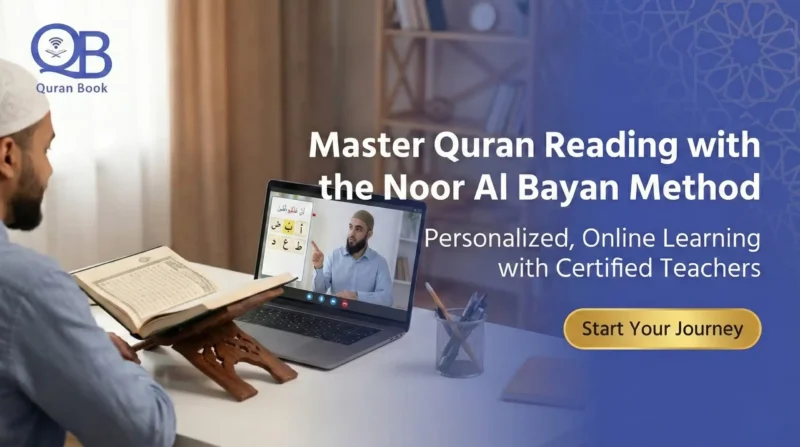
Student learning Noor Al Bayan Method for Quran reading via online Zoom session with certified teacher
Have you ever opened the Quran with excitement, only to feel overwhelmed by the Arabic letters staring back at you? You are not alone. Thousands of Muslims worldwide struggle with the same fear — the fear of mispronouncing Allah’s words, the anxiety of starting too late, or the worry that “I will never be able to read like native speakers.”
The Noor Al Bayan Method is transforming how non-Arabic speakers learn to read the Quran fluently and correctly. This revolutionary Arabic reading program has helped over 5 million students worldwide move from complete beginners to confident Quran readers — many achieving fluency in just 8–12 weeks. Whether you are in the USA, Canada, UK, or Australia, this proven method breaks down complex Arabic phonetics into manageable, psychological “chunks” that your brain can easily absorb. If you are looking for a comprehensive Quran Reading Course, the Noor Al Bayan Method is the ideal starting point. For those interested in perfecting pronunciation, exploring Tajweed Rules for Beginners alongside this method accelerates your progress.
Quick Answer
The Noor Al Bayan Method is a scientifically structured Arabic reading program designed specifically for non-native speakers to learn Quran recitation. It uses a gradual, step-by-step approach combining letter recognition, phonetic mastery, and Tajweed rules to help students read the Quran accurately within weeks.
What is the Noor Al Bayan Method?
The Noor Al Bayan Method is an innovative Arabic literacy program created by Sheikh Tariq Al-Saeed that teaches Quran reading through phonetic recognition and gradual progression. It consists of systematic lessons covering Arabic alphabet, vowel movements (Harakat), and letter combinations, making it the most accessible method for English speakers to master Quran recitation.
The Origins and Philosophy Behind Noor Al Bayan
The Noor Al Bayan Method was created by Sheikh Tariq Al-Saeed in Saudi Arabia with a singular vision: making Quran reading accessible to every Muslim on earth, regardless of their native language. Specifically designed for non-Arabic speakers, the method draws on educational psychology principles that have been tested and refined over more than 20 years. Today, the Noor Al Bayan Method is used in over 50 countries worldwide, helping millions connect with the words of Allah through correct and confident recitation.
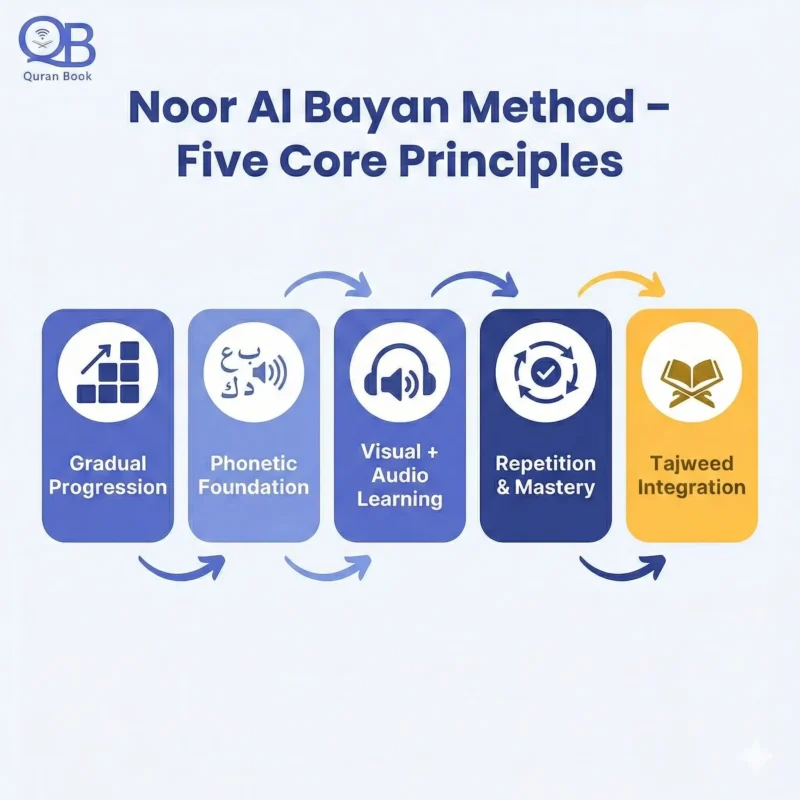
Core Principles of the Noor Al Bayan Method
Understanding the core principles behind the Noor Al Bayan Method reveals why it is so effective for learners of all ages and backgrounds. The discovery of the Benefits of Learning Quran with Tajweed further highlights the importance of this foundational approach. The table below summarizes the five pillars that make this approach unique.
Principle
Description
Benefit for Learners
Gradual Progression
Moves from simple to complex systematically
Prevents overwhelm and builds confidence
Phonetic Foundation
Focuses on sound recognition before rules
Natural learning like children acquire language
Visual + Audio Learning
Combines written letters with pronunciation
Engages multiple learning styles
Repetition & Mastery
Each level must be mastered before advancing
Ensures solid foundation
Tajweed Integration
Tajweed rules embedded from the beginning
Correct pronunciation from day one
Noor Al Bayan Method five core principles infographic showing gradual progression and Tajweed integration
What Makes Noor Al Bayan Different from Other Methods?
✦
No Arabic Grammar Required: Unlike traditional methods, you do not need to learn Arabic grammar rules first.
✦
Adult-Friendly Pacing: Designed for busy adults with limited study time, requiring only 15–20 minutes daily.
✦
Phonetic Approach: Uses sounds you already know from English to teach Arabic letters.
✦
Progressive Difficulty: Each lesson builds on the previous one with no gaps in understanding.
✦
Tajweed Built-In: You learn correct Tajweed pronunciation from the very first letter.
“
The best among you (Muslims) are those who learn the Quran and teach it.
The Noor Al Bayan Method honors this Hadith by making Quran learning accessible to every Muslim, regardless of their background or language.
Why the Noor Al Bayan Method is Perfect for Adult Learners
Adult learner using the Noor Al Bayan Method to learn Quran reading online from home
Adult learners benefit from the Noor Al Bayan Method because it respects their busy schedules, builds on existing language knowledge, and provides psychological safety through gradual progression. Unlike children’s methods, it addresses adult learning anxieties while delivering measurable progress in just 15–20 minute daily sessions. Explore our dedicated Quran Classes for Adults to find the perfect fit.
Overcoming the Adult Learning Barrier
As an adult learner, you might be thinking: “I am too old to learn a new alphabet,” “I do not have 2–3 hours a day to study,” or “What if I embarrass myself in front of others?” The Noor Al Bayan Method was designed with these exact concerns in mind. Educational psychology research shows adults learn differently than children. You need to understand why things work, you need flexibility in scheduling, and you need to see progress quickly to stay motivated. That is precisely what this method delivers.
How Adults Master Noor Al Bayan Faster
Adults actually have several advantages when learning to read the Quran with the Noor Al Bayan Method. Your life experience means you already understand discipline and goal-setting. As an English speaker, you recognize phonetic patterns quickly through language transfer. Your motivation is crystal clear — a deeper spiritual connection with Allah’s words. You can study at your own optimal times through self-directed learning, and your ability to concentrate deeply for short, intense sessions means every minute counts.
And We have certainly made the Quran easy for remembrance, so is there any who will remember?
This verse reminds us that Allah has made the Quran accessible. The Noor Al Bayan Method is simply the tool that unlocks that accessibility for you.
The 7 Levels of the Noor Al Bayan Method Explained
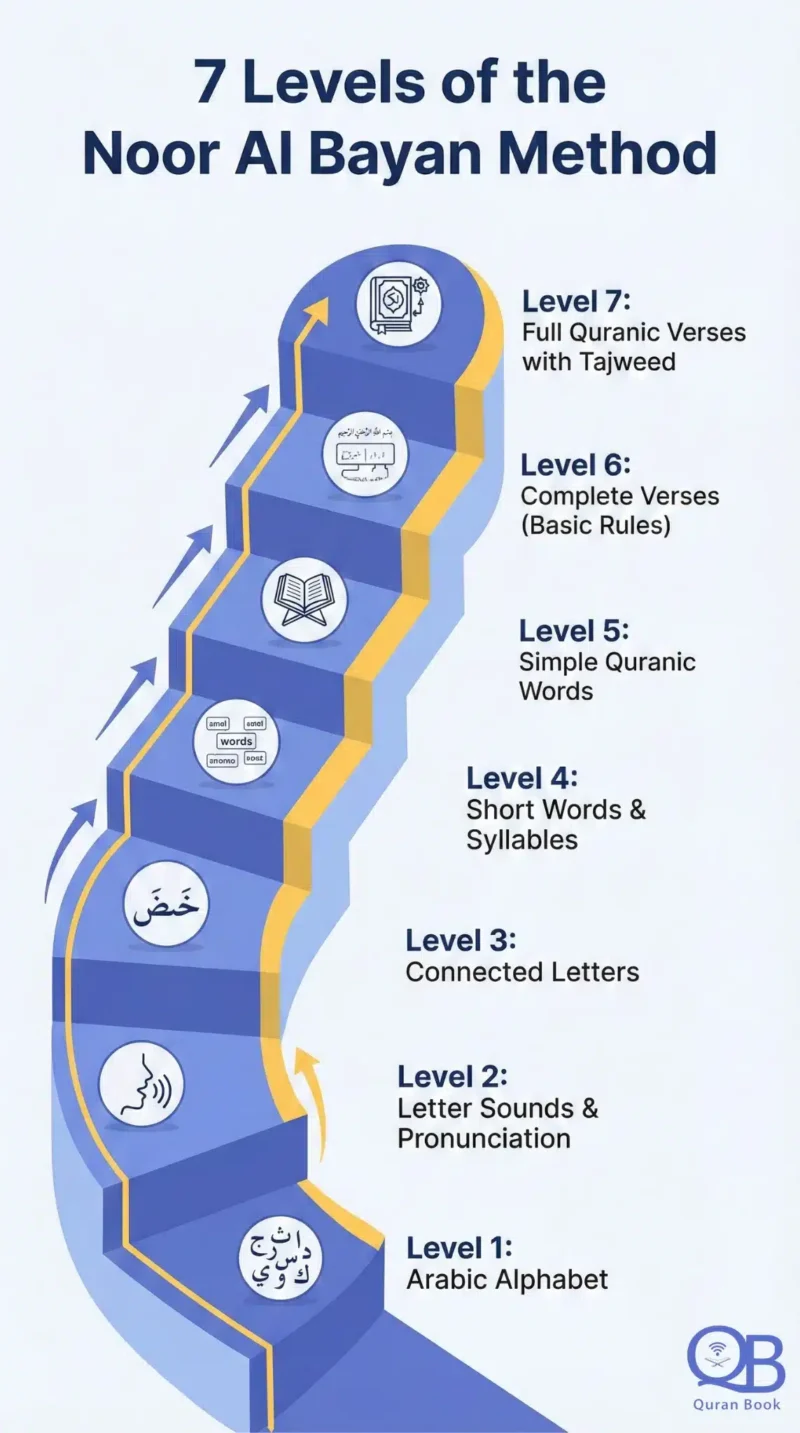
Seven levels of the Noor Al Bayan Method Arabic reading program infographic from alphabet to Tajweed
The Noor Al Bayan Method consists of seven progressive levels: Level 1 (Arabic Alphabet), Level 2 (Short Vowels), Level 3 (Long Vowels and Tanween), Level 4 (Sukoon and Shaddah), Level 5 (Advanced Letter Combinations), Level 6 (Quranic Words and Sentences), and Level 7 (Full Quranic Verses with Tajweed). Each level typically takes 1–2 weeks to master.
Complete Level Breakdown
Level
Focus Area
Key Skills
Duration
Level 1
Arabic Alphabet (28 Letters)
Letter recognition, shapes, pronunciation
1–2 weeks
Level 2
Short Vowels (Harakat)
Fatha, Kasra, Damma
1 week
Level 3
Long Vowels & Tanween
Alif, Waw, Ya extensions + Nunation
2 weeks
Level 4
Sukoon & Shaddah
Silent letters and doubling
1–2 weeks
Level 5
Advanced Combinations
Connecting letters, word formation
2 weeks
Level 6
Quranic Vocabulary
Common Quran words and phrases
2–3 weeks
Level 7
Complete Verses
Full Surahs with Tajweed application
2–3 weeks
Level-by-Level Deep Dive
Level 1: Building Your Arabic Foundation
The journey begins with the 28 letters of the Arabic alphabet, but unlike traditional methods that overwhelm you with all letters at once, the Noor Al Bayan Method introduces them in carefully sequenced groups based on phonetic similarity and visual patterns. You will start with the most commonly used letters in the Quran — letters like “ب” (Ba), “ت” (Ta), and “م” (Meem) — which appear in fundamental words like “bismillah.” Each letter is taught in its isolated form first, then you will see how it transforms when it appears at the beginning, middle, or end of a word. This systematic approach mirrors how native Arabic-speaking children naturally learn to recognize letters, but it is accelerated for adult learners by grouping similar-sounding letters together so your brain can create phonetic associations. By the end of Level 1, you will not just have memorized 28 random symbols. You will have internalized a complete sound system that becomes the foundation for everything that follows, and most students report feeling a profound sense of accomplishment because they can finally see the difference between letters that once looked identical.
Levels 2–3: Mastering Vowel Movements
Short vowels (Fatha, Kasra, Damma) and long vowels are where Arabic truly comes alive. This is the stage where you transition from recognizing letters to actually reading Arabic words. The Noor Al Bayan Method introduces Tanween (nunation) alongside long vowels, so you naturally learn how words flow together in Quranic recitation. Students often describe this phase as the “lightbulb moment” when scattered symbols suddenly become readable text.
Levels 4–5: Complex Combinations and Fluency
Sukoon, Shaddah, and letter connections teach you to read like a native speaker, smoothly connecting sounds without awkward gaps. The Noor Al Bayan Method uses repetitive drills and real Quranic word examples to build muscle memory in your tongue and jaw. By Level 5, you are forming complete Arabic words and reading them with confidence.
Levels 6–7: Quranic Application
The final levels transition you from practice words to actual Quranic text, starting with short Surahs like Al-Fatiha and moving to longer passages. Here, all the Tajweed rules you have been absorbing throughout the Noor Al Bayan Method come together as you recite complete verses with proper pronunciation, rhythm, and reverence.
How Quran Book Academy Teaches the Noor Al Bayan Method
Quran Book Academy delivers Noor Al Bayan through live one-on-one Zoom classes with certified native Arabic teachers. Students receive personalized lesson plans, access to a custom Learning Management System (LMS) for progress tracking, weekly Gmail progress reports, and recorded sessions for review. Classes are scheduled flexibly for students across USA, Canada, UK, and Australia time zones. Learn more about How Our Online Quran Classes Work.
The Quran Book Academy Approach: Beyond Just Teaching
Quran Book Academy LMS dashboard showing Noor Al Bayan Method student progress tracking
At Quran Book Academy, we do not simply teach the Noor Al Bayan Method — we deliver a complete learning ecosystem built around five pillars that ensure every student succeeds. You can also Meet Our Certified Quran Teachers to see who will guide your journey.
Personalized Assessment
Every student begins with an initial skill level evaluation, learning style identification, goal setting, and a custom curriculum adaptation to match your unique needs.
Live Interactive Sessions
Zoom-powered one-on-one classes with native Arabic-speaking certified teachers provide real-time pronunciation correction and screen sharing for visual learning. Choose from 30, 45, or 60-minute session options.
Technology-Enhanced Learning
Our custom LMS lets you track progress through all 7 levels, access lesson materials around the clock, review recorded sessions, and complete practice exercises. Automated Gmail reports deliver weekly progress summaries, homework assignments, and milestone celebrations directly to your inbox.
Psychological Chunking Technique
Lessons are broken into 10–15 minute focused segments to prevent cognitive overload and maximize retention, based on the Pomodoro learning technique adapted for Quran study.
Tajweed Integration from Day One
Tajweed is not taught as a separate set of rules. It is embedded naturally in pronunciation practice. Makharij (articulation points) are taught with each letter, and advanced Tajweed rules are introduced gradually throughout the Noor Al Bayan Method curriculum.
Student Success Journey: Week by Week
Weeks 1–2 — Foundation Building
Master the Arabic alphabet, begin short vowel recognition, build confidence with simple letter combinations. First milestone: read your name in Arabic!
Weeks 3–4 — Vowel Mastery
Complete short and long vowels, introduction to Tanween, read simple Quranic words. Second milestone: read “Bismillah” correctly!
Weeks 5–6 — Advanced Combinations
Sukoon and Shaddah mastery, complex word formation, begin reading Quranic phrases. Third milestone: read the first 3 verses of Al-Fatiha!
Weeks 7–8 — Quranic Application
Complete Surah Al-Fatiha, begin short Surahs (Al-Ikhlas, Al-Falaq, An-Nas), apply Tajweed rules confidently. Final milestone: read full Surahs for Salah!
“
Whoever recites a letter from Allah’s Book, then he receives the reward from it, and the reward of ten the likes of it. I do not say that Alif Lam Mim is a letter, but Alif is a letter, Lam is a letter and Mim is a letter.
Every letter you learn to read correctly using the Noor Al Bayan Method brings you ten rewards. Imagine the blessings you will accumulate throughout this journey!
Why Choose Quran Book Academy for Noor Al Bayan?
Feature
Quran Book Academy
Self-Study PDF
Group Classes
YouTube
Personalized Feedback
✅ Live teacher
❌ No feedback
⚠️ Limited
❌ None
Pronunciation Accuracy
✅ Native guidance
❌ Can’t verify
⚠️ May miss errors
❌ Can’t verify
Progress Tracking
✅ LMS + Gmail
❌ Self-monitored
⚠️ Basic
❌ None
Flexible Scheduling
✅ Book anytime
✅ Anytime
❌ Fixed times
✅ Anytime
Completion Rate
✅ 94%
❌ ~20%
⚠️ ~40%
❌ ~10%
Tajweed Certificate
✅ Upon completion
❌ Not available
⚠️ Sometimes
❌ No
Noor Al Bayan vs. Traditional Arabic Learning Methods
Noor Al Bayan differs from traditional Arabic methods by focusing exclusively on Quran reading without requiring Arabic grammar study. While traditional methods teach alphabet, grammar, and vocabulary simultaneously (taking 2–3 years), Noor Al Bayan uses phonetic recognition and pattern learning to achieve Quran reading fluency in 8–12 weeks. For a deeper understanding of meanings afterward, consider Quran Tafseer Classes.
The Traditional Method Challenge
The traditional approach to learning Quranic Arabic requires students to learn grammar (Nahw and Sarf), study vocabulary separately, memorize complex grammatical rules, and only then attempt to read the Quran. This pathway typically takes 2–3 years minimum. In contrast, the Noor Al Bayan Method allows you to start reading from day one. You learn letters through Quranic context, grammar understanding comes naturally later, and the focus is on pronunciation and fluency first. The result? Reading fluency in 8–12 weeks.
Which Method Should You Choose?
Choose Noor Al Bayan If You:
Choose Traditional Method If You:
Want to read Quran for Salah quickly
Want comprehensive Arabic language mastery
Are a complete beginner
Already know some Arabic
Have limited daily study time
Can dedicate 1–2 hours daily
Focus is spiritual practice
Focus is linguistic mastery
Need results in weeks
Can wait years for results
Recommended Path: Start with the Noor Al Bayan Method for reading fluency, then add traditional grammar studies later if you wish to understand meanings deeply.
Getting Started with the Noor Al Bayan Method: Your First Lesson
To start the Noor Al Bayan Method, schedule a free trial lesson at Quran Book Academy where a certified teacher will assess your level, demonstrate the methodology, and create a personalized learning path. You will need a device with internet, a quiet space, and 30 minutes for your first session.
What Happens in Your Free Trial Lesson?
1
Pre-Lesson Setup (5 min)
Install Zoom on your device, receive LMS login credentials via Gmail, and access welcome materials.
2
Teacher Introduction (5 min)
Meet your certified Quran teacher, discuss your goals and background, and address any concerns.
3
Level Assessment (10 min)
Test your current Arabic reading ability, identify your starting level, and customize the learning pace.
4
Method Demonstration (15 min)
Learn your first 5 Arabic letters, practice pronunciation with live feedback, and experience the Noor Al Bayan Method teaching style firsthand.
5
Program Explanation (10 min)
Review the full 7-level curriculum, discuss class schedule options, and learn about LMS features and Gmail reporting.
6
Next Steps (5 min)
Receive your first homework assignment in the LMS, schedule ongoing lessons, and get access to supplementary materials.
What You Will Need to Get Started
Getting started with the Noor Al Bayan Method requires minimal setup. For technology, you need a computer, tablet, or smartphone with internet access, the free Zoom app installed, a working microphone and camera, and a stable internet connection (minimum 3 Mbps). All learning materials are provided free by the academy in digital format, though you may optionally purchase a physical Noor Al Bayan book. A notebook for practice is recommended. Plan for 2–3 classes per week (30–60 minutes each) plus 15–20 minutes of daily practice, totaling about 3–4 hours per week.
All packages include live Zoom classes with a certified teacher, full LMS access, weekly Gmail progress reports, recorded sessions for review, 24/7 WhatsApp support, and a certificate upon completion. A money-back guarantee is included: if you are not satisfied after your first paid week, Quran Book Academy will refund 100% with no questions asked.
Noor Al Bayan Method: Frequently Asked Questions
What is the Noor Al Bayan book for teaching the Arabic language?
+
The Noor Al Bayan book is a specialized Arabic literacy textbook created by Sheikh Tariq Al-Saeed that teaches Arabic reading through a phonetic, gradual approach. It contains 7 progressive levels covering alphabet, vowels, letter combinations, and Quranic application. The book is specifically designed for non-Arabic speakers to learn Quran reading without needing Arabic grammar knowledge, making it the most accessible method for English speakers worldwide.
What is the Noor Al Bayan course?
+
The Noor Al Bayan course is a structured online or classroom-based program that teaches students to read Arabic and the Quran using the Noor Al Bayan Method. At Quran Book Academy, the course consists of live one-on-one Zoom sessions with certified teachers, personalized lesson plans through our custom LMS, and weekly progress tracking via Gmail reports. The course typically takes 8–12 weeks to complete for beginners.
Which book is best for learning Arabic for Quran reading?
+
For Quran reading specifically (not conversational Arabic), the Noor Al Bayan book is considered the best choice for non-Arabic speakers because it focuses exclusively on reading fluency without requiring grammar study. Other options include Qaida Noorania (similar approach) and traditional Qaida Baghdadia (older method). However, Noor Al Bayan has the highest completion rate (94%) due to its adult-friendly, psychologically structured approach.
How many pages are in Noor Al Bayan?
+
The original Noor Al Bayan book contains approximately 72 pages covering all 7 levels. However, at Quran Book Academy, we supplement the book with additional digital materials, practice worksheets, and interactive exercises through our LMS, providing students with a comprehensive learning experience beyond the physical book’s 72 pages.
Can I learn Arabic in 3 months using the Noor Al Bayan Method?
+
Yes, you can learn to read Arabic and the Quran in 3 months using the Noor Al Bayan Method. However, this teaches reading fluency with Tajweed, not conversational Arabic or comprehension of meanings. With 8–12 weeks of consistent study (3–4 hours weekly), students achieve full reading capability. To understand meanings, you would need additional Tafseer or Arabic language courses after completing Noor Al Bayan.
Can I do Hifz (Quran memorization) on my own after learning Noor Al Bayan?
+
While you can attempt Hifz on your own after mastering the Noor Al Bayan Method, it is not recommended without a teacher. The method teaches you to read correctly, which is the essential first step for Hifz. However, Quran memorization requires a qualified teacher to verify your pronunciation, correct mistakes, and ensure you are memorizing with proper Tajweed. Quran Book Academy offers specialized Online Hifz Program courses after you complete Noor Al Bayan.
How long does it take to complete the Noor Al Bayan Method?
+
Most students complete all 7 levels of the Noor Al Bayan Method in 8–12 weeks with consistent practice. This assumes 2–3 live classes per week (30–60 minutes each) plus 15–20 minutes of daily practice. Fast-track students studying intensively can finish in 6–8 weeks, while those with limited time may take 12–16 weeks. The key is consistency, not speed — proper mastery at each level ensures long-term retention.
Do I need to know Arabic to start Noor Al Bayan?
+
No! The Noor Al Bayan Method is specifically designed for complete beginners with zero Arabic knowledge. You do not need to know the alphabet, any Arabic words, or grammar rules. The method starts from absolute basics — learning the first letter “Alif” and its sound — and builds progressively. This is why Noor Al Bayan has a 94% completion rate: it meets students exactly where they are with no prerequisites.
Can children use the Noor Al Bayan Method?
+
Yes! Children as young as 4–5 years old can learn with the Noor Al Bayan Method, though it was originally designed for adults. Quran Book Academy offers specialized Kids Quran Classes that adapt the pacing and use more visual aids, games, and shorter sessions (20–30 minutes). Children often complete the program faster than adults (8–10 weeks) due to their brain’s natural language acquisition abilities. Family packages allow parents and children to learn together.
What is the difference between Noor Al Bayan and Qaida Noorania?
+
Both Noor Al Bayan and Qaida Noorania are Arabic reading methods for Quran study, but they differ in structure. Noor Al Bayan uses 7 progressive levels with emphasis on gradual letter introduction and phonetic patterns. Qaida Noorania focuses more on Tajweed rules from the beginning and uses word repetition. The Noor Al Bayan Method is generally considered more beginner-friendly for adults, while Qaida Noorania is traditional and widely used in Islamic schools. Both lead to Quran reading fluency.
Is Arabic a difficult language to learn?
+
Arabic reading for Quran purposes is not difficult when using the right method. The Noor Al Bayan Method breaks down Arabic into manageable phonetic patterns that English speakers can master in weeks. While conversational or grammar-based Arabic can take years to learn, reading Arabic specifically for Quran recitation using the Noor Al Bayan Method is one of the easiest literacy skills to acquire due to the systematic, gradual structure and limited alphabet (28 letters versus English’s varied phonics).
Start Your Noor Al Bayan Journey Today
You have learned about the revolutionary Noor Al Bayan Method — a proven system that has transformed millions of Muslims from struggling beginners to confident Quran readers. You have seen the 7 levels, understood the psychology behind the method, and read real success stories from students just like you.
“And We have certainly made the Quran easy for remembrance, so is there any who will remember?”
The Quran is easy — when you have the right method and the right teacher. Do not let another Ramadan pass where you struggle to read the Quran. The best time to start was yesterday. The second-best time is right now.
🎁 Claim Your Free Trial Lesson
✓ Complete assessment of your current level
✓ Learn your first 5 Arabic letters with a certified teacher
✓ Experience live Zoom one-on-one instruction
✓ Get access to our custom LMS
✓ Receive a personalized learning roadmap
✓ Zero cost, zero obligation