Tajweed Rules: 12 Powerful Essentials for Beautiful Quran Recitation
Master the art of Quranic recitation with clear, step-by-step guidance
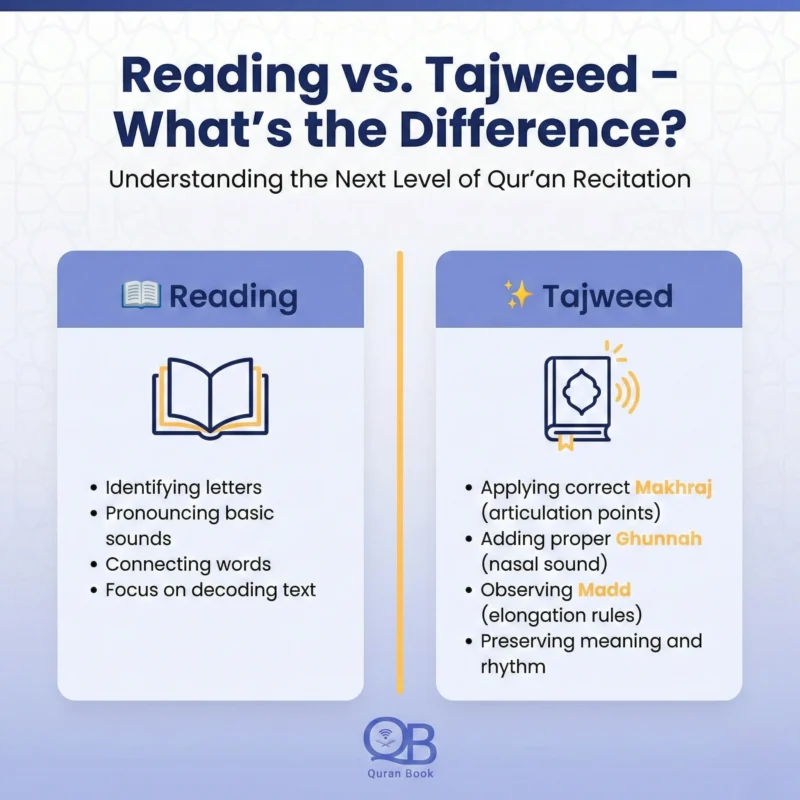
Tajweed Rules can feel intimidating when Arabic isn’t your first language—especially if you’re worried about making mistakes or feel like you “don’t have time”. You might look at a page of the Quran and feel overwhelmed by the symbols, wondering if you will ever recite with the flow and beauty of your favorite reciters.
You are not alone. The good news is that Tajweed is a skill, not a talent. With small daily practice and guided feedback, your mouth and tongue build new “recitation muscle memory”.
Remember this gentle Islamic motivation: The Prophet ﷺ taught that the one who struggles while reciting still receives two rewards—one for the recitation and one for the struggle. So your effort counts, even before you reach perfection. 📖 (Bukhari: 5027)
Tajweed Rules for Beginners: What Tajweed Really Means
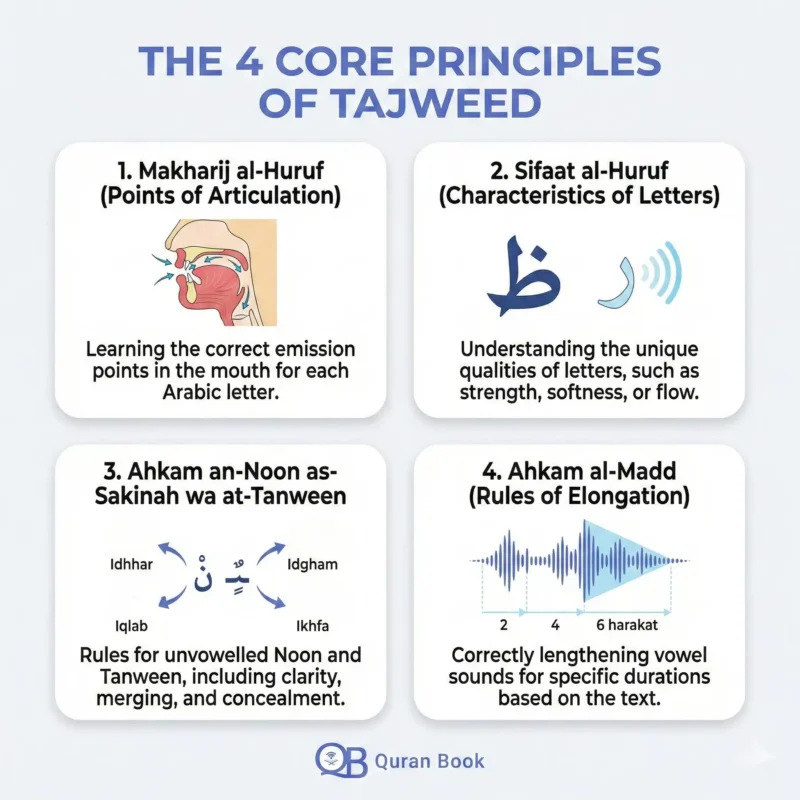
Tajweed Rules are the guidelines for pronouncing Arabic letters correctly when reciting the Quran—giving each letter its proper articulation point (makhraj), characteristics (sifaat), and timing.
For beginners, Tajweed isn’t about having a “perfect voice.” It is about clarity, consistency, and avoiding mistakes that can change the meaning of Allah’s words.
Tajweed Rules vs. “Just Reading”
There is a difference between simply reading Arabic and reciting with Tajweed:
- • Tajweed focuses on how letters sound and connect.
- • Quran reading fluency combines rhythm, accuracy, and confidence.
- • Beginner Goal: Aim for clear and steady recitation, not “fast” recitation.
Why Tajweed Rules Matter in Quran Recitation
Tajweed Rules matter because Allah commands measured recitation (Tarteel), and Tajweed helps protect Quranic meanings from pronunciation errors. 📖 (Quran 73:4)
Beyond obligation, it builds confidence. Many adult learners avoid reciting aloud due to a fear of mistakes. Learning Tajweed rules turns that fear into a simple plan: learn the rules in small steps and practice them daily. Explore our Tajweed Course for Beginners for structured guidance.
Tajweed Rules Foundations: Makhraj & Sifaat
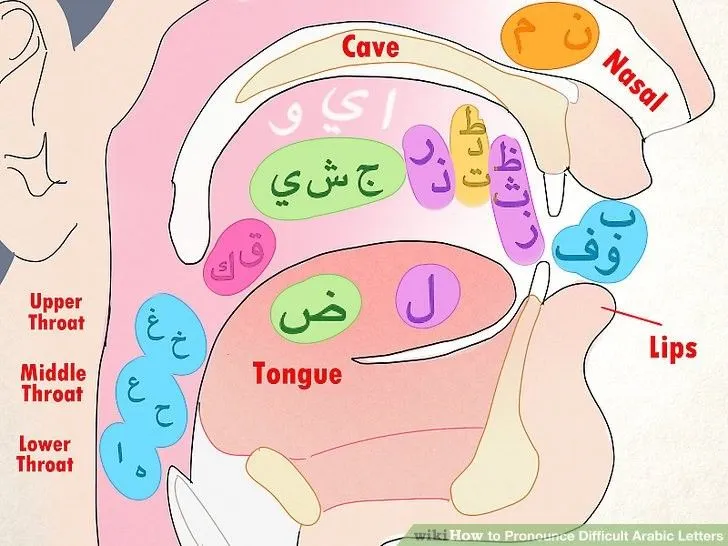
Before memorizing complex Tajweed Rules, beginners must train their mouth map: knowing where each Arabic letter comes from (makhraj) and how it behaves (sifaat). This is the fastest way to fix common pronunciation issues for English speakers and makes every later rule—like Ikhfa or Idgham—much easier.
How Many Throat Letters are in Tajweed?
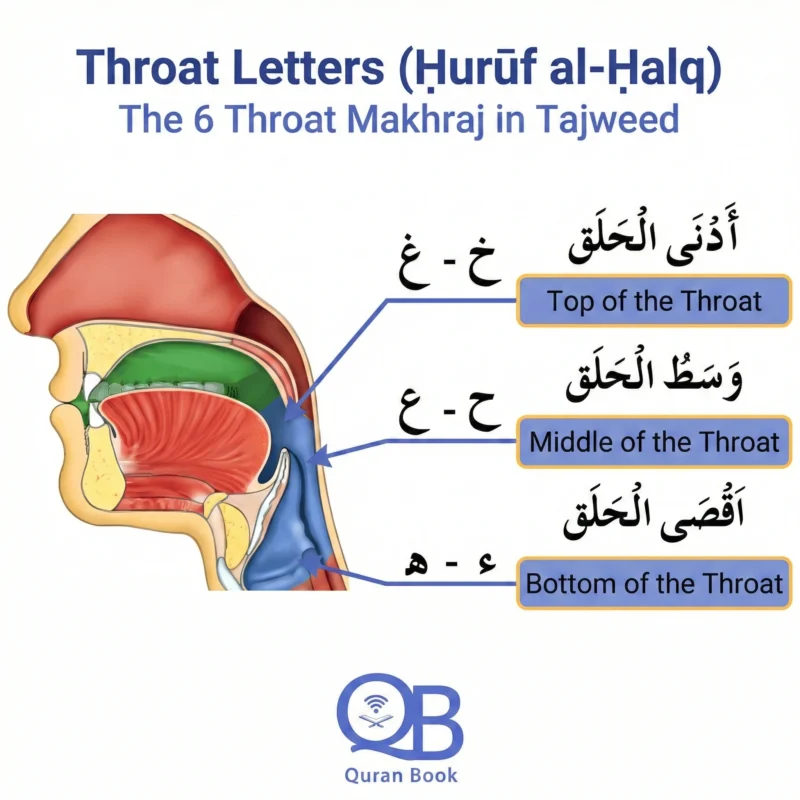
There are 6 throat letters (حروف الحلق) that come from three different parts of the throat:
- Top of throat: خ (Kha), غ (Ghain)
- Middle of throat: ح (Ha), ع (Ain)
- Bottom of throat: ء (Hamzah), هـ (Ha)
Tajweed Rules: 7 Heavy Letters + Tafkheem & Tarqeeq
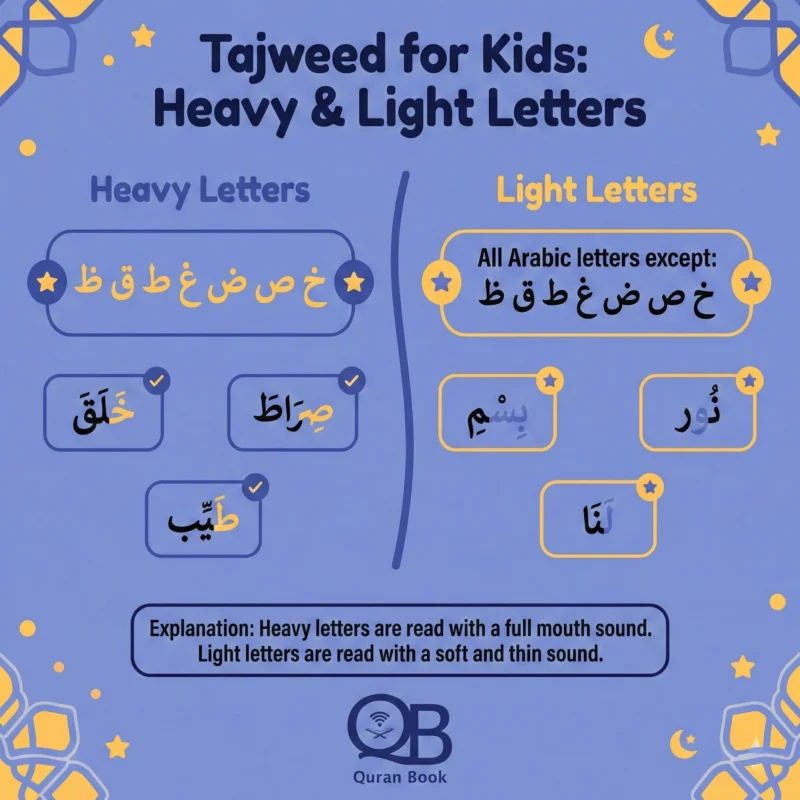
One of the quickest upgrades for your recitation is learning “heavy vs. light” pronunciation. The 7 heavy letters are: خ ص ض غ ط ق ظ.
Tajweed Rules for Tafkheem (heavy) and Tarqeeq (light) teach you how to shape the tongue and mouth so the sound is correct without exaggeration.
Heavy vs. Light Letters Breakdown
| Category | What it means | Letters | Beginner mistake to avoid |
|---|---|---|---|
| Heavy (Tafkheem) | Full-mouth sound | خ ص ض غ ط ق ظ | Over-darkening nearby letters |
| Light (Tarqeeq) | Clear/bright sound | Most letters | Making ر / ل heavy everywhere |
Tajweed Rules for Noon Sakinah and Tanween
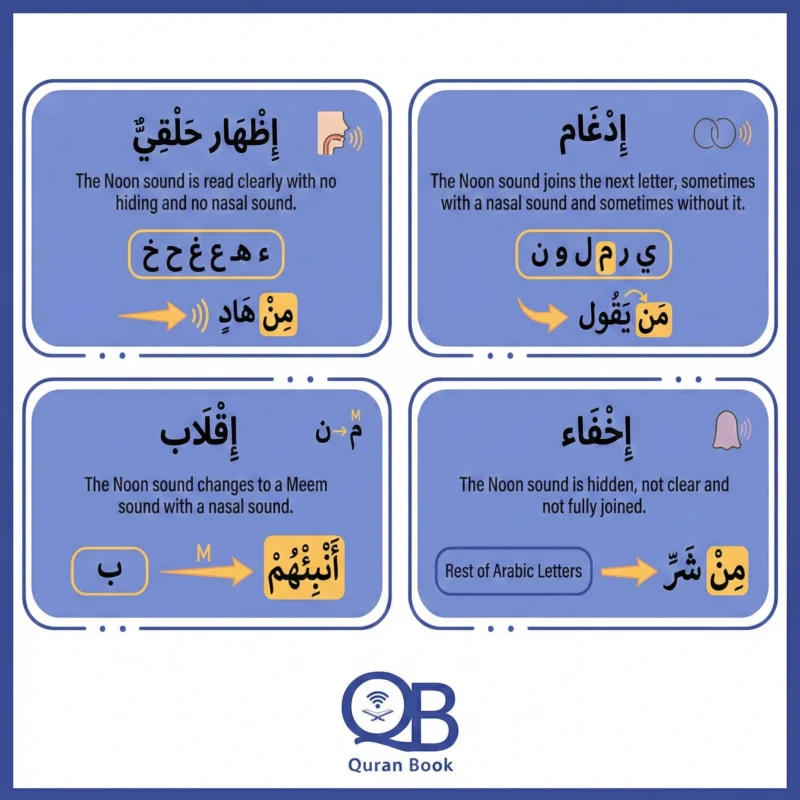
Noon Sakinah (نْ) and Tanween (double vowels: ــًــ / ــٍــ / ــٌــ) follow four core Tajweed Rules: Izhar, Idgham, Iqlab, and Ikhfa. These rules depend entirely on the next letter after the Noon or Tanween. Mastering this single chapter removes a huge percentage of beginner mistakes.
When learners hear “Noon Sakinah rules,” they often panic because it feels like memorization. However, it is actually a simple recognition skill: spot the نْ or tanween, then look at the next letter to apply one of four actions (clear, merge, change, or hide). The easiest way to train your brain is through “micro-drills”: take one rule per day, practice 10 examples aloud, and record yourself for 60 seconds. Don’t confuse confidence with speed; rushing creates mistakes and reinforces anxiety. Slow down (30–60 seconds per line) and treat every correction as success evidence.
1. Izhar Rule (Clear)
Izhar means “clear pronunciation”. When Noon Sakinah or Tanween is followed by a throat letter (ء هـ ع ح غ خ), the ن sound is read clearly without any nasal hiding.
2. Idgham Rule (Merging)
Idgham means “merging”.
- Idgham with Ghunnah: If followed by ي، ن، م، و, the sound merges with a nasal sound.
- Idgham without Ghunnah: If followed by ل، ر, the sound merges completely without nasal sound.
3. Iqlab Rule (Conversion)
Iqlab means “conversion”. If Noon Sakinah or Tanween is followed by the letter ب (Ba), the ن sound changes into a hidden م (Meem) sound with a Ghunnah. This is one of the easiest Tajweed rules because the trigger is just one letter.
4. Ikhfa Rule (Hiding)
Ikhfa means “hiding”. When followed by any of the remaining 15 letters, the sound is neither clear nor merged. Instead, you produce a controlled nasal sound (Ghunnah) while keeping the tongue slightly away from the palate.
Summary: Noon Sakinah & Tanween Rules
| Rule | What happens | Trigger letters | Quick cue |
|---|---|---|---|
| Izhar | Clear ن sound | ء هـ ع ح غ خ | “Throat = clear” |
| Idgham | Merge into next | ي ن م و / ل ر | “Merge letters” |
| Iqlab | Change to hidden م | ب | “B = becomes M” |
| Ikhfa | Hidden with ghunnah | (15 letters) | “Between clear & merge” |
Tajweed Rules for Meem Sakinah
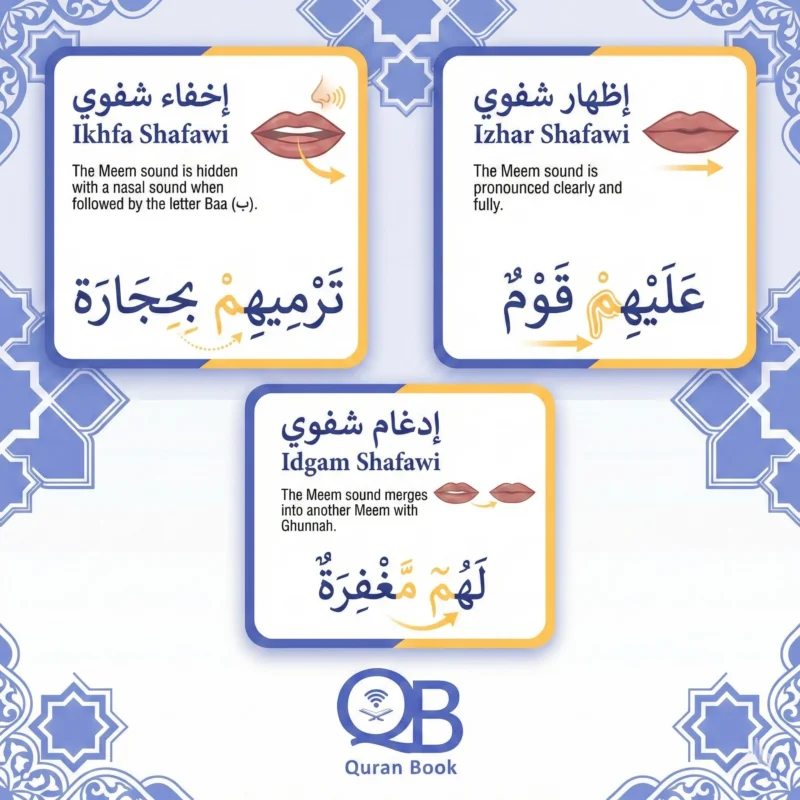
Meem Sakinah (مْ) has three Tajweed Rules: Ikhfa Shafawi, Idgham Shafawi, and Izhar Shafawi. These rules depend on the letter following the مْ. This chapter is very beginner-friendly because it is consistent and strongly connected to lip movement.
| Rule | Trigger | What to do | Beginner tip |
|---|---|---|---|
| Ikhfa Shafawi | ب | Hide meem with ghunnah | Don’t fully close lips too early |
| Idgham Shafawi | م | Merge with ghunnah | Hold nasal sound steadily |
| Izhar Shafawi | All other letters | Clear meem | “Close lips cleanly, no extra hum” |
Tajweed Rules: Ghunnah Rule
Ghunnah is the nasal sound used in specific Tajweed Rules (especially Ikhfa and some types of Idgham).
Beginners often either remove Ghunnah completely or overdo it. The goal is a steady, controlled nasal tone—not a dramatic “singing hum”.
Tajweed Rules: Qalqalah in Tajweed
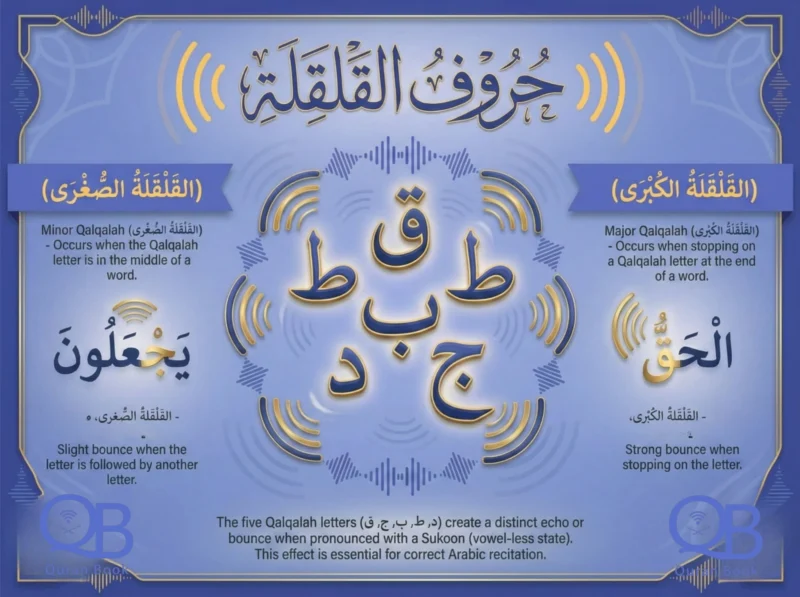
Qalqalah is the “echo” or “bounce” sound produced on certain letters when they carry a sukoon (or when you stop on them). The Qalqalah letters are collected in the phrase “Qutb Jad” (ق ط ب ج د).
The bounce should be crisp and small—enough to hear the letter clearly, but not so strong that it sounds like you added an extra vowel.
- Minor Qalqalah: Happens in the middle of a word.
- Major Qalqalah: Happens when stopping at the end of a word (stronger bounce).
Tajweed Rules: Madd Rules and Types of Madd
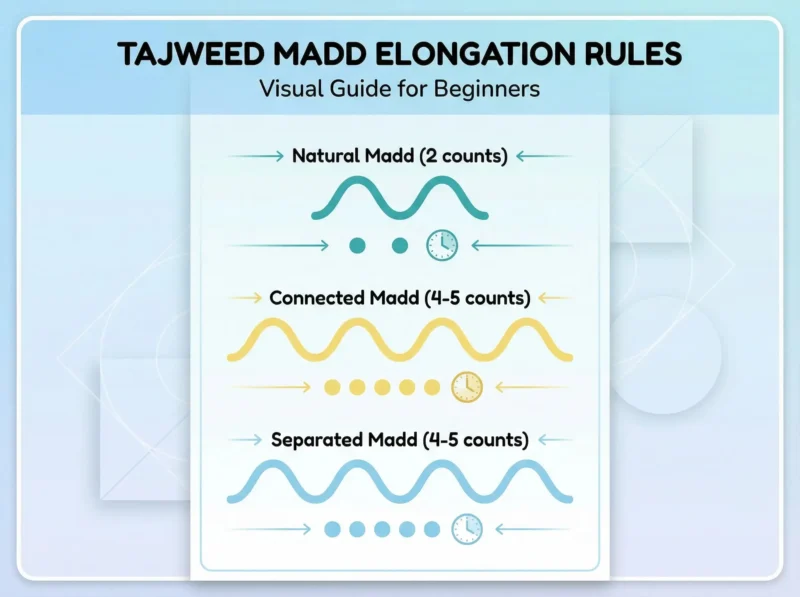
Madd means lengthening a vowel sound. Madd rules teach you how long to stretch specific letters in different situations. Beginners improve quickly by learning Madd Asli (natural length) first, then moving to longer Madd types caused by a Hamzah or Sukoon.
| Type | Typical length | Trigger | Beginner note |
|---|---|---|---|
| Madd Asli (Tabee’i) | 2 counts | Natural vowel | Your foundation timing |
| Madd Muttasil | 4–5 counts | Hamzah in same word | Don’t rush this stretch |
| Madd Munfasil | 4–5 counts | Hamzah in next word | Keep length consistent |
| Madd ‘Arid lis-Sukun | 2/4/6 counts | Stopping | Choose one style & stick to it |
| Madd Lazim | 6 counts | Fixed sukoon | Advanced but important |
Tajweed Rules: Laam and Raa Rules
The Laam (ل) and Raa (ر) rules are common “why does it sound different?” moments for beginners. Tajweed Rules explain when these letters are heavy or light depending on the vowels and surrounding letters.
- Laam in “Allah”: It is heavy if preceded by a Fatha or Damma, and light if preceded by a Kasra.
- Raa: Heavy in certain vowel environments (like Fatha/Damma) and light in others (like Kasra). Mastering Raa alone makes your recitation sound noticeably more correct and confident.
How to Perform Tajweed Rules While Reading (Step-by-Step)
To perform Tajweed Rules correctly, don’t try to apply everything at once. Use a simple reading routine: identify the rule, slow down, apply it once correctly, then repeat the same ayah until it feels natural.
- Choose 5–10 lines daily (keep it short and repeatable).
- Mark one rule (e.g., Ikhfa) with a pencil or highlighter before you start.
- Listen to a clear reciter, then read aloud slowly.
- Record yourself for 60 seconds and compare it to the expert.
- Get teacher feedback weekly to prevent “locked-in” mistakes.
Learn more about our structured approach in our Quran Reading Course.
How to Improve Tajweed Rules Fast (Beginner Practice Plan)
You improve Tajweed Rules fastest with short daily practice and corrective feedback. Most learners don’t fail from “difficulty”—they fail from inconsistent routines and the fear of being corrected. A 10-minute daily plan is often enough to build confidence.
Common Mistakes to Watch For:
- Mixing similar letters (like mixing س/ص or د/ض).
- Over-lengthening your Madd counts.
- Overdoing the Ghunnah sounds.
- Speeding up to “hide” your mistakes.
Psychological Tip: Use the “2-minute start” rule to reduce procrastination and track your streaks to see visible progress.
Can You Learn Tajweed by Yourself?
Yes, you can learn Tajweed Rules by yourself to a basic level using videos and practice, but most beginners progress faster with a teacher because small pronunciation errors are hard to self-detect. Many learners feel improvement in 4–8 weeks with consistent practice.
| Option | Pros | Cons | Best for |
|---|---|---|---|
| Self-study | Flexible, low pressure | Mistakes can become habits | Motivated learners + strong listening |
| Teacher-led | Fast correction, confidence | Scheduled time | Beginners, kids, adults who want structure |
Quran Book Academy Method for Tajweed Rules
At Quran Book Academy, we teach Tajweed Rules in manageable psychological “chunks” so beginners don’t feel overwhelmed. You learn one rule family at a time, apply it in real ayat, then build fluency through repetition.
The Academy Method:
- Chunk 1: Letters & Makhraj (foundation).
- Chunk 2: Core Tajweed Rules (Noon/Meem/Madd/Qalqalah).
- Chunk 3: Fluency training (flow, stops, confidence).
Our Tech Stack: We use Live Zoom classes for real-time correction, a custom LMS to track your milestones, and Gmail progress reports to keep you consistent and accountable.
We also offer specialized programs like our Nour El Bayan / Noorani Qaida Path and Quran for Kids programs.
Tajweed Rules FAQ
Q1: What are the basic rules of Tajweed?
The basic Tajweed Rules cover correct letter pronunciation (makhraj), nasal sounds (ghunnah), Noon Sakinah/Tanween rules (Izhar, Idgham, Iqlab, Ikhfa), Meem Sakinah rules, Qalqalah, and Madd (lengthening). Beginners should learn them gradually and apply them in short daily recitation.
Q2: What are the 7 heavy letters in Arabic?
The 7 heavy (Tafkheem) letters are: خ ص ض غ ط ق ظ. They are pronounced with a fuller mouth sound. Learning these letters early makes your recitation noticeably clearer.
Q3: How to perform Tajweed?
Perform Tajweed by pronouncing each letter from its correct makhraj and applying rules based on the next letter (especially for Noon Sakinah/Tanween). The quickest method is daily short practice plus weekly correction from a qualified teacher.
Q4: Can you learn Tajweed by yourself?
You can learn Tajweed Rules by yourself using videos for theory. But because Tajweed is physical (tongue/lips/throat), teacher feedback helps you catch errors you may not hear in yourself—saving months of re-learning later.
Q5: What happens if you read the Quran without Tajweed?
If you read without Tajweed, your recitation may include pronunciation mistakes that could change meanings. However, Islam encourages learning step-by-step; the Prophet ﷺ mentioned that even the struggling reciter is rewarded for effort. 📖 (Muslim: 798a)
Q6: How long does it take to learn Tajweed?
Many beginners notice improvement in 4–8 weeks with consistent practice (10–20 minutes daily). Mastering all Tajweed Rules takes longer depending on your goals and live correction.
Q7: How many throat letters are in Tajweed?
There are six throat letters: ء هـ ع ح غ خ. They are important because they trigger Izhar (clear pronunciation) when they come after Noon Sakinah.
Book Your Free Trial Lesson
If Tajweed Rules feel overwhelming, don’t do it alone. A teacher can fix the “tiny mistakes” that keep you stuck and help you build confidence fast.
Join Quran Book Academy for a Free Trial Lesson—we’ll assess your level, create a simple plan, and start improving your recitation from day one.
Start Your Free Trial Lesson Today →Start your Free Trial Lesson today and learn Tajweed Rules with supportive, step-by-step coaching on Zoom—plus progress tracking to keep you consistent.
You can also reach us directly via WhatsApp or join our Free Online Maqra on Telegram.
References & Resources
Islamic Sources
- Quran.com – Surah 73:4 (Al-Muzzammil) – On measured recitation (Tarteel)
- Quran.com – Surah 17:106 (Al-Isra) – On gradual revelation
- Sunnah.com – Bukhari: 5027 – Hadith on double reward for struggling reciters
- Sunnah.com – Muslim: 798a – Hadith on Quran recitation rewards
- Sunnah.com – Bukhari: 5023 – Excellence of learning the Quran
- Sunnah.com – Tirmidhi: 2914 – Virtues of Quran recitation
Learning Resources
- Quran Book Online YouTube Channel – Free Tajweed lessons and recitation practice
- Free Online Maqra (Telegram) – Join our community for group learning
Our Courses & Programs
- Free Trial Lesson – Start your Tajweed journey with a personalized assessment
- About Quran Book Academy – Learn about our teaching methodology
- Quran Reading Course – Comprehensive reading program with Tajweed
- Tajweed Course for Beginners – Focused Tajweed rules training
- Nour El Bayan / Noorani Qaida Path – Foundation Arabic and reading skills
- Quran for Kids – Specialized programs for young learners
- Contact via WhatsApp – Get instant support and enrollment assistance