How to Make Dua for Beginners: 7 Powerful Steps to Connect with Allah
By Quran Book Academy — Your step-by-step path to heartfelt supplication

Learning how to make dua for beginners can feel overwhelming — you might wonder if your Arabic is good enough, whether Allah will accept your words, or if you’re even doing it right. Here is the truth: you don’t need perfect Arabic to speak to your Creator. Allah invites every single one of us to call upon Him, and this guide gives you a clear, step-by-step path to do exactly that.
“And when My servants ask you concerning Me, indeed I am near. I respond to the invocation of the supplicant when he calls upon Me.” Surah Al-Baqarah 2:186
In this article, you will learn what dua truly means in Islam, how to make dua properly in 7 simple steps, 7 essential duas with Arabic text, transliteration, and English meaning, the best times to make dua, common mistakes to avoid, and how to download a free Duas PDF for daily practice.
What Is Dua in Islam? (The Simple Truth Beginners Need to Know)
Dua is a personal supplication or prayer to Allah (SWT). Unlike Salah (the five daily prayers), dua has no fixed format — you can make it anytime, anywhere, in any language. It is your direct, private conversation with your Creator. The Prophet Muhammad ﷺ called dua “the essence of worship” (Tirmidhi 3371).
Many beginners confuse dua with Salah, but they serve different purposes. Here is a quick comparison:
| Feature | Salah (Prayer) | Dua (Supplication) |
|---|---|---|
| Format | Fixed movements and recitations | Free-form, personal |
| Language | Arabic only | Any language |
| Timing | 5 specific times daily | Anytime |
| Required? | Obligatory (Fard) | Highly encouraged (Sunnah) |
| Position | Standing, bowing, prostrating | Any position |
Dua is not merely about asking for things. It is an act of worship in itself. When you raise your hands and call upon Allah, you are acknowledging His power, His mercy, and your complete dependence on Him. Allah tells us directly in Surah Ghafir 40:60: “Call upon Me; I will respond to you.”
Learn the basics of Salah in our Islamic Courses for Kids and Adults →How to Make Dua Properly — 7 Steps for Beginners
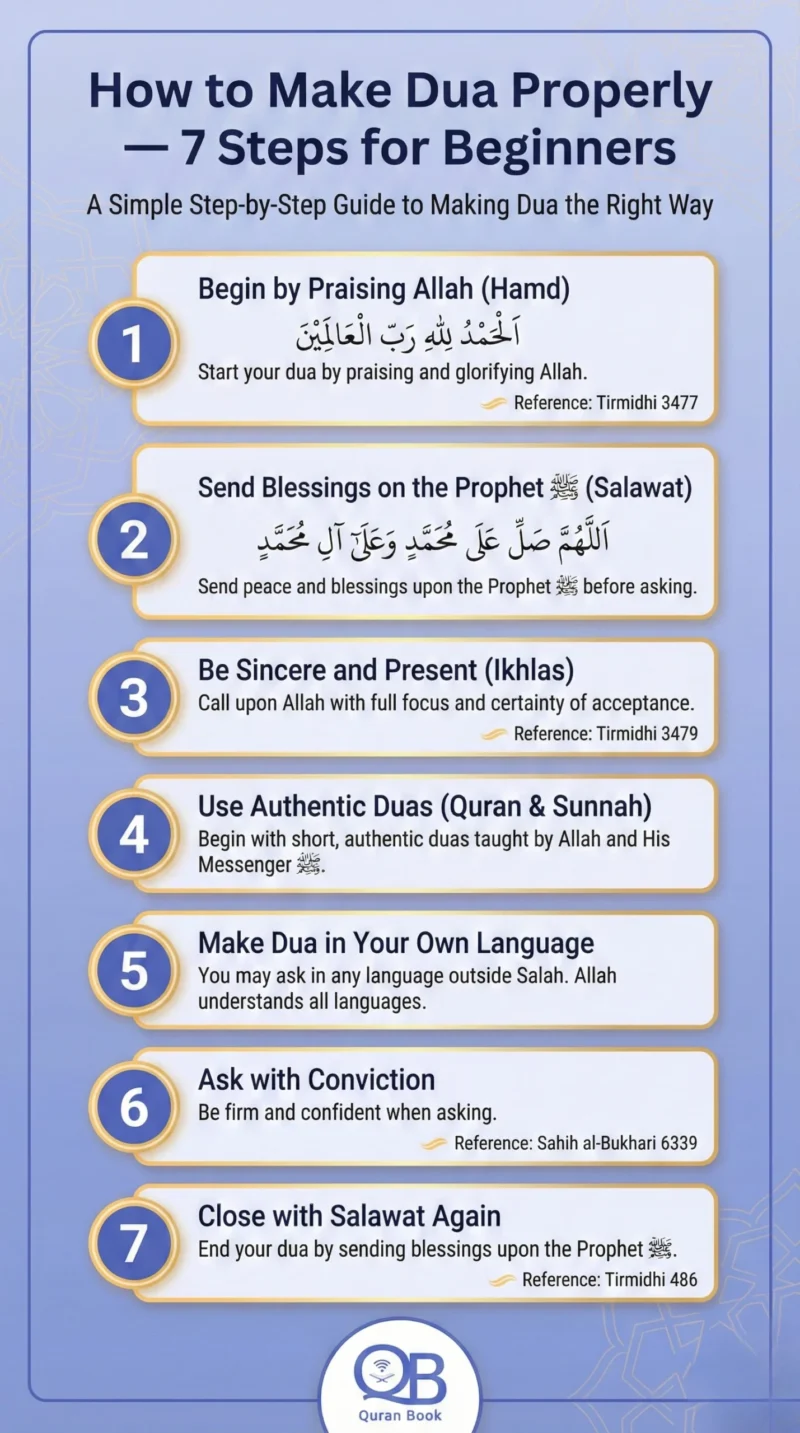
To make dua properly as a beginner, follow these 7 steps: start with praising Allah, send blessings upon the Prophet ﷺ, be sincere, ask with conviction, use both Arabic duas and your own words, repeat your dua, and close with blessings on the Prophet ﷺ again.
Begin by Praising Allah (Hamd)
Every dua should begin with glorifying Allah. Start by saying “Alhamdulillahi Rabbil Aalameen” (All praise belongs to Allah, Lord of all worlds). The Prophet ﷺ said: “When any of you makes dua, let him begin by praising Allah, then send blessings on the Prophet, then ask for what he wishes.” (Tirmidhi 3477)
Send Blessings on the Prophet ﷺ (Salawat)
After praising Allah, recite Salawat: “Allahumma salli ala Muhammad wa ala aali Muhammad” (O Allah, send peace and blessings upon Muhammad and the family of Muhammad). This opens the doors of dua acceptance and is a beloved Sunnah that draws you closer to the Prophet ﷺ.
Be Sincere and Present (Ikhlas)
Sincerity is the soul of dua. The Prophet ﷺ said: “Call upon Allah while being certain of being answered.” (Tirmidhi 3479). Put your phone down, face the Qiblah if possible, raise your hands, and speak to Allah as if He is right there — because He is closer to you than your jugular vein.
Use Authentic Duas from the Quran and Sunnah
Beginners should start with short, memorizable duas from the Quran and the Sunnah. These are the words that Allah Himself taught us or that the Prophet ﷺ used regularly. We cover 7 essential duas in the next section, and you can also download the free Duas PDF we provide for daily use.
Make Dua in Your Own Language Too
One of the most common questions beginners ask is: “Is it OK to make dua in English?” The answer is yes. Scholars confirm that dua (outside of Salah) can be made in any language. Allah understands all languages. Start with the Arabic duas you have memorized, then pour your heart out in English, Urdu, Malay, or your mother tongue. What matters most is the sincerity of your heart, not the language on your tongue.
Ask with Conviction, Not Hesitation
Never be timid in your dua. The Prophet ﷺ said: “None of you should say, ‘O Allah, forgive me if You wish.’ Rather, he should be firm in asking, for no one can compel Allah.” (Sahih al-Bukhari 6339). Ask Allah as if you are certain He will answer — because He promised He would.
Close with Salawat Again
Just as you opened with blessings on the Prophet ﷺ, close the same way. Umar ibn al-Khattab (RA) said: “Dua is suspended between heaven and earth and none of it is taken up until you send blessings upon your Prophet ﷺ.” (Tirmidhi 486). This beautiful bookending ensures your supplication reaches its destination.
7 Essential Duas Every Beginner Should Memorize (Arabic + English)
The best duas for beginners are short, authentic supplications from the Quran and Sunnah that cover daily life — waking up, sleeping, eating, seeking forgiveness, and asking for guidance. Here are 7 duas you can start memorizing today.
1 Dua When Waking Up
Transliteration: Alhamdu lillahil-ladhi ahyana ba’da ma amatana wa ilayhin-nushur
English: “All praise is for Allah who gave us life after having taken it from us, and to Him is the resurrection.”
Source: Sahih al-Bukhari 6324
2 Dua Before Sleeping
Transliteration: Bismika Allahumma amutu wa ahya
English: “In Your name, O Allah, I die and I live.”
Source: Sahih al-Bukhari 6324
3 Dua Before Eating
Transliteration: Bismillah
English: “In the name of Allah.”
Source: Abu Dawood 3767
4 Dua for Forgiveness (Sayyid al-Istighfar)
Transliteration: Allahumma anta Rabbi la ilaha illa anta, khalaqtani wa ana ‘abduka…
English: “O Allah, You are my Lord, there is no deity except You. You created me and I am Your servant…”
Source: Sahih al-Bukhari 6306
This is called the “master supplication for forgiveness.” The Prophet ﷺ said whoever recites it with conviction during the day and passes away that same day will enter Paradise. This dua for forgiveness is one of the most powerful supplications a Muslim beginner can learn.
5 Dua When Leaving the House
Transliteration: Bismillah, tawakkaltu ‘ala Allah, wa la hawla wa la quwwata illa billah
English: “In the name of Allah, I place my trust in Allah, and there is no might nor power except with Allah.”
Source: Abu Dawood 5095
6 Dua for Guidance (Istikhara — Simplified)
When facing an important decision — whether about marriage, a job, moving, or any life matter — the Prophet ﷺ taught the Istikhara prayer. It is a specific two-rak’ah prayer followed by a heartfelt dua asking Allah to guide you toward what is best. Learning how to make dua for guidance is essential for every Muslim beginner navigating life’s crossroads.
Source: Sahih al-Bukhari 1166
7 The Comprehensive Dua (Rabbana Atina)
Transliteration: Rabbana atina fid-dunya hasanatan wa fil-akhirati hasanatan wa qina ‘adhaban-nar
English: “Our Lord, give us in this world that which is good and in the Hereafter that which is good, and protect us from the punishment of the Fire.”
Source: Quran 2:201 — The Prophet ﷺ made this dua more than any other (Sahih Muslim 2690).
What Are the Best Times to Make Dua? (When Allah Answers Most)
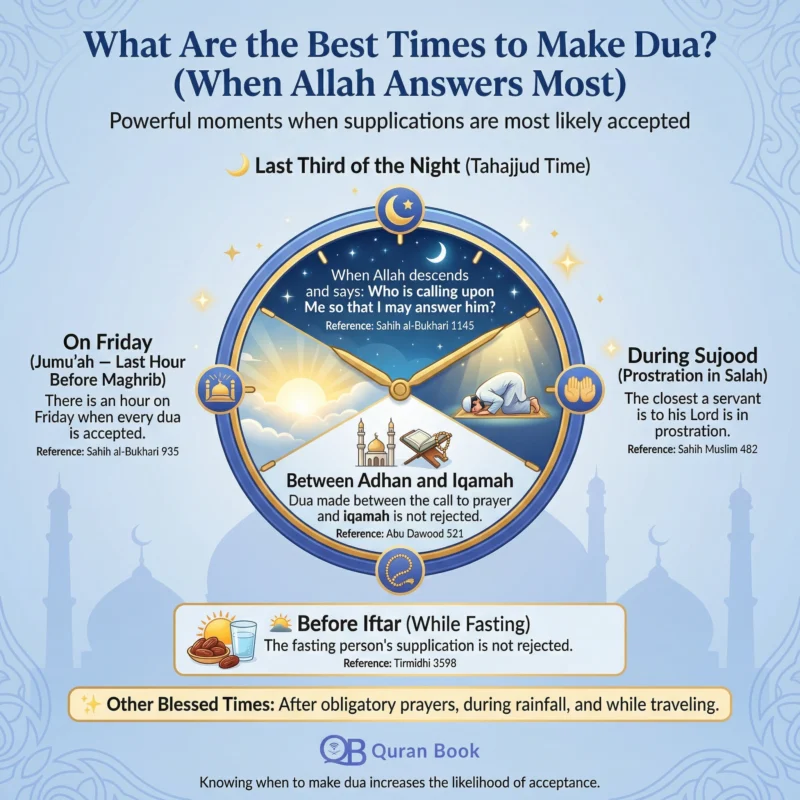
The best times to make dua in Islam are during the last third of the night, between the adhan and iqamah, while prostrating in Salah, on Friday afternoons, and while fasting before breaking the fast. Knowing when to make dua can dramatically increase the likelihood of acceptance.
The last third of the night (Tahajjud time) is when Allah descends to the lowest heaven and asks: “Who is calling upon Me so that I may answer him?” (Sahih al-Bukhari 1145). Waking up even 15 minutes before Fajr to make dua is one of the most powerful habits a Muslim beginner can develop.
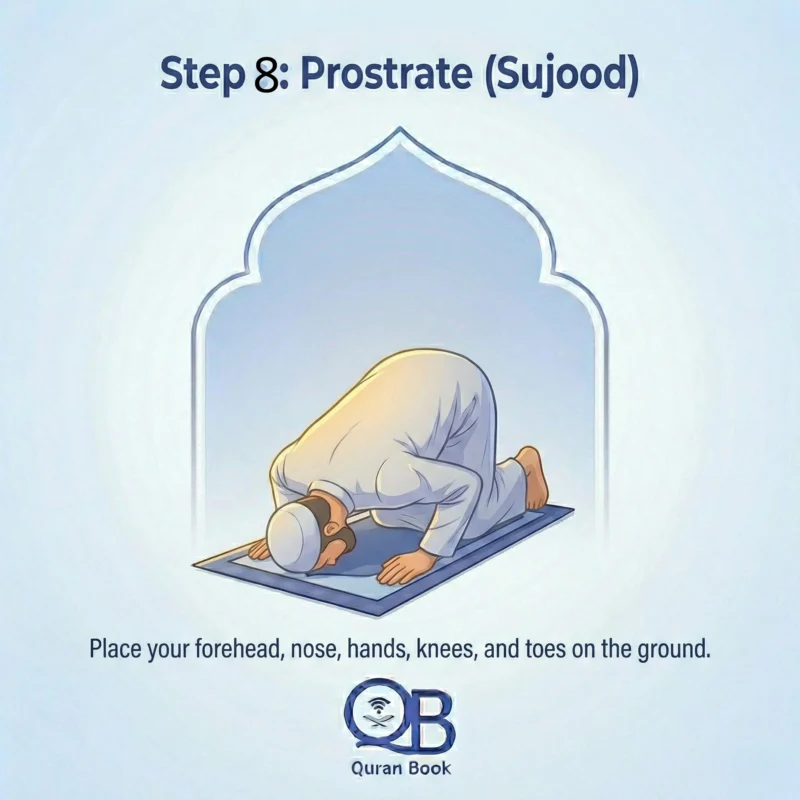
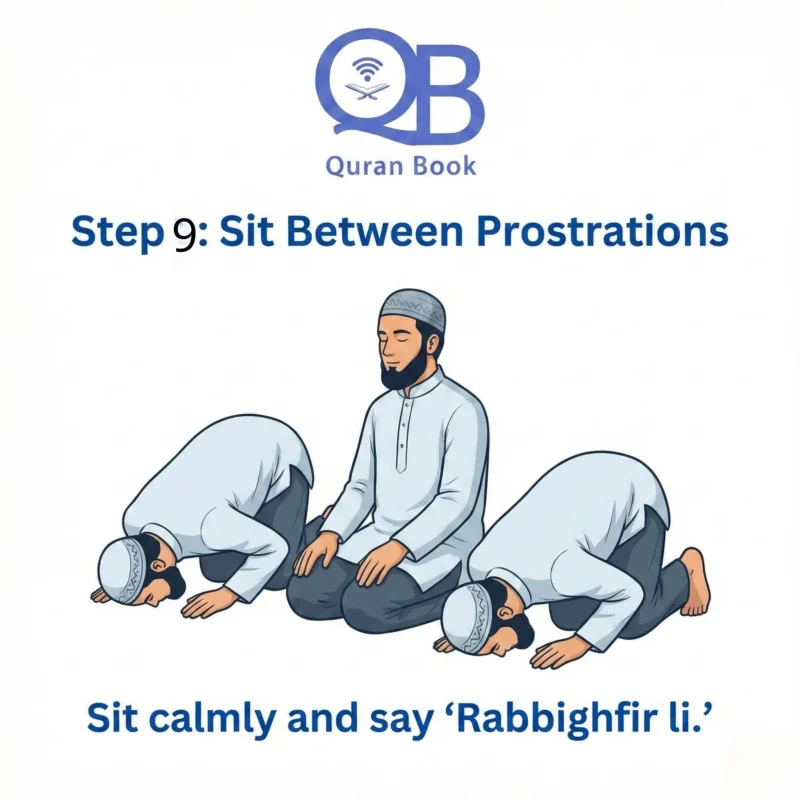
While prostrating (Sujood) is another deeply blessed time. The Prophet ﷺ said that the closest a servant is to his Lord is during prostration, and he urged us to increase supplication in that position (Sahih Muslim 482). Learning how to make dua in sujood is a game-changer for your spiritual life.
Between Adhan and Iqamah is a window that should never be wasted. A supplication made during this time is not rejected (Abu Dawood 521).
On Friday (Jumu’ah), there is a special hour when every dua is accepted (Sahih al-Bukhari 935). Scholars differ on the exact time, but many say it falls in the last hour before Maghrib.
While fasting, just before Iftar, the Prophet ﷺ said the fasting person’s supplication is never rejected (Tirmidhi 3598). Other blessed times include after obligatory prayers, during rainfall, and while traveling.
What Makes Dua Not Accepted? (5 Mistakes Beginners Must Avoid)
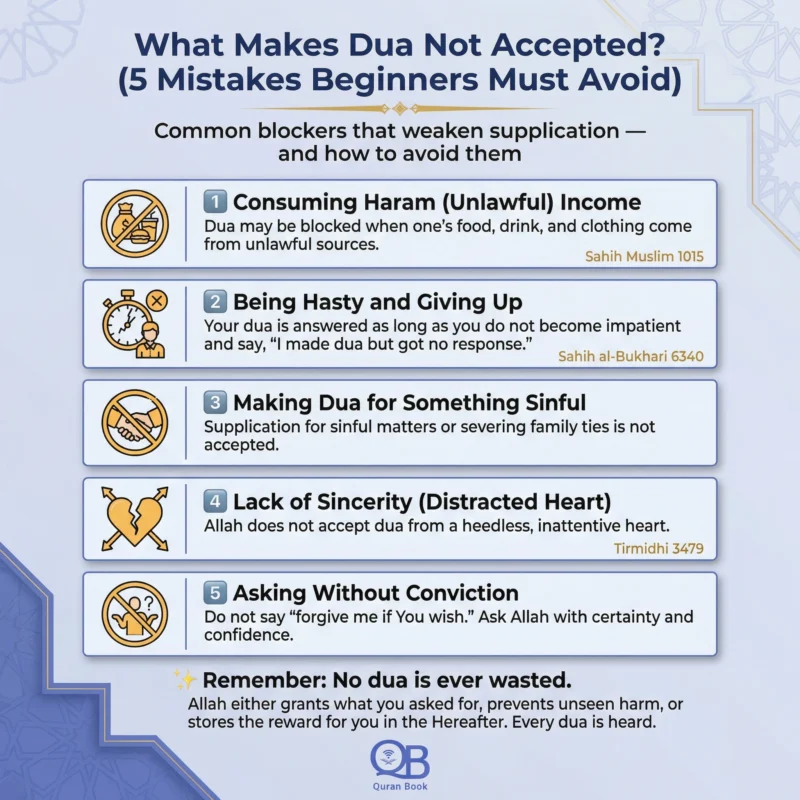
Dua may not be accepted due to consuming haram (unlawful) income, being hasty and giving up, making dua for something sinful, lack of sincerity, or not having conviction while asking. Avoiding these pitfalls is just as important as learning how to make dua for beginners.
Earning or consuming Haram is one of the most serious blockers. The Prophet ﷺ described a traveler, dusty and disheveled, raising his hands to the sky calling upon Allah — yet his food, drink, and clothing were all from unlawful sources, so how could his dua be answered? (Sahih Muslim 1015)
Being hasty and giving up is another trap. The Prophet ﷺ said your supplication is answered as long as you do not become impatient and say “I made dua but got no response” (Sahih al-Bukhari 6340). Patience is part of the dua itself.
Making dua for something sinful or for severing family ties is explicitly warned against.
A distracted, heedless heart weakens dua. Allah does not accept supplication from a heart that is wandering and inattentive (Tirmidhi 3479). When you speak to Allah, be fully present.
Lack of conviction — asking with an “if You want” mentality — contradicts the very spirit of supplication. Ask boldly. Ask with certainty.
💡 The most encouraging perspective: unanswered dua is never wasted. Allah either gives you what you asked for, prevents a harm you could not see, or stores it as reward for you in the Hereafter. Every single dua is heard.
The Academy Method — How Quran Book Academy Teaches Duas in Manageable Steps

At Quran Book Academy, we understand that learning Arabic duas can feel intimidating — especially for non-Arabic speakers in the USA, Canada, UK, and Australia. That is why we use a proven, psychology-backed teaching method that breaks learning into manageable chunks.
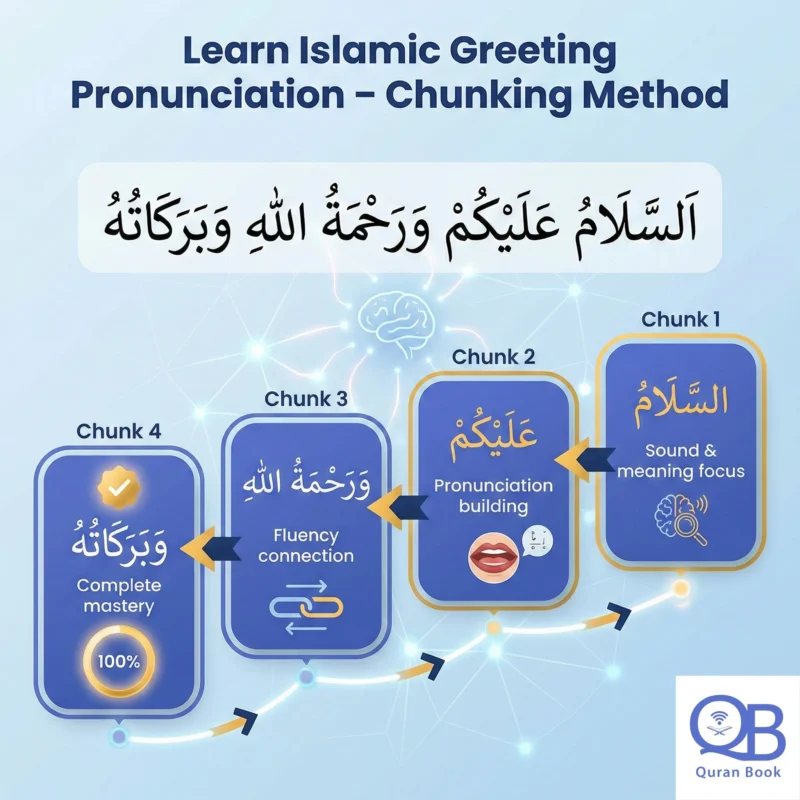
The Chunking Technique: We teach 1–2 duas per week, not 20 at once. Educational psychology shows that spaced repetition of small units leads to lasting memorization. Our students retain what they learn because they practice it daily before moving on.
The 3-Layer Approach: Every dua is taught in three stages — (1) Hear it pronounced correctly by a qualified teacher, (2) Read it with proper Tajweed, and (3) Use it in daily life so it becomes second nature.
Live on Zoom: All lessons are conducted live via Zoom with qualified teachers — real-time correction of pronunciation, personalized feedback, and genuine human connection. These are not pre-recorded videos.
Custom LMS Tracking: Our custom Learning Management System tracks every student’s progress. Parents and adult learners receive weekly Gmail progress reports showing mastery levels for each dua and Quran lesson.
For Kids and Adults: We offer separate learning tracks — a gamified, visual approach for children and a structured, flexible scheduling option for adults. Whether you are learning how to make dua for the first time or refining your Arabic pronunciation, there is a track for you.
Can I Make Dua in English? In Bed? In My Own Words? (Common Beginner Questions Answered)
Can I make dua in English? Yes, outside of Salah, you may make dua in any language. Allah understands all languages and hears every whisper of your heart. Start with the Arabic duas you know, then speak freely in English or your mother tongue.
Can I make dua in bed? Yes. There are specific Sunnah duas for bedtime (like “Bismika Allahumma amutu wa ahya”), and you may also make personal dua while lying down. Allah’s door is never closed.
Can I say my own dua? Absolutely. The Prophet ﷺ encouraged personal supplication alongside memorized Quranic and Sunnah duas. Speak to Allah about your worries, hopes, gratitude, and struggles in your own words.
Can I say sorry to Allah? Yes, seeking repentance (Tawbah) is itself a dua. Say “Astaghfirullah” (I seek forgiveness from Allah) and sincerely intend not to repeat the sin. Allah is Al-Ghaffar — the Repeatedly Forgiving. He loves those who turn back to Him.
What if my dua is not immediately answered? Be patient. The Prophet ﷺ said your dua is answered in one of three ways: you receive exactly what you asked for, a harm is prevented from reaching you, or it is stored as reward for you in the Hereafter (Musnad Ahmad 10749). No dua is ever lost.
Frequently Asked Questions (FAQ)
Q1: What are the basic duas of Islam?
The most basic duas include Bismillah (before eating), Alhamdulillah (after eating), the dua for waking up, sleeping, entering and leaving the house, and seeking forgiveness (Astaghfirullah). These are short, easy to memorize, and recommended daily by the Prophet ﷺ.
Q2: How do I begin my dua?
Begin by praising Allah (saying Alhamdulillah or Subhanallah), then send blessings on the Prophet ﷺ (Allahumma salli ala Muhammad), then make your request with sincerity and conviction.
Q3: Which dua brings provision and sustenance?
The Quran teaches that Istighfar (seeking forgiveness) is a means of abundance. In Surah Nuh 71:10-12, Allah connects constant repentance with increased provision, rain, wealth, and children.
Q4: What dua is for forgiveness of major sins?
Sayyid al-Istighfar (the master supplication for forgiveness) reported in Sahih al-Bukhari 6306 is the most powerful dua for forgiveness. Sincere Tawbah (repentance) with a genuine intention not to repeat the sin is the door to Allah’s mercy.
Q5: What are the best times to make dua?
The best times include the last third of the night, during prostration (sujood), between adhan and iqamah, on Fridays, while fasting before iftar, and after obligatory prayers.
Q6: What makes dua not accepted?
Dua may be hindered by consuming haram income, being impatient, making dua for something sinful, or having a heedless and distracted heart. The Prophet ﷺ urged persistence and sincerity.
Q7: Can I make dua for someone else?
Yes, and it is highly virtuous. The Prophet ﷺ said that when a Muslim makes dua for a brother or sister in their absence, an angel says “Ameen, and for you likewise” (Sahih Muslim 2733).
Start Your Dua Journey Today — Free Trial Lesson at Quran Book Academy

You have now learned how to make dua for beginners — the steps, the etiquette, the best times, and 7 essential duas to start with. But reading is only the first step. The real transformation happens when you hear the Arabic pronounced correctly, practice it with a qualified teacher, and build it into your daily life.
References
- 1. Surah Al-Baqarah 2:186 — “Indeed I am near…”
- 2. Tirmidhi 3371 — Dua is the essence of worship
- 3. Surah Ghafir 40:60 — “Call upon Me; I will respond”
- 4. Tirmidhi 3477 — Begin dua with praise
- 5. Tirmidhi 3479 — Certainty in dua
- 6. Sahih al-Bukhari 6339 — Ask with conviction
- 7. Tirmidhi 486 — Dua suspended until Salawat
- 8. Sahih al-Bukhari 6324 — Waking & sleeping duas
- 9. Abu Dawood 3767 — Dua before eating
- 10. Sahih al-Bukhari 6306 — Sayyid al-Istighfar
- 11. Abu Dawood 5095 — Leaving the house
- 12. Sahih al-Bukhari 1166 — Istikhara prayer
- 13. Quran 2:201 — Rabbana Atina
- 14. Sahih Muslim 2690 — Most frequent dua of the Prophet ﷺ
- 15. Sahih al-Bukhari 1145 — Last third of the night
- 16. Sahih Muslim 482 — Dua in sujood
- 17. Abu Dawood 521 — Between adhan & iqamah
- 18. Sahih al-Bukhari 935 — Friday dua
- 19. Tirmidhi 3598 — Fasting person’s dua
- 20. Sahih Muslim 1015 — Haram income blocks dua
- 21. Sahih al-Bukhari 6340 — Don’t be hasty in dua
- 22. Quran 71:10-12 — Istighfar for provision
- 23. Sahih Muslim 2733 — Dua for others