🏠 Home About
🕌 About Us ⚙️ How It Works 👨‍🏫 Meet Our Teachers
🧒 For Kids
Fiqh for Kids Arabic Online for Kids Islamic School for Kids Tajweed Made Easy Quran Memorization Nour El Bayan Noorani Qaida
👨 For Adults
Tajweed for Adults Islamic School for Adults Quran Memorization Arabic Online Online Quran for Adults
🧕 Ladies Section
Online Quran for Ladies Islamic Studies for Sisters Female Quran Teachers
✨ More Programs
Online Islamic School Quran with Tajweed Quranic Arabic Ijaza in Quran Online Quran Classes Qiraat Course Online Hifz Course Quran Memorization Course New Muslim Programs
📝 Articles 💰 Price 🎁 Free Trial

Author: rabieabdo06841@gmail.com

  • benefits of learning arabic for quran

    7 Powerful Benefits of Learning Arabic for Quran | Quran Book Academy
    Comprehensive Guide 2026

    7 Powerful Benefits of Learning Arabic for Quran That Will Transform Your Recitation

    Published by Quran Book Academy · Expert Islamic Education Since 2018

    Start Your Free Trial Lesson
    Student experiencing the benefits of learning Arabic for Quran at Quran Book Academy
    A Muslim student experiencing the spiritual and educational journey of learning Quranic Arabic

    Why Every Muslim Should Discover the Benefits of Learning Arabic for Quran

    The benefits of learning Arabic for Quran go far beyond simply reading words on a page. When you learn Arabic for Quran, you unlock a direct, unfiltered connection with Allah’s words—hearing His guidance exactly as it was revealed. For non-Arabic speakers, this journey may feel overwhelming at first, but it is one of the most rewarding steps a Muslim can take in their spiritual life.

    You may be thinking: “I’m too old to start,” or “Arabic looks impossible.” These feelings are completely natural, and you are not alone. At Quran Book Academy, we have guided thousands of students—from complete beginners to confident reciters—using a step-by-step method built on educational psychology and Islamic pedagogy. Whether you are a busy professional in the USA, a parent in Canada, or a student in the UK, our approach meets you exactly where you are.

    In this comprehensive guide, we will explore the life-changing benefits of learning Arabic for Quran, explain why the Quran was revealed in Arabic, share a proven method for learning Quranic Arabic, and show you how to get started today—completely free.

    Why Is the Quran in Arabic? Understanding Allah’s Choice

    Open Quran book in Arabic showing why learning Arabic for Quran preserves divine meaning
    An open Quran displaying Arabic calligraphy — the linguistic miracle of the divine revelation

    The Quran was revealed in Arabic because Allah chose it as the most eloquent and precise language to convey His message. Surah Yusuf (12:2) states: “Indeed, We have sent it down as an Arabic Quran so that you might understand.” Arabic’s unique grammar preserves layers of meaning that no translation can fully capture, making the importance of Arabic language for understanding Islam undeniable.

    This concept is known as the linguistic miracle, or I’jaz, of the Quran. The Arabic language possesses a richness in its morphology, syntax, and rhetorical devices that makes it uniquely suited for divine revelation. Surah Az-Zumar (39:28) emphasizes: “An Arabic Quran, without any crookedness,” highlighting that the language itself was chosen to preserve the purity and precision of the message.

    Surah Fussilat (41:3) further reinforces this: “A Book whose verses have been detailed, an Arabic Quran for a people who know.” Scholars throughout Islamic history have echoed this understanding. Umar ibn al-Khattab (RA) famously said: “Learn Arabic, for it is part of your religion.” This is why the Quran is in Arabic—the language is inseparable from the message itself.

    When you understand this, the benefits of learning Arabic for Quran become even clearer: you are not merely learning a language—you are accessing the very vessel Allah chose to deliver His guidance to humanity.

    7 Benefits of Learning Arabic for Quran Every Muslim Needs to Know

    Now let us explore the seven most transformative benefits of learning Arabic for Quran that can reshape your relationship with Allah’s Book.

    1

    Understand the Quran Directly Without Translation

    Learning Arabic for Quran allows you to understand Allah’s words in their original form, bypassing the limitations of translation. You experience the full depth of meaning, context, and emotion that translators simply cannot replicate. Surah Ibrahim (14:4) reminds us: “We have not sent a messenger except in the language of his people.” When you learn Arabic, you become part of that direct conversation.

    Translations, while valuable, are inherently limited. A single Arabic word in the Quran can carry multiple layers of meaning—historical, grammatical, and spiritual—that a translator must reduce to one English equivalent. By learning Quranic Arabic grammar, you access all those layers yourself.

    2

    Perfect Your Tajweed and Quran Recitation

    When you learn Arabic for Quran, you naturally improve your Tajweed—the correct pronunciation and articulation of every letter. Understanding makhraj huruf (articulation points) becomes intuitive rather than mechanical, leading to beautiful and accurate recitation.

    The Prophet (PBUH) said: “The one who is proficient in the Quran will be with the noble and obedient angels.” (Sahih al-Bukhari 4937). Mastering Tajweed rules through Arabic knowledge transforms your recitation from hesitant reading into a flowing, melodious experience that honors the divine text.

    3

    Deepen Your Salah and Spiritual Connection

    Deepening Salah connection through learning Arabic for Quran and understanding prayer
    Deep spiritual connection through understanding Quranic Arabic during daily Salah

    Knowing Arabic transforms your daily prayers from routine repetition into a heartfelt conversation with Allah. You understand every word of Al-Fatiha, every supplication, and every verse recited in Salah. This is one of the most personally impactful benefits of learning Arabic for Quran—your five daily prayers become moments of genuine connection and reflection, not just physical motions.

    Imagine standing in prayer and truly comprehending the words “Ihdina as-sirat al-mustaqeem”—feeling the weight of asking Allah for guidance on the straight path. This level of spiritual engagement is only possible when you understand the Arabic language for Islam at its core.

    4

    Access Classical Islamic Scholarship

    Arabic opens the door to Tafsir (Quran commentary), Hadith collections, and centuries of Islamic scholarship in their original language. Works by scholars like Ibn Kathir, Al-Qurtubi, and An-Nawawi were written in Arabic, and their insights carry nuances that are inevitably lost in translation. The benefits of Arabic language extend far beyond the Quran itself—they grant you access to the entire Islamic intellectual tradition.

    5

    Boost Cognitive Skills and Memory

    Research in educational psychology shows that learning a new language, especially one with a different script like Arabic, strengthens neural pathways associated with memory, attention, and problem-solving. Studies have found that bilingual individuals demonstrate significant improvement in executive function tasks compared to monolinguals.

    For Muslims learning Arabic for Quran, this cognitive benefit is compounded by the memorization (Hifz) tradition. Regularly memorizing Quran verses builds long-term memory capacity and mental discipline. The structured repetition used in Quranic memorization mirrors evidence-based spaced repetition techniques used in modern education.

    At Quran Book Academy, our teaching methodology leverages these psychological principles by breaking Arabic learning into manageable “chunks”—small, achievable lessons that build confidence and reduce overwhelm. This approach aligns with the Chunking Theory in cognitive psychology and makes even the Arabic alphabet for beginners feel approachable and achievable.

    6

    Protect Yourself from Misinterpretation

    Reading the Quran in Arabic ensures you receive the message as Allah intended. Translations vary significantly depending on the translator’s perspective, linguistic choices, and cultural background. By learning Arabic, you gain the ability to verify meanings independently, cross-reference with Tafsir, and protect yourself from misunderstandings that can arise from relying solely on translated texts.

    This is a crucial yet often overlooked benefit of learning Arabic for Quran. In a world where misinformation about Islam is widespread, having direct access to the source material empowers you to engage with your faith on your own terms.

    7

    Earn Greater Rewards (Ajr) with Every Letter
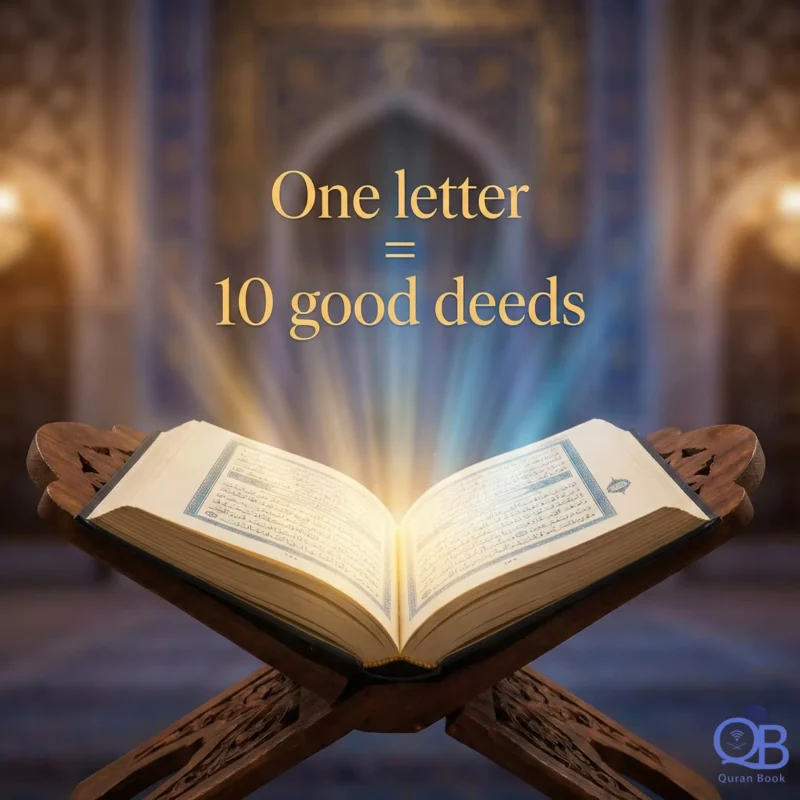
    Earning spiritual rewards by learning Arabic for Quran and reciting with Tajweed
    Light emanating from the Quran — symbolizing multiplied spiritual rewards through Arabic recitation

    The Prophet (PBUH) said: “Whoever reads a letter from the Book of Allah will receive a hasanah (good deed), and the hasanah is multiplied by ten.” (Jami’ at-Tirmidhi 2910). Learning Arabic for Quran amplifies this reward by enabling you to recite Quran with Tajweed, understanding, and reflection.

    Every moment spent learning Arabic is an investment in both your worldly education and your eternal rewards. The more fluently you read, the more letters you recite, and the greater your accumulation of hasanat. This spiritual incentive makes learning Arabic one of the highest-return activities a Muslim can pursue.

    How to Learn Arabic for Quran Step-by-Step (The Academy Method)
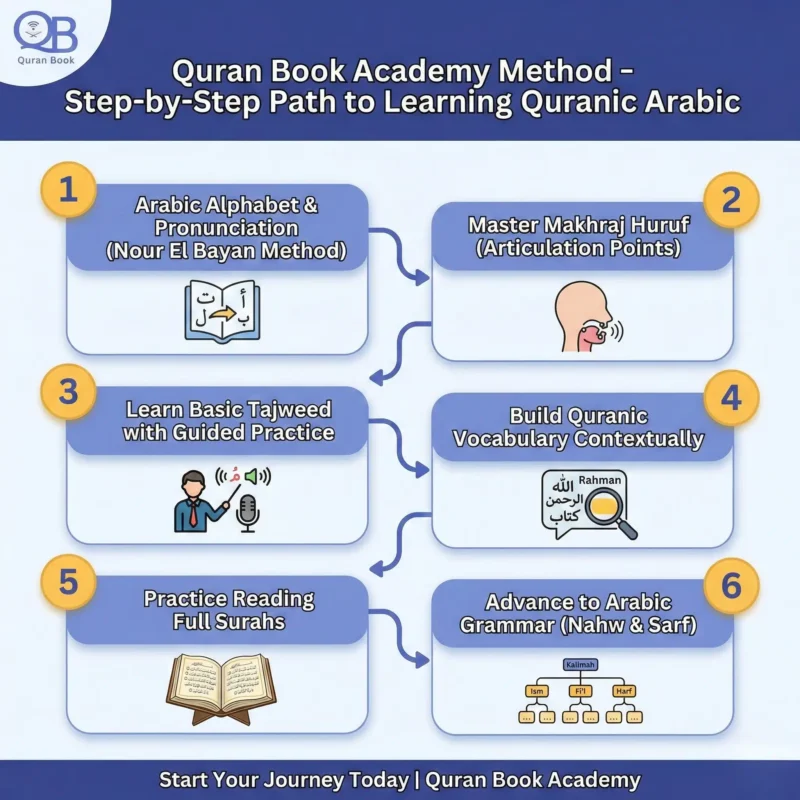
    How to learn Arabic for Quran step-by-step using the Academy Method at Quran Book Academy
    The six steps of the Academy Method for learning Quranic Arabic

    If you are wondering how to learn Arabic for Quran, Quran Book Academy has developed a proven, step-by-step method that has helped thousands of students achieve Quran reading fluency. Here is the Academy Method:

    1

    Start with the Arabic alphabet and pronunciation using the Nour El Bayan method—a renowned pedagogical approach that introduces letters systematically.

    2

    Master makhraj huruf (articulation points) for each letter, ensuring correct sound production from the very beginning.

    3

    Learn basic Tajweed rules through guided practice with a certified teacher who provides real-time feedback.

    4

    Build Quranic vocabulary through contextual learning—understanding words as they appear in the Quran, not in isolation.

    5

    Practice reading full Surahs with a certified instructor to develop fluency and confidence.

    6

    Advance to Arabic grammar (Nahw & Sarf) for deeper understanding of sentence structure and word derivation.

    This structured progression—from reading to Tajweed to grammar to understanding—ensures that every student builds a solid foundation. The Nour El Bayan method is available on the Quran Book Academy YouTube channel, and makhraj huruf video lessons are also accessible for self-study.

    Best Way to Learn Arabic for Quran Online with Live Teachers
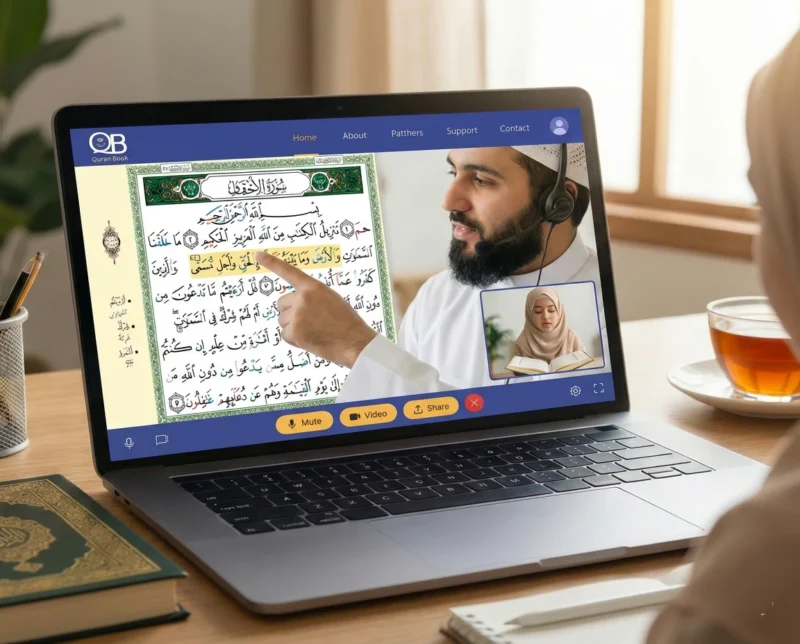
    Learn Arabic for Quran online with live teachers at Quran Book Academy via Zoom
    Live online Quran class with real-time interaction and Tajweed correction via Zoom

    The best online Quranic Arabic course combines the convenience of remote learning with the effectiveness of live, interactive instruction. At Quran Book Academy, we believe that the best way to learn Quranic Arabic is through real-time sessions with certified teachers who can correct your pronunciation, answer your questions, and adapt to your pace.

    Our technology stack is designed to support your learning journey at every step. We use Zoom for live one-on-one and group sessions with screen sharing for real-time correction. Our custom Learning Management System (LMS) tracks student progress, lesson completion, quiz scores, and Tajweed milestones. Weekly Gmail progress reports are sent to students and parents with actionable feedback. And our Telegram channel serves as a community practice group for Quran reading with Tajweed corrections.

    When you learn Arabic for Quran online with Quran Book Academy, you get the structure of a traditional Islamic classroom combined with the flexibility and accessibility of modern technology. Classes are available for students in the USA, Canada, UK, and Australia, with flexible scheduling to accommodate different time zones.

    Reading Quran in Arabic vs. Translation: A Clear Comparison

    To fully appreciate the benefits of learning Arabic for Quran, it helps to see a direct comparison between reading in Arabic and relying on translation alone.

    Aspect Arabic (Original) Translation Only
    Meaning Depth Full semantic layers and nuance Approximation; translator-dependent
    Tajweed Natural pronunciation and rhythm Not applicable
    Spiritual Reward Reward for every Arabic letter Reward for effort, less for recitation
    Salah Understanding Full comprehension in prayer Requires separate memorization
    Scholarly Access Direct access to Tafsir & Hadith Limited to translated works
    Emotional Impact Original rhetorical power (I’jaz) Diluted emotional resonance
    Misinterpretation Minimal with proper knowledge Higher due to translator choices

    As the table above illustrates, while translations serve as a helpful starting point, they cannot replace the depth, beauty, and spiritual reward of engaging with the Quran in its original Arabic. This is precisely why the benefits of learning Arabic for Quran are so transformative.

    How to Overcome the Fear of Learning Arabic for Quran

    Overcoming the fear of learning Arabic for Quran with supportive teaching methods
    From fear and hesitation to confidence — a student’s journey through structured Arabic learning

    To overcome the fear of learning Arabic for Quran, start with small, achievable goals—like learning five new letters per week. Choose a structured course with a supportive teacher, use the Nour El Bayan method for gradual progression, and remember that every effort you make is rewarded by Allah.

    Many students hesitate because they feel they are too old, too busy, or simply not talented enough to learn a new language. These feelings are natural, but they are not facts. The truth is that Arabic can be learned at any age, and the Quran itself was meant to be understood by all people—not just scholars.

    The Prophet (PBUH) encouraged this journey: “The best of you are those who learn the Quran and teach it.” (Sahih al-Bukhari 5027). Notice that he did not say “the youngest of you” or “the most talented of you.” The best are simply those who begin.

    At Quran Book Academy, we use the “chunking” approach—breaking how to read Quran in Arabic correctly into small, manageable pieces that reduce overwhelm and build confidence step by step. Our student success stories prove that anyone, regardless of age or background, can achieve fluency with the right support.

    Frequently Asked Questions About Learning Arabic for Quran

    Q: Does learning Arabic help with the Quran?
    Yes, learning Arabic is one of the most effective ways to deepen your understanding of the Quran. It allows you to access the original meaning, improve Tajweed, and build a stronger spiritual connection during Salah and personal study. The benefits of learning Arabic for Quran are both spiritual and intellectual.
    Q: Should I learn Arabic to understand the Quran?
    While translations provide a starting point, learning Arabic for Quran gives you a direct understanding of Allah’s words. Even basic Arabic knowledge can dramatically improve your comprehension and recitation quality. Quran Book Academy offers a structured Quran Reading Course for beginners.
    Q: Is it better to read the Quran in Arabic?
    Yes. Reading the Quran in Arabic preserves the original meaning, rhythm, and linguistic miracle (I’jaz) that translations cannot fully convey. The Prophet (PBUH) recited in Arabic, and the reward for reading each Arabic letter is multiplied. (Jami’ at-Tirmidhi 2910).
    Q: What does Allah say about learning Arabic?
    While there is no direct Quranic verse commanding Muslims to learn Arabic, Allah revealed the Quran in Arabic (Surah Yusuf 12:2) and scholars like Umar ibn al-Khattab encouraged Arabic learning as part of the faith. Understanding Arabic enables you to fulfill the command to reflect on the Quran (Surah Muhammad 47:24).
    Q: What are the advantages of learning Arabic?
    The advantages include understanding the Quran directly, perfecting Tajweed, deepening prayer, accessing Islamic scholarship, boosting cognitive abilities, protecting against misinterpretation, and earning greater spiritual rewards. See our full 7 benefits section above for a detailed breakdown.
    Q: How long does it take to learn Arabic for Quran?
    With consistent practice of three to four sessions per week, most beginners can read Arabic fluently within three to six months using the Nour El Bayan method. Understanding Quranic Arabic at a deeper grammatical level may take one to two years depending on your goals. Quran Book Academy offers a Free Trial Lesson to help you get started.
    Q: What is the best way to learn Quranic Arabic?
    The best way is through structured, live classes with a certified teacher. At Quran Book Academy, we combine the Nour El Bayan method, Tajweed instruction, and Quranic vocabulary in manageable lessons via Zoom. Our custom LMS tracks your progress and ensures accountability throughout your learning journey.

    Start Your Free Trial Lesson at Quran Book Academy

    Start your free trial lesson to experience benefits of learning Arabic for Quran at Quran Book Academy
    Book your free trial — experience the Quran Book Academy method firsthand

    You have now seen the incredible benefits of learning Arabic for Quran—from understanding Allah’s words directly to earning greater rewards with every letter. The question is not whether you should start; it is how soon.

    Free Trial Lesson – No commitment, no pressure

    Certified Teachers – Native Arabic-speaking instructors with Ijazah

    Flexible Scheduling – USA, Canada, UK, Australia

    Proven Results – Thousands of students, from beginners to confident reciters

    ➡ Book Your Free Trial Lesson Now

    “The best of you are those who learn the Quran and teach it.” (Sahih al-Bukhari 5027). Your journey starts with a single step. Let us walk it with you.

    References

    Quranic Verses

    1. 1. Surah Yusuf 12:2 — Revelation of the Quran in Arabic
    2. 2. Surah Az-Zumar 39:28 — Purity of the Arabic Quran
    3. 3. Surah Fussilat 41:3 — Detailed Book in Arabic
    4. 4. Surah Ibrahim 14:4 — Messengers in the language of their people
    5. 5. Surah Muhammad 47:24 — Reflecting upon the Quran

    Hadith Collections

    1. 6. Sahih al-Bukhari 4937 — Proficiency in Quran recitation
    2. 7. Sahih al-Bukhari 5027 — The best are those who learn and teach the Quran
    3. 8. Jami’ at-Tirmidhi 2910 — Reward for every letter of Quran
    Academy Resources

    1. 9. YouTube: Makhraj al-Huruf Video Lessons
    2. 10. YouTube: Nour El Bayan Course Playlist
    3. 11. Telegram: Tajweed Practice Community
  • mashallah meaning guide

    Mashallah Meaning: 7 Powerful Ways to Use It Correctly in 2025
    Quran Book Academy
    Start Free Trial

    Mashallah Meaning: 7 Powerful Ways to Use It Correctly in 2025

    A complete guide to the meaning, usage, and spiritual depth of one of Islam’s most beautiful expressions.

    QA
    Quran Book Academy Published 2025 · 15 min read

    Why Understanding Mashallah Meaning Changes How You Practice Islam

    Mashallah meaning — Muslim family expressing gratitude and blessings together
    Mashallah meaning — Muslim family expressing gratitude and blessings together

    Mashallah meaning in English is “God has willed it” or “What Allah has willed.” Muslims say Mashallah to express admiration, gratitude, and protection from the evil eye. Understanding its correct usage strengthens your daily Islamic practice and deepens your connection with Allah’s blessings.

    If you have ever felt unsure whether you are saying Mashallah at the right time, or worried about making mistakes with Arabic phrases, you are not alone. Thousands of new Muslims and non-Arabic speakers across the USA, UK, Canada, and Australia share the same concern.

    The fear of mispronunciation, cultural intimidation, and simply not knowing when to use certain expressions can feel overwhelming at first. But the good news is that learning the mashallah meaning is simpler than you think — and this guide will walk you through it step by step.

    Learning Islamic phrases is a journey, not a test. Every Muslim — whether born into the faith or a new revert — started by learning one word at a time.

    The mashallah meaning is deeply rooted in the Quran itself. In Surah Al-Kahf (18:39), Allah recounts the story of two men, where the righteous one advises his companion: “It was better for him to say, when he entered his garden: That which Allah wills (Mashallah)! There is no power but with Allah.”

    This verse reminds us that acknowledging Allah’s will is not just a cultural habit — it is a Quranic instruction and a shield of humility. By the end of this article, you will understand the full mashallah meaning, know exactly when and how to say it, and feel confident using it in your everyday conversations.

    Explore our full range of Islamic Courses for Kids and Adults at Quran Book Academy to deepen your understanding further.

    What Is the Actual Mashallah Meaning in English?

    The actual mashallah meaning is “What Allah has willed” or “God has willed it.” It comes from three Arabic words: “Ma” (what), “Sha” (willed), and “Allah” (God). Muslims say it to acknowledge that all good things come from Allah and to express wonder at His creation.

    This phrase carries a profound spiritual weight. When a Muslim says Mashallah, they are essentially declaring that whatever beauty, success, or goodness they see before them exists solely because Allah willed it. It removes arrogance from the heart and replaces it with gratitude and humility.

    Mashallah in Arabic Script and Transliteration

    Mashallah meaning transliteration guide showing Arabic script and English spellings
    Mashallah meaning transliteration guide showing Arabic script and English spellings

    Here is a quick reference for the correct way to write and spell Mashallah:

    Arabic Script Transliteration Common English Spellings
    ما شاء الله Mā shāʾ Allāh MashAllah, Masha’Allah, Ma Sha Allah

    Whether you write it as MashAllah, Masha’Allah, or Ma Sha Allah, the mashallah meaning remains the same. It is an expression of awe and recognition of Allah’s divine will.

    The Quranic Origin of Mashallah

    The mashallah meaning has its strongest roots in Surah Al-Kahf (18:39). The story tells of two men: one who owned a lush, prosperous garden and boasted about his wealth, and another who humbly reminded him that all blessings come from Allah.

    The righteous man told his companion that he should have said “Mashallah, La Quwwata Illa Billah” — meaning “What Allah has willed! There is no power except with Allah.”

    The lesson is timeless. Mashallah is not just a word of praise — it is a shield of humility and gratitude. It reminds us that no matter how impressive something appears, it exists only because Allah decreed it. This Quranic foundation makes the mashallah meaning much deeper than a simple cultural expression. Strengthen your understanding through our Online Quran Classes.

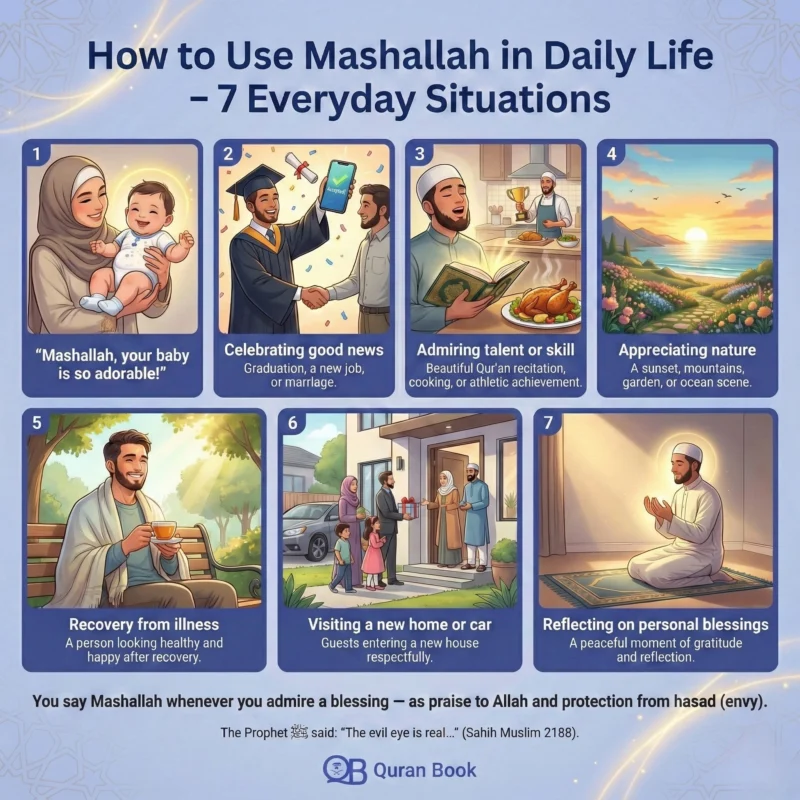
    How to Use Mashallah Correctly — 7 Everyday Situations

    How to use mashallah meaning correctly in 7 everyday Muslim life situations
    How to use mashallah meaning correctly in 7 everyday Muslim life situations

    You use Mashallah correctly by saying it whenever you admire something good — a child’s achievement, someone’s health, a new home, or any blessing. It serves as both praise to Allah and protection from the evil eye (hasad).

    Here are the seven most common everyday situations where saying Mashallah is appropriate:

    01

    When you see a beautiful child or baby

    Saying “Mashallah, your baby is so adorable!” is one of the most common uses. The mashallah meaning here combines admiration with a prayer of protection over the child.

    02

    When someone shares good news

    Whether it is a new job, a graduation, or a marriage announcement, responding with Mashallah shows you recognize Allah’s hand in their blessing.

    03

    When admiring someone’s talent or skill

    Hearing beautiful Quran recitation, tasting someone’s cooking, or watching an athletic achievement — all are perfect moments to say Mashallah.

    04

    When you see something beautiful in nature

    Sunsets, mountains, blooming gardens, the ocean — Allah’s creation constantly inspires the mashallah meaning in our hearts.

    05

    When someone recovers from illness

    Expressing “Mashallah, you look so much better!” conveys gratitude for Allah’s mercy in restoring their health.

    06

    When visiting someone’s new home or car

    Saying Mashallah when entering someone’s new space is both respectful and protective, guarding their blessing from envy.

    07

    When reflecting on your own blessings

    The mashallah meaning is not only for others. Looking at your own life and whispering Mashallah is a personal act of gratitude and spiritual protection.

    The Prophet Muhammad ﷺ confirmed the reality of the evil eye when he said: “The evil eye is real…” (Sahih Muslim 2188). Saying Mashallah is directly connected to protecting yourself and others from hasad (envy). It is a sunnah-based practice rooted in both Quran and Hadith.

    Enroll your children in our Islamic Studies for Kids program and join our Quran Book Academy Telegram Channel for daily practice support.

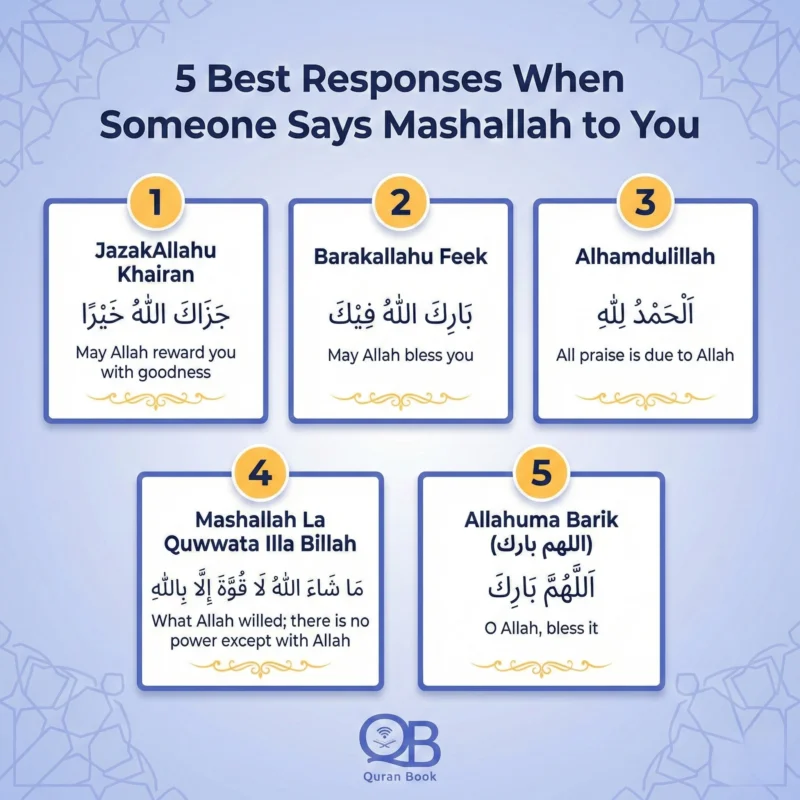
    How to Reply to Mashallah — The Complete Response Guide

    How to reply to Mashallah meaning — best Islamic responses and phrases guide
    How to reply to Mashallah meaning — best Islamic responses and phrases guide

    When someone says Mashallah to you, the best replies are “JazakAllahu Khairan” (May Allah reward you), “Barakallahu Feek” (May Allah bless you), or simply “Alhamdulillah” (All praise is due to Allah). Each response shows gratitude and acknowledges the blessing.

    5 Best Responses When Someone Says Mashallah to You

    Understanding the mashallah meaning also means knowing how to respond gracefully. Here are the five best responses:

    # Response Arabic Meaning
    1 JazakAllahu Khairan جزاك الله خيرًا May Allah reward you with goodness
    2 Barakallahu Feek بارك الله فيك May Allah bless you
    3 Alhamdulillah الحمد لله All praise is due to Allah
    4 Mashallah La Quwwata Illa Billah ما شاء الله لا قوة إلا بالله What Allah willed; there is no power except with Allah
    5 Allahuma Barik اللهم بارك O Allah, bless it

    The most complete Quranic response is “Mashallah La Quwwata Illa Billah,” which directly mirrors the verse in Surah Al-Kahf. However, in daily conversation, any of these five responses is appropriate and beautiful. Learn proper Arabic pronunciation through our Arabic Language Course.

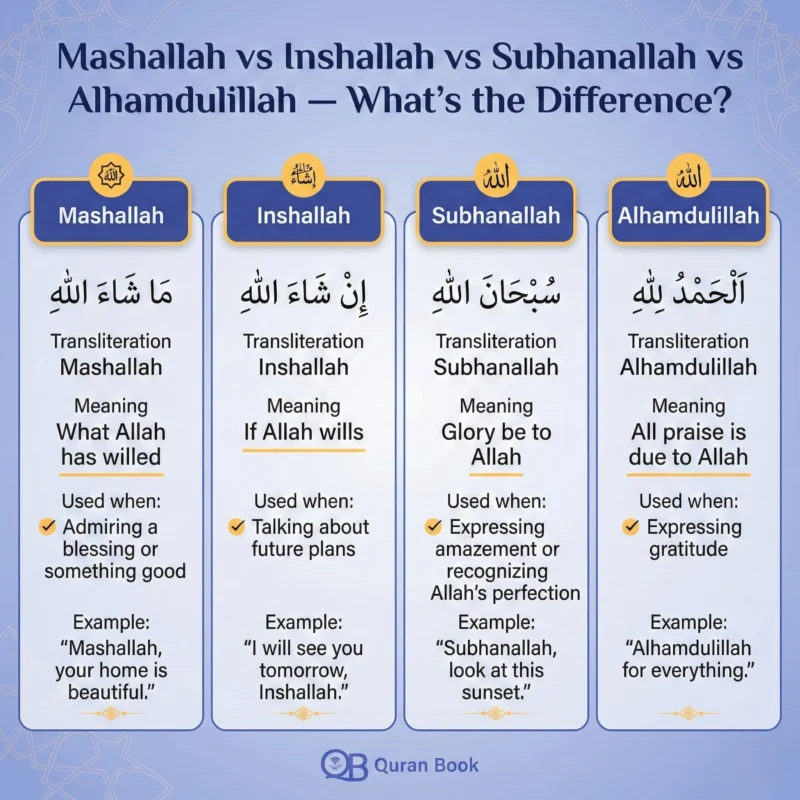
    Mashallah vs Inshallah vs Subhanallah vs Alhamdulillah — What’s the Difference?

    Mashallah meaning vs Inshallah vs Subhanallah vs Alhamdulillah — differences explained
    Mashallah meaning vs Inshallah vs Subhanallah vs Alhamdulillah — differences explained

    Mashallah means “God has willed it” and is used for admiration. Inshallah means “If God wills” for future events. Subhanallah means “Glory be to God” for amazement. Alhamdulillah means “Praise be to God” for gratitude.

    Each phrase has a distinct purpose in a Muslim’s vocabulary. Many people confuse these expressions, so here is a clear comparison:

    Phrase Arabic Meaning When to Use
    Mashallahما شاء اللهWhat Allah has willedAdmiring something present
    Inshallahإن شاء اللهIf Allah willsSpeaking about the future
    Subhanallahسبحان اللهGlory be to AllahAmazement or glorification
    Alhamdulillahالحمد للهPraise be to AllahExpressing gratitude
    TabarakAllahتبارك اللهBlessed is AllahDeep admiration and glorification

    Understanding the mashallah meaning alongside these related phrases helps you speak with greater clarity and spiritual precision.

    What Is Mashallah TabarakAllah Meaning?

    The combined phrase “Mashallah TabarakAllah” translates to “What Allah has willed; Blessed is Allah.” Muslims use this expression when they witness something truly remarkable.

    It adds a layer of glorification on top of the admiration that Mashallah alone carries. In Arab culture, saying Mashallah TabarakAllah is common when seeing something exceptionally beautiful — such as a newborn, a stunning Quran recitation, or a life-changing accomplishment.

    The mashallah meaning becomes even more powerful when paired with TabarakAllah.

    Can I Say Subhanallah and Alhamdulillah Together?

    Yes, absolutely. Combining SubhanAllah and Alhamdulillah is a beautiful and recommended form of dhikr (remembrance of Allah).

    The Prophet Muhammad ﷺ said: “Two words which are light on the tongue, heavy on the Scale, and beloved to the Most Merciful: SubhanAllahi wa bihamdihi, SubhanAllahil-Azeem” (Sahih al-Bukhari 6406). Pairing these phrases in your daily remembrance earns tremendous reward and draws you closer to Allah.

    How Quran Book Academy Teaches Islamic Phrases the Right Way

    At Quran Book Academy, learning Islamic phrases like Mashallah, Inshallah, and Alhamdulillah does not feel overwhelming — it feels like a natural part of your spiritual growth. The teaching methodology is built on the principle of manageable psychological “chunks,” a proven educational technique where complex knowledge is broken into small, digestible lessons.

    Whether you are an adult learner juggling work and family, or a parent enrolling your child in Islamic Courses for Kids, every lesson is designed to remove the fear of failure and replace it with steady progress.

    Live sessions are conducted via Zoom with certified teachers, and every student’s journey is tracked through a custom LMS (Learning Management System) which sends detailed progress reports to parents and adult learners.

    Free downloadable resources are also available, including a Reward Chart for Salah, a Salah Lesson Plan for Kids, and a Prayer Chart for Kids in Islam — tools that make daily practice fun and structured. This is not just an online course — it is a complete Islamic learning ecosystem designed around how the brain actually learns.

    Explore our Online Quran Classes for Adults and join the Quran Book Academy YouTube Channel and Telegram Channel for ongoing support.

    What We Offer — Islamic Courses for Kids and Adults

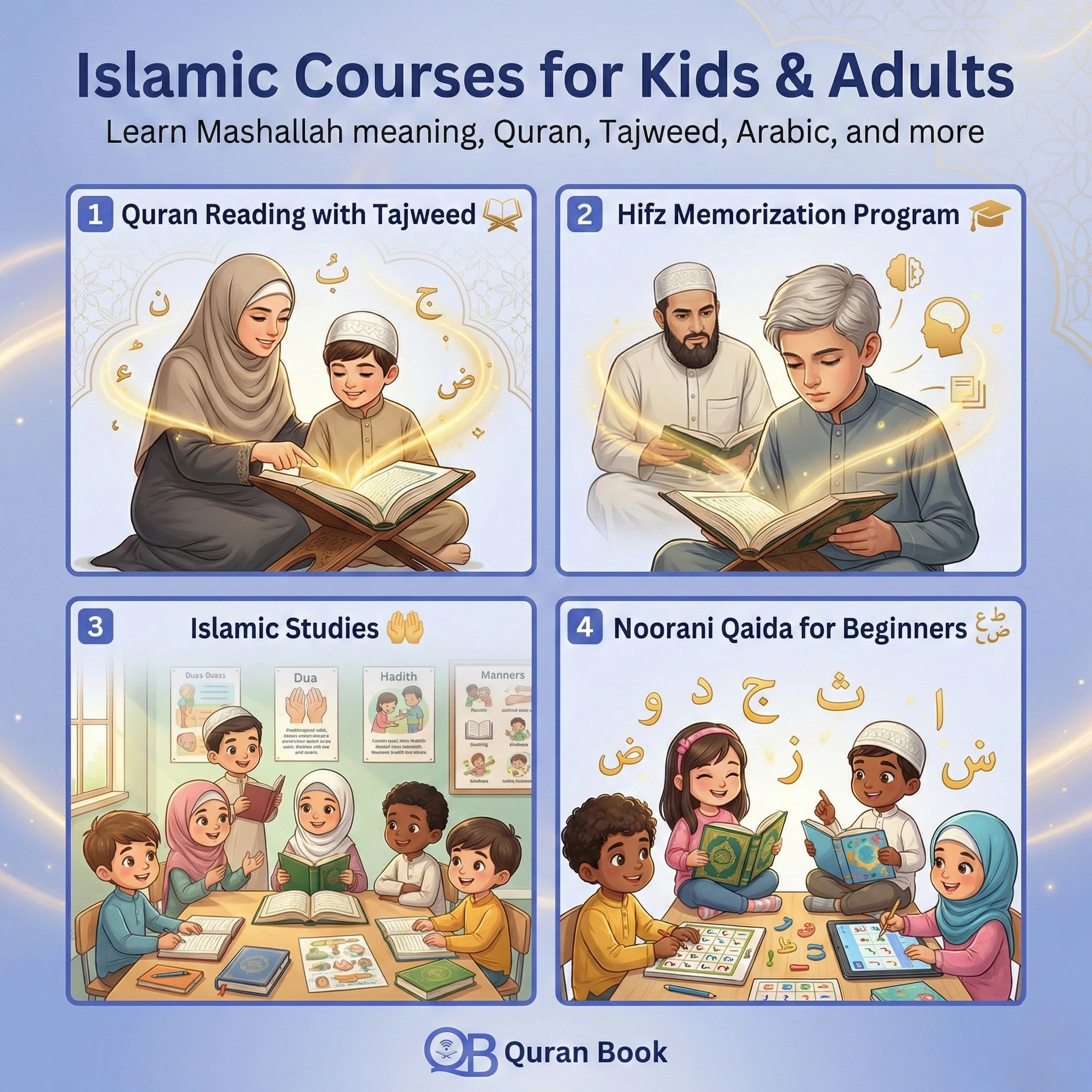
    Islamic courses for kids and adults — learn mashallah meaning, Quran, Tajweed, and Arabic
    Islamic courses for kids and adults — learn mashallah meaning, Quran, Tajweed, and Arabic

    Quran Book Academy offers a comprehensive range of courses designed for every level of learner. Available programs include Quran Reading with Tajweed, Quran Memorization (Hifz), Islamic Studies, Arabic Language, and Noorani Qaida for absolute beginners.

    Free resources such as the Reward Chart for Salah, Salah Lesson Plan for Kids, and Prayer Chart for Kids in Islam are included to support students between sessions.

    Our Tech Stack — How We Deliver World-Class Learning

    The Academy uses Zoom for live one-on-one and group sessions. A custom LMS tracks progress, attendance, and milestones automatically.

    Gmail reports are sent to parents weekly, and a dedicated Telegram Channel supports students in practicing Quran reading with Tajweed between sessions. This technology-powered approach ensures that learning the mashallah meaning — and the full Islamic curriculum — happens in a structured and supportive environment.

    Frequently Asked Questions About Mashallah Meaning

    Q. What is the actual meaning of Mashallah?

    Mashallah literally means “What Allah has willed.” It is used by Muslims to express admiration and gratitude while acknowledging that all good things come from Allah alone.

    The mashallah meaning also includes an element of protection from the evil eye, making it both a phrase of praise and a spiritual shield.

    Q. How to use Mashallah correctly?

    Say Mashallah when you admire something — a person’s beauty, a child’s achievement, someone’s health, or any blessing. It shows you recognize Allah’s will behind all good things.

    Always say it sincerely from the heart, and remember that the mashallah meaning is rooted in humility, not flattery.

    Q. How to reply to Mashallah?

    The best replies include “JazakAllahu Khairan” (May Allah reward you), “Barakallahu Feek” (May Allah bless you), or “Alhamdulillah” (All praise to Allah).

    The full Quranic response is “Mashallah La Quwwata Illa Billah,” which comes directly from Surah Al-Kahf.

    Q. What can I say instead of Masha Allah?

    You can say “TabarakAllah” (Blessed is Allah), “Allahuma Barik” (O Allah, bless it), or “SubhanAllah” (Glory to Allah). Each carries a similar spirit of acknowledging Allah’s blessings.

    However, the mashallah meaning remains the most specific expression for admiration.

    Q. What does “اللهم بارك” (Allahuma Barik) mean?

    Allahuma Barik means “O Allah, bless it.” It is often said alongside or instead of Mashallah to ask Allah to place blessings upon what is being admired.

    It functions as a dua (supplication) of goodwill and protection.

    Q. What is TabarakAllah?

    TabarakAllah means “Blessed is Allah” or “May Allah bless.” It is used to glorify Allah when you witness something beautiful or impressive.

    It is often paired with Mashallah as “Mashallah TabarakAllah,” combining admiration with glorification.

    Q. What is Hamdullah?

    Hamdullah is a casual shortening of Alhamdulillah, meaning “Praise be to Allah.” Both are used to express gratitude, especially after receiving good news, finishing a meal, or recovering from illness.

    Understanding the mashallah meaning alongside Hamdullah completes your essential Islamic vocabulary.

    Q. Is it Alhamdulillah or Hamdullah?

    Both are correct. “Alhamdulillah” (الحمد لله) is the full, formal Arabic phrase. “Hamdullah” is its shortened, colloquial version.

    In formal settings like prayer or Quran recitation, always use the full form Alhamdulillah.

    Q. Can I say Subhanallah and Alhamdulillah together?

    Yes, absolutely. Combining SubhanAllah and Alhamdulillah is a beautiful form of dhikr (remembrance of Allah).

    The Prophet Muhammad ﷺ said these words are light on the tongue, heavy on the Scale, and beloved to the Most Merciful (Sahih al-Bukhari 6406).

    Start Your Free Quran Lesson at Quran Book Academy Today

    Start your free Quran lesson today — learn mashallah meaning and more at Quran Book Academy
    Start your free Quran lesson today — learn mashallah meaning and more at Quran Book Academy

    Now that you understand the beautiful mashallah meaning and how to use it in your daily life, imagine what a full Islamic education could do for you or your child.

    At Quran Book Academy, a FREE trial lesson is offered with a certified teacher — no commitment, no pressure. Whether you are in the USA, UK, Canada, or Australia, Zoom-based live classes fit your schedule.

    Plus, download the free Reward Chart for Salah and Prayer Chart for Kids in Islam when you sign up. Do not let another day pass without growing closer to the Quran. The mashallah meaning is just the beginning of your journey.

    Book Your FREE Trial Lesson Now

    References & Sources

    © 2025 Quran Book Academy. All rights reserved.

    Understanding the mashallah meaning is just the beginning of your Islamic learning journey.

  • sunnah compliments etiquette

    Sunnah Compliments Etiquette: 7 Powerful Rules Every Muslim Should Know
    QB
    Quran Book Academy
    🎁 FREE Trial

    Sunnah Compliments Etiquette: 7 Powerful Rules Every Muslim Should Know

    ✍️ By Quran Book Academy | 📅 Islamic Manners Series

    Sunnah compliments etiquette -- Muslim greeting with kindness and respect
    Two Muslims exchanging kind words, embodying the Islamic manners of praise and appreciation

    Introduction

    Have you ever complimented someone and immediately wondered — was that okay Islamically? Or received praise and felt unsure how to respond without sounding arrogant? You are not alone. Many Muslims struggle with the etiquette of giving and receiving compliments because of the fear of giving the evil eye, showing off, or simply not knowing the right words to say.

    Understanding sunnah compliments etiquette removes this anxiety and replaces it with confidence rooted in prophetic guidance. The Quran itself encourages us to acknowledge blessings openly: “And as for the favor of your Lord, report it.” (Quran 93:11). This article breaks the topic into 7 clear rules backed by authentic hadith, so you can praise others — and receive praise — the way the Prophet ﷺ taught us.

    🌟 Want to deepen your understanding of Islamic manners?

    Explore Islamic Courses for Adults →

    What Does the Sunnah Teach About Compliments in Islam?

    The Sunnah teaches that compliments in Islam are permissible and even encouraged when done sincerely, moderately, and with attribution to Allah. The Prophet ﷺ himself praised companions for specific virtues but warned against excessive flattery that could lead to arrogance or harm the praised person’s faith.

    “If one of you must praise someone, he should say, ‘I consider that so-and-so is such-and-such.’ Allah is the One who will take account of him… and none can attest to someone’s character before Allah.”

    Sahih al-Bukhari 6162

    There is a clear distinction between encouraged and discouraged praise in Islam:

    Type of Praise Ruling Example
    Sincere, moderate appreciation Permissible / Recommended “Mashallah, I think you’re dedicated to your studies”
    Excessive flattery to someone’s face Discouraged / Disliked “You’re the best Muslim I’ve ever seen!”
    Praise with attribution to Allah Sunnah “Allahumma barik — what Allah has willed”
    Praise seeking personal gain Forbidden Flattering a boss dishonestly for a promotion

    Learning how to praise someone in Islam correctly is a core part of Islamic manners that every Muslim should master. For comprehensive guidance, consider exploring our complete course programs.

    Is It Sunnah to Compliment Someone? — 7 Prophetic Rules

    1 Attribute Every Good Quality to Allah First

    The Sunnah way is to say “Mashallah” or “Allahumma Barik” before or alongside any compliment. This Mashallah etiquette protects the praised person from the evil eye and keeps the heart humble. Allah says: “But you should have said, ‘What Allah willed [has occurred]; there is no power except in Allah.’” (Quran 18:39)

    2 Avoid Excessive Praise to Someone’s Face

    The hadith about praising someone excessively carries a strong warning. The Prophet ﷺ once heard a man over-praising another and said: “Woe to you! You have cut the neck of your companion!”Al-Adab Al-Mufrad 333. Excessive face-to-face flattery can breed arrogance and spiritual harm.

    3 Use Conditional Language (“I Consider…”)

    Following proper sunnah compliments etiquette means saying “I consider him/her to be…” rather than making absolute statements about someone’s character. Only Allah truly knows what lies in people’s hearts.

    4 Compliment Specific Actions, Not Just the Person

    The Prophet ﷺ praised specific qualities: the modesty of Uthman (RA) and the knowledge of Aisha (RA). When you learn how to compliment someone in Islam, focus on effort and behavior rather than sweeping character judgments. This approach is especially important when teaching Islamic manners to children.

    5 Say Mashallah to Protect from the Evil Eye

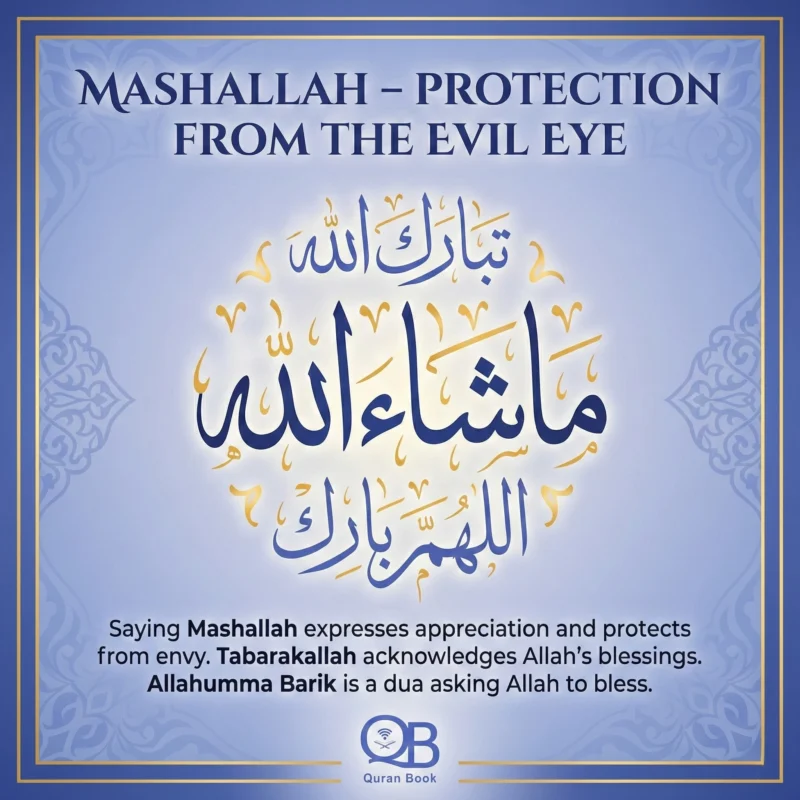
    Evil eye protection through compliments is a real concern in Islam. The Prophet ﷺ confirmed: “The evil eye is real.”Sahih Muslim 2188. Saying “Mashallah, Tabarakallah, Allahumma Barik” serves as a sunnah-based shield when admiring someone or their blessings.

    Saying Mashallah for evil eye protection -- praise in Islam
    The protective phrases: Mashallah, Tabarakallah, and Allahumma Barik

    6 Respond to Compliments with the Dua of Abu Bakr (RA)

    What do you say when someone compliments you in Islam? The best response is the dua of Abu Bakr (RA):

    “Allāhumma lā tu’ākhidhnī bimā yaqūlūn, wa’ghfir lī mā lā ya’lamūn, waj’alnī khayran mimmā yadhunnūn.”

    (O Allah, do not hold me accountable for what they say, forgive me for what they do not know, and make me better than what they think.)

    This dua perfectly balances gratitude, humility, and reliance on Allah.

    7 Return Compliments with Dua, Not Just Words

    The Sunnah teaches us to respond to kindness with supplication. The Prophet ﷺ said: “Whoever does you a favor, then reciprocate; if you cannot find anything to reciprocate, then supplicate for him.”Abu Dawud 1672. Learning how to respond to compliments in Islam means making dua for the one who praises you.

    How to Respond to Compliments Islamically — A Step-by-Step Guide

    1

    Say “JazakAllahu Khairan” (May Allah reward you with good).

    2

    Attribute the praise to Allah: “This is from the blessing of my Lord.”

    3

    Recite the Dua of Abu Bakr (RA) silently or aloud.

    4

    Make dua for the person who complimented you.

    5

    Avoid false modesty that denies Allah’s blessings upon you.

    Islamic humility does not mean denying your blessings — it means acknowledging their source. Praise in Islam is always directed back to the One who grants all good.

    Compliments in Islam — Common Mistakes to Avoid

    Making absolute character judgments — Only Allah knows someone’s true state.

    Praising someone to get something in return — This nullifies sincerity entirely.

    Forgetting Mashallah — Increases the risk of the evil eye, as taught in the Sunnah.

    Over-praising children publicly — Can create arrogance from a young age.

    Denying blessings out of false humility — The Quran says to “report” Allah’s favors (93:11).

    FAQ — Sunnah Compliments Etiquette

    Q1: Is it Sunnah to compliment someone?

    Yes, sincere and moderate compliments are part of Islamic etiquette. The Prophet ﷺ praised his companions for specific virtues. However, excessive flattery is discouraged. Always attribute every good quality to Allah by saying Mashallah or Allahumma Barik.

    Q2: Can Muslims give compliments?

    Absolutely. Islam encourages appreciation and encouragement. The prophetic guidance is to compliment sincerely, avoid exaggeration, use conditional language (“I consider him to be…”), and always attribute goodness to Allah.

    Q3: How do you respond to compliments Islamically?

    The Sunnah response is to say “JazakAllahu Khairan,” attribute the praise to Allah, and recite the dua of Abu Bakr (RA): “O Allah, do not hold me accountable for what they say, forgive me for what they do not know, and make me better than what they think.”

    Q4: What do Muslims say after complimenting someone?

    Muslims say “Mashallah” (What Allah has willed), “Tabarakallah” (Blessed is Allah), and “Allahumma Barik” (O Allah, bless it). These phrases protect from the evil eye and center all praise on Allah.

    Q5: What is the best response to a compliment in Islam?

    The best response combines gratitude and humility: thank the person, say “JazakAllahu Khairan,” acknowledge the blessing is from Allah, and make dua for the person who complimented you.

    Start Learning Islamic Etiquette the Right Way

    Understanding sunnah compliments etiquette is just one part of living Islam with confidence and beauty. At Quran Book Academy, certified teachers guide you through Quran recitation, Tajweed, and Islamic manners in live, one-on-one Zoom sessions — with a custom LMS to track your every milestone. Whether you are a beginner or a returning learner, we meet you where you are.

    👉 Book Your FREE Trial Lesson Now

    Also explore: Learn Quran OnlineAll Courses

    📚 References