
How to Prepare for Ramadan: Your Complete Guide to a Blessed Month

1. Introduction: Embracing the Sacred Journey
Learning how to prepare for Ramadan can feel overwhelming, especially if you’re new to fasting or worried about balancing worship with daily responsibilities. You might be asking yourself: “Will I be able to read Quran properly? Can I manage fasting while working? Am I spiritually ready?” These feelings are completely normal, and you’re not alone in experiencing them.
The beautiful truth is that preparing for Ramadan is itself an act of worship. When you take the time to plan and ready yourself for this blessed month, you’re already walking the path of spiritual growth. Whether you’re a complete beginner or someone looking to deepen their connection with Allah, this guide will show you how to prepare for Ramadan in a way that can transform your experience of the month.
“O you who believe, fasting is prescribed for you as it was prescribed for those before you, that you may become righteous.”
— Surah Al-Baqarah 2:183

2. What is Ramadan Preparation? Understanding the Basics
Ramadan preparation involves spiritual, physical, and practical steps taken before the holy month begins. This includes setting worship goals, adjusting sleep schedules, preparing for fasting, improving Quran recitation skills, and creating a supportive environment. Good preparation helps Muslims make the most of this blessed month.
Why Preparing for Ramadan Matters
The Prophet Muhammad ﷺ used to fast more in Sha’ban, the month before Ramadan, than in any other month apart from Ramadan itself, which shows the value of preparing gradually. According to a hadith narrated by Bukhari and Muslim: “Whoever fasts Ramadan out of faith and seeking reward, his previous sins will be forgiven.” This powerful promise reminds us why knowing how to prepare for Ramadan is so essential: it’s not just about the physical act of fasting, but about entering the month with the right spiritual mindset.
The 3 Pillars of Ramadan Readiness
🕌 Spiritual
- Quran reading goals
- Dua memorization
- Tajweed practice
💪 Physical
- Sleep schedule adjustment
- Practice fasting
- Hydration habits
📋 Practical
- Work/school planning
- Meal prep strategies
- Family coordination
3. 7 Essential Steps to Prepare for Ramadan
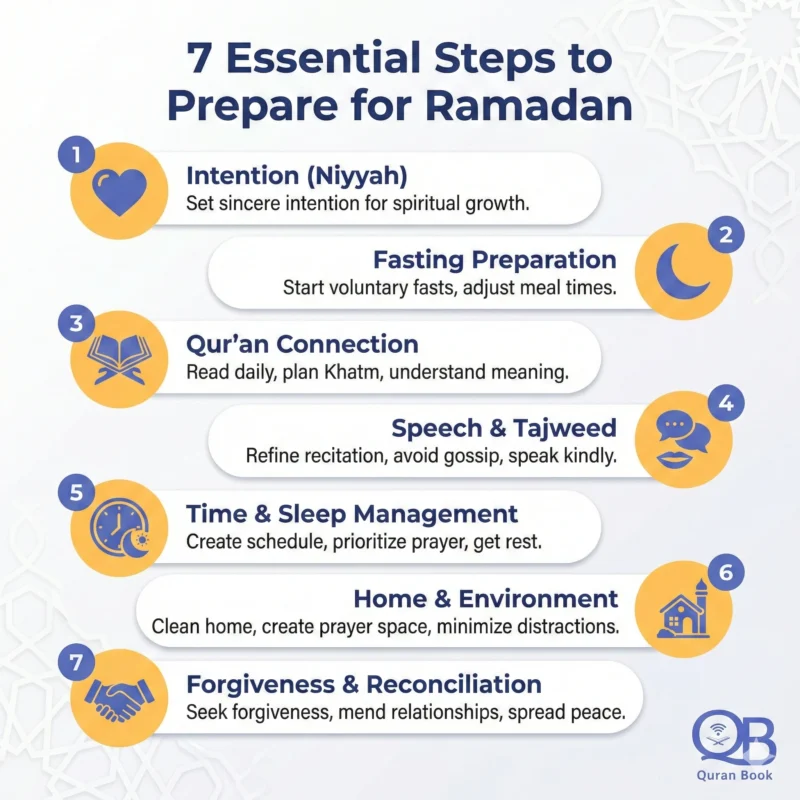
When planning Ramadan preparation, following a structured approach helps you cover all bases. Here are seven essential steps to help you get ready for Ramadan effectively:
Set Clear Spiritual Intentions (Niyyah)
Begin your journey of preparing for Ramadan by setting sincere intentions. Write down 3–5 specific goals: improving your Quran recitation, praying more consistently, memorizing new surahs, or increasing your charitable giving. The Prophet ﷺ said, “Actions are judged by intentions” (Sahih al-Bukhari 1). Your niyyah sets the foundation for everything that follows.
Start Practicing Your Fasting
One of the most practical ways to learn how to prepare for Ramadan fasting is to increase voluntary fasts in Sha’ban. Good places to start are the recommended Sunnah fasts of Mondays and Thursdays and the “white days” (the 13th, 14th, and 15th of each Islamic month).
‘Aishah (may Allah be pleased with her) narrated that the Prophet ﷺ would sometimes fast so continuously that people said he would not stop fasting, and at other times leave fasting until they said he would not fast. She said she never saw him fast a complete month except Ramadan, and never saw him fast more in any month than in Sha’ban (Sahih al-Bukhari 1969).
Two things to keep in mind: Do not start fasting a day or two before Ramadan just as a precaution for the month. The Prophet ﷺ forbade this, except for someone whose regular habit of voluntary fasting falls on that day (Sahih al-Bukhari 1914), and scholars also exclude obligatory fasts such as making up missed days. And if you still owe days from last Ramadan, make those up first before focusing on voluntary fasting goals.
Establish Your Quran Reading Routine
This is where many Muslims struggle when figuring out how to get ready for Ramadan. Start with just 15–20 minutes of daily Quran reading. Consistency matters more than quantity at this stage. Even beginners can build confidence with proper guidance through our Quran Reading Course. Choose a specific time each day, perhaps after Fajr prayer, and protect this time.
Learn or Refresh Your Tajweed Basics
Learning Tajweed helps you recite the Quran correctly and avoid mistakes that can change the meaning of the words. Even basic pronunciation rules can transform your reading experience. The Prophet ﷺ said that the one who recites the Quran proficiently, having mastered it, will be with the noble, righteous scribes, and the one who recites it with great difficulty, struggling to learn it, will have a double reward (Sahih al-Bukhari 4937).
So if you are a beginner who stumbles over the words, keep going: your effort is rewarded, and a beautiful voice is not a condition for that reward. Investing in Tajweed learning is one of the best ways to prepare spiritually.
Adjust Your Sleep Schedule
Start waking up 15 minutes earlier each week leading up to Ramadan. This gradual adjustment prepares your body for Suhoor before dawn, Taraweeh prayers, and night prayer (Tahajjud), especially in the last ten nights. Managing your sleep effectively is crucial for maintaining energy throughout the fasting day.
Prepare Your Environment
Create a dedicated prayer and reading corner in your home. Organize your Ramadan supplies, meal prep containers, and Quran materials. Communicate schedule changes with your family and employer in advance. Reduce social media distractions by adjusting notification settings or using app timers.
Seek Forgiveness and Mend Relationships
Enter Ramadan with a clean heart. Reach out to anyone you may have wronged or have unresolved issues with. Make amends, ask for forgiveness, and let go of grudges. This spiritual cleansing is one of the most important steps in preparing for Ramadan, as it opens your heart to the blessings of the month.
4. How to Prepare Your Quran Reading for Ramadan

To prepare your Quran reading for Ramadan, assess your current level, set a realistic daily goal (by minutes or lines if you are still learning the letters, by pages once you can read), practice Tajweed rules, and keep a consistent reading time. Many Muslims aim to complete the entire Quran (Khatmah) during the month. It is a recommended goal, not an obligation, and correct recitation and reflection matter more than speed.
Assessing Your Current Quran Level
Understanding where you are is the first step in planning Ramadan Quran goals. Beginners are those still learning Arabic letters and basic reading skills. Intermediate readers can read but need Tajweed improvement for proper pronunciation. Advanced readers focus on fluency and memorization. Be honest with yourself about your level so you can set realistic, achievable goals.
Setting Realistic Reading Goals
| Level | Daily Goal | Approximate Total in Ramadan |
|---|---|---|
| Learning the letters | 10–15 minutes, or a few lines, based on your ability | Steady progress in letters and reading accuracy |
| Beginner reader | 1–2 pages | ≈ 1.5–3 Juz |
| Intermediate | 4–5 pages | ≈ 6–7.5 Juz |
| Advanced | 1 Juz (≈ 20 pages) | 30 Juz: a complete Khatmah in 30 days |
These figures are estimates. The number of pages per Juz varies between Mushaf prints, and Ramadan may last 29 days, so a one-Juz-a-day Khatmah plan needs a small adjustment, such as reading slightly more than a Juz on some days.
Remember, the goal is progress, not perfection. Whether you complete one Juz or the entire Quran, every verse you read is a step closer to Allah. Focus on correct recitation and understanding, not speed. Consider enrolling in our Khatmah Course for guided completion.
5. The Academy Method: Building Your Quran Reading Before Ramadan
At Quran Book Academy, teachers break Tajweed and reading rules into small, manageable learning steps, taught in live one-on-one Zoom sessions, with progress tracked through our learning system and weekly progress reports. How far you get before Ramadan depends on your starting level and how consistently you practice.
Our Teaching Philosophy
At Quran Book Academy, we understand that learning to read Quran, especially for non-Arabic speakers, requires more than just repetition. Our teachers break complex Tajweed rules into small, manageable learning steps, each building on the previous lesson, with guided practice and correction along the way.
How We Support Your Learning
Live Zoom Sessions
One-on-one interactive classes with native Arabic-speaking teachers
Learning Tracking System
Track your progress and complete practice exercises between classes
Weekly Progress Reports
Weekly email updates on your progress with detailed teacher feedback
Courses to Prepare for Ramadan
- Quran Reading Course — For beginners learning Arabic letters and basic reading skills
- Tajweed Course — Learn pronunciation rules for accurate recitation
- Khatmah Course — Complete Quran recitation with guidance
- Quran Memorization (Hifz) — Structured, step-by-step memorization programs
- Islamic Studies Course — A clear understanding of Islamic principles
6. Creating Your Daily Ramadan Routine
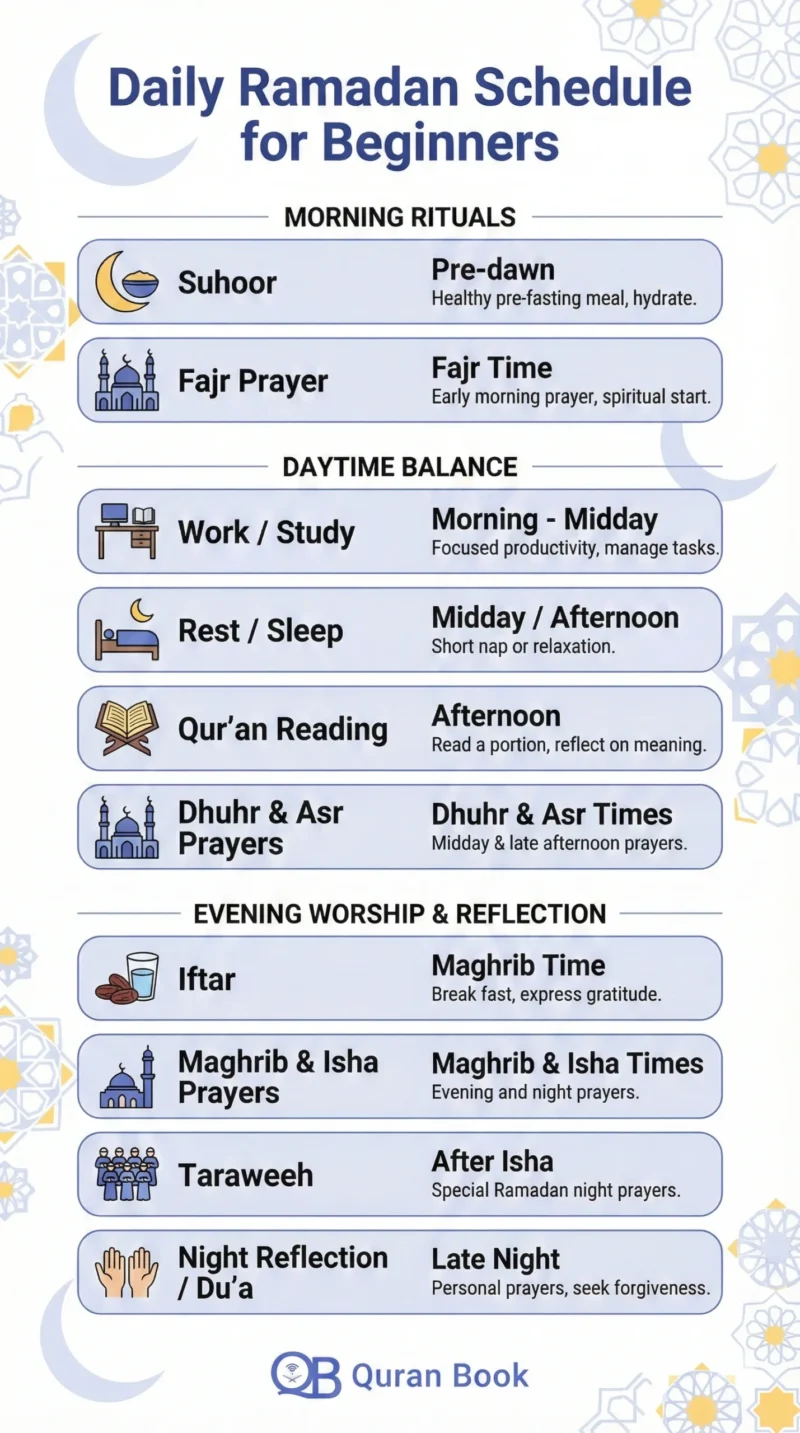
A productive daily routine in Ramadan is built around your local prayer times: Suhoor before Fajr, Fajr prayer, morning adhkar and Quran reading as you are able, work or school while praying Dhuhr and Asr on time, dua and Iftar preparation before sunset, breaking the fast once the sun has set, Maghrib prayer, then Isha and Taraweeh, and enough rest to wake for Suhoor.
Sample Ramadan Daily Schedule
| When | Activity | Spiritual Focus |
|---|---|---|
| Before Fajr | Suhoor | Tahajjud as you are able, dua |
| At Fajr time | Fajr prayer | Praying on time |
| After Fajr | Morning adhkar & Quran reading | Reading as you are able, reflection |
| During work or school | Work/School | Dhuhr and Asr on time, dhikr in breaks |
| Before Maghrib | Rest & Iftar preparation | Dua before Iftar |
| At sunset | Break the fast, then pray Maghrib | Hastening Iftar (Sunnah) |
| When Isha time begins | Isha, then Taraweeh | Night prayer, at the mosque or at home |
| A suitable bedtime | Rest & sleep | Gratitude reflection |
This is a suggested way to organize your day, not a required act of worship. Adapt it to your local prayer times, work schedule, and family needs. The key is consistency: a routine helps you make the most of every precious day of Ramadan.
7. Ramadan Rules for Beginners: What You Need to Know
Basic Ramadan rules for beginners include fasting from true dawn (Fajr) until sunset (Maghrib), abstaining from food, drink, and marital relations during fasting hours, making the intention (niyyah) before dawn, breaking the fast once sunset is confirmed, and increasing prayer, Quran reading, and charity throughout the month. Hastening Iftar is a Sunnah, not a condition for a valid fast.
When You Can Eat and Drink
You may eat and drink from sunset until true dawn (Fajr) begins. This window is not limited to the time it takes to finish your Suhoor meal; you can eat and drink until Fajr time starts, and delaying Suhoor toward the end of its time is a Sunnah. The fast ends once the sun has set, and you can rely on a trusted local Adhan or prayer timetable to know when that happens. Breaking the fast promptly is a Sunnah: the Prophet ﷺ said people will remain upon good as long as they hasten to break the fast (Sahih al-Bukhari 1957).
What Breaks and Doesn’t Break Your Fast
❌ Breaks Fast
- Intentionally eating or drinking
- Intentional vomiting
- Smoking
- IV nutrition
✓ Does NOT Break Fast
- Accidentally eating (forgetfulness)
- Unintentional vomiting
- Using miswak/toothbrush (without swallowing)
- Injections (non-nutritive)
Who is Exempt from Fasting?
Islam is a religion of mercy, and some people are excused from fasting. The rulings differ from group to group:
- Children before pubertyFasting is not obligatory for them, and they do not make up days missed before reaching puberty. Parents can train them to fast gradually, as they are able, without harming them.
- Temporary illness and travelA person who is ill, or traveling a distance that permits breaking the fast, may break it and makes up the missed days later, once able.
- Menstruation and post-natal bleedingA woman does not fast during these days, as her fast would not be valid, and she makes up the missed days later.
- Permanent inability (old age or an illness with no expected recovery)Someone who cannot fast and is not expected to become able to fast is excused. The majority of scholars hold that they must feed one needy person for each missed day (fidya) if they can afford it, while the Maliki school considers this recommended rather than obligatory. This concession is only for those genuinely unable to fast; fidya is not an optional substitute for someone who can fast. It is given as food to a person in need.
- Pregnancy and breastfeedingA pregnant or breastfeeding woman who fears harm to herself or her baby may break her fast. Scholars differ on what she owes afterwards (making up the days, feeding a needy person for each day, or both), so she should ask a qualified scholar about her own situation.
For any specific situation, consult a qualified scholar or a trusted fatwa service such as IslamQA.
8. FAQs About How to Prepare for Ramadan
Q1: How do Muslims prepare for Ramadan?
Muslims prepare for Ramadan by increasing voluntary fasting in Sha’ban, setting spiritual goals, improving Quran reading skills, organizing daily schedules, preparing meal plans, and seeking forgiveness from others. This holistic approach to Ramadan preparation helps them benefit fully from the holy month.
Q2: What are the fasting rules for Ramadan?
The main fasting rules include abstaining from food, drink, smoking, and marital relations from true dawn (Fajr) until sunset (Maghrib). Fasting also involves avoiding lies, gossip, and anger. Make your intention (niyyah) before Fajr, and break your fast once the sun has set; a trusted local Adhan or prayer timetable can confirm this. Hastening Iftar is a Sunnah, not a condition for a valid fast.
Q3: Can you drink water during Ramadan?
During fasting hours (from true dawn until sunset), you cannot drink water. You may eat and drink from sunset until true dawn (Fajr) begins, not only until you finish your Suhoor meal. It’s recommended to hydrate well during these hours to stay healthy throughout the fast.
Q4: How to break fast during Ramadan?
It is Sunnah to break your fast with dates and water. Anas ibn Malik narrated that the Prophet ﷺ would break his fast before prayer with fresh dates; if unavailable, with dried dates; and if unavailable, with a few sips of water (Jami’ at-Tirmidhi 696). No specific number of dates is authentically established. This is a recommended Sunnah, not a condition for a valid Iftar: your fast is complete once the sun sets, whatever you break it with.
Q5: What can I do during Ramadan to maximize rewards?
Maximize Ramadan rewards by reading Quran daily (even one page counts), performing all five prayers on time, praying Taraweeh at night, giving charity regularly, making abundant dua especially before Iftar, seeking Laylatul Qadr in the last ten nights, and practicing patience and kindness in all interactions.
Q6: How long before Ramadan should I start preparing?
Start preparing in the weeks before Ramadan, especially during Sha’ban. This gives you time to build Quran reading habits, practice voluntary fasting, adjust sleep schedules, and enroll in courses like Quran Reading or Tajweed to strengthen your recitation skills before the holy month begins.
9. Start Your Ramadan Journey with Quran Book Academy
“The month of Ramadan in which the Quran was revealed, a guidance for mankind and clear proofs of guidance and criterion.”
— Surah Al-Baqarah 2:185
Your Transformation Starts Now
Don’t let this Ramadan pass without a meaningful connection to the Quran. Whether you’re a complete beginner learning Arabic letters or working on your Tajweed, Quran Book Academy is here to guide you. Our experienced teachers, flexible Zoom scheduling, and progress tracking make learning accessible wherever you are in the USA, Canada, UK, or Australia.
Experience our teaching approach firsthand. No obligation, no pressure: just the first step toward a more meaningful Ramadan.
One-on-one Zoom session with a qualified teacher
Personalized assessment of your current level
Custom learning plan for Ramadan readiness
No credit card required
Join our community: Telegram Channel
Sources & References
Quran & Hadith
- Surah Al-Baqarah 2:183 and 2:185: the obligation of fasting and the month of Ramadan
- Sahih al-Bukhari 1: actions are judged by intentions
- Sahih al-Bukhari 1969: the Prophet’s fasting in Sha’ban, narrated by ‘Aishah
- Sahih al-Bukhari 1914: not fasting a day or two before Ramadan, except for one with a fasting habit
- Sahih al-Bukhari 4937: the proficient reciter and the one who recites with difficulty
- Sahih al-Bukhari 1957: hastening Iftar
- Jami’ at-Tirmidhi 696: breaking the fast with fresh dates, dried dates, or water
Fiqh Rulings (Arabic)
- IslamWeb Fatwa 30681: the end of Suhoor time is true dawn
- IslamWeb Fatwa 306070: no specific number of dates is established for Iftar
- IslamWeb Fatwa 180829: feeding the needy for one permanently unable to fast (majority and Maliki views)
- IslamWeb Fatwa 115558: the chronically ill person feeds one needy person for each day
This article is educational and is not a fatwa. For a ruling on your personal situation, consult a qualified scholar.
📚 Learn More
Continue your Ramadan journey with these related articles:
Laylatul Qadr
Discover the Night of Power and how to seek its blessings during the last ten nights of Ramadan.
How to Complete Quran in Ramadan
A practical guide to achieving Khatmah during the blessed month with daily reading strategies.
The Last Ten Days in Ramadan
Make the most of the final stretch with I’tikaf, increased worship, and seeking Laylatul Qadr.