Best Way to Learn Quranic Arabic: 7 Proven Steps for Beginners in 2026
A comprehensive guide for Muslims in the West seeking to understand Allah’s words directly

You hear the beautiful recitation of the Quran in salah, but you cannot understand a single word. That feeling of disconnect — the guilt of depending entirely on translations, the frustration of thinking Arabic is “too hard,” or the fear that you are “too old” to begin — is something millions of Muslims in the West experience every day.
But here is the truth: the best way to learn Quranic Arabic is not about becoming a linguist or a scholar. It is about following a clear, structured roadmap designed specifically for non-Arabic speakers like you.
Allah says in Surah Yusuf (12:2): “Indeed, We have sent it down as an Arabic Quran so that you may understand.” This verse is an invitation — a divine encouragement to learn. Whether you live in the USA, Canada, the UK, or Australia, this guide gives you a proven 7-step path to make Quranic Arabic accessible, manageable, and deeply rewarding.
Why Every Muslim Should Learn Quranic Arabic (Not Just Read Translations)

Learning Quranic Arabic allows you to connect with Allah’s words directly, grasp the linguistic miracles (i’jaz) that no translation can capture, and deepen your khushoo in salah. Translations convey approximate meaning, but the Arabic carries layers of emotional, grammatical, and rhetorical beauty that are lost in any other language.
Think about the difference between reading the Quran through a translator’s lens and actually recognizing words during your prayer. The moment you understand “Alhamdulillahi Rabbil ‘Aalameen” not just as a memorized phrase but as a living conversation with your Creator — that is when everything changes.
The Prophet ﷺ said: “The best among you are those who learn the Quran and teach it.” (Sahih al-Bukhari 5027). He ﷺ also told us that the one who struggles with the Quran receives a double reward (Sahih Muslim 798). So even if you find it difficult, your effort is multiplied.
It is important to understand the difference between Quranic Arabic and modern Arabic. Quranic Arabic, also called Classical Arabic, is the preserved and unchanged language of revelation. Modern Standard Arabic shares the same grammatical core but adds contemporary vocabulary. For understanding Allah’s Book, you need Quranic Arabic specifically.
The psychological benefit is immense. Understanding what you recite in salah transforms your prayer from a mechanical ritual into a real, heartfelt conversation with Allah.
7 Steps: The Best Way to Learn Quranic Arabic Step by Step
Step 1: Master the Arabic Alphabet and Pronunciation (Tajweed Foundations)
Watch how to pronounce Arabic Alphabet throughout channel with a fun way: YouTube Tutorial
Begin with the 28 Arabic letters and their forms — initial, medial, and final. Pay special attention to sounds that have no English equivalent, such as ع, خ, ح, ق, and ض.
Pair alphabet learning with basic tajweed rules from day one. This way, your reading and pronunciation develop together, and you avoid building bad habits that become harder to fix later. A solid foundation here makes every future step easier.
Step 2: Build Your Core Quranic Arabic Vocabulary List
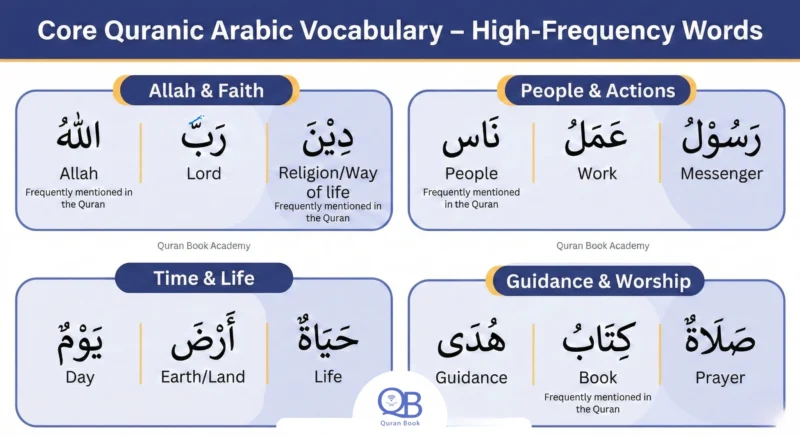
Here is a critical insight that changes everything: approximately 300 words make up nearly 70% of the entire Quran. Focus on these words first.
Learn them thematically — names of Allah, words related to faith, words about the hereafter, and common verbs. This approach is what makes Quranic Arabic easy. You do not need thousands of words to start understanding the Book of Allah. A focused Quranic Arabic vocabulary list is your shortcut to comprehension.
Step 3: Learn Basic Quranic Arabic Grammar (Nahw & Sarf Essentials)
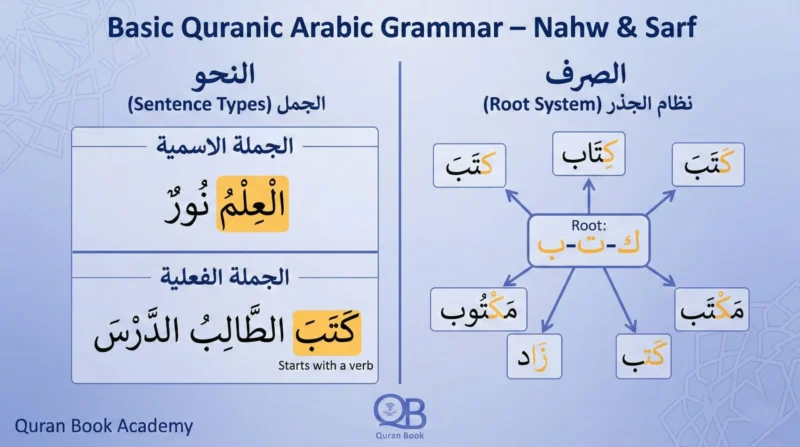
Cover the fundamentals: sentence types (nominal vs. verbal), subject-verb agreement, pronouns, prepositions, and the powerful 3-letter root system. The root system is the master key to unlocking Arabic — once you understand it, new words become predictable rather than random.
The goal is not to become a professional grammarian. The goal is to recognize patterns when reading the Quran. Basic Quranic Arabic grammar becomes intuitive with consistent practice.
Allah reminds us in Surah Al-Qamar (54:17): “And We have certainly made the Quran easy to remember. So is there anyone who will be mindful?” The Quran itself reassures you that this path is achievable.
Step 4: Practice Word-by-Word Quran Translation
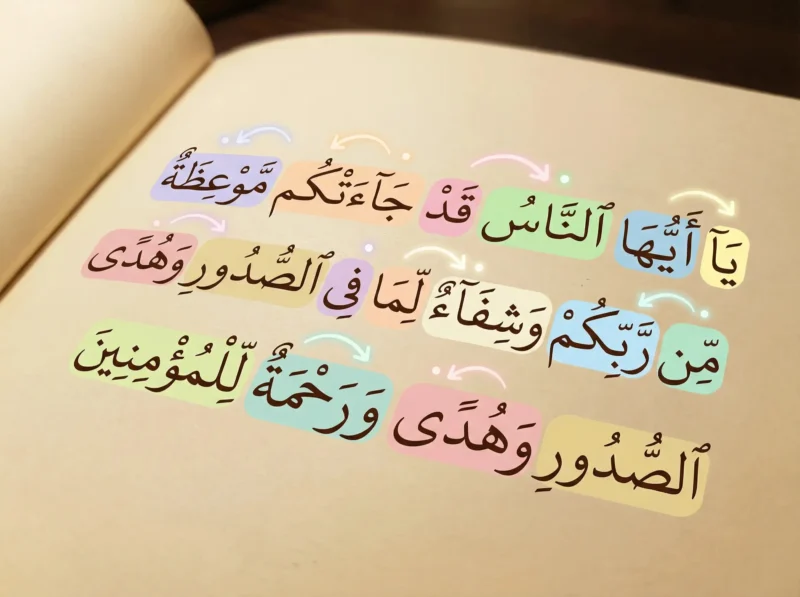
Now move from isolated vocabulary to reading the Quran word by word with a translation guide. Start with short surahs you already know by heart — Al-Fatiha, Al-Ikhlas, An-Nas, and Al-Falaq.
The emotional impact of understanding what you have been reciting for years is a powerful motivator. Many students describe this moment as a spiritual awakening. It fuels your desire to keep going.
Step 5: Study Quranic Arabic Sentence Structure and I’rab
Layer in sentence-level analysis at this stage. Understand how Quranic Arabic sentence structure works — how word endings change meaning, how emphasis and word order in Arabic differ from English, and how recognizing i’rab (grammatical case endings) deepens your comprehension.
This step transforms you from someone who understands individual words into someone who grasps complete meanings. It is where real fluency begins to take shape.
Step 6: Immerse Yourself Through Listening and Recitation Practice
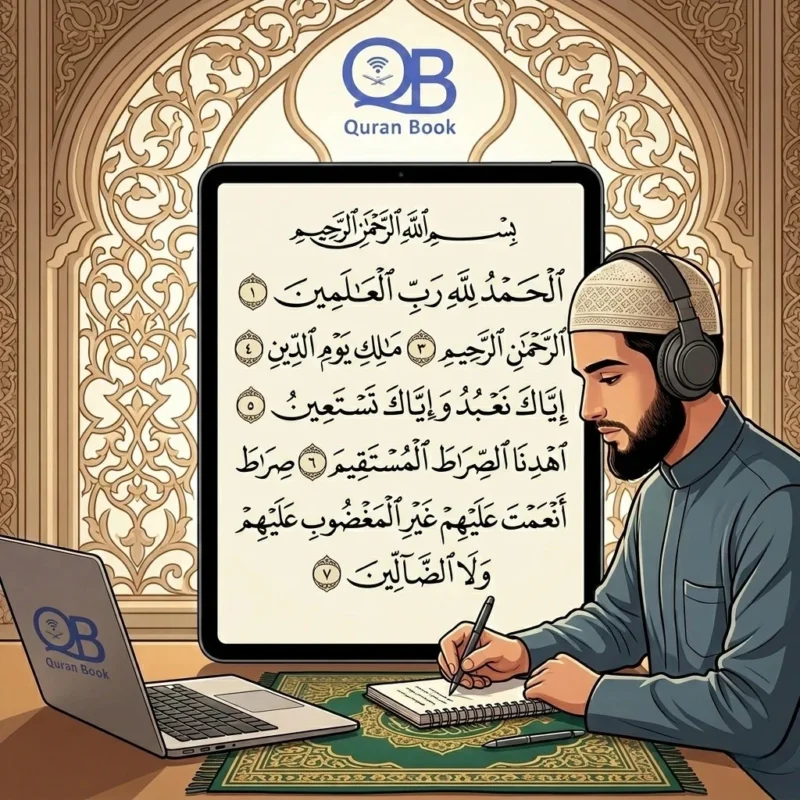
Listen to renowned reciters daily — Mishary Rashid, Abdul Basit — while following along with the Arabic text. Shadow-read by reciting aloud along with the reciter.
This builds your ear, strengthens your pronunciation, and reinforces vocabulary and grammar in context. Join a practice community such as Quran Book Academy’s Telegram channel to stay consistent and motivated.
Step 7: Enroll in a Structured Quranic Arabic Course with a Live Teacher
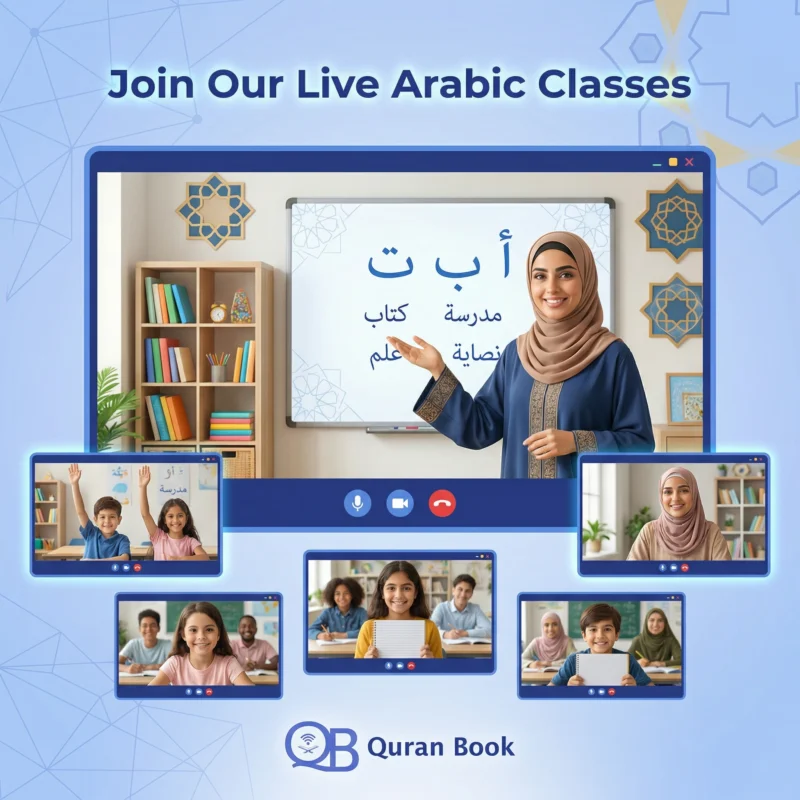
Self-study can only take you so far. A live teacher corrects your mistakes in real time, answers nuanced questions, and keeps you accountable.
This is where an online Quranic Arabic course for beginners like Quran Book Academy becomes essential. Having expert guidance turns scattered effort into focused, measurable progress.
The Academy Method: How Quran Book Academy Makes Quranic Arabic Easy
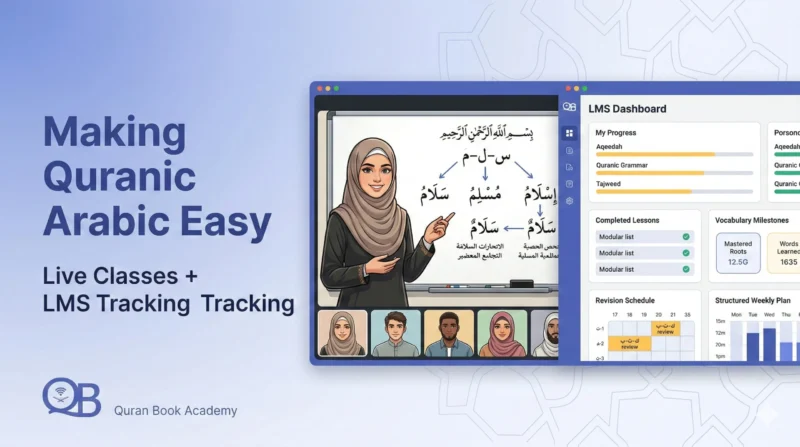
Quran Book Academy uses an approach grounded in educational psychology and Islamic pedagogy. Our methodology is built around the concept of cognitive chunking — the same principle used in the best language acquisition research. Instead of overwhelming students with the entire Arabic grammar system at once, we break learning into small, psychologically manageable “chunks.” Each lesson focuses on one concept, practiced through direct Quran application, so that students see immediate relevance and experience a sense of progress from week one.
Our classes are delivered live via Zoom, ensuring real-time interaction, pronunciation correction, and personal attention from certified teachers. Every student’s progress is tracked through our custom Learning Management System (LMS), which monitors lesson completion, quiz scores, and recitation milestones. Parents and adult learners receive regular progress reports so they can see tangible improvement over time.
This method works for both Islamic courses for kids and adults — children benefit from gamified elements and shorter lesson durations, while adults appreciate the focused, efficient structure that respects their limited time. Whether you are a busy professional in New York, a university student in London, or a parent in Sydney, our structured Quranic Arabic course adapts to your schedule with flexible session times across all major time zones.
What makes this more than just an Arabic class is the Islamic ethos woven into every interaction. Teachers begin with Basmala, lessons include reflection on the verses being studied, and the entire learning journey is framed as an act of ‘ibadah.
Quranic Arabic vs. Modern Standard Arabic: What’s the Difference?
Quranic Arabic (also called Classical Arabic) is the preserved language of the Quran, revealed over 1,400 years ago. Modern Standard Arabic (MSA) evolved from it and shares the same grammar core but adds modern vocabulary for technology, politics, and daily life. For understanding the Quran, you need Classical Quranic Arabic specifically.
If your goal is to understand the Quran, focus your energy on Quranic Arabic. It is a more focused and spiritually rewarding path than studying MSA first.
Frequently Asked Questions About Learning Quranic Arabic
How long does it take to learn Quranic Arabic?
With consistent study of 3–5 hours per week in a structured course, most beginners can understand the majority of common Quranic vocabulary and basic grammar within 6–12 months. Full fluency in Quranic Arabic is a longer journey, but meaningful comprehension starts much sooner than most people expect.
Can I learn Quranic Arabic if I don’t speak any Arabic at all?
Absolutely. Quran Book Academy’s courses are designed specifically for Quranic Arabic for non-Arabic speakers. Our entire curriculum assumes zero prior Arabic knowledge. Many of our most successful students started as complete beginners from the USA, Canada, UK, and Australia.
What is the difference between Quranic Arabic and conversational Arabic?
Quranic Arabic is the Classical Arabic of the Quran — preserved and unchanged. Conversational Arabic refers to regional dialects (Egyptian, Gulf, Levantine) that differ significantly from Classical Arabic. Learning Quranic Arabic teaches you the formal, literary Arabic that is universally understood across the Muslim world.
Is it possible to understand the Quran without translation?
Yes, and this is the ultimate goal. By building your Quranic Arabic vocabulary list and learning basic grammar, you can gradually understand the Quran without needing a translation. Most students at Quran Book Academy report understanding short surahs independently within their first few months.
What is the best app or course for Quranic Arabic for beginners?
While apps provide helpful supplementary practice, the most effective method is a structured Quranic Arabic course with a live teacher who can correct pronunciation, answer questions, and provide accountability. Quran Book Academy combines live Zoom sessions with an LMS for the best of both worlds.
Do you offer Islamic courses for kids?
Yes. Quran Book Academy offers Islamic courses for kids and adults. Our children’s program uses age-appropriate methods, shorter sessions, and engaging activities to make Quranic Arabic fun and accessible for young learners.
Start Your Quranic Arabic Journey Today — Free Trial Lesson

The path to understanding Allah’s Book is one of the most rewarding journeys a Muslim can undertake. The Prophet ﷺ reminded us that even the one who struggles with the Quran receives a double reward. You do not need to be perfect. You just need to begin.
Book your free trial lesson at Quran Book Academy today. Experience our live Zoom classes, meet your teacher, and see how our step-by-step method makes Quranic Arabic accessible — no matter your age, background, or schedule.
Book Your Free Trial Lesson Now →Join our Telegram channel for daily Quran reading practice with tajweed.
References
Islamic References:
- • Quran, Surah Yusuf (12:2)
- • Quran, Surah Al-Qamar (54:17)
- • Sahih al-Bukhari 5027
- • Sahih Muslim 798