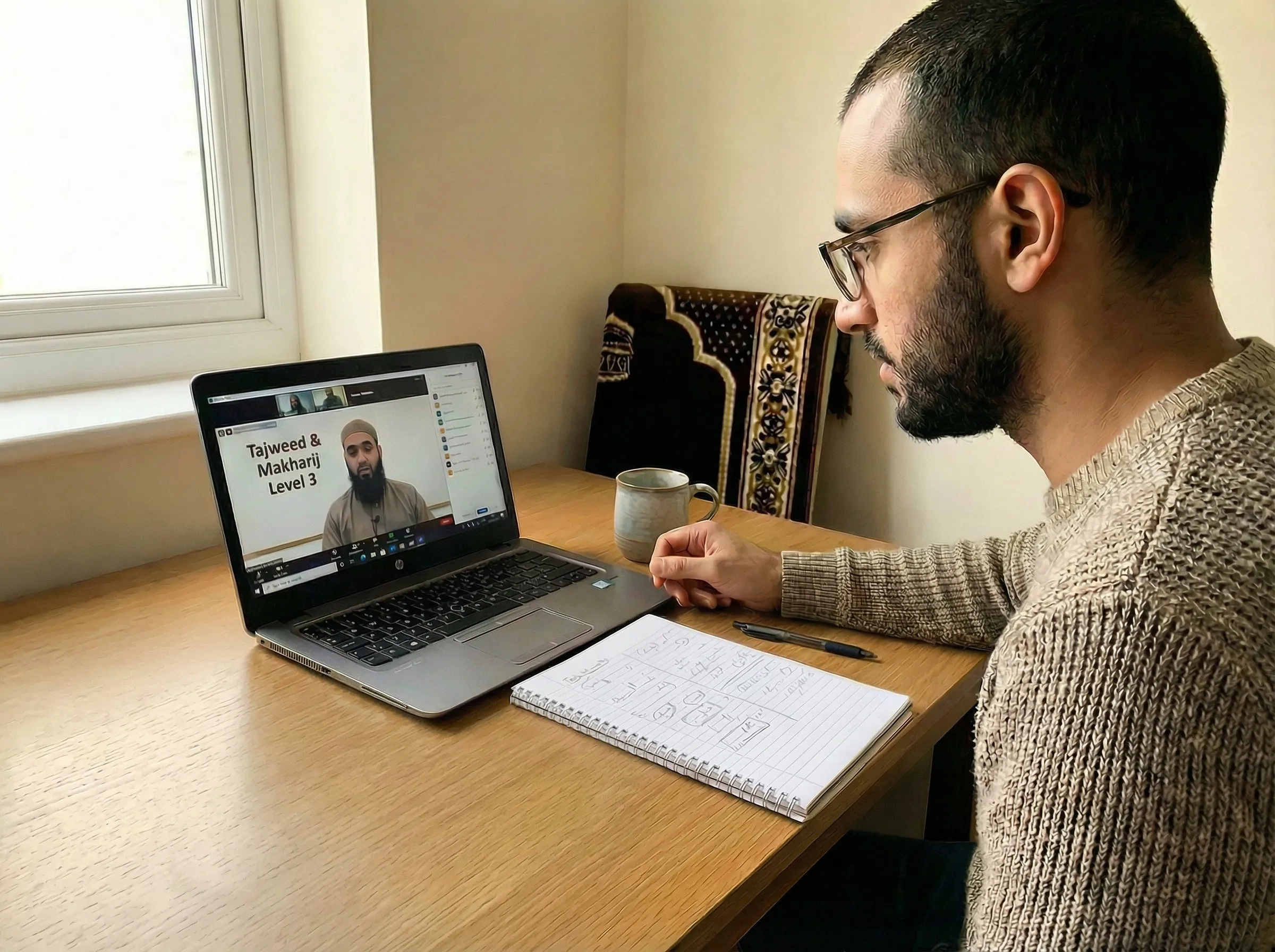
If you’ve been searching for Quran Tajweed online classes but feel overwhelmed by Arabic pronunciation, unfamiliar rules, or the fear of making mistakes — you’re not alone. Thousands of non-Arabic speaking Muslims in the USA, Canada, UK, and Australia share the same struggle. The good news is that learning Tajweed has never been more accessible than it is today.
Most of our students at Quran Book Academy felt the exact same way before their very first lesson. Some thought they were “too old.” Others worried about juggling work, family, and study. But the truth is, Allah rewards your effort even when it feels hard — especially when it feels hard.
The Prophet ﷺ said: “The one who recites the Quran and finds it difficult, stammering through its verses, will have a double reward.” — Sahih al-Bukhari 4937
And Allah Himself commands: “And recite the Quran with measured recitation (tarteel).” — Surah Al-Muzzammil 73:4
This article will show you exactly how to answer that call, step by step.
What Is Tajweed and Why Does Every Muslim Need It?
Tajweed is the science of reciting the Quran with correct pronunciation, proper articulation points (makharij), and the precise characteristics (sifaat) of each Arabic letter. It preserves the meaning of Allah’s words exactly as they were revealed to Prophet Muhammad ﷺ through Angel Jibreel.
The word “Tajweed” comes from the Arabic root j-w-d, meaning “to improve” or “to make excellent.” In Quranic context, it refers to the set of rules that govern how every letter must be pronounced. Scholars classify applying Tajweed when reciting the Quran as fard ‘ayn — an individual obligation on every Muslim.
Without Tajweed, even one mispronounced letter can change the entire meaning of a verse. For example, confusing the letter Saad (ص) with Seen (س) turns one word into a completely different one. This is why Quran Tajweed online classes are seeing massive growth among English-speaking Muslims worldwide.
Allah says: “Those to whom We have given the Book recite it with its true recital…” — Surah Al-Baqarah 2:121. “True recital” means applying Tajweed — and that requires proper guidance from a qualified teacher.
7 Proven Steps to Learn Quran with Tajweed Online (Even If You Don’t Speak Arabic)
You can learn Quran with Tajweed step by step by mastering the Arabic alphabet, learning articulation points, studying core rules like Noon Sakinah and Madd, practicing with a qualified teacher through Quran Tajweed online classes, and building daily consistency through short focused sessions.
Master the Arabic Alphabet and Makharij (Articulation Points)
The Arabic language has 28 letters, each produced from a specific point in the mouth, throat, lips, or nasal passage. These are called makharij (articulation points). For non-Arabic speakers, this is the most critical foundation — without it, every rule you learn later will rest on shaky ground.
Pay special attention to throat letters like ع (Ayn), غ (Ghayn), خ (Kha), ح (Ha), and ه (Ha) — these have no equivalent in English. At Quran Book Academy, teachers spend dedicated time on makharij letters until students feel confident before moving forward.
Learn the Core Tajweed Rules Explained in English
Once your alphabet is solid, begin learning the essential basic Tajweed rules. Start with the four rules of Noon Sakinah and Tanween: Idgham (merging), Ikhfaa (hiding), Iqlab (converting), and Izhar (clear pronunciation). Then move to the rules of Meem Sakinah and Madd (elongation).
The key advantage of Quran Tajweed online classes at Quran Book Academy is that every rule is taught and explained in English. You don’t need any prior Arabic knowledge. Our teachers break down each rule with examples you can see, hear, and practice immediately.
Start with Short Surahs and Build Confidence
Begin applying your Tajweed rules on short Surahs from Juz’ Amma (the 30th part of the Quran). Surahs like Al-Fatiha, Al-Ikhlas, and An-Nas are ideal because they’re short, familiar from daily prayers, and rich with Tajweed rules. This builds real confidence from day one.
Don’t wait until you’ve “learned all the rules” to start reciting. The best way to learn Quran recitation correctly is to apply each rule the moment you learn it. Practice and theory should move together, not separately.
Study with a Qualified, Ijazah-Certified Teacher
Apps and YouTube videos can supplement your learning, but they cannot replace a qualified teacher who corrects you in real-time. The Prophet ﷺ himself learned directly from Jibreel (AS), and the Companions learned by listening and repeating. This teacher-to-student chain (isnad) is the backbone of Tajweed.
Quran Book Academy provides live Tajweed classes via Zoom with Ijazah-certified teachers. Every session is one-on-one, so you receive personalized feedback on your exact pronunciation. This is what makes our Quran Tajweed online classes different from passive, pre-recorded courses.
Listen, Imitate, and Record Yourself
One of the fastest ways to improve your Quran recitation with Tajweed is through active listening. Choose a renowned Qari — Sheikh Al-Husary for precision, or Mishary Alafasy for melodic beauty — and listen to the same passage repeatedly. Focus on their elongations, pauses, and letter clarity.
Then record yourself reciting the same passage and compare. You’ll be surprised how much your ear catches when you listen back. This self-feedback loop accelerates your improvement between class sessions and trains your tongue to adapt naturally.
Practice Daily — Even 15 Minutes Counts
Consistency beats intensity. Research in educational psychology shows that 15 minutes of focused daily practice produces far better results than two hours once a week. Your brain needs regular repetition to convert new Tajweed rules from short-term memory into automatic, long-term skill.
Set a fixed daily time — right after Fajr, during lunch, or before bed — and protect it. Even on busy days, 15 minutes of recitation with Tajweed keeps your tongue trained and your connection to the Quran alive.
Track Your Progress and Stay Accountable
Progress without tracking leads to plateaus. At Quran Book Academy, every student gets access to our custom LMS (Learning Management System), where you can see completed lessons, rules mastered, and upcoming goals in one dashboard. Parents of young students can monitor their child’s progress remotely.
You’ll also receive weekly Gmail progress reports summarizing your achievements, areas to improve, and your next lesson plan. This accountability system keeps you motivated and gives you a clear roadmap — so you never feel lost.
The Prophet ﷺ said: “The best of you are those who learn the Quran and teach it.” — Sahih al-Bukhari 5027
The Academy Method — How Quran Book Academy Teaches Tajweed Differently
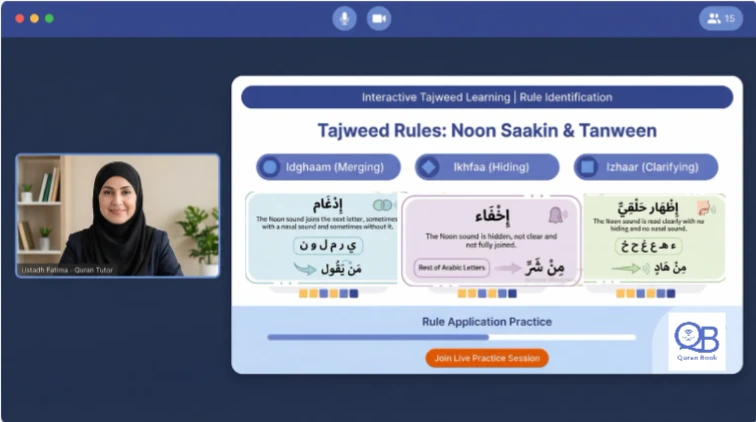
Quran Book Academy uses a psychology-backed teaching method that breaks Tajweed into small, manageable “chunks,” delivered through live Zoom sessions with Ijazah-certified teachers, tracked via a custom LMS, and reinforced with weekly Gmail progress reports — making our Quran Tajweed online classes uniquely effective.
◆ Live 1-on-1 Zoom Sessions with Certified Teachers
Every class at Quran Book Academy is conducted live on Zoom — never pre-recorded. Your teacher sees your mouth movements, hears your pronunciation in real-time, and corrects you instantly. This interactive format is what makes our Quran Tajweed online classes as effective as sitting face-to-face with a scholar.
All our teachers hold Ijazah certifications, meaning they have an unbroken chain of authorization tracing back to the Prophet ﷺ. Beginners are never rushed — your teacher adjusts the pace to your comfort and ability level.
◆ Our Custom LMS — Your Quran Learning Dashboard
Our proprietary Learning Management System gives students a clear visual dashboard of their entire Tajweed journey. You can see which rules you’ve mastered, which lessons are next, and how far you’ve come since day one. It transforms a big goal into small, visible wins.
For parents enrolling children in Tajweed classes for kids, the LMS provides peace of mind. You can check your child’s progress anytime without disrupting their learning flow.
◆ Weekly Gmail Progress Reports
Every week, you or your child’s parent receives a detailed progress report via Gmail. It covers three things: what was accomplished this week, specific areas that need more practice, and the plan for the next session. No guessing, no surprises — just clear, consistent communication.
◆ Psychological “Chunking” for Tajweed Mastery
Quran Book Academy breaks the 70+ Tajweed rules into small cognitive “chunks” based on educational psychology. According to Miller’s Law, the brain retains information best when it’s grouped into 3–5 related items at a time. That’s why our students focus on one rule cluster each week — for example, all four rules of Noon Sakinah — and apply it in actual Quran recitation before moving to the next. This approach prevents cognitive overload, which research shows is the number one reason adult learners quit any new skill. Instead of memorizing a long list of rules in isolation, students internalize each rule through practice and repetition. By the time they move forward, the previous rule already feels natural and automatic.
This mirrors the Islamic concept of tadreej (gradual progression) — the same method by which the Quran itself was revealed over 23 years, not all at once. Allah sent guidance in stages so the Companions could absorb, understand, and live it. At Quran Book Academy, we follow this prophetic wisdom in every Tajweed class — for kids and adults alike.
Quran Tajweed Online Classes vs. In-Person — Which Is Better?
Quran Tajweed online classes offer flexible scheduling, 1-on-1 teacher attention, and access to Ijazah-certified instructors worldwide. This makes them ideal for non-Arabic speakers in the USA, Canada, UK, and Australia who may not have qualified local Tajweed teachers nearby.
For Muslim families living in Western countries, finding a qualified local Tajweed teacher with an Ijazah can be extremely difficult. Quran Tajweed online classes solve this problem by connecting you with certified teachers from established Islamic institutions — all from the comfort of your home, on your schedule.
| Feature | Quran Tajweed Online Classes | In-Person Classes |
|---|---|---|
| Schedule Flexibility | ✅ Choose any time | ❌ Fixed schedule |
| 1-on-1 Attention | ✅ Personalized | ❌ Group setting |
| Teacher Quality | ✅ Global certified pool | ⚠️ Depends on location |
| Progress Tracking | ✅ LMS + Gmail Reports | ❌ Usually informal |
| Cost | ✅ More affordable | ❌ Higher overhead |
| Comfort | ✅ Learn from home | ❌ Travel required |
| Best For | Non-Arabic speakers abroad | Those near qualified mosques |
Tajweed for Kids vs. Tajweed for Adults — What’s Different?
Tajweed for kids uses playful, visual, and story-driven techniques to match shorter attention spans. Tajweed for adults focuses on rule-based learning and self-correction. Both programs at Quran Book Academy use the same psychology-backed chunking method, adapted for each age group.
Tajweed Classes for Kids (Ages 5–12)
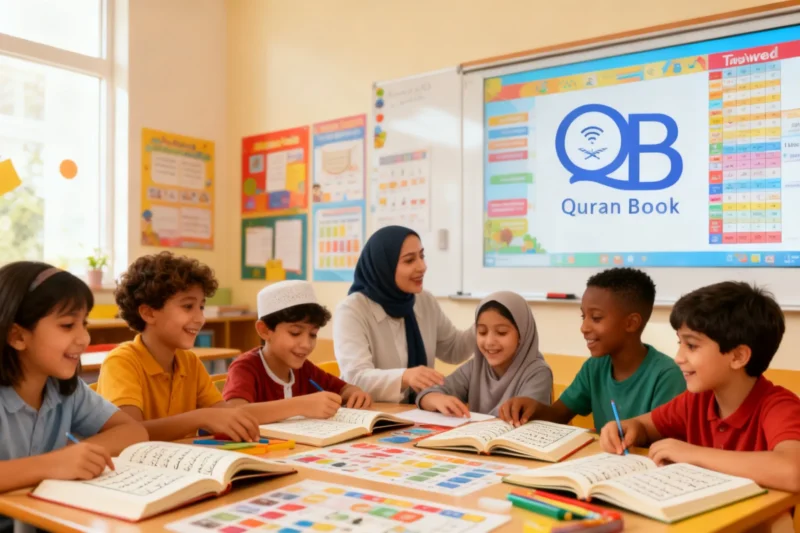
Children learn best through play, color, and positive reinforcement. Our Tajweed classes for kids use gamified elements, colorful letter charts, and a reward system that celebrates every small achievement. Sessions are kept short (25–30 minutes) to match young attention spans.
Parents stay informed through the LMS dashboard and weekly Gmail reports — so you always know exactly where your child stands. No more wondering if they’re actually progressing.
Tajweed Course for Adults and New Muslims
Adults need a different approach: clear explanations, logical rule progression, and the freedom to ask questions without judgment. Our Tajweed course for adults provides exactly that — with flexible evening and weekend Zoom sessions designed for working professionals and busy parents.
We welcome new Muslims (reverts) with open arms. Many of our adult students started with zero Arabic knowledge and now recite with confidence. The learning environment is safe, patient, and completely judgment-free.
Practice Quran Reading with Tajweed — Join Our Free Telegram Community
Practicing Quran reading with Tajweed outside of class is essential for steady improvement. The Quran Book Academy Telegram channel offers daily recitation practice, Tajweed tips, audio clips for imitation, and a supportive community of learners from around the world.
What you learn in class needs reinforcement between sessions. That’s why we created a free Telegram community where students practice together, share recitation clips, and receive daily Tajweed tips. It’s the accountability partner you didn’t know you needed.
Inside the channel, you’ll find:
Audio recitation clips for imitation practice, quick Tajweed rule reminders, Q&A access with teachers, and encouragement from fellow learners on the same journey.
Join Free — Telegram CommunityFrequently Asked Questions About Quran Tajweed Online Classes
Q1: Can I learn Quran with Tajweed online effectively?
Yes. Quran Tajweed online classes with a qualified teacher on Zoom are highly effective — often more so than group settings. Quran Book Academy offers live 1-on-1 sessions with Ijazah-certified teachers who provide real-time correction, which is the most essential element of Tajweed learning.
Q2: How long does it take to learn Tajweed for beginners?
Most beginners can learn basic Tajweed rules in 3–6 months with consistent daily practice of 15–30 minutes. Completing a full Tajweed course typically takes 6–12 months depending on your starting level and lesson frequency.
Q3: Is Tajweed mandatory (fard) in Islam?
Scholars consider applying Tajweed rules when reciting the Quran to be an individual obligation (fard ‘ayn). Allah commands in Surah Al-Muzzammil: “And recite the Quran with measured recitation.” — Quran 73:4.
Q4: Can adults learn Tajweed from scratch with no Arabic?
Absolutely. Many students at Quran Book Academy are adults who started with zero Arabic knowledge. The Prophet ﷺ promised a double reward for those who find recitation difficult. — Sahih Muslim 798.
Q5: What is the best Tajweed course online for non-Arabic speakers?
The best Tajweed course online for non-Arabic speakers includes English-medium instruction, Ijazah-certified teachers, a structured curriculum, and progress tracking. Quran Book Academy provides all of these through live Zoom sessions and a custom LMS.
Q6: Are online Tajweed classes effective for children?
Yes. With engaging age-appropriate methods, 1-on-1 attention, and parental progress reports, Tajweed classes for kids online are often more effective than large group settings at local mosques or weekend schools.
Q7: What basic Tajweed rules should I learn first?
Start with the articulation points (makharij letters), then learn the rules of Noon Sakinah and Tanween (Idgham, Ikhfaa, Iqlab, Izhar), Meem Sakinah rules, and Madd (elongation) rules. These form the foundation of Quran recitation with Tajweed.
“So when the Quran is recited, then listen to it and pay attention that you may receive mercy.” — Surah Al-A’raf 7:204
You’ve read this far because something inside you wants to recite the Quran beautifully. That feeling is a gift from Allah. Don’t let fear, busy schedules, or self-doubt hold you back from answering His call. Every great reciter started exactly where you are right now.
Quran Book Academy offers live Zoom classes with Ijazah-certified teachers, full English instruction, a custom LMS for tracking your progress, and weekly Gmail reports. We have Quran Tajweed online classes for kids and adults — and your first lesson is completely free. No commitment, no pressure.
Book Your Free Tajweed Trial Lesson NowReferences & Sources
Quranic References:
— Surah Al-Muzzammil 73:4 — “And recite the Quran with measured recitation.”
— Surah Al-Baqarah 2:121 — “Those to whom We have given the Book recite it with its true recital…”
— Surah Al-A’raf 7:204 — “So when the Quran is recited, then listen to it and pay attention…”
Hadith References:
— Sahih al-Bukhari 4937 — Double reward for those who find recitation difficult.
— Sahih al-Bukhari 5027 — “The best of you are those who learn the Quran and teach it.”
— Sahih Muslim 798 — Double reward for those struggling with recitation.
Academy Resources:
— Noorani Qaida Course / Arabic Basics
— Our Teachers / Meet Our Instructors