5 Engaging Islamic History for Kids Lessons That Inspire Faith & Pride
By Quran Book Academy | Islamic Education Experts
Introduction
Islamic history for kids opens a window to 1,400 years of inspiring stories, remarkable achievements, and faith-building lessons that every Muslim child deserves to know. These powerful narratives connect children to their heritage while building lasting pride in their identity as Muslims.
As parents, you face a significant challenge today. Your child grows up surrounded by Western history in school, rarely hearing about the scholars, explorers, and leaders who shaped Islamic civilization. Many parents worry their children feel disconnected from their Muslim roots or find history lessons boring and irrelevant to their modern lives.
The truth is that Islamic history for children doesn’t have to be dull memorization of dates and names. When taught correctly, the history of Islam for kids becomes an exciting adventure filled with heroes, discoveries, and miraculous events. At Quran Book Academy’s Islamic Studies Course for Kids, thousands of families across the USA, Canada, UK, and Australia have transformed Islamic education from a chore into an unforgettable journey.
This comprehensive guide shares five essential Islamic history lessons for kids, proven teaching methods, and practical ways to make learning both memorable and meaningful for your child.
What Is Islamic History? A Simple Explanation for Kids
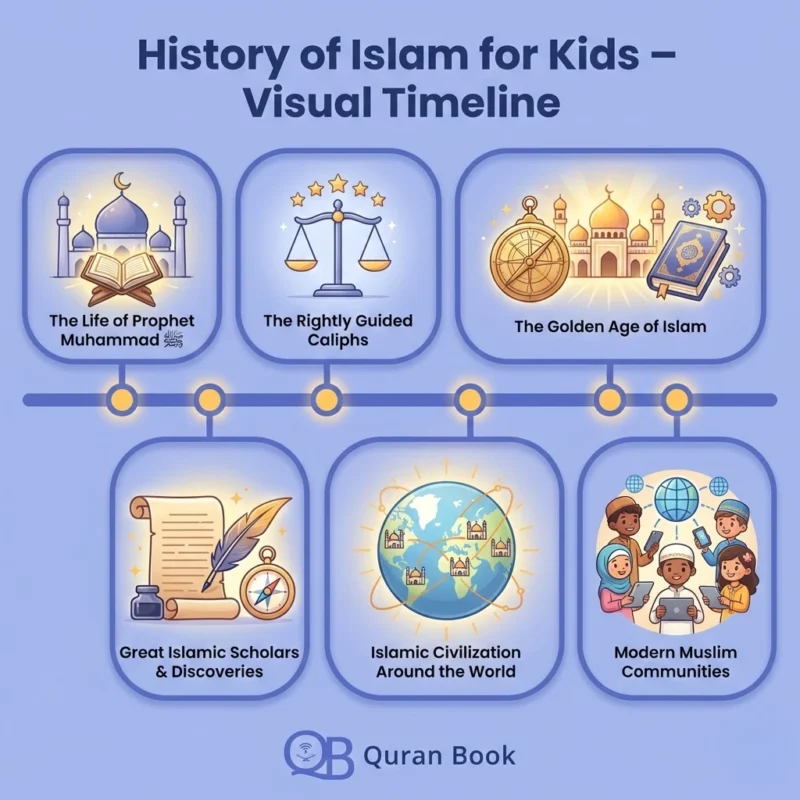
Islamic history is the incredible story of how Islam began with Prophet Muhammad ﷺ and grew into a worldwide civilization known for faith, knowledge, and remarkable achievements. For children, understanding this story provides context for their beliefs and practices.
Children benefit from viewing history as a living story rather than memorizing dates. When kids see themselves as part of this continuing narrative, Islamic history becomes personal and relevant.
Three Eras of Islamic History for Kids
“You are the best nation produced for mankind.”
— Surah Al-Imran 3:110
This verse inspires children to understand that they belong to an exceptional community with a rich heritage worth knowing and celebrating.
Why Should Kids Learn Islamic History?
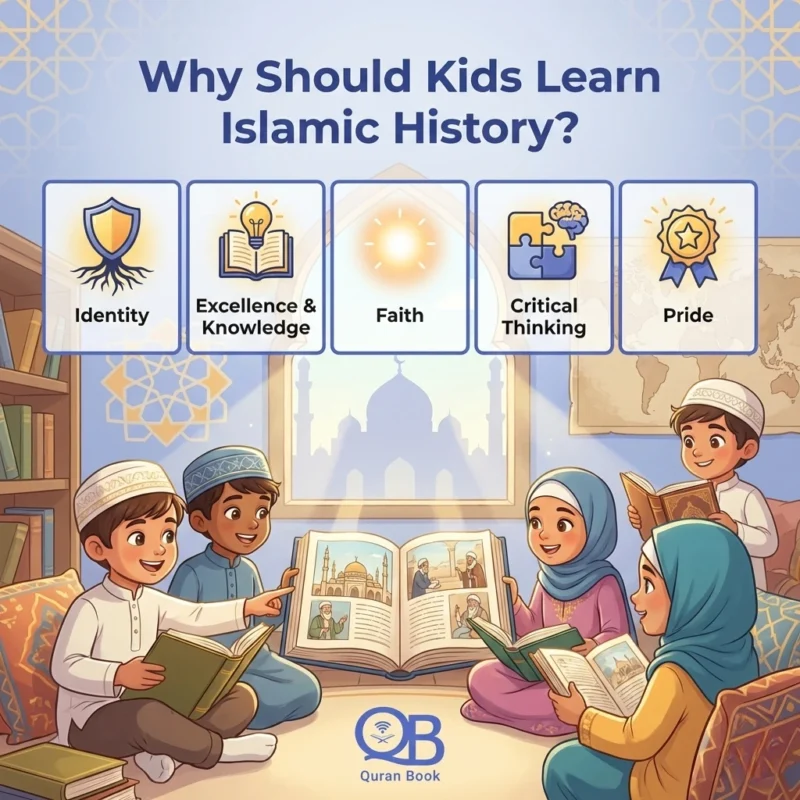
Learning Islamic history builds children’s Muslim identity, teaches valuable life lessons, and connects them to a legacy of faith and excellence spanning fourteen centuries. This isn’t just education—it’s identity formation.
5 Powerful Benefits of Teaching History of Islam for Kids
1 Building Muslim Identity
Children understand who they are and where they come from. This foundation creates confidence in diverse environments.
2 Inspiring Excellence
Stories of Muslim scholars like Ibn Sina and Al-Khwarizmi motivate academic achievement. Children learn that intellectual pursuit is part of their heritage.
3 Strengthening Faith
Historical examples demonstrate Allah’s plan unfolding through generations. Kids see how patience and trust in Allah led to success.
4 Developing Critical Thinking
Analyzing historical events builds reasoning skills that benefit children academically and personally.
5 Creating Lasting Pride
Children feel confident about their heritage when they know the achievements of Muslim civilization.
“The best of you are those who learn the Quran and teach it.”
— Sahih al-Bukhari 5027
Who Were the First Muslims? The Companions’ Stories
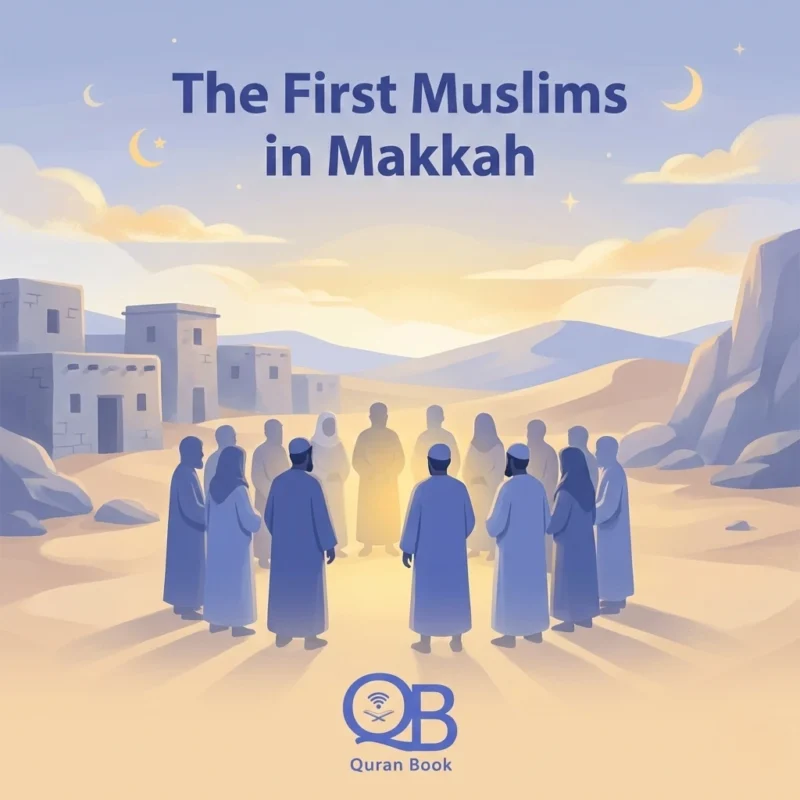
The first Muslims were the brave companions who accepted Islam in Makkah, including Khadijah (RA), Abu Bakr (RA), Ali (RA), and Bilal (RA). Each faced tremendous hardship with unwavering faith, providing children with relatable heroes. You can explore more inspiring narratives through our Stories of the Prophets series.
✦ Khadijah (RA) — The First Believer
The Prophet’s ﷺ beloved wife was the first person to accept Islam. Her unwavering support and sacrifice teach children about loyalty, courage, and standing by truth even when facing opposition. She was a successful businesswoman who used her resources to support the early Muslim community.
✦ Bilal (RA) — The Voice of Courage
An enslaved man who endured severe torture for his faith, Bilal (RA) became the first muezzin (caller to prayer). His incredible story teaches children about perseverance, dignity, and the equality that Islam established. When other companions purchased his freedom, he dedicated his life to serving Islam.
✦ The Young Companions
Children like Ali (RA), who accepted Islam at approximately ten years old, demonstrate that age doesn’t limit faith or courage. These young companions proved themselves as devoted Muslims, showing today’s children that they too can make meaningful contributions to their faith community.
The Islamic Golden Age — When Muslims Led the World
The Islamic Golden Age represents one of history’s most remarkable periods of human achievement, spanning roughly five centuries from 750 to 1258 CE. During this extraordinary era, while much of Europe experienced the Dark Ages, the Muslim world blazed with intellectual brilliance.
Muslim scholars translated Greek, Persian, and Indian texts into Arabic, preserving ancient knowledge while making groundbreaking discoveries of their own. Baghdad’s House of Wisdom (Bayt al-Hikmah) functioned as the world’s greatest library and research center, attracting scholars from every corner of the known world regardless of their religious background.
Children learning about this period discover that Muslims invented algebra—the word itself comes from the Arabic “al-jabr.” Muslim scientists developed sophisticated surgical techniques still studied today, mapped the stars with remarkable precision, and created algorithms that power modern computers.
Ibn Sina (Avicenna) wrote medical textbooks used in European universities for over 600 years. Al-Khwarizmi’s mathematical works gave us the word “algorithm.” Muslim architects designed buildings that still inspire awe worldwide, from the Alhambra in Spain to the magnificent mosques of Istanbul and beyond.
This wasn’t merely borrowing from other civilizations—it was an explosion of original creativity driven by the Quranic command to seek knowledge. Understanding this heritage helps children realize that pursuing education and scientific inquiry fulfills a sacred Islamic tradition. Enrolling in our Online Quran Classes can complement historical learning with foundational knowledge.
Muslim Achievements Kids Should Know
“Seeking knowledge is an obligation upon every Muslim.”
— Sunan Ibn Majah 224
How to Teach Islamic History to Kids: 5 Proven Methods
Teaching Islamic history to kids effectively requires engaging methods that match how children naturally learn—through stories, visuals, activities, and connection to their daily lives. Here are five proven approaches:
Start with Stories
Begin with exciting narratives before introducing dates and facts. Children remember stories long after they forget statistics.
Use Visual Aids
Maps, timelines, and illustrations make history tangible. Visual learners especially benefit from seeing where events happened.
Connect to Today
Show how Islamic innovations affect modern life. When children use mathematics, they’re using Muslim discoveries.
Make It Interactive
Quizzes, crafts, and discussions deepen understanding. Active participation increases retention significantly.
Chunk Information
Divide lessons into 15-20 minute segments. This matches children’s natural attention spans and prevents overwhelm.
The Academy Method — How We Teach Islamic History Online
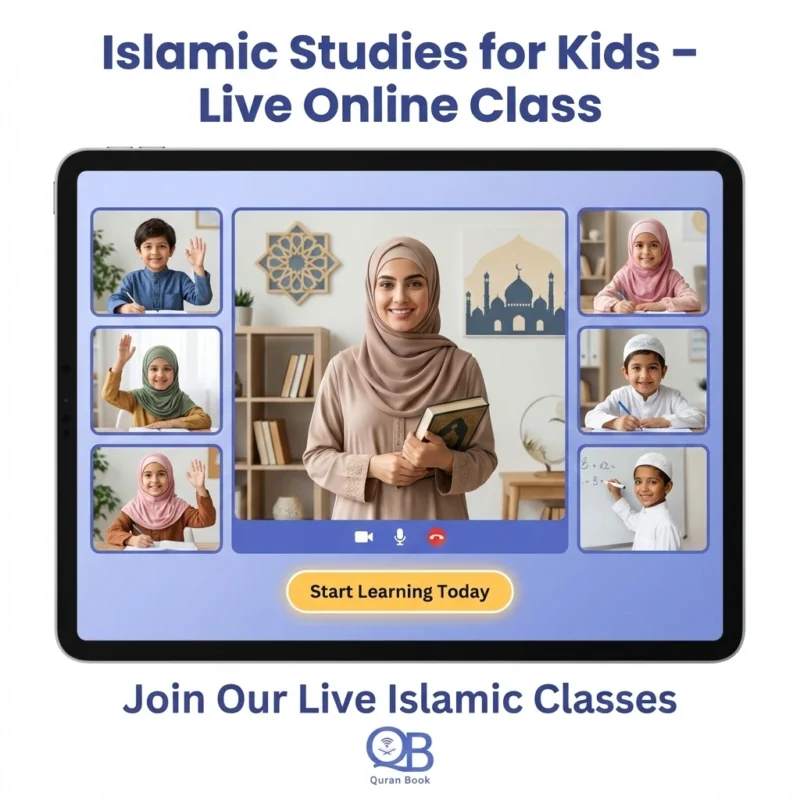
At Quran Book Academy, we transform Islamic history for kids into an adventure through our proven methodology designed specifically for young learners.
Our Technology Stack
▸ Live Zoom Sessions — Face-to-face interaction with expert teachers who specialize in children’s Islamic education.
▸ Custom LMS Platform — Track progress with detailed reports sent weekly via email to parents.
▸ Interactive Resources — Digital timelines, maps, and engaging activities keep children interested.
Our Teaching Approach
▸ Psychological Chunking — We divide lessons into 15-20 minute segments matching children’s natural attention spans.
▸ Story-Based Learning — Every historical period becomes an adventure children understand and remember.
▸ Connection to Faith — We link historical events to Quranic verses and Hadith, reinforcing both knowledge and iman.
For a comprehensive approach, explore our Quran Memorization Course and Arabic Language Course to build a complete Islamic education foundation for your child.
FAQ — Islamic History for Kids
What is the history of Islam in simple terms? +
Islam began in 610 CE when Prophet Muhammad ﷺ received the first revelation from Allah through Angel Jibreel. From Makkah, Islam spread throughout Arabia and eventually across continents, creating a civilization known for faith, knowledge, and justice.
Who was the first child born in Islam? +
Abdullah ibn al-Zubayr (RA) is widely recognized as the first child born among the Muhajirun (emigrants) in Madinah after the Hijrah. His birth brought great joy to the Muslim community.
Who were Prophet Ibrahim’s wives? +
Prophet Ibrahim (AS) had two wives: Sarah (RA), his first wife, and Hajar (RA). Both women play significant roles in Islamic history, with Hajar’s story connected to the sacred rituals of Hajj.
How can I make Islamic history interesting for my child? +
Use storytelling, visual timelines, interactive activities, and connect historical achievements to things your child uses daily. Online courses with engaging teachers also help tremendously. Our Islamic Studies Curriculum makes learning both fun and meaningful.
What is Islamic history today? +
Islamic history today refers to the ongoing story of 1.8 billion Muslims worldwide, including Muslim nations, preserved scholarship, and Muslims contributing to every field of human endeavor.
Start Your Child’s Islamic History Journey Today
Your child deserves to know the inspiring history that shaped their faith and civilization. Every day without this knowledge is a missed opportunity to build their identity and pride.
Leave a Reply