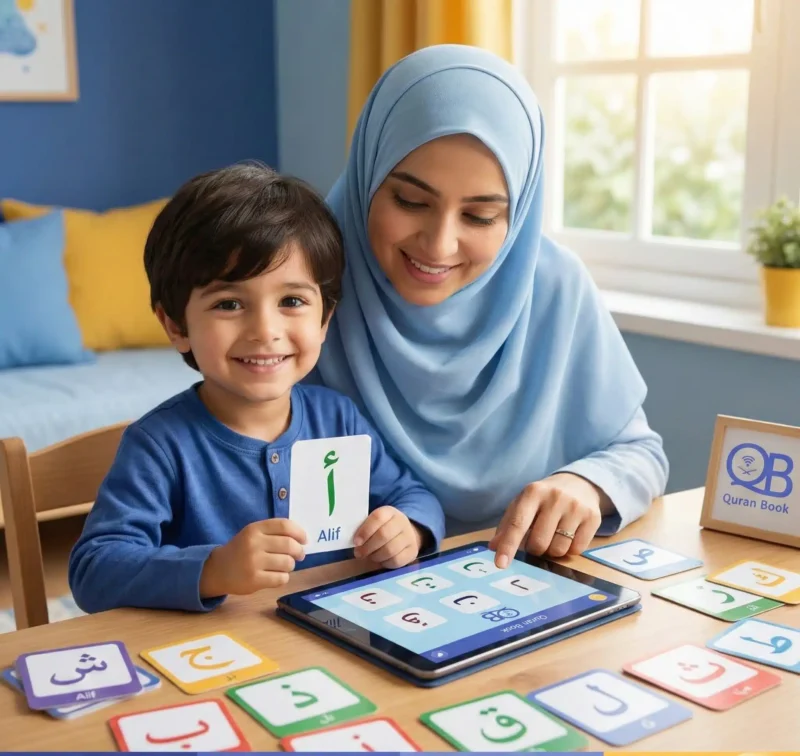
Introduction: Why This Guide Matters
You open an Arabic textbook for your child, and within five minutes, frustration takes over. The letters look foreign, the sounds feel impossible, and you wonder: Am I failing my child’s Islamic education? If this sounds familiar, you are not alone. Thousands of Muslim parents across the USA, Canada, the UK, and Australia face this exact struggle every single day.
The truth is, learning Arabic is absolutely achievable with the right approach, even if you do not speak Arabic yourself. In this comprehensive guide, we reveal the 7 best methods to teach Arabic to kids at home — proven strategies backed by educational psychology and Islamic pedagogy that make learning fun, not frustrating. Whether your child is 4 or 14, these methods will transform their Arabic journey from a chore into an adventure they actually look forward to.
Allah (SWT) Himself reassures us in the Quran:
“Indeed, We have made this Qur’an easy to remember. Is there anyone who will be mindful?”
— Surah Al-Qamar 54:17
This divine promise applies to our children too. With the right methods, the Arabic language opens its doors wide. Let us show you how.
Why Teaching Arabic to Kids Early Is a Game-Changer
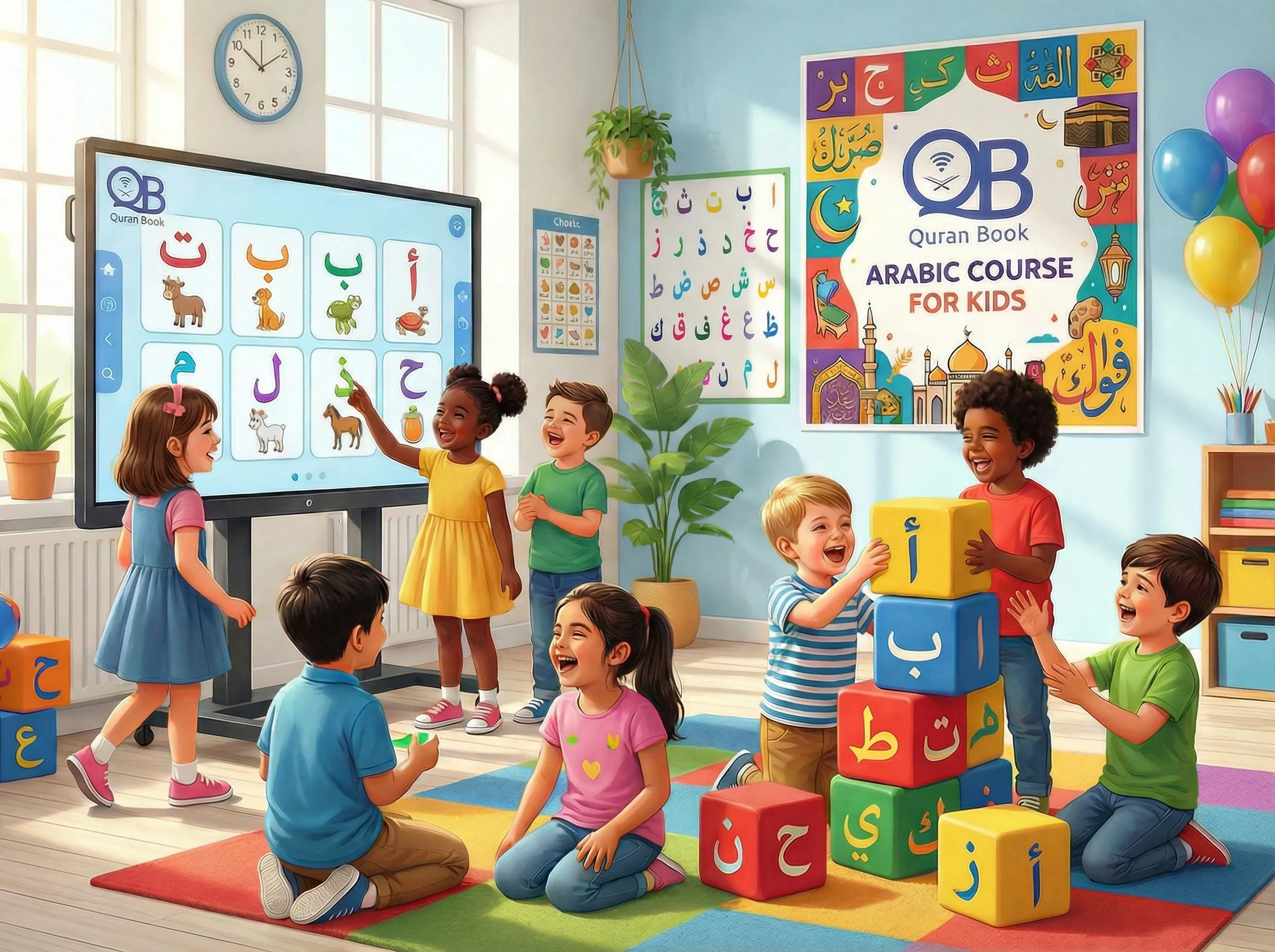
Teaching Arabic to kids early enhances cognitive development, builds a deep spiritual connection to the Quran, and develops powerful bilingual advantages. Research confirms that children between the ages of 3 and 7 are in a critical window for language acquisition, making this the golden period for introducing Arabic.
Cognitive Benefits
Studies from leading universities, including Harvard, show that bilingual children develop stronger problem-solving abilities, enhanced memory, and greater mental adaptability. When children learn Arabic alongside English, their brains build denser neural networks that benefit all areas of learning.
Spiritual Foundation
Arabic is the language of Salah, the Quran, and Du’a. When a child understands what they are reciting in prayer, it transforms a routine act into a deeply personal conversation with Allah (SWT). This spiritual connection becomes the anchor of their Islamic identity.
Critical Age Window
Between ages 3 and 7, the brain is most receptive to new phonetic systems. Children in this window can absorb Arabic sounds, including the unique throat and emphatic letters, far more naturally than older learners.
Cultural Identity
Arabic bridges children to their heritage and connects them to the global Muslim Ummah. It fosters a sense of belonging that transcends borders.
The Prophet Muhammad (ﷺ) emphasized the importance of Quran education:
“The best of you are those who learn the Qur’an and teach it.”
— Sahih al-Bukhari 5027
7 Best Methods to Teach Arabic to Kids
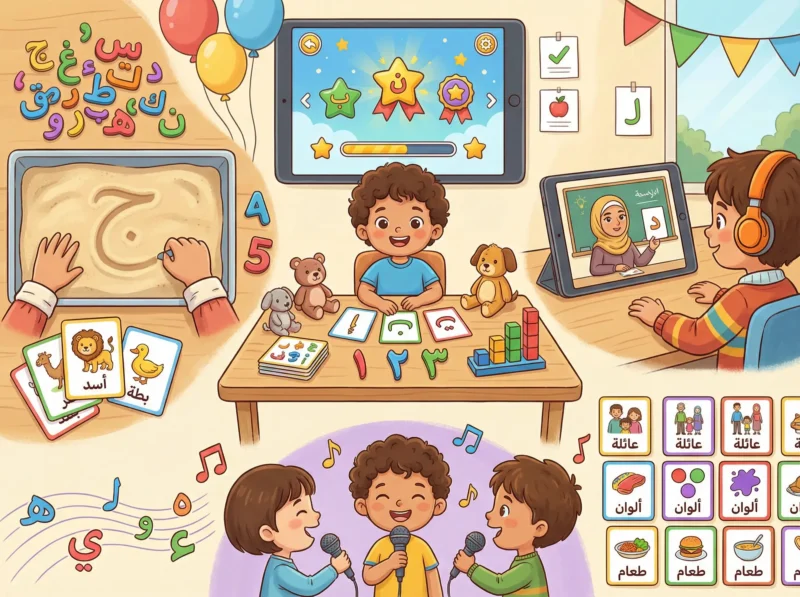
The 7 best methods to teach Arabic to kids include gamification, consistent micro-lessons, visual aids, the Nour El Bayan phonics method, the chunking technique, interactive online classes, and storytelling with Islamic themes. Each method is grounded in educational research and enhanced with Islamic values.
Gamification — Turn Every Arabic Lesson Into a Game
Gamification is one of the most powerful best methods to teach Arabic to kids because it taps into the brain’s natural reward system. When children play Arabic learning games, their brains release dopamine, the feel-good chemical that strengthens memory and motivation. Instead of dreading Arabic practice, children actually ask for more.
Start with simple, hands-on games: Arabic Bingo, where children match Arabic letters to called-out sounds; Letter Treasure Hunts, where flashcards are hidden around the house; and Memory Card Matching, where kids pair Arabic letters with pictures. For digital learners, apps that use achievement badges, points, and streaks keep the excitement going between lessons.
At Quran Book Academy, we integrate gamified elements directly into our custom LMS. Children earn rewards for completing milestones, keeping them engaged and eager to progress through their Arabic and Tajweed courses.
Consistency Over Intensity — Why 10 Minutes a Day Beats 2 Hours a Week
One of the most overlooked best methods to teach Arabic to kids is simply being consistent. Educational psychology shows that spaced repetition, which means short daily sessions, builds neural pathways far faster than cramming. We call it the 10-Minute Arabic Rule: just ten focused minutes every day produces dramatically better results than a two-hour weekend marathon.
Here is how this works in practice:
| Factor | 10 Min/Day | 2 Hours/Week | Winner |
|---|---|---|---|
| Retention Rate | 85%+ (spaced repetition) | 40–50% (cramming) | 10 Min/Day ✓ |
| Child Engagement | High (short & fun) | Low (fatigue & boredom) | 10 Min/Day ✓ |
| Parent Commitment | Easy to maintain | Hard to schedule | 10 Min/Day ✓ |
| Monthly Progress | Steady & measurable | Inconsistent | 10 Min/Day ✓ |
For busy working parents, this is liberating. Even on the most hectic day, ten minutes is always achievable. And over the course of a month, those small sessions compound into remarkable progress.
Visual Aids — Colors, Animation & the Power of Images
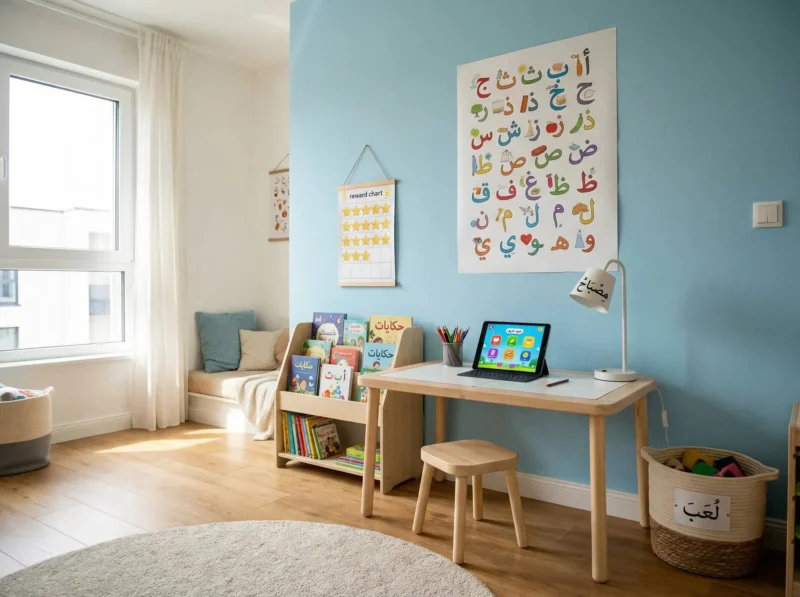
Research shows that approximately 65% of children are visual learners, making visual aids one of the best methods to teach Arabic to kids effectively. When Arabic letters are paired with colors, animations, and images, retention rates skyrocket.
Start with color-coded Arabic letters. For instance, use different colors for similar-looking letters like ب, ت, and ث to help children distinguish between them at a glance. Pair each letter with a relatable image: ج for جمل (camel), ب for بيت (house). Arabic flashcards with vibrant illustrations are inexpensive to make and incredibly effective.
For animated learning, the Quran Book Academy YouTube channel offers fun, engaging Arabic letter videos that children love. Embedding video content into your child’s daily routine maximizes dwell time and creates multi-sensory learning connections that stick.
The Nour El Bayan Method — A Proven Phonics-First Approach
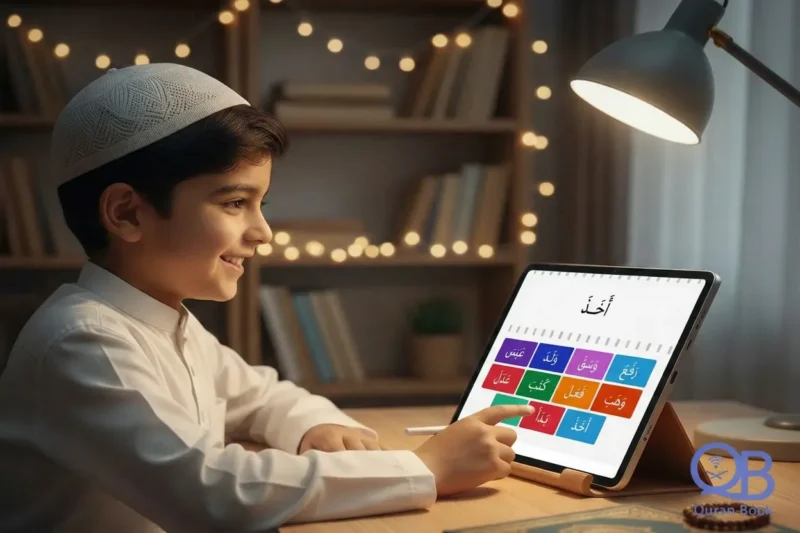
The Nour El Bayan method is a structured phonics-based approach that teaches children Arabic letter sounds before their names. This phonics-first strategy is one of the best methods to teach Arabic to kids because it enables them to actually read Arabic, not just memorize letter shapes.
The method follows a clear progression: individual sounds, then connected letters, then short words, and finally Quran verses. By starting with sounds, children build a solid decoding foundation that makes Quran reading with Tajweed feel natural and intuitive.
Quran Book Academy offers a full Nour El Bayan course on our YouTube channel for free practice, and our live Zoom classes follow this method with certified native Arabic teachers who guide each child through the progression at their own pace.
The Chunking Technique — Manageable Psychological Chunks
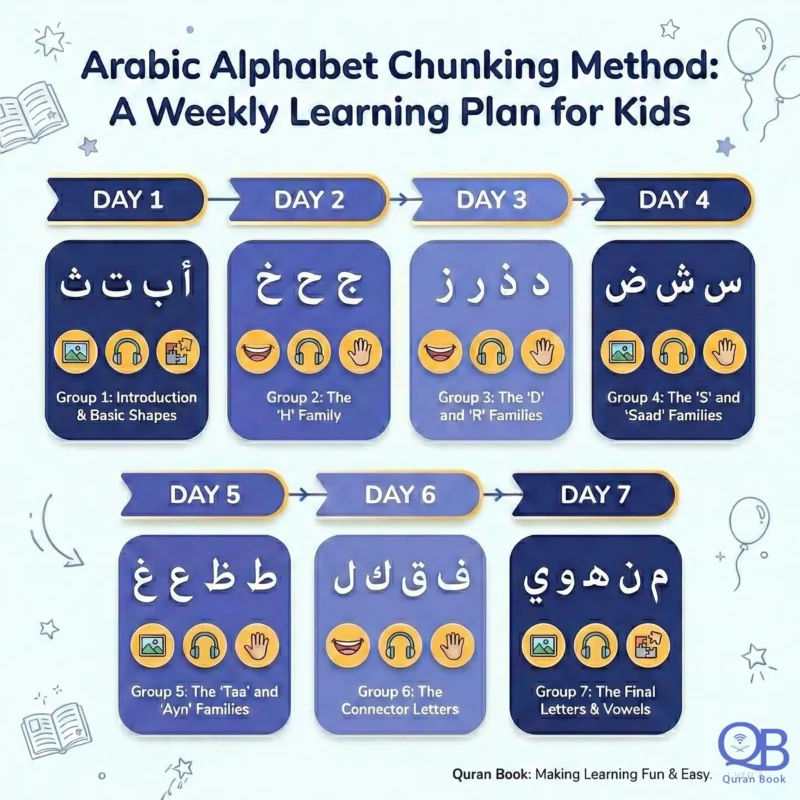
The concept of “chunking” was introduced by cognitive psychologist George Miller in 1956, and it remains one of the most effective best methods to teach Arabic to kids to this day. Miller’s research demonstrated that the human brain can process only 5 to 9 pieces of new information at any given time. For Arabic learning, this means you should never attempt to teach all 28 letters at once. Instead, break them into manageable groups of 3 to 5 letters. Each chunk should be paired with a visual cue, a sound recording, and a hands-on activity to engage multiple senses simultaneously.
For example, in Week 1, you might introduce ا (Alif), ب (Ba), and ت (Ta), pairing each with a picture, a short song, and a clay-molding activity where children shape the letters with their hands. By the end of 6 to 8 weeks, your child will have mastered the full Arabic alphabet without the overwhelming feeling that causes most kids to quit.
This technique is exactly how Quran Book Academy structures its Arabic homeschool curriculum: our live Zoom sessions break every lesson into digestible 15-minute focus chunks with interactive exercises, and our custom LMS tracks each child’s progress through these chunks, sending parents detailed progress reports via Gmail after every session.
This approach directly eliminates the number one reason children abandon Arabic: cognitive overload. Instead of thinking “I will never learn this,” they experience small, meaningful wins every single day. The Prophet Muhammad (ﷺ) taught us the same principle of steady, consistent progress:
“The most beloved deeds to Allah are those done consistently, even if they are small.”
— Sahih al-Bukhari 6464
Interactive Online Arabic Classes — Live, Personal & Effective
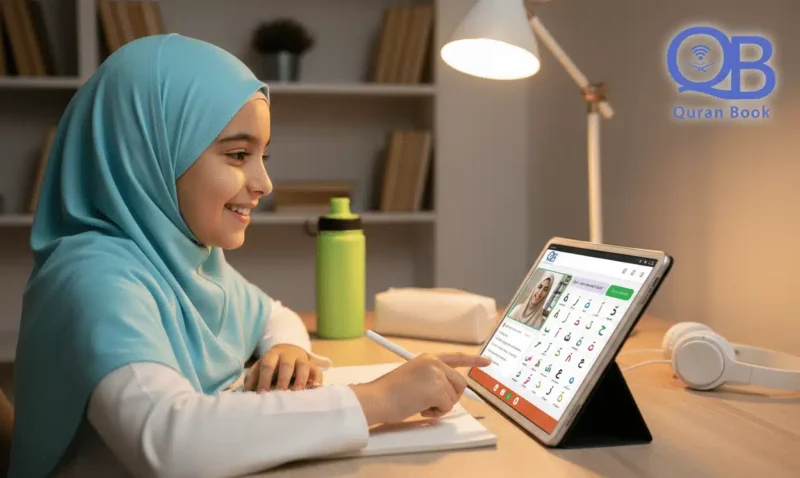
Live interactive classes are among the best methods to teach Arabic to kids because they combine real-time feedback with personal connection and accountability. Unlike pre-recorded lessons, live sessions allow teachers to correct pronunciation instantly, adjust pace based on the child’s needs, and build meaningful mentor-student relationships.
Quran Book Academy’s approach combines live Zoom sessions with certified native Arabic teachers, a custom LMS that tracks letters learned, Surahs completed, and attendance, plus Gmail progress reports sent directly to parents. Whether your family is in the USA, Canada, the UK, or Australia, your child can learn from home with zero commute.
The social element matters too. Group classes with other Muslim kids create peer motivation, friendly competition, and a sense of community that keeps children excited about their Arabic and Quran journey.
Storytelling & Islamic Themes — Making Arabic Meaningful
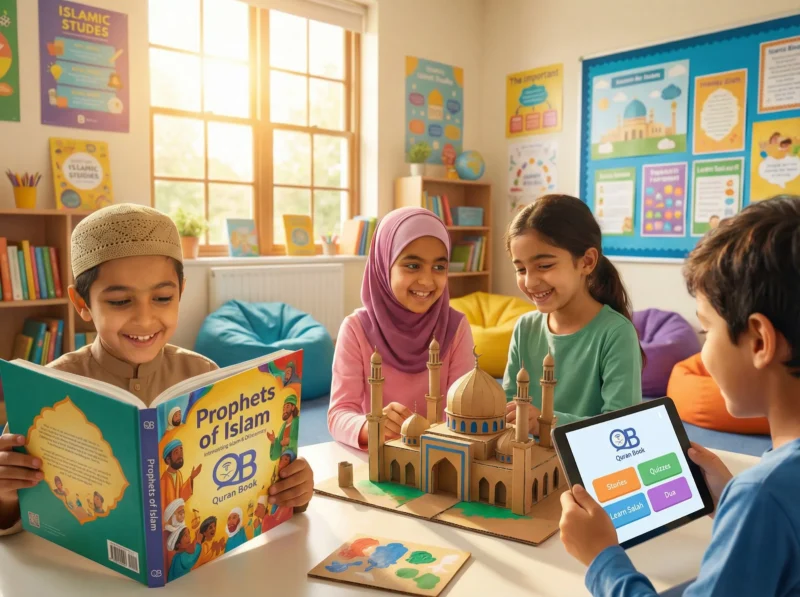
The final and perhaps most inspiring of the best methods to teach Arabic to kids is storytelling rooted in Islamic themes. When children learn Arabic vocabulary through the stories of the Prophets, daily Du’as like Bismillah, Alhamdulillah, and SubhanAllah, and beautiful Nasheeds, the language becomes alive with meaning and purpose.
Arabic stories for kids drawn from the Quran teach vocabulary in context. A story about Prophet Yusuf (AS) naturally introduces words for family, patience, trust, and faith. Daily Du’as serve as vocabulary builders that children practice multiple times a day without even realizing they are learning. And simple Islamic Nasheeds with repetitive Arabic words boost memory through rhythm and melody.
Once children have learned letters through stories and songs, the transition to reading short Surahs feels natural and rewarding. Allah (SWT) tells us:
“We relate to you the best of stories through this Qur’an.”
— Surah Yusuf 12:3
The Academy Method — How Quran Book Academy Teaches Arabic & Tajweed

Quran Book Academy uses a unique blend of the best methods to teach Arabic to kids — combining live Zoom sessions, a custom LMS, and the Nour El Bayan phonics method to teach children Arabic and Tajweed in manageable, engaging chunks with real-time feedback and parent progress reports.
Our Methodology
Every student receives live one-on-one and group Zoom sessions with certified native Arabic teachers, many of whom are Al-Azhar graduates. Lessons follow the Nour El Bayan phonics progression, ensuring children build genuine reading skills from day one.
Tajweed Integration
Every Arabic lesson connects directly to Quran reading fluency with proper Tajweed rules. Children do not just learn letters; they learn to recite the Quran beautifully and correctly.
Our Tech Stack
Zoom provides live interaction with instant feedback. Our custom LMS tracks letters learned, Surahs completed, and attendance milestones. Gmail Reports keep parents informed with weekly progress updates delivered straight to their inbox.
Psychological Approach
Lessons are broken into 15-minute focus chunks, rewards are given for milestones, and positive reinforcement ensures every child feels confident and motivated. Plus, our YouTube channel offers free resources including Arabic letter animations and a complete Nour El Bayan course.
Arabic Alphabet for Kids — A Step-by-Step Starter Guide
To teach the Arabic alphabet for kids, start with phonics by teaching sounds before letter names, introduce 3 to 5 letters per week using visual aids and hands-on activities, and use songs and games to reinforce learning daily.
🎯 Milestone: With consistent daily practice of 10 to 15 minutes, most children master all 28 Arabic letters within 2 to 3 months. The Arabic alphabet for kids becomes an achievable and exciting goal.
Building an Arabic Homeschool Curriculum That Works
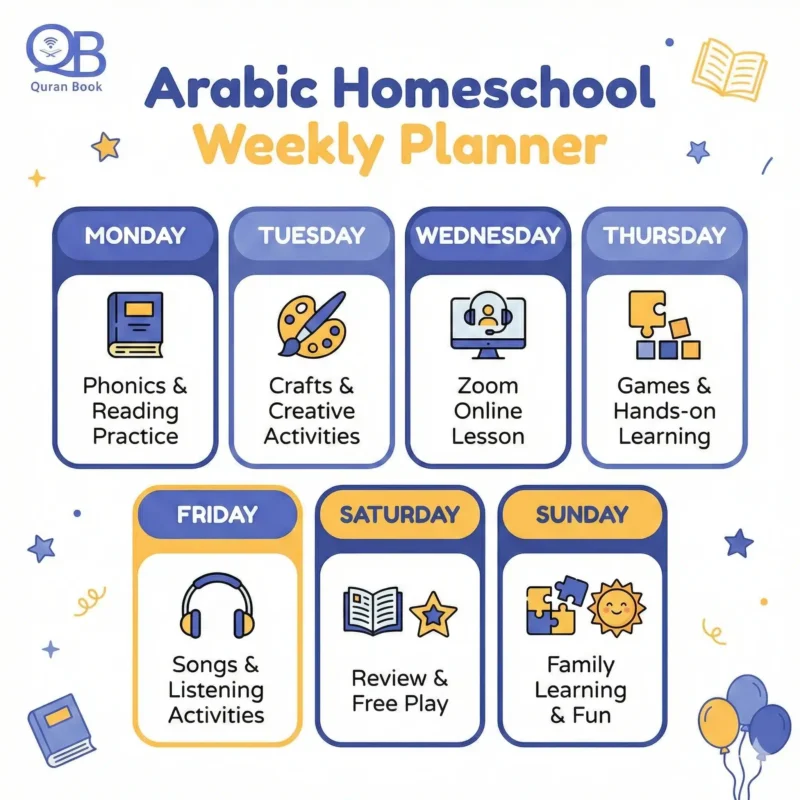
An effective Arabic homeschool curriculum combines structured phonics lessons, daily 10 to 15 minute practice sessions, visual aids, live online classes, and Islamic storytelling to keep kids engaged and progressing. Here is a sample weekly schedule you can start using today:
| Day | Activity (10–15 min) | Resource |
|---|---|---|
| Mon | New letters (phonics + visuals) | Nour El Bayan YouTube |
| Tue | Arabic handwriting practice + clay letters | Printable worksheets |
| Wed | Live Zoom class with teacher | Quran Book Academy |
| Thu | Arabic games + flashcards | DIY games + apps |
| Fri | Quran listening + short Surah review | Quran.com + Academy LMS |
| Sat | Storytelling + Islamic Nasheeds | YouTube + Islamic books |
| Sun | Review week’s progress + fun quiz | LMS Progress Report |
This Arabic homeschooling schedule is flexible. Adjust the activities to your child’s energy levels, and remember: consistency matters more than perfection. Even following this plan three or four days a week will produce noticeable results within the first month.
Frequently Asked Questions About Teaching Arabic to Kids
Start Your Child’s Arabic Journey Today — Free Trial Lesson

Your child deserves to connect with the Quran in the language it was revealed. At Quran Book Academy, our certified Al-Azhar teachers use the best methods to teach Arabic to kids — live on Zoom, tracked through our LMS, and reported directly to your inbox. Do not let another month pass. Book your FREE trial lesson today and watch your child fall in love with Arabic.
🟢 BOOK YOUR FREE TRIAL LESSON NOW
Live Zoom Classes | Native Arabic Teachers | 5,000+ Students Worldwide | 4.9/5 Parent Rating
quranbookonline.com — Start FreeReferences & Sources
Quranic References
- Surah Al-Qamar 54:17 — quran.com/54/17
- Surah Yusuf 12:3 — quran.com/12/3
Hadith References
- Sahih al-Bukhari 5027 — sunnah.com/bukhari:5027
- Sahih al-Bukhari 6464 — sunnah.com/bukhari:6464
Academy Resources
- Quran Book Academy Homepage — quranbookonline.com
- Arabic for Kids Course — Arabic Online for Kids
- Quran Reading & Tajweed Course — Learn Quran with Tajweed
- Nour El Bayan Course — Quran Reading for Beginners
- About Our Teachers — About Us
- YouTube Channel — Quran Book Academy on YouTube
- Telegram Channel (Tajweed Practice) — t.me/maqraquranbookonline
Leave a Reply