
Introduction — You’re Not Behind, You’re Beginning
If you want to learn Quran with Tajweed, you are taking one of the most rewarding steps in your spiritual journey. Millions of non-Arabic speaking Muslims around the world share the same desire—to recite Allah’s words with correct pronunciation and deep understanding. Yet many feel overwhelmed, too old to start, or unsure where to begin. The truth is: you are not behind, and you are not alone.
Life is busy. Between work, parenting, and daily responsibilities, finding time to study Quran recitation can feel impossible. But here is the beautiful reality: the Prophet (ﷺ) reminded us that “The one who recites the Quran and struggles with it will have a double reward.” (Sahih al-Bukhari 4937). Your effort, no matter how small, carries immense spiritual weight.
Allah Himself reassures us in the Quran: “And We have certainly made the Quran easy for remembrance.” (Surah Al-Qamar 54:17). This verse is a divine promise that the Quran is accessible to everyone who approaches it with sincerity. Whether you are a complete beginner or someone returning after years away, this guide will show you the powerful benefits of learning Quran with Tajweed and exactly how to get started from home.
What Is Tajweed? A Simple Explanation for Beginners
Tajweed is the science of reciting the Quran correctly. Linguistically, the Arabic word “Tajweed” means beautification or improvement. Technically, it refers to the precise set of rules that govern how every letter of the Quran should be pronounced—from its correct articulation point (makhraj) with its proper characteristics (sifaat). When you learn Quran with Tajweed, you ensure that each word carries its intended meaning exactly as it was revealed to the Prophet Muhammad (ﷺ).
Think of Tajweed as the grammar of Quran recitation. Just as English grammar protects the meaning of a sentence, Tajweed protects the meaning of Allah’s words. A small change in pronunciation can completely alter the meaning of a verse. The majority of Islamic scholars consider learning basic Tajweed rules an individual obligation (fard ‘ayn) for every Muslim, based on the Quranic verse: “…and recite the Quran with measured recitation.” (Surah Al-Muzzammil 73:4).
7 Powerful Benefits of Learning Quran with Tajweed
Here are the seven most impactful benefits you will experience when you learn Quran with Tajweed online or with a qualified teacher: improved pronunciation accuracy, greater spiritual rewards, unshakeable confidence in Salah, a deeper connection with Allah, protection of the Quran’s meaning, enhanced cognitive function, and membership in a global community of learners.
1. Recite the Quran the Way It Was Revealed
The most fundamental benefit of learning Quran with Tajweed is that it allows you to recite the Quran in the exact manner it was revealed to the Prophet Muhammad (ﷺ) through Angel Jibreel. Tajweed preserves the original sound, rhythm, and phonetic precision of the divine revelation. Without proper Tajweed, even a single articulation error can change one word into another entirely.
For example, the difference between the Arabic words “qalb” (heart) and “kalb” (dog) lies in just one articulation point. When a reciter masters these distinctions through Tajweed study, they build a deeply personal identity as a faithful carrier of the Quran’s original message. This is not merely an academic exercise—scholars across centuries have emphasized that Tajweed is the guardian of the Quran’s linguistic integrity.
From a psychological perspective, mastering correct pronunciation builds a student’s self-concept as a competent Quran reader, which in turn motivates continued learning and deeper engagement with the text. Each correctly articulated letter becomes a building block of confidence, transforming the student from a hesitant beginner into a purposeful reciter who carries the words of Allah with dignity and precision.
2. Earn Greater Spiritual Rewards
The Prophet (ﷺ) said: “The best among you are those who learn the Quran and teach it.” (Sahih al-Bukhari 5027). When you learn Quran with Tajweed, you are not only improving your recitation—you are striving toward a rank of excellence in the eyes of Allah.
Every letter recited with proper Tajweed carries a reward (hasanah), and the Prophet (ﷺ) confirmed that each hasanah is multiplied tenfold. Imagine the accumulated blessings from reciting just one page of the Quran with beautiful, accurate Tajweed every single day.
3. Build Unshakeable Confidence in Salah
For many Muslims, prayer is a source of anxiety rather than peace—not because they lack devotion, but because they are unsure whether they are pronouncing the verses correctly. When you learn Quran with Tajweed online, you systematically eliminate that uncertainty.
Students who master Tajweed rules report feeling a profound shift in their prayer experience: they stop second-guessing every syllable and start truly connecting with the meaning of what they recite. This transforms Salah from a source of stress into a sanctuary of tranquility.
4. Strengthen Your Connection with Allah (سبحانه وتعالى)
Tajweed is not just about technical accuracy—it is about contemplation (tadabbur). When you pronounce each word correctly and understand the rules behind the elongation and pauses, you begin to feel the emotional weight of the verses. Online Tajweed classes help students slow down, listen to the rhythm of the Quran, and develop a personal, heartfelt relationship with Allah’s message. This deeper connection is one of the most life-changing benefits students describe.
5. Protect the Meaning of the Quran
Tajweed prevents lahn (errors) that can unintentionally distort the meaning of Allah’s words. There are two types of lahn: major errors (lahn jaliyy) that change the meaning entirely, and minor errors (lahn khafiyy) that affect the beauty of recitation without altering meaning. Learning Tajweed online equips you to avoid both types, ensuring that when you recite the Quran—whether in prayer or study—you are faithfully conveying the exact message Allah intended.

6. Improve Cognitive Function and Mental Wellness
The benefits of learning Quran with Tajweed extend beyond spirituality into neuroscience. Studying Tajweed engages multiple cognitive systems simultaneously: phonetic processing, auditory discrimination, working memory, and motor coordination of the mouth and tongue. Research has shown that regular Quran recitation activates brain regions associated with calmness and emotional regulation. For adults, this makes Tajweed study a powerful form of cognitive exercise that can sharpen focus, reduce stress, and promote overall mental wellness.
7. Join a Global Community of Learners
When you learn Quran with Tajweed online, you join a worldwide community of Muslims who share the same goal. Platforms like Quran Book Academy connect students from the USA, Canada, UK, and Australia with certified teachers and fellow learners. The Academy’s Telegram channel offers daily Tajweed practice, peer support, and encouragement—making the journey less lonely and far more sustainable. Community accountability is one of the strongest predictors of long-term learning success.
The 4 Core Principles of Tajweed Every Student Must Know
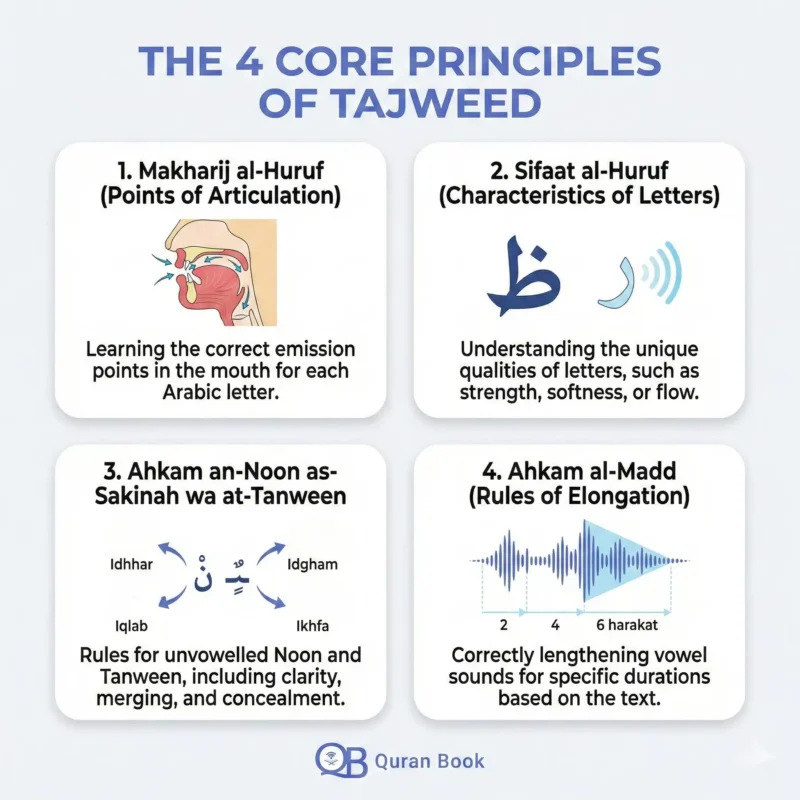
The four core principles of Tajweed are: (1) Makharij al-Huruf (articulation points), (2) Sifaat al-Huruf (letter characteristics), (3) rules of Noon Sakinah and Tanween, and (4) rules of Madd (elongation). Mastering these four areas provides the complete foundation for beautiful Quran recitation.
Makharij al-Huruf
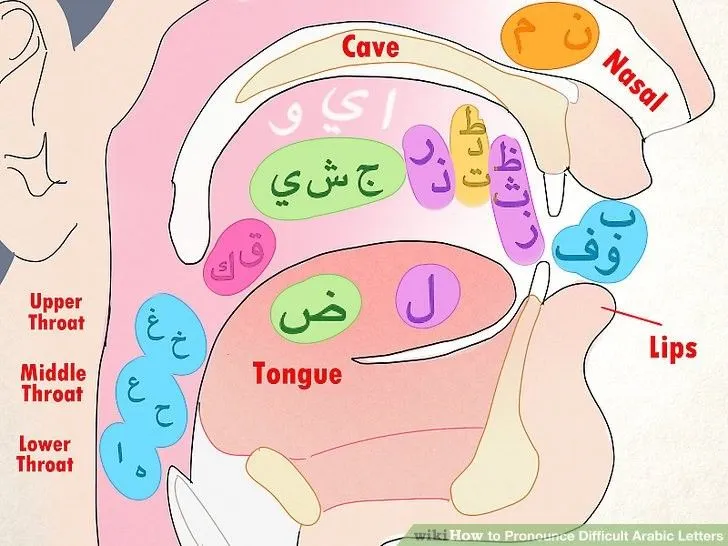
Every Arabic letter originates from a specific point in the mouth, throat, or nasal passage. Knowing the exact makhraj of each letter is the first step toward accurate Tajweed. For instance, the letter “Ain” comes from the middle of the throat, while “Ba” comes from both lips. Quran Book Academy’s YouTube channel features detailed Makhraj Huruf video lessons that demonstrate each articulation point visually.
Sifaat al-Huruf
Each letter carries specific qualities that distinguish it from others. These include heaviness (tafkheem), lightness (tarqeeq), softness (hams), and strength (jahr). Understanding sifaat ensures that letters are not just pronounced from the right place but also carry the right sonic character.
Noon Sakinah & Tanween
When the letter Noon carries a sukoon or when Tanween appears, four specific rules apply: Ikhfa (concealment), Idgham (merging), Iqlab (conversion), and Izhar (clear pronunciation). These rules dictate how the Noon sound interacts with the letter that follows it, and they are among the most frequently applied Tajweed rules in daily recitation.
Rules of Madd (Elongation)
Madd rules determine when and how to stretch vowel sounds for 2, 4, or 6 counts. There are several types of Madd, including Madd Tabee’ee (natural elongation), Madd Muttasil (connected), and Madd Munfasil (separated). Proper elongation adds beauty and rhythm to recitation and is essential for anyone who wants to learn Quran with Tajweed correctly.
How to Learn Quran with Tajweed at Home (Step-by-Step)
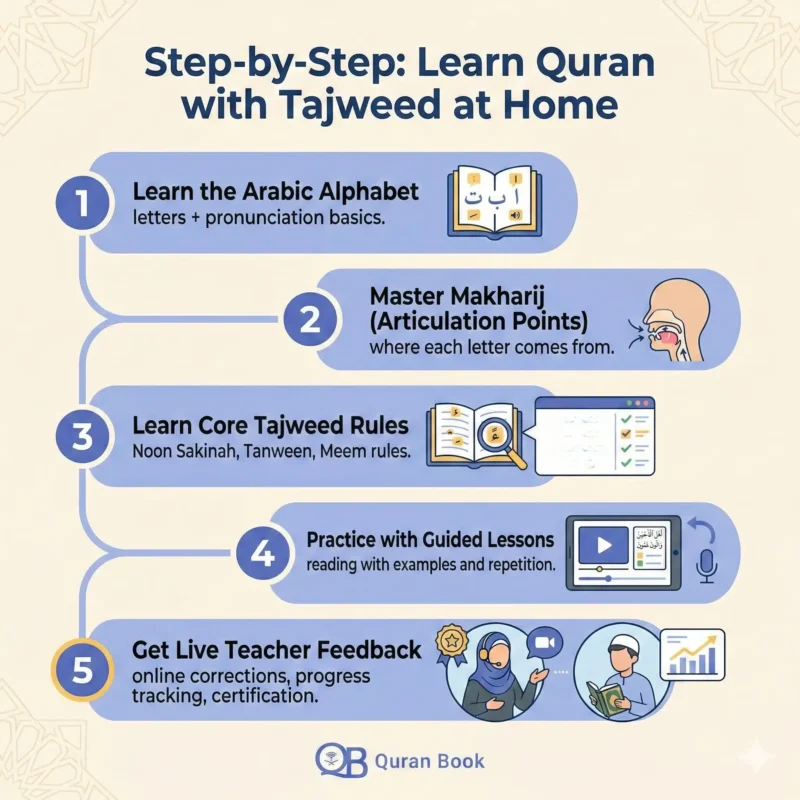
You can learn Quran with Tajweed at home by following these five proven steps: (1) learn the Arabic alphabet and sounds, (2) master the articulation points, (3) study basic Tajweed rules, (4) apply rules through daily Quran reading, and (5) get feedback from a certified teacher.
Learn the Arabic Alphabet and Sounds
Begin with a foundational course such as Nour El Bayan, which teaches Arabic letter recognition and proper pronunciation from scratch. Quran Book Academy offers a complete Nour El Bayan course on YouTube and through live sessions, designed specifically for non-Arabic speaking beginners.
Master the Makharij (Articulation Points)
Practice each letter’s exit point with guidance from a qualified teacher. Live Zoom sessions allow your instructor to see and hear your pronunciation in real time and provide immediate corrections that self-study alone cannot offer.
Study Basic Tajweed Rules
Start with the most commonly applied rules: Noon Sakinah, Tanween, and Madd. A good approach is to learn one rule per week, practicing it in context with short Quranic passages. This “cognitive chunking” method prevents overwhelm and builds lasting mastery.
Apply Rules by Reading Quran Daily
Dedicate 10–15 minutes each day to reciting a short surah while consciously applying the Tajweed rules you have learned. Consistency matters more than duration. Track your progress through a structured learning management system like the one offered by Quran Book Academy.
Get Feedback from a Certified Teacher
Self-study has its limits. A certified Quran teacher catches pronunciation mistakes that your own ear cannot detect. Booking a free trial with Quran Book Academy connects you with experienced instructors who specialize in teaching Tajweed to non-Arabic speakers in the USA, Canada, UK, and Australia.
The Academy Method — How Quran Book Academy Teaches Tajweed
Quran Book Academy has developed a distinctive teaching methodology rooted in educational psychology and modern technology. Here is what sets the Academy apart for students who want to learn Quran with Tajweed online.
Psychological Chunking
Complex Tajweed rules are broken into small, manageable lessons that build on each other—a technique known as cognitive chunking. This approach, grounded in educational psychology research, reduces overwhelm and accelerates skill acquisition. Lessons are designed with spaced repetition, immediate feedback, and incremental difficulty to maximize retention.
Live Zoom Sessions
Every student receives real-time correction and personalized feedback via live Zoom. Sessions are available in one-on-one or small group formats with flexible scheduling to accommodate students across time zones in the USA, Canada, UK, and Australia. Each teacher is certified in Quran recitation and trained to work with non-Arabic speakers.
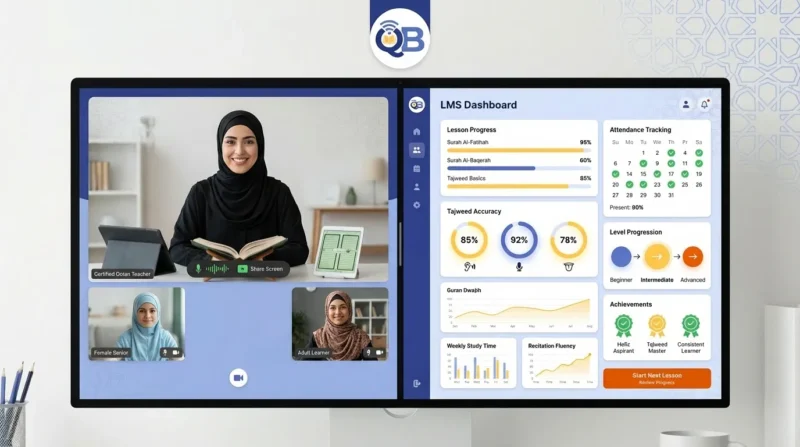
Custom LMS & Progress Reports
Students and parents receive regular progress reports tracking lesson completion, Tajweed rule mastery, and areas for improvement. The Academy’s custom Learning Management System logs every session and skill milestone, providing a transparent view of your learning journey.
Courses We Offer
Quran Book Academy offers a comprehensive suite of courses: Quran Reading & Tajweed Course, Quran Memorization (Hifz) Course, Nour El Bayan Course, and Islamic Studies. Each course is structured for online delivery with live teacher interaction and LMS tracking.
What Happens to Your Brain When You Listen to the Quran?
Listening to the Quran activates brain regions associated with calmness, emotional regulation, and deep memory processing. Neuroscience research has shown that rhythmic, melodic recitation—the kind that Tajweed enables—stimulates the parasympathetic nervous system, reducing cortisol (the stress hormone) and promoting a state of tranquility.
Studies conducted on Quran listeners have documented measurable decreases in anxiety levels and improvements in emotional well-being. This aligns with the Quranic verse: “Verily, in the remembrance of Allah do hearts find rest.” (Surah Ar-Ra’d 13:28).
When you learn Quran with Tajweed, you are not only fulfilling a spiritual obligation—you are investing in your mental health. The precise rhythm and pronunciation that Tajweed teaches enhances the naturally calming effect of Quran recitation, making every listening session a form of therapeutic meditation.
Tajweed vs. No Tajweed — A Side-by-Side Comparison
The following table highlights the practical differences between reciting the Quran with and without Tajweed. This comparison illustrates why so many Muslims choose to learn Quran with Tajweed online.
| Aspect | With Tajweed ✓ | Without Tajweed ✗ |
|---|---|---|
| Pronunciation Accuracy | Correct makhraj for each letter | Frequent mispronunciation risk |
| Meaning Preservation | Original meaning protected | Potential meaning distortion |
| Spiritual Reward | Higher reward (reciting as revealed) | Reward present but diminished |
| Confidence in Salah | High — no second-guessing | Low — constant uncertainty |
| Listening Experience | Beautiful, melodic recitation | Choppy, inconsistent flow |
| Learning Speed (long-term) | Faster with strong foundation | Slower due to bad habits |
| Community Recognition | Respected reciter (Qari/Qari’ah) | Casual reader |
FAQ — Your Top Questions About Learning Quran with Tajweed
Start Your Free Tajweed Lesson Today
Your journey to beautiful, confident Quran recitation starts with a single lesson. Whether you are a complete beginner who has never read Arabic or an intermediate reader looking to perfect your Tajweed, Quran Book Academy is here to walk with you every step of the way.
Here is what you get when you sign up for a free trial lesson: a live one-on-one Zoom session with a certified Quran teacher, a personalized assessment of your current recitation level, a customized learning plan based on your goals, and access to our Learning Management System for progress tracking.
➤ Book Your Free Trial Lesson Now ➤
References
[1] Sahih al-Bukhari 4937 — Hadith on double reward for struggling reciters. sunnah.com/bukhari/4937
[2] Sahih al-Bukhari 5027 — “The best among you are those who learn the Quran and teach it.” sunnah.com/bukhari/5027
[3] Surah Al-Qamar 54:17 — “And We have certainly made the Quran easy for remembrance.” quran.com/54/17
[4] Surah Al-Muzzammil 73:4 — “…and recite the Quran with measured recitation.” quran.com/73/4
[5] Surah Ar-Ra’d 13:28 — “Verily, in the remembrance of Allah do hearts find rest.” quran.com/13/28
[6] Makhraj Huruf Video Lessons — YouTube Playlist. YouTube Playlist
[7] Nour El Bayan Course — YouTube Playlist. YouTube Playlist
[8] Quran Book Academy Telegram Practice Channel. t.me/maqraquranbookonline
Leave a Reply