
Benefits of Tajweed: 9 Powerful Ways to Improve Quran Recitation

If you’ve ever felt nervous reciting the Qur’an out loud, you’re not alone. Many Muslims—especially non-Arabic speakers—worry they’ll “say it wrong,” change a word, or be judged for an accent. That’s exactly where the benefits of Tajweed become a mercy: Tajweed gives you a clear, step-by-step way to recite with correct pronunciation, protect the meaning of Allah’s words, and feel calmer in worship.
The goal isn’t perfection overnight. Tajweed is simply learning how to give each Arabic letter its right sound (makhraj) and apply a few common rules so your recitation becomes steady and confident. And the beautiful part? Effort counts. The Prophet ﷺ taught that the one who struggles and stumbles while reciting still receives reward for the struggle itself. Once you understand the basics, the benefits of Tajweed show up in your very next recitation—clearer letters, smoother flow, and fewer “guessing” moments.
In this guide, you’ll learn the 9 benefits of Tajweed (with beginner-friendly examples), what happens if you read the Quran without Tajweed, the 4 core Tajweed rules to start with, and the simplest way to learn Tajweed online without overwhelm. If you’d like gentle feedback from a teacher, start with a free trial lesson and get a clear plan for what to practice next.
Benefits of Tajweed (Quick Summary for Busy Learners)
The benefits of Tajweed are simple: it helps you pronounce Arabic letters correctly, protect the meaning of Quranic words, and recite with more beauty and confidence. For beginners, Tajweed reduces the fear of “reading wrong,” creates steady progress, and makes Quran recitation feel calmer and more worship-focused. These benefits of Tajweed are exactly why so many beginners choose a structured plan instead of learning randomly.
The 9 Benefits of Tajweed

- ✔ Protects meaning by preventing letter mix-ups that can change words.
- ✔ Improves pronunciation (makhraj) and letter characteristics (ṣifāt).
- ✔ Builds smoother fluency, rhythm, and confidence in joining words.
- ✔ Reduces common mistakes like skipping sounds or over-stretching madd.
- ✔ Increases confidence to recite aloud—in class, with family, or in the masjid.
- ✔ Supports memorization because correct sound patterns “stick” better.
- ✔ Deepens khushu’ (focus in worship) by reducing mental guesswork.
- ✔ Helps you feel more comfortable with salah recitation, especially out loud.
- ✔ Makes learning structured for non-Arabic speakers (clear steps, clear goals).
Next step: If you want a structured path, explore Quran with Tajweed.
What Is Tajweed and Why Is It Important?
Tajweed is the science of reciting the Quran correctly—giving each letter its proper articulation point (makhraj) and characteristics, then applying rules that keep your recitation clear and accurate. It matters because small sound changes can change meanings, and Allah commands measured recitation (tartīl), encouraging careful, respectful tilāwah.
A beginner-friendly definition
Think of Tajweed as “how to recite.” It teaches you where sounds come from (throat, tongue, lips) and how long to hold certain vowels. It’s not about showing off or sounding like someone else—it’s about being careful and correct.
Why Tajweed became a “science”
As Islam spread beyond Arabia, many new Muslims and non-Arabic speakers needed a reliable method to recite accurately. Scholars organized patterns of pronunciation and common rules into an easy-to-teach system—so the Qur’an could be recited correctly across cultures and accents.
Helpful foundations: Tajweed Course for Beginners and Tajweed for Adults are popular starting points.
Preserving Meaning & Avoiding Big Mistakes
One of the biggest benefits of Tajweed is preserving meaning. If a letter is mispronounced, a Quranic word can change—sometimes completely. Tajweed trains your tongue and ear so you avoid major errors (like swapping letters) and steadily improve smaller rules (like madd or ghunnah) over time.
Major vs. minor mistakes (without panic)
- Major mistakes: changes that alter a letter, add/remove a sound, or shift a vowel so the meaning can change. These are the ones beginners should focus on avoiding first.
- Minor mistakes: issues that don’t typically change meaning but affect the beauty and precision of recitation (like exact lengths of madd). These improve naturally as you practice.
With Tajweed vs Without Tajweed (Beginner Impact)
| Area | With Tajweed (Structured) | Without Tajweed (Guessing) |
|---|---|---|
| Accuracy (meaning) | Lower risk of changing words; you learn correct letter sounds. | Higher risk of mixing similar letters or skipping sounds. |
| Confidence | You know what to fix and how to practice. | Fear of reading aloud stays high. |
| Speed of improvement | Weekly corrections prevent repeating the same error. | Progress feels random; mistakes “fossilize.” |
| Salah comfort | More peace when reciting in prayer. | Persistent worry: “Did I read correctly?” |
| Consistency (30 days) | Clear routine and measurable goals. | On/off practice with no roadmap. |
Want structured correction? Start here: Tajweed for Adults (Online)
Confidence, Calm, and Consistency

For beginners, the benefits of Tajweed go beyond rules: it lowers anxiety, gives you a clear learning roadmap, and replaces “random guessing” with simple habits. With supportive correction, you stop fearing mistakes and start hearing progress week by week—especially when learning is broken into small, manageable chunks.
The beginner mindset reset
- Fear of failure → normal and solvable. Everyone starts messy. Tajweed just makes the “fix” clear.
- Time stress → solved with micro-practice (5–10 minutes). Short daily sessions beat rare long sessions.
- Accent shame → replaced with skill-building. Tajweed is a trainable mouth and ear skill.
Tajweed learning works best when it matches how the brain actually builds a new skill: tiny repetitions, clear feedback, and spaced practice. If you’re a non-Arabic speaker, your tongue and hearing are doing “new-muscle” training—so struggling at first is not a sign you’re bad at Quran, it’s a sign you’re learning.
What Does Allah Say About Reciting the Quran Properly?

Allah encourages careful, measured recitation. The Quran commands believers to recite in tartīl—a clear, paced style that supports correct pronunciation and reflection. The Quran also highlights following the recitation carefully and reciting over time, which supports learning step by step instead of rushing.
Key verses that support careful recitation
- Qur’an 73:4 — a command to recite in a measured way (tartīl).
- Qur’an 17:106 — the Qur’an was revealed in stages so it can be recited at a deliberate pace.
- Qur’an 75:16–19 — guidance not to rush, and to follow the recitation as it is taught.
What Happens If You Read Quran Without Tajweed?

Reading without Tajweed doesn’t automatically mean your recitation is “invalid,” but it can lead to mistakes—especially letter changes that may affect meaning. Many scholars distinguish between basic correct pronunciation (essential) and advanced beautification rules (recommended). The safest path is learning the essentials with a teacher, step by step.
Do Tajweed mistakes invalidate salah?
Rulings can vary depending on whether the mistake changes meaning and whether the person is able to correct it. If mistakes are unintentional or due to inability while you’re learning, many scholars emphasize Allah’s mercy—while still encouraging you to learn the essentials.
The 4 Core Tajweed Rules Beginners Should Learn First
If you’re new, don’t start with “everything.” The fastest path is mastering 4 core Tajweed areas: (1) correct letter articulation (makhārij), (2) basic letter characteristics (ṣifāt), (3) elongations (madd), and (4) common rule families like Noon Sakinah/Tanween. These cover most beginner errors quickly.
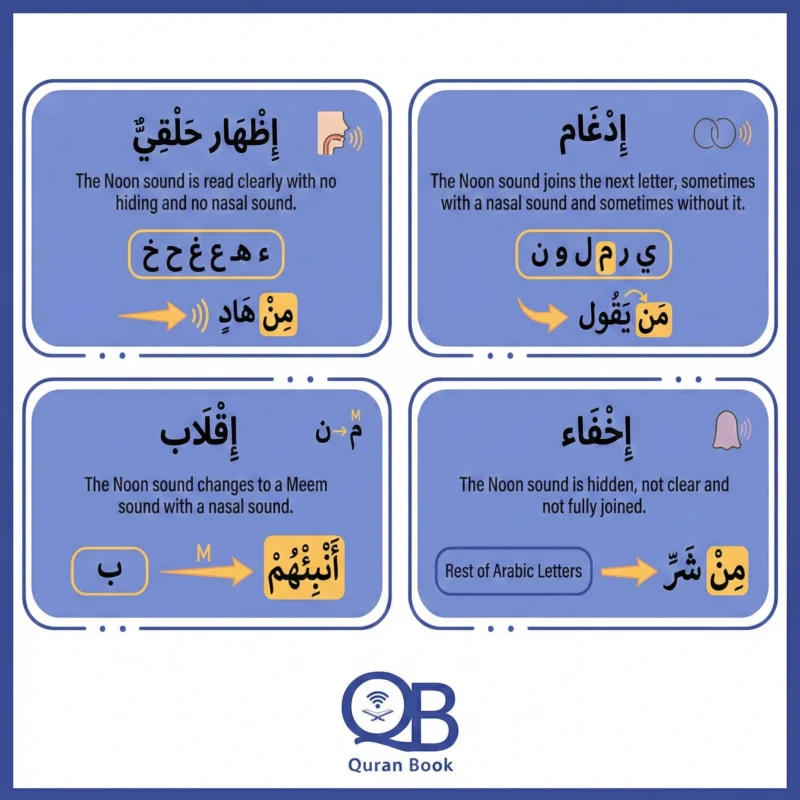
Noon Sakinah & Tanween Rules (Beginner Cheat Sheet)
| Rule | Simple meaning | Easy example |
|---|---|---|
| Izhar | Clear pronunciation (no merging) | مِنْ هَادٍ |
| Idgham | Merge into the next letter | مِنْ رَبِّهِمْ |
| Iqlab | Change to a hidden “m” sound | أَنْبِئْهُمْ |
| Ikhfa | Hide/soften with nasal sound | مِنْ شَرِّ |
Mini Tajweed Guide: 7 Heavy Letters, Nun Sakinah & Iqlaab
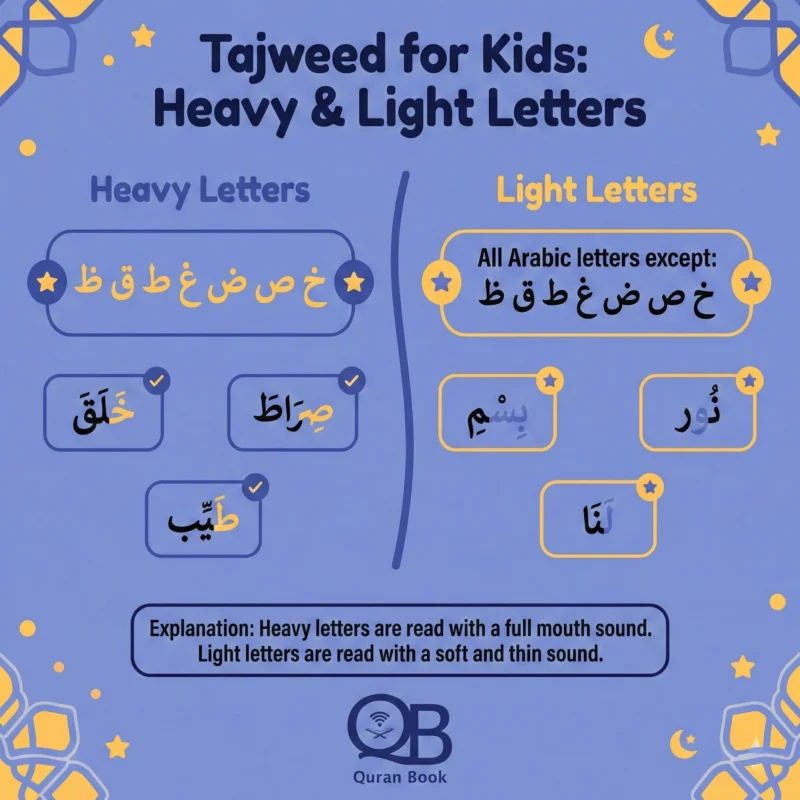
A practical Tajweed shortcut is learning “high-impact” topics: the 7 heavy letters (letters of isti’lā) that sound fuller, the rules of Nun Sakinah (very common in Quran), and Iqlab (a special transformation rule). These three areas alone noticeably improve a beginner’s sound and clarity.
The 7 heavy letters in Arabic (isti’lā): خ ص ض غ ط ق ظ
How to Start Learning Tajweed Online (Without Overwhelm)
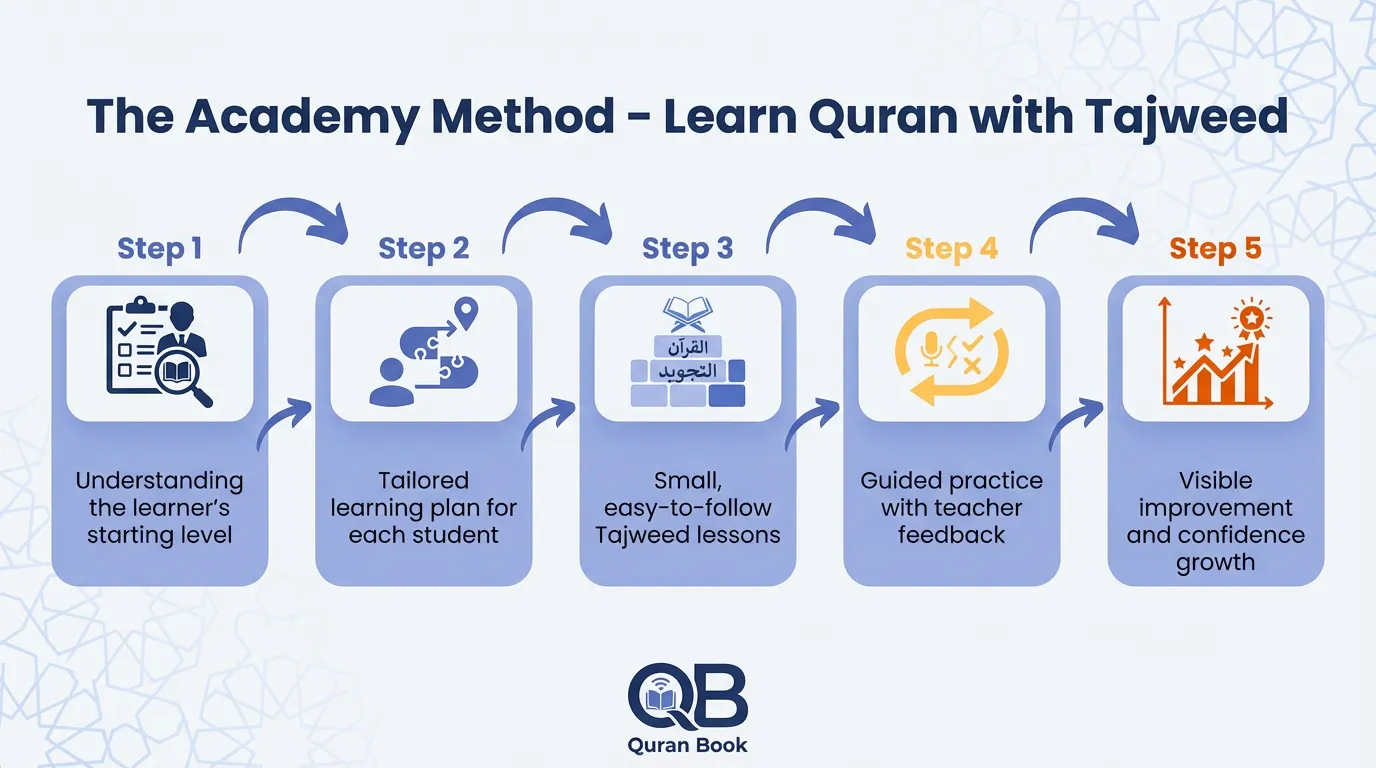
To learn Tajweed online, start small: choose a structured beginner path, practice 5–10 minutes daily, and get weekly correction from a teacher. This prevents “fossilizing” mistakes (repeating the same error). A simple routine plus feedback is faster than long, irregular study sessions.
Step-by-step: a simple Tajweed plan
- Start with letters + vowels (a foundations book like Nour El Bayan).
- Learn makhraj families (throat, tongue, lips, nasal) instead of random letters.
- Add one rule set per week (Noon Sakinah → Madd → Qalqalah).
- Record your recitation (30–60 seconds) and review corrections.
- Repeat with spaced practice (3–4 days/week) so skills stick.
How Quran Book Online Teaches Tajweed
A beginner-friendly Tajweed program works best when it follows a clear sequence: foundations → makhraj → rule families → guided fluency. When lessons are live (video call) and progress is tracked, you always know what to improve next—so you don’t feel lost or overwhelmed.
A practical teaching method (what to expect)
- Accuracy first: correct letter sounds and basic joining.
- Fluency second: smoother rhythm and fewer stops.
- Beauty third: refinement of madd counts, ghunnah strength, and tone.
Self-Study vs Teacher: Which Works Faster?
Self-study helps you understand concepts, but a teacher helps you fix hidden pronunciation errors you may not hear yourself—especially with makhraj and letter qualities. For most beginners, combining free resources (videos) with live correction is the fastest and most confidence-building approach.
| Factor | Self-study | Teacher / Live class |
|---|---|---|
| Speed of correction | Slower: you may not hear your own mistakes. | Fast: immediate correction + drills. |
| Confidence | Can stay shaky without feedback. | Grows quickly with gentle correction. |
| Accountability | Depends on motivation. | Built-in schedule + goals. |
Frequently Asked Questions
What are the benefits of Tajweed?
The benefits of Tajweed include clearer pronunciation, preserving meaning, smoother recitation, stronger confidence, and deeper worship focus. Tajweed helps non-Arabic speakers avoid common letter mix-ups and develop a consistent method for improvement over time.
What are the benefits of focusing on Tajweed during recitation?
Focusing on Tajweed trains your ear and tongue together. You notice mistakes earlier, correct them faster, and build a stable recitation style—especially for makhraj and frequent rules like Noon Sakinah and elongations.
What is the importance of the science of Tajweed?
Tajweed organizes pronunciation and rule patterns so learners can recite consistently. It became especially valuable as Islam spread to non-Arab communities, helping protect accurate Quran recitation across languages and accents.
What does Allah say about Tajweed?
The word “Tajweed” is a later term, but the principle is directly supported: the Qur’an commands measured recitation (tartīl) and encourages careful, deliberate reading rather than rushing.
What happens if you read the Quran without Tajweed?
If you still pronounce letters and vowels correctly, many scholars say your recitation is valid, though less refined. The bigger concern is major mistakes that change meaning. The best approach is learning essentials gradually with feedback.
What are the 4 rules of Tajweed?
Often this refers to the four rules of Noon Sakinah & Tanween: Izhar, Idgham, Iqlab, and Ikhfa. These rules appear constantly in Quran recitation and give beginners quick improvement.
Do Tajweed mistakes invalidate salah?
Rulings vary based on whether the mistake changes meaning and whether the person can correct it. If mistakes were due to ignorance or inability while learning, scholars often emphasize mercy while encouraging improvement.
Who codified Tajweed rules?
Tajweed practice comes from the Prophet ﷺ’s recitation, while later scholars codified the rules to teach learners and preserve accuracy. Well-known names include Abu ‘Amr al-Dani and Ibn al-Jazari.
What are the 7 heavy letters in Arabic?
The seven heavy (isti’lā) letters are: ظ ق ط غ ض ص خ. Learning them helps beginners instantly improve “heaviness vs lightness” in pronunciation.
Is Nun Sakinah related to Tajweed?
Yes. Nun Sakinah (and Tanween) rules are among the most frequent Tajweed rules in the Quran, and mastering them gives fast improvement in flow and clarity.
What is Iqlaab in Tajweed?
Iqlaab is a Noon Sakinah/Tanween rule where the sound shifts in a specific way before the letter ب, with a nasal tone. Beginners learn it as part of the four Noon Sakinah rules because it’s common and easy to spot once taught.
Ready to Experience the Benefits of Tajweed?
Start with a free trial lesson and get a clear starting level, a simple learning plan, and supportive correction.
- ✅ Live session with a qualified teacher
- ✅ A simple beginner roadmap
- ✅ Friendly, confidence-building correction
- ✅ Clear next steps and practice targets
Written By

Jehad Mahmoud
Hafidha of the Quran · Arabic Language Graduate · Writer on Islamic Sciences
Jehad Mahmoud is a graduate of the Department of Arabic Language and a hafidha who has memorised the entire Holy Quran. She writes the Islamic content at Quran Book Academy, specialising in Tajweed, the Quranic sciences and the Arabic language that underpins them.
Having memorised the Quran herself, she writes about recitation from the inside — she knows which letters non-Arabic speakers actually struggle with, and why. Every rule she explains is traced back to the established science of Tajweed, and where the scholars differ, she says so plainly.
Her articles are educational, not fatwa. For a ruling on a specific personal situation, readers are advised to consult a qualified scholar or mufti.