

Why Every Muslim Should Discover the Benefits of Learning Arabic for Quran
The benefits of learning Arabic for Quran go far beyond simply reading words on a page. When you learn Arabic for Quran, you unlock a direct, unfiltered connection with Allah’s words—hearing His guidance exactly as it was revealed. For non-Arabic speakers, this journey may feel overwhelming at first, but it is one of the most rewarding steps a Muslim can take in their spiritual life.
You may be thinking: “I’m too old to start,” or “Arabic looks impossible.” These feelings are completely natural, and you are not alone. At Quran Book Academy, we have guided thousands of students—from complete beginners to confident reciters—using a step-by-step method built on educational psychology and Islamic pedagogy. Whether you are a busy professional in the USA, a parent in Canada, or a student in the UK, our approach meets you exactly where you are.
In this comprehensive guide, we will explore the life-changing benefits of learning Arabic for Quran, explain why the Quran was revealed in Arabic, share a proven method for learning Quranic Arabic, and show you how to get started today—completely free.
Why Is the Quran in Arabic? Understanding Allah’s Choice

Allah revealed the Quran in Arabic, and Islamic scholars have extensively discussed the language’s rhetorical richness, precision and expressive qualities. Surah Yusuf (12:2) states: “Indeed, We have sent it down as an Arabic Quran so that you might understand.” Arabic’s unique grammar preserves layers of meaning that no translation can fully capture, making the importance of Arabic language for understanding Islam undeniable.
This concept is known as the linguistic miracle, or I’jaz, of the Quran. The Arabic language possesses a richness in its morphology, syntax, and rhetorical devices that makes it uniquely suited for divine revelation. Surah Az-Zumar (39:28) describes the Quran as “An Arabic Quran, without any crookedness,” affirming that it was revealed in Arabic and is free from crookedness, deviation, and confusion.
Surah Fussilat (41:3) further reinforces this: “A Book whose verses have been detailed, an Arabic Quran for a people who know.” Scholars throughout Islamic history have echoed this understanding. Umar ibn al-Khattab (RA) is reported to have said: “Learn Arabic, for it is part of your religion.” This is why the Quran is in Arabic—the language is inseparable from the message itself.
When you understand this, the benefits of learning Arabic for Quran become even clearer: you are not merely learning a language—you are accessing the very vessel Allah chose to deliver His guidance to humanity.
7 Benefits of Learning Arabic for Quran Every Muslim Needs to Know
Now let us explore the seven most transformative benefits of learning Arabic for Quran that can reshape your relationship with Allah’s Book.
Understand the Quran Directly Without Translation
Learning Arabic for Quran allows you to understand Allah’s words in their original form, bypassing the limitations of translation. You gain a deeper appreciation of the Quran’s meanings, context, and linguistic beauty, including nuances that translations may not fully convey. Surah Ibrahim (14:4) reminds us: “We have not sent a messenger except in the language of his people.” When you learn Arabic, you become part of that direct conversation.
Translations, while valuable, are inherently limited. A single Arabic word in the Quran can carry multiple layers of meaning—historical, grammatical, and spiritual—that a translator must reduce to one English equivalent. By learning Quranic Arabic grammar, you can recognize more linguistic nuances, while reliable Tafsir helps you understand the verses more accurately.
Perfect Your Tajweed and Quran Recitation
When you learn Arabic for Quran, you become familiar with Arabic letters and sounds, which supports your Quran reading and your awareness of how words are pronounced. Tajweed, however, is a separate discipline: it is learned by studying the Tajweed rules themselves and by practising recitation under guidance. Familiarity with Arabic makes that study easier, but makhraj al-huruf (articulation points) still needs to be taught, corrected and practised rather than absorbed automatically.
The Prophet (PBUH) said: “The one who is proficient in the Quran will be with the noble and obedient angels.” (Sahih Muslim 798). Proficiency in recitation is built through dedicated Tajweed study and consistent guided practice, and your growing knowledge of Arabic supports that journey from hesitant reading toward a flowing recitation that honors the divine text.
Deepen Your Salah and Spiritual Connection

Knowing Arabic transforms your daily prayers from routine repetition into a heartfelt conversation with Allah. As your Arabic knowledge grows, you can gain a deeper understanding of Al-Fatiha, the supplications, and the verses recited during Salah. This is one of the most personally impactful benefits of learning Arabic for Quran—your five daily prayers become moments of genuine connection and reflection, not just physical motions.
Imagine standing in prayer and truly comprehending the words “Ihdina as-sirat al-mustaqeem”—feeling the weight of asking Allah for guidance on the straight path. Understanding the meanings of Quranic verses and supplications can deepen your spiritual engagement during Salah. Learning Arabic can further enrich that experience.
Access Classical Islamic Scholarship
Arabic opens the door to Tafsir (Quran commentary), Hadith collections, and centuries of Islamic scholarship in their original language. Works by scholars like Ibn Kathir, Al-Qurtubi, and An-Nawawi were written in Arabic, and their insights carry nuances that are inevitably lost in translation. The benefits of Arabic language extend far beyond the Quran itself—they grant you access to the entire Islamic intellectual tradition.
Boost Cognitive Skills and Memory
Learning a new language, especially one with a different script like Arabic, is a demanding mental exercise. Many learners find that working regularly with new letters, sounds and vocabulary keeps them mentally engaged and sharpens their attention and recall as a practical result of steady practice.
For Muslims learning Arabic for Quran, this benefit sits alongside the memorization (Hifz) tradition. Regularly memorizing and revisiting Quran verses builds mental discipline, and repeated practice with regular review can help learners retain what they have already covered.
At Quran Book Academy, our teaching methodology breaks Arabic learning into manageable “chunks”—small, achievable lessons that build confidence and reduce overwhelm. Breaking material into smaller units in this way tends to make learning easier to sustain, and it makes even the Arabic alphabet for beginners feel approachable and achievable.
Protect Yourself from Misinterpretation
Reading the Quran in Arabic gives you more direct access to the wording of the revelation itself. Translations vary significantly depending on the translator’s perspective, linguistic choices, and cultural background. By learning Quranic Arabic, you reduce your dependence on any single translation and can follow the Arabic wording alongside reliable Tafsir. Interpreting the Quran, however, remains a scholarly discipline: reliable Tafsir, scholarly explanation and the Islamic sciences are still essential, and Arabic knowledge on its own does not qualify a person to interpret the Quran independently.
This is a crucial yet often overlooked benefit of learning Arabic for Quran. In a world where misinformation about Islam is widespread, having more direct access to the source material—while relying on qualified scholarship for interpretation—helps you engage with your faith with greater confidence and care.
Earn Greater Rewards (Ajr) with Every Letter

The Prophet (PBUH) said: “Whoever reads a letter from the Book of Allah will receive a hasanah (good deed), and the hasanah is multiplied by ten.” (Jami’ at-Tirmidhi 2910). This reward is attached to reciting the letters of the Book of Allah. Learning Arabic for Quran helps you approach that recitation with greater confidence, understanding and reflection.
Every moment spent learning Arabic is an investment in both your worldly education and your relationship with the Quran. The more comfortably you read, the more you are able to recite and reflect upon. This spiritual encouragement makes learning Arabic one of the most meaningful pursuits a Muslim can take up.
How to Learn Arabic for Quran Step-by-Step (The Academy Method)
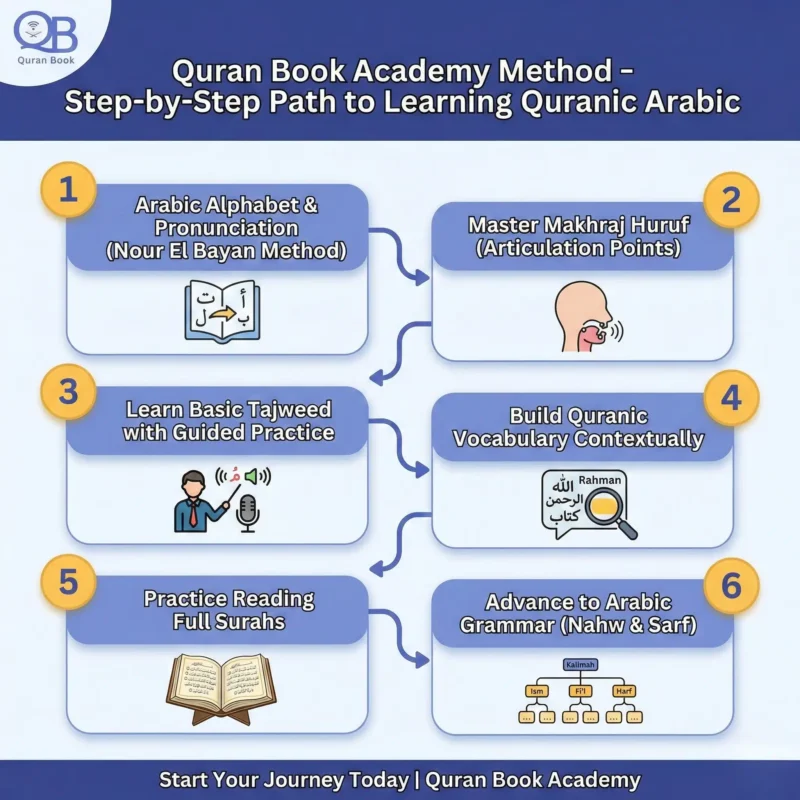
If you are wondering how to learn Arabic for Quran, Quran Book Academy has developed a proven, step-by-step method that has helped thousands of students achieve Quran reading fluency. Here is the Academy Method:
Start with the Arabic alphabet and pronunciation using the Nour El Bayan method—a renowned pedagogical approach that introduces letters systematically.
Master makhraj huruf (articulation points) for each letter, ensuring correct sound production from the very beginning.
Learn basic Tajweed rules through guided practice with a certified teacher who provides real-time feedback.
Build Quranic vocabulary through contextual learning—understanding words as they appear in the Quran, not in isolation.
Practice reading full Surahs with a certified instructor to develop fluency and confidence.
Advance to Arabic grammar (Nahw & Sarf) for deeper understanding of sentence structure and word derivation.
This structured progression—from reading to Tajweed to grammar to understanding—ensures that every student builds a solid foundation. The Nour El Bayan method is available on the Quran Book Academy YouTube channel, and makhraj huruf video lessons are also accessible for self-study.
Try an Interactive Arabic Learning Game
At Quran Book Academy, interactive activities can be used alongside guided lessons to help students practise Arabic letters and reading skills in an engaging way. Try one of our learning games below.
Want guided practice with a teacher? Explore our Online Arabic Course.
Best Way to Learn Arabic for Quran Online with Live Teachers
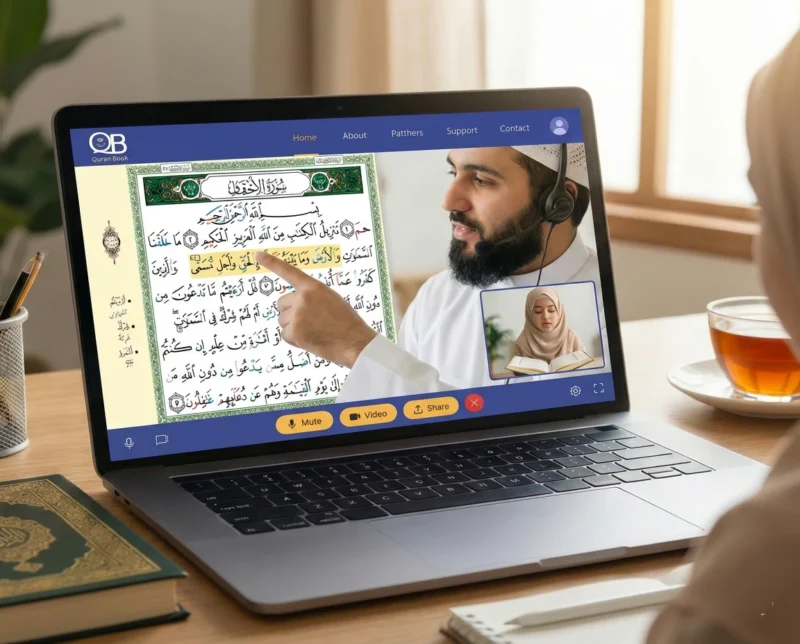
The best online Quranic Arabic course combines the convenience of remote learning with the effectiveness of live, interactive instruction. At Quran Book Academy, we believe that the best way to learn Quranic Arabic is through real-time sessions with certified teachers who can correct your pronunciation, answer your questions, and adapt to your pace.
Our technology stack is designed to support your learning journey at every step. We use Zoom for live one-on-one and group sessions with screen sharing for real-time correction. Our custom Learning Management System (LMS) tracks student progress, lesson completion, quiz scores, and Tajweed milestones. Weekly Gmail progress reports are sent to students and parents with actionable feedback. And our Telegram channel serves as a community practice group for Quran reading with Tajweed corrections.
When you learn Arabic for Quran online with Quran Book Academy, you get the structure of a traditional Islamic classroom combined with the flexibility and accessibility of modern technology. Classes are available for students in the USA, Canada, UK, and Australia, with flexible scheduling to accommodate different time zones.
Reading Quran in Arabic vs. Translation: A Clear Comparison
To fully appreciate the benefits of learning Arabic for Quran, it helps to see a direct comparison between reading in Arabic and relying on translation alone.
| Aspect | Arabic (Original) | Translation Only |
|---|---|---|
| Meaning Depth | Greater access to the Quran’s original wording and linguistic nuances, supported by reliable Tafsir. | Approximation; translator-dependent |
| Tajweed | Arabic knowledge supports pronunciation; Tajweed still requires dedicated study and practice | Not applicable |
| Spiritual Reward | Reward for reciting the letters of the Book of Allah | Supports understanding; a translation is not itself the Arabic Quran |
| Salah Understanding | Supports a deeper understanding of Quranic verses and supplications recited during Salah. | Requires separate memorization |
| Scholarly Access | Direct access to Tafsir & Hadith | Limited to translated works |
| Emotional Impact | Original rhetorical power (I’jaz) | Diluted emotional resonance |
| Misinterpretation | Less reliance on translations; reliable Tafsir and scholarly guidance remain essential | Higher due to translator choices |
As the table above illustrates, while translations serve as a helpful starting point, they cannot replace the depth, beauty, and spiritual reward of engaging with the Quran in its original Arabic. This is precisely why the benefits of learning Arabic for Quran are so transformative.
How to Overcome the Fear of Learning Arabic for Quran

To overcome the fear of learning Arabic for Quran, start with small, achievable goals—like learning five new letters per week. Choose a structured course with a supportive teacher, use the Nour El Bayan method for gradual progression, and remember that every effort you make is rewarded by Allah.
Many students hesitate because they feel they are too old, too busy, or simply not talented enough to learn a new language. These feelings are natural, but they are not facts. The truth is that Arabic can be learned at any age, and the Quran itself was meant to be understood by all people—not just scholars.
The Prophet (PBUH) encouraged this journey: “The best of you are those who learn the Quran and teach it.” (Sahih al-Bukhari 5027). Notice that he did not say “the youngest of you” or “the most talented of you.” This hadith highlights the great virtue of learning the Quran and teaching it to others. Whatever your age or starting level, you can begin working toward this noble goal.
At Quran Book Academy, we use the “chunking” approach—breaking how to read Quran in Arabic correctly into small, manageable pieces that reduce overwhelm and build confidence step by step. Our student success stories show that learners from different backgrounds can make meaningful progress with consistent practice and support.
Frequently Asked Questions About Learning Arabic for Quran

Continue Learning
Hafidha of the Quran · Arabic Language Graduate · Writer on Islamic Sciences
Jehad Mahmoud is a graduate of the Arabic Language department and a Hafidha of the Quran who writes the Islamic educational content at Quran Book Academy.
She specialises in Quranic Arabic, tajweed and the sharia sciences, making correct pronunciation and complex rulings accessible to English-speaking Muslim families.
Her background in Arabic, Tajweed and Quranic studies supports the educational guidance presented in this article.
Her articles are educational, not fatwa. For a ruling on a specific personal situation, readers are advised to consult a qualified scholar or mufti.
References
Quranic Verses
- 1. Surah Yusuf 12:2 — Revelation of the Quran in Arabic
- 2. Surah Az-Zumar 39:28 — Purity of the Arabic Quran
- 3. Surah Fussilat 41:3 — Detailed Book in Arabic
- 4. Surah Ibrahim 14:4 — Messengers in the language of their people
- 5. Surah Muhammad 47:24 — Reflecting upon the Quran
Hadith Collections
- 6. Sahih Muslim 798 — Proficiency in Quran recitation
- 7. Sahih al-Bukhari 5027 — The best are those who learn and teach the Quran
- 8. Jami’ at-Tirmidhi 2910 — Reward for every letter of Quran
Leave a Reply